


The last word of chapter 2 still hangs in the air: “Where is the God of justice?” Malachi 3 answers it. The Lord will come to His own temple. A messenger will go before Him. Fire will sit down to work. The people will be told to return. Quiet conversations of those who still fear God will be written down. Then, for those who love His name, a Sun will rise with healing in His wings.
Malachi 3:1-5 - Messenger, temple, refining fire, and justice
1 Behold, I send forth my messenger, and he shall survey the way before me: and the Lord, whom ye seek, shall suddenly come into his temple, even the angel of the covenant, whom ye take pleasure in: behold, he is coming, saith the Lord Almighty. 2 And who will abide the day of his coming? or who will withstand at his appearing? for he is coming in as the fire of a furnace and as the herb of fullers. 3 He shall sit to melt and purify as it were silver, and as it were gold: and he shall purify the sons of Levi, and refine them as gold and silver, and they shall offer to the Lord an offering in righteousness.
4 And the sacrifice of Juda and Jerusalem shall be pleasing to the Lord, according to the former days, and according to the former years. 5 And I will draw near to you in judgment; and I will be a swift witness against the witches, and against the adulteresses, and against them that swear falsely by my name, and against them that keep back the hireling’s wages, and them that oppress the widow, and afflict orphans, and that wrest the judgment of the stranger, and fear not me, saith the Lord Almighty.
The people wanted justice on their terms. God answers with His presence. First He sends a messenger to survey the way. The Gospels name that forerunner as John the Baptist, who comes in the spirit and power of Elijah, preaching repentance and pointing to the Lamb of God. Then the Lord Himself comes suddenly to His temple. The pious have longed for this coming since the first promise after the fall. Many who say they seek Him will still be unready when He stands among them.
Two figures must be kept distinct. The messenger prepares. The Lord comes. Brenton then names the coming One “the angel of the covenant.” That word must be heard as messenger, not as a created spirit. The Church reads this Lord as Christ. He is the covenant in Person: the Word who visits His house, purifies worship, and later judges the world. His first coming is sudden in the temple of Jerusalem. John places that arrival at the opening of the public ministry, not only in Passion week. The Lord whom they seek comes to His Father’s house, drives out merchandise, and names His own Body as the true sanctuary. See The True Temple and the Cleansing of Worship. His second coming will be sudden for the whole earth. Malachi holds both horizons in one sentence.
The question that follows is pastoral, not curious: “who will abide the day of his coming?” Desire without repentance cannot survive the day it asked for. The Lord sits as a refiner. Furnace fire does not destroy gold; it burns what is not gold. Fuller’s herb is the strong soap that lifts stains ordinary water cannot touch. The aim is not annihilation of Levi, but an offering in righteousness. Worship is healed when the worshiper is healed.
Verse 5 then names the sins that hide under religious speech. Sorcery, adultery, false oaths, withheld wages, cruelty to widows and orphans, twisted judgment against the stranger, and the refusal to fear God all stand before the same Lord. He will not accept incense from a hand that cheats a worker or crushes the weak. The God who comes to His temple is a swift witness. He does not need our explanations.
Language insight
Hebrew mal’ak and Greek angelos both mean messenger. The same word can name a human envoy, a prophet, a priest, or a heavenly angel. Malachi has already called the priest “the messenger of the Lord” in 2:7. Here the first messenger is John. The second title, “angel of the covenant,” belongs to the Lord who comes. The wording is easy to misuse. It does not make Christ a creature. It says that the covenant itself has a living Herald, and that Herald is God the Word.
Gems from the Fathers 💎
St. John Chrysostom reads Malachi 3:1 through John the Baptist. The Baptist is “sent from God,” so his words are not a private religious opinion. Chrysostom says the dignity of that office is obedience:
Wherefore he is called “messenger” (Mal. iii. 1), for the excellence of a messenger is, that he say nothing of his own.1
A true forerunner does not gather a following for himself. He clears a road for Another. Every preacher, parent, and servant stands under that same measure.
Eusebius hears the second figure as God the Word: the Almighty promises that a Lord will come to His own temple, “speaking of another: And He surely means God the Word.”2 The Father sends. The Son comes. The temple is not abandoned; it is visited.
Iconography and Visual Teaching 🖼️
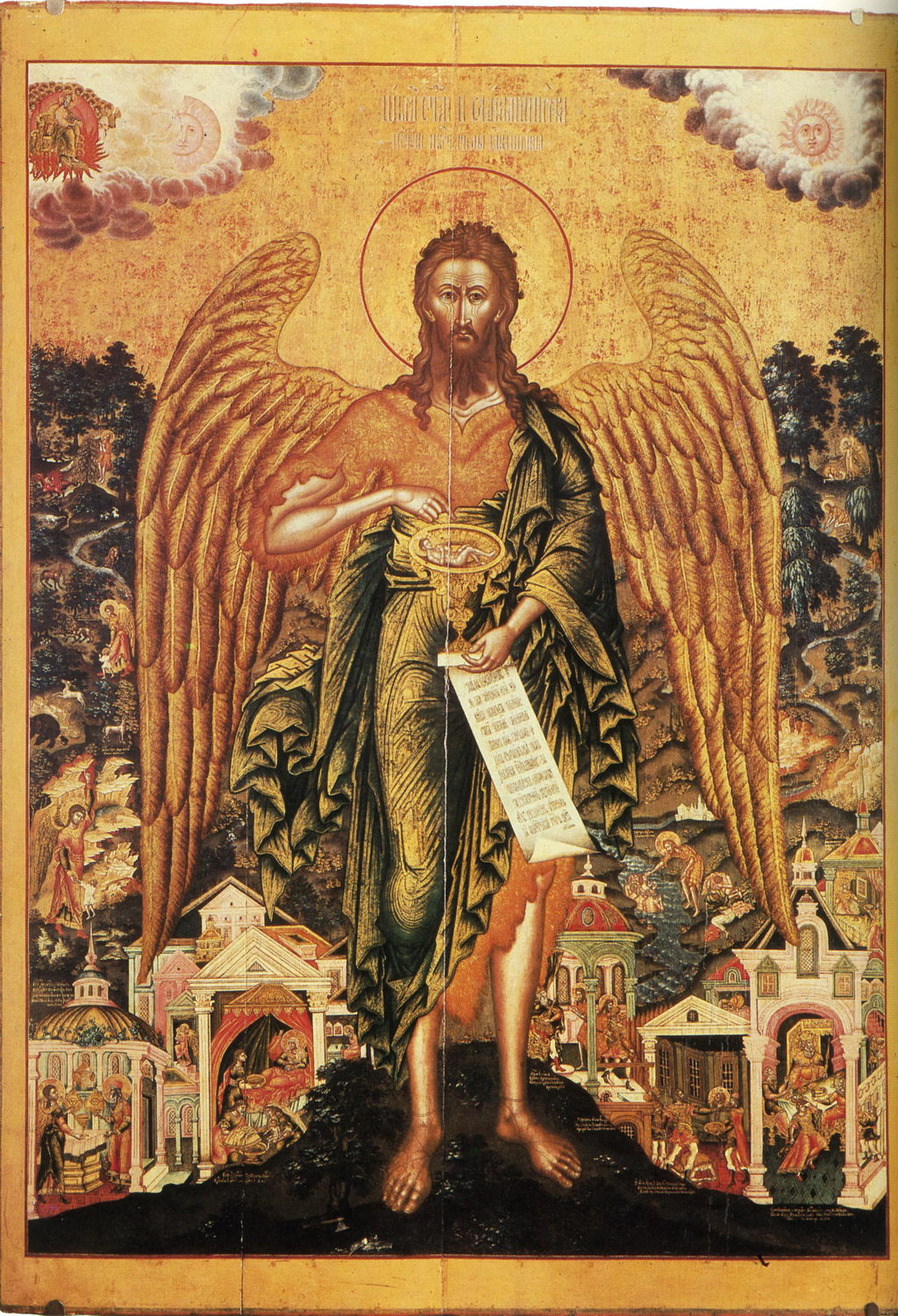 Source: St John the Baptist, Angel of the Desert, Wikimedia Commons, public domain.
This is not a picture of Malachi’s Hebrew page. It is the Church’s visual reading of the Forerunner. The wings confess John’s vocation: he lives as a messenger, not as a created angel by nature. The desert clothing and the scroll keep the same truth Chrysostom named. John has no word of his own. He points.
Malachi 3:6-12 - Return to Me, and I will return to you
6 For I am the Lord your God, and I am not changed: 7 but ye, the sons of Jacob, have not refrained from the iniquities of your fathers: ye have perverted my statutes, and have not kept them. Return to me, and I will return to you, saith the Lord Almighty. But ye said, Wherein shall we return?
8 Will a man insult God? for ye insult me. But ye say, Wherein have we insulted thee? In that the tithes and first-fruits are with you still. 9 And ye do surely look off from me, and ye insult me.
10 The year is completed, and ye have brought all the produce into the storehouses; but there shall be the plunder thereof in its house: return now on this behalf, saith the Lord Almighty, see if I will not open to you the torrents of heaven, and pour out my blessing upon you, until ye are satisfied. 11 And I will appoint food for you, and I will not destroy the fruit of your land; and your vine in the field shall not fail, saith the Lord Almighty. 12 And all nations shall call you blessed: for ye shall be a desirable land, saith the Lord Almighty.
“I am not changed” is mercy before it is metaphysics. The sons of Jacob still exist because God has not become weary of His own promise. Their fathers twisted the statutes. They have done the same. If the Lord changed as they change, there would be no people left to call back.
“Return to me, and I will return to you” is the heart of the chapter. Repentance is not a mood. It is a turning of the whole life toward the God who already stands toward us. Their answer, “Wherein shall we return?” is more dangerous than open rebellion. They have drifted so far that they cannot even locate the wound.
God names the wound in the language of offering. Tithes and first-fruits remain in their own houses. Brenton’s wording is sharp: they insult God by keeping what belongs at His table. This is not a prosperity bargain and not a license to manipulate the poor. The storehouse exists so that worship, priesthood, and the hungry of the people have bread. To withhold is to treat God as a mascot and the neighbor as optional.
The promise that follows is covenant trust. Open the storehouse, and God will open the torrents of heaven. The land will feed them. The nations will call them blessed. Fr. Tadros reads this as practical return: God does not ask them to sit still until they feel holy. He asks for concrete steps of worship and mercy, trusting that the Unchanging One still receives His children.3
The Church’s Voice in Worship ⛪
The Coptic lectionary reads Malachi 3:1-18 on Great Lent, week 2, day 3, together with Exodus 2:11-20 and Isaiah 5:17-25. That placement is exact for verses 1-18, not for the closing six verses. In Lent the Church hears the messenger, the refining fire, the call to return, the justice of withheld wages, and the book of remembrance. The set does not shrink repentance to money. It joins purified worship to mercy, and it asks whether we still know how to come back.
Malachi 3:13-18 - Hard words and the book of remembrance
13 Ye have spoken grievous words against me, saith the Lord. Yet ye said, Wherein have we spoken against thee? 14 Ye said, He that serves God labours in vain: and what have we gained in that we have kept his ordinances, and in that we have walked as suppliants before the face of the Lord Almighty? 15 And now we pronounce strangers blessed; and all they who act unlawfully are built up; and they have resisted God, and yet have been delivered.
16 Thus spoke they that feared the Lord, every one to his neighbour: and the Lord gave heed, and hearkened, and he wrote a book of remembrance before him for them that feared the Lord and reverenced his name. 17 And they shall be mine, saith the Lord Almighty, in the day which I appoint for a peculiar possession; and I will make choice of them, as a man makes choice of his son that serves him. 18 Then shall ye return, and discern between the righteous and the wicked, and between him that serves God, and him that serves him not.
Another “Wherein?” appears, and this one is colder. Serving God feels useless. The arrogant look blessed. Lawless people seem delivered. Malachi does not mock the pain under that speech. Faithful people do feel the scandal of delayed justice. What he refuses is the next step: calling evil success, and treating prayer as a failed investment.
Two conversations fill the same town. One conversation accuses God and blesses the violent. The other belongs to those who fear the Lord and speak to one another. They do not wait for public vindication before they honor His name. God leans in. He heeds. He writes.
The book of remembrance is not a clerk in heaven taking minutes. It is Scripture’s way of saying that no quiet fidelity is lost. Tears, hidden obedience, and the strengthening word spoken to a neighbor are treasured. Fr. Tadros notes that the image is human language for a divine tenderness: God keeps the words, sighs, and holy thoughts of His children as a father keeps what is dear.4
Then comes the oldest covenant name for a loved people. They will be His “peculiar possession” on the day He appoints. He will choose them as a man chooses the son who serves him. Discernment will return. The fog that made wickedness look blessed will lift.
Language insight
Brenton’s “peculiar possession” renders Hebrew segullah: a treasured property, wealth shut up as one’s own. At Sinai God called Israel His segullah among the nations (Exodus 19:5). Deuteronomy repeats it. Here the word is given again to the remnant who still fear His name. The Church hears the same mercy in 1 Peter 2:9 and Titus 2:14: a people for God’s own possession. Belonging is not a feeling we manufacture. It is the Lord’s claim on those who keep speaking His name when the world calls that speech useless.
Malachi 3:19-24 - Sun of Righteousness, Moses, and Elijah
19 For, behold, a day comes burning as an oven, and it shall consume them; and all the aliens, and all that do wickedly, shall be stubble: and the day that is coming shall set them on fire, saith the Lord Almighty, and there shall not be left of them root or branch.
20 But to you that fear my name shall the Sun of righteousness arise, and healing shall be in his wings: and ye shall go forth, and bound as young calves let loose from bonds. 21 And ye shall trample the wicked; for they shall be ashes underneath your feet in the day which I appoint, saith the Lord Almighty. 22 And, behold, I will send to you Elias the Thesbite, before the great and glorious day of the Lord comes; 23 who shall turn again the heart of the father to the son, and the heart of a man to his neighbour, lest I come and smite the earth grievously.
24 Remember the law of my servant Moses, accordingly as I charged him with it in Choreb for all Israel, even the commandments and ordinances.
Brenton’s Malachi has three chapters. The six verses printed as English Malachi 4:1-6 stand here as 3:19-24. The Coptic Bible follows this Septuagint shape. These verses are the true ending of the book in the text this series uses. They are not part of the verified Great Lent reading of 3:1-18.
The same Day is oven and sunrise. Nothing in the fire changes. The heart that meets it changes everything. For the proud it leaves neither root nor branch, no shoot left to grow again. For those who fear His name, the Sun of Righteousness rises with healing in His wings. The calves loosed from bonds are not a quiet metaphor. Salvation skips. The redeemed come out like animals let out of a stall, because holiness arriving is joy, not grim endurance.
How the last verses are arranged
Hebrew Malachi and the NKJV carry the same six verses in the same order. The only difference between them is the chapter number. What the Hebrew prints as 3:19-24, the NKJV prints as 4:1-6. Neither tradition reorders the lines. Both end the book on the same last word: the threat of a curse, Hebrew herem, the ban of destruction.
The Septuagint does reorder the last three verses. Brenton keeps the Day, the Sun, and the trampling where the Hebrew has them (3:19-21 / NKJV 4:1-3). Then it places Elijah and the turning of hearts (Hebrew 3:23-24 / NKJV 4:5-6) before the command to remember Moses (Hebrew 3:22 / NKJV 4:4). So the Greek book still contains the blow against the earth, but it does not close on it. It closes on Sinai remembered.
| Content | Hebrew | NKJV | Brenton / LXX / Coptic |
|---|---|---|---|
| Day burning like an oven | 3:19 | 4:1 | 3:19 |
| Sun of Righteousness, healing | 3:20 | 4:2 | 3:20 |
| The wicked as ashes | 3:21 | 4:3 | 3:21 |
| Remember the Law of Moses | 3:22 | 4:4 | 3:24 (moved to the end) |
| Elijah sent before the Day | 3:23 | 4:5 | 3:22 |
| Hearts turned, lest a curse / blow | 3:24 | 4:6 | 3:23 |
Hebrew last word of Malachi: the curse. NKJV last word of Malachi: the curse. Brenton last word of Malachi: remember Moses.
That is the real textual difference. Hebrew and NKJV agree with each other. The LXX disagrees with both about the last word, not about the substance.
One more distinction belongs here, because English Bibles make it easy to miss. The NKJV Old Testament ends the whole first testament with these verses. The Hebrew Bible does not. In the Tanakh, Malachi ends the Twelve and so ends the Prophets. The Writings still follow, and the common Jewish order finishes with Chronicles, not with Malachi. The Coptic and wider Septuagint Old Testament likewise does not treat Malachi as the last book of Scripture. What is last here is the last of the Twelve, leaning toward the Forerunner.
When this passage is chanted as a Jewish haftarah, a synagogue custom often repeats the Elijah verse after the curse so the public reading does not rest on herem. That is liturgy, not a change in the Hebrew text. The written Hebrew still ends where the NKJV ends. The Church hears the same refusal to leave the hearer only under a ban. The LXX moves Moses to the last line. The Gospel answers the curse itself: “Christ has redeemed us from the curse of the law, having become a curse for us” (Galatians 3:13).
Moses and Elijah are named together because the whole old covenant is being summoned as two witnesses: the Law given at Horeb, and the prophet who will turn hearts before the Day. Those same two later stand with Christ on Tabor. Horeb is where Moses received the commandments and where Elijah heard the Lord in the thin silence. The last of the Twelve already faces that mountain. In the Gospel, John comes in the spirit and power of Elijah to turn hearts, and the Church still looks for Elijah’s witness before the last appearing. The first coming has a Forerunner. The last Day is not left without one.
flowchart LR
  Moses["Moses at Horeb: commandments remembered"] --> Malachi["Malachi: return before the day"]
  Malachi --> Elijah["Elijah promised"]
  Elijah --> John["John the Baptist, Forerunner"]
  John --> Christ["Christ, the Sun of Righteousness"]
Language insight
“Sun of righteousness” is Hebrew shemesh tsedaqah. Shemesh is the sun; tsedaqah is righteousness as God’s saving rightness, not a mood of niceness. Malachi does not say that righteousness will merely increase. He says a Sun will rise. “Wings” renders kanaf, the ray of that dawn. The same Hebrew word can also mean the corner or hem of a garment. Some teachers hear a Gospel echo when the woman touches the hem of Christ’s robe and healing goes out from Him. That is a possible preacher’s bridge, not a proof that Malachi’s noun requires the hem. The sure sense here is healing radiating from the rising Sun. The Church does not worship the created sun. She confesses Christ as the uncreated Light who heals what night has bound.
“Turn” in the Elijah promise is from shuv, the root of return and repentance. The Forerunner’s work is not new information. It is the turning of hearts: father to child, neighbor to neighbor, the household and the people back toward God, so the Day does not meet the earth only as a ban.
Cyril on the Sun of Righteousness
St. Cyril of Alexandria uses this verse to protect the Godhead of the Son. If creatures were already “very light” in the same way the Son is Light, they would not need a Sun to rise on them. The Father promised the Sun of Righteousness to those who fear His Name because we were in need. “We have received it and are lighted.” The Only-Begotten is “Very Light and able to lighten things that need light.”5
Eusebius makes the same confession from another angle. The One already named Lord, Word, and Image is now called Sun of Righteousness, and the Father says He will rise “not on all, but only on those that fear His Name.”6 Hiddenness here is mercy and judgment together. The Light is given; the proud remain in the dark they chose.
Spiritual Fruit 🍇
Do not ask for the Lord’s coming as if it were a rescue from repentance. The same Christ who heals also refines. If there is a part of your life that wants His consolation and not His fire, that is the part this chapter addresses first.
Learn the difference between honest lament and hard speech. It is one thing to tell God that faithfulness feels costly. It is another to call obedience useless and to bless the people who crush others. The first can still become prayer. The second trains the heart to admire what God will burn.
Return in something concrete. Malachi will not let “Wherein shall we return?” remain a puzzle. For some the return is confession. For some it is the wage owed, the apology delayed, the first-fruits of time given back to the Liturgy, the poor, or the hidden work of the house. The Unchanging One has already turned His face toward you. The next step is yours, and it will have a shape.
Speak to one another as people whose words are being written down. The remnant in this chapter is not a party. It is a few neighbors who still fear God enough to strengthen each other. The Church is meant to be that conversation: not gossip about collapse, but remembrance of the Name.
Wait for the Sun, not for a softer religion. Christ is the healing dawn. Ask Him to rise on the particular night you are actually in: the cynicism, the withheld mercy, the tired priesthood of ordinary duty. Healing is in His wings. Freedom follows, like a calf let out of the stall.
Let the turning reach the house. Elijah is sent to turn the heart of the father to the son, and a man to his neighbor. Repentance that never mends the people nearest you is still facing the wrong way when the Day comes.
Teaching Notes
Malachi 3:1-5 - The Lord comes to His temple
- Ask: Why is the coming they wanted also a coming they may not survive unchanged?
- Emphasize: John prepares the way; Christ is the Lord who comes to His temple.
- Watch for: “Angel of the covenant” means messenger. Do not teach that Christ is a created angel.
- Connect: Refining fire joins worship, justice, and repentance. The Lord is a swift witness against hidden oppression. Use John 2:13-25 for the sudden coming to the house.
- Show: Use the Angel of the Desert icon to explain John’s vocation as messenger.
Malachi 3:6-12 - Return and offering
- Ask: What does “Wherein shall we return?” reveal about a dull conscience?
- Emphasize: God’s unchangeableness is why Jacob is not consumed. Return is concrete.
- Watch for: Do not preach tithes as a prosperity contract or as a tool for financial pressure.
- Connect: The Great Lent reading of 3:1-18 sets this call inside fasting, mercy, and purified worship, with Exodus 2:11-20 and Isaiah 5:17-25.
- Show: If teaching in Lent, keep the three prophecies together so justice and return are not reduced to one theme.
Malachi 3:13-18 - The book of remembrance
- Ask: When has serving God felt useless, and what speech grew from that feeling?
- Emphasize: God hears the quiet conversations of those who still fear His name.
- Watch for: Do not shame honest lament. Rebuke the speech that blesses lawlessness.
- Connect: Segullah names the remnant as God’s treasured people, fulfilled in the Church as a people of His own possession.
- Show: Contrast the two conversations: accusation that envies evil, and speech that honors the Name.
Malachi 3:19-24 - Sun, Moses, and Elijah
- Ask: Why does one Day become oven for some and sunrise for others?
- Emphasize: Hebrew and NKJV end Malachi on the same last word, the curse. The LXX keeps that threat but closes on “Remember Moses.”
- Watch for: Do not claim verses 19-24 as part of the verified Great Lent reading. Do not say the Hebrew Bible as a whole ends with Malachi. Do not treat kanaf / hem as a proved lexical hinge.
- Connect: John comes in Elijah’s spirit; Moses and Elijah stand with Christ at the Transfiguration; Galatians 3:13 answers herem.
- Show: Use the Moses / Elijah / John / Christ chart, then the Hebrew / NKJV / LXX order if readers are using a four-chapter English Bible.
Sources
Embedded Scripture is from Brenton’s English Septuagint (LXX).
Primary sources
- Malachi 3, Brenton’s English Septuagint.
- John 2:13-25, The True Temple and the Cleansing of Worship, for the Lord coming to His house.
- St. John Chrysostom, Homilies on John, Homily 6, on John 1:6 and Malachi 3:1: https://www.ccel.org/ccel/schaff/npnf114.iv.viii.html#iv.viii-p4.
- St. Cyril of Alexandria, Commentary on John, Book 1, chapter 3: https://www.tertullian.org/fathers/cyril_on_john_01_book1.htm#C3.
- Eusebius of Caesarea, Proof of the Gospel 5.28-29: https://www.tertullian.org/fathers/eusebius_de_07_book5.htm#C28.
Coptic Orthodox / pastoral sources
- Fr. Tadros Y. Malaty, The Book of Malachi (2006), especially chapter 3 on the coming Messiah, return, and the book of remembrance: https://ukmidcopts.org/kotob/Fr%20Tadros%20Malaty/Malachi.pdf.
Worship
- Coptic Great Lent, week 2, day 3: Malachi 3:1-18, with Exodus 2:11-20 and Isaiah 5:17-25.
Language
- mal’ak, messenger / angel: https://biblehub.com/hebrew/4397.htm.
- shemesh, sun: https://biblehub.com/hebrew/8121.htm.
- tsedaqah, righteousness: https://biblehub.com/hebrew/6666.htm.
- kanaf, wing / edge: https://biblehub.com/hebrew/3671.htm.
- shuv, turn / return: https://biblehub.com/hebrew/7725.htm.
- segullah, treasured possession: https://biblehub.com/hebrew/5459.htm.
Visual sources
St John the Baptist, Angel of the Desert: https://commons.wikimedia.org/wiki/File:St_John_the_Baptist,_Angel_of_the_Desert,_17the.jpg.
Footnotes
-
John Chrysostom, Homilies on John, Homily 6 on John 1:6, NPNF 14, https://www.ccel.org/ccel/schaff/npnf114.iv.viii.html#iv.viii-p4. ↩
-
Eusebius of Caesarea, Proof of the Gospel 5.28, tr. W. J. Ferrar, https://www.tertullian.org/fathers/eusebius_de_07_book5.htm#C28. ↩
-
Fr. Tadros Y. Malaty, The Book of Malachi (2006), chapter 3, opening exposition of the coming Messiah and the call to return, https://ukmidcopts.org/kotob/Fr%20Tadros%20Malaty/Malachi.pdf. ↩
-
Fr. Tadros Y. Malaty, The Book of Malachi (2006), on Malachi 3:16 and the book of remembrance, https://ukmidcopts.org/kotob/Fr%20Tadros%20Malaty/Malachi.pdf. ↩
-
Cyril of Alexandria, Commentary on John, Book 1, chapter 3, https://www.tertullian.org/fathers/cyril_on_john_01_book1.htm#C3. ↩
-
Eusebius of Caesarea, Proof of the Gospel 5.29, https://www.tertullian.org/fathers/eusebius_de_07_book5.htm#C29. ↩