


Amos opens like a courtroom where everyone is ready to hear someone else condemned. Damascus, Gaza, Tyre, Edom, Ammon, and Moab pass before the judgment seat. Then Judah is named. Then Israel. The prophetic word moves in a tightening circle until the listener has nowhere left to stand except before God.
Amos 1-2
Translation: Brenton Septuagint.
- The words of Amos which came to him in Accarim out of Thecue, which he saw concerning Jerusalem, in the days of Ozias king of Juda, and in the days of Jeroboam the son of Joas king of Israel, two years before the earthquake.
- And he said, The Lord has spoken out of Sion, and has uttered his voice out of Jerusalem; and the pastures of the shepherds have mourned, and the top of Carmel is dried up.
- And the Lord said, For three sins of Damascus, and for four, I will not turn away from it; because they sawed with iron saws the women with child of the Galaadites.
- And I will send a fire on the house of Azael, and it shall devour the foundations of the son of Ader.
- And I will break to pieces the bars of Damascus, and will destroy the inhabitants out of the plain of On, and will cut in pieces a tribe out of the men of Charrhan: and the famous people of Syria shall be led captive, saith the Lord.
- Thus saith the Lord; For three sins of Gaza, and for four, I will not turn away from them; because they took prisoners the captivity of Solomon, to shut them up into Idumea.
- And I will send forth a fire on the walls of Gaza, and it shall devour its foundations.
- And I will destroy the inhabitants out of Azotus, and a tribe shall be cut off from Ascalon, and I will stretch out my hand upon Accaron: and the remnant of the Philistines shall perish, saith the Lord.
- Thus saith the Lord; For three transgressions of Tyre, and for four, I will not turn away from it; because they shut up the prisoners of Solomon into Idumea, and remembered not the covenant of brethren.
- And I will send forth a fire on the walls of Tyre, and it shall devour the foundations of it.
- Thus saith the Lord; For three sins of Idumea, and for four, I will not turn away from them; because they pursued their brother with the sword, and destroyed the mother upon the earth, and summoned up his anger for a testimony, and kept up his fury to the end.
- And I will send forth a fire upon Thaman, and it shall devour the foundations of her walls.
- Thus saith the Lord; For three sins of the children of Ammon, and for four, I will not turn away from him; because they ripped up the women with child of the Galaadites, that they might widen their coasts.
- And I will kindle a fire on the walls of Rabbath, and it shall devour her foundations with shouting in the day of war, and she shall be shaken in the days of her destruction:
- and her kings shall go into captivity, their priests and their rulers together, saith the Lord.
- Thus saith the Lord; For three sins of Moab, and for four, I will not turn away from it; because they burnt the bones of the king of Idumea to lime.
- But I will send forth a fire on Moab, and it shall devour the foundations of its cities: and Moab shall perish in weakness, with a shout, and with the sound of a trumpet.
- And I will destroy the judge out of her, and slay all her princes with him, saith the Lord.
- Thus saith the Lord; For three sins of the children of Juda, and for four, I will not turn away from him; because they have rejected the law of the Lord, and have not kept his ordinances, and their vain idols which they made, which their fathers followed, caused them to err.
- And I will send a fire on Juda, and it shall devour the foundations of Jerusalem.
- Thus saith the Lord; For three sins of Israel, and for four, I will not turn away from him; because they sold the righteous for silver, and the poor for sandals,
- wherewith to tread on the dust of the earth, and they have smitten upon the heads of the poor, and have perverted the way of the lowly: and a son and his father have gone in to the same maid, that they might profane the name of their God.
- And binding their clothes with cords they have made them curtains near the altar, and they have drunk wine gained by extortion in the house of their God.
- Nevertheless I cut off the Amorite from before them, whose height was as the height of a cedar, and he was strong as an oak; and I dried up his fruit from above, and his roots from beneath.
- And I brought you up out of the land of Egypt, and led you about in the desert forty years, that ye should inherit the land of the Amorites.
- And I took of your sons for prophets, and of your young men for consecration. Are not these things so, ye sons of Israel? saith the Lord.
- But ye gave the consecrated ones wine to drink; and ye commanded the prophets, saying, Prophesy not.
- Therefore, behold, I roll under you, as a waggon full of straw is rolled.
- And flight shall perish from the runner, and the strong shall not hold fast his strength, and the warrior shall not save his life:
- and the archer shall not withstand, and he that is swift of foot shall in no wise escape; and the horseman shall not save his life.
- And the strong shall find no confidence in power: the naked shall flee away in that day, saith the Lord.
These two chapters form the textual foundation for the study below. The movement of the oracle matters: the word circles through the nations, reaches Judah, and finally exposes Israel and the reader.
Light from the Word 🕯️
The Lord roars from Zion
Amos begins, “The Lord uttered a voice out of Sion, and the pastures of the shepherds mourned” (Amos 1:2). This opening matters. The prophet is not driven by personal anger or social theory. The voice begins from Zion, the place of worship, covenant, and divine presence. Judgment comes from God, not from Amos’s temperament.
That keeps the book spiritually sane. Amos is severe because God is holy and merciful, not because Amos enjoys severity. The same God who roars also calls, “Seek ye me, and ye shall live” (Amos 5:4). The roar is the sound mercy makes when the beloved is destroying himself.
Judgment circles inward
The nations are judged for cruelty: threshing Gilead, carrying away captives, betraying brotherhood, ripping open pregnant women, and burning bones. Amos does not treat injustice as a minor civil problem. Violence against the vulnerable cries out before God.
But the rhetorical trap is deliberate. Israel can nod along while hearing about foreign sins. Judah is judged for rejecting the law. Then Israel is judged for selling the righteous for silver and the poor for sandals, for profaning God’s name, and for silencing the holy. The word that began outside finally comes home.
This is one of Amos’s most searching spiritual lessons. I often prefer sermons that confirm my disgust with other people. Amos lets that happen briefly, then turns the light toward my own compromise. If I enjoy the judgment of Damascus but refuse the judgment of Israel, I have not heard Amos.
Silencing prophecy and corrupting consecration
Amos 2:11-12 is easy to pass over, but it is one of the deepest accusations in the opening section. God says He raised up prophets and consecrated ones from among Israel’s sons, but Israel made the consecrated drink wine and commanded the prophets not to prophesy.
The sin is not only social cruelty. It is resistance to holiness. God placed witnesses among His people, and the people trained themselves not to hear them. The Church must take this personally. Every time we make repentance sound extreme, every time we pressure a serious soul to become careless, every time we prefer religious comfort to prophetic truth, we repeat the pattern.
Christological reading
Christ stands at the center of this opening judgment because He is the true Israelite, the righteous poor One sold for silver, the Prophet silenced by religious and political power, and the Holy One rejected by His own. Amos exposes the sin. Christ bears the sin and breaks its power.
The Cross also prevents pride. The nations are judged, Judah is judged, Israel is judged, and I am judged. But in Christ, judgment becomes the door of mercy when it brings me to repentance rather than defensiveness.
Iconography and Visual Teaching 🖼️
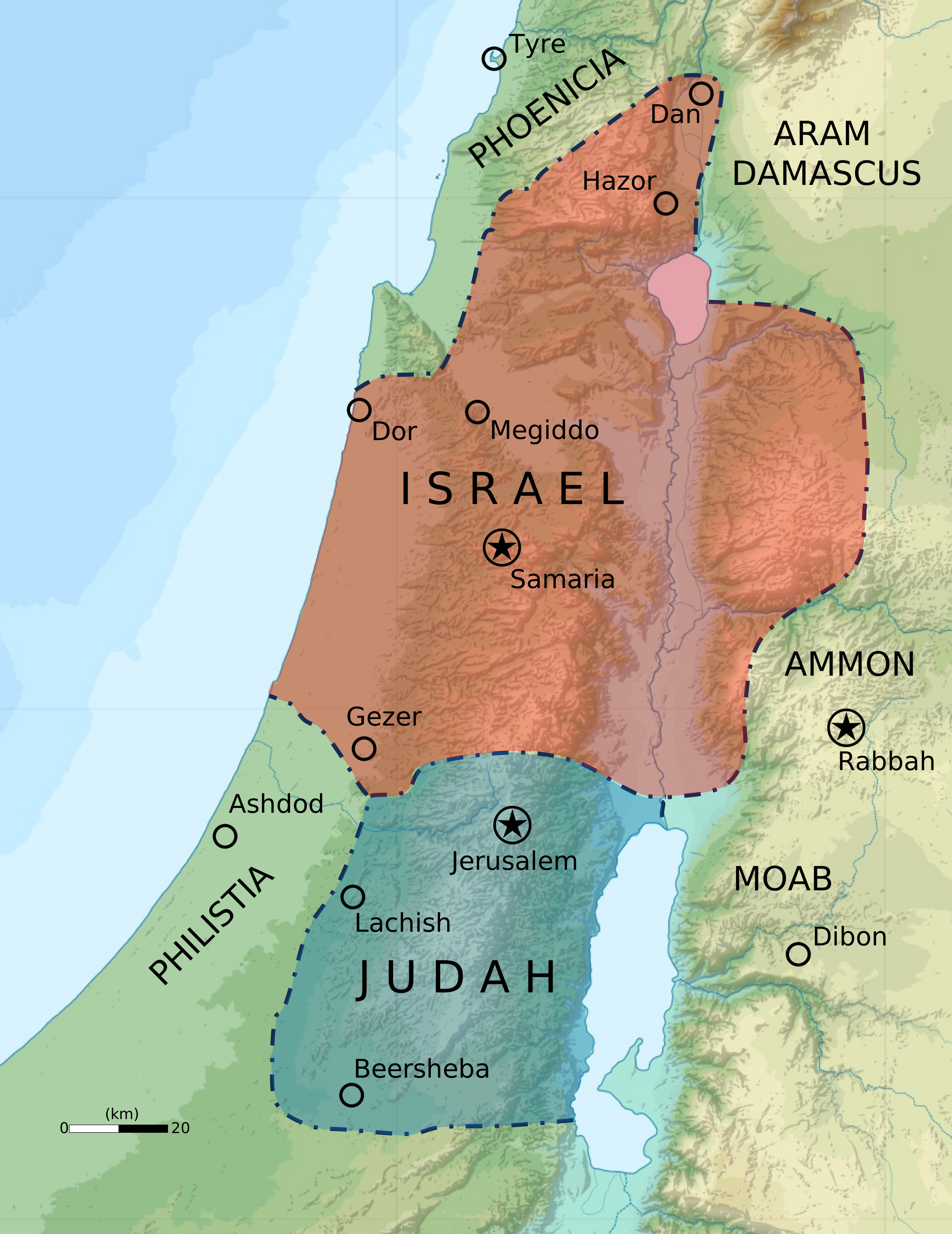 Source: Tobias Schäfer 87, Wikimedia Commons, CC BY 4.0.
Use the map to trace the movement of Amos 1-2. The surrounding nations are not random. The word circles Israel before turning inward. Visually, this helps the reader feel the trap: the comfortable listener becomes the accused.
Spiritual Fruit 🍇
- Let sermons against others become repentance for yourself. When a passage exposes someone else’s sin, pause before agreeing too quickly. Ask where the same root lives in you.
- Do not train yourself to resist holy correction. Israel’s guilt included silencing prophets and corrupting consecrated lives. A soul can become skilled at avoiding the very words that would save it.
- See the poor as persons before God, not as abstractions. Amos names the poor, the righteous, the needy, and the afflicted because God sees what powerful people learn to ignore.
- Let Christ judge and heal the hidden court inside you. The Cross exposes all sin, but it also gives the courage to confess without despair.
Teaching Notes
Amos 1-2
- Ask: why does Amos begin with the surrounding nations instead of beginning with Israel?
- Emphasize: the prophetic word is not partisan. It judges cruelty outside the covenant and hypocrisy inside the covenant.
- Watch for: turning Amos into a lesson about “bad people out there.” The passage is designed to remove that escape.
- Connect: Christ as the righteous One sold, silenced, and rejected, yet becoming mercy for the guilty.
- Show: use the map to trace the judgment circle around Israel, then into Israel.
Sources
Primary sources
- Scripture: Brenton, The Septuagint Version of the Old Testament, public domain English translation.
- Coptic Orthodox Holy Week/Pascha readings: local lectionary reference data drawn from the St. Mary Ottawa Holy Pascha source text and related Pascha day-hour indexes.
Secondary academic sources
- John Goldingay, Hosea-Micah, used for historical orientation to the Twelve Prophets.
- Standard Bible atlas and historical background resources were used for the 8th-century Israel/Judah setting.
Coptic Orthodox / pastoral sources
- Fr. Tadros Yacoub Malaty, commentary on Amos and the Twelve Prophets, used for Coptic pastoral framing where directly relevant.
- Pope Shenouda III and Fr. Bishoy Kamel, pastoral writings on repentance, worship, mercy, and service, used as modern Coptic spiritual framing rather than patristic proof.
- St. John Chrysostom and other Fathers are not cited directly in this guide because no strong passage-specific patristic comment was used here.
Web pages and non-academic sources cited
- Wikimedia Commons, Kingdoms of Israel and Judah (8th century BCE), CC BY 4.0, https://commons.wikimedia.org/wiki/File:Kingdoms_of_Israel_and_Judah_(8th_century_BCE).svg.