


These two chapters show how a kingdom can begin to collapse long before a battle is fought. Absalom wins loyalty not by truth or holiness, but by charm, grievance, staged humility, and false piety. David, whose own sin has already torn open wounds in his house, now walks out of Jerusalem in tears, refuses to use the ark as a talisman, receives the loyalty of the outsider Ittai, and endures cursing without reaching for instant revenge. The chapters are therefore about more than political revolt. They are about the theft of hearts, the discipline of a guilty king, and the strange holiness of accepting humiliation under the hand of God.
2 Samuel 15-16 - Absalom’s Revolt and David’s Humiliation
Historical and Scriptural Context
Where in Scripture
These chapters come after the catastrophe of 2 Samuel 11-14. David’s adultery with Bathsheba, the murder of Uriah, Nathan’s rebuke, and the violence inside David’s own house have already prepared the ground for this revolt. Amnon has violated Tamar. Absalom has killed Amnon. David has longed for Absalom and yet failed to restore him truthfully. So when chapter 15 opens, the rebellion is not a sudden accident. It is the ripening of sin, silence, vanity, and unresolved judgment.
They also prepare what follows in 2 Samuel 17-18. The battle has not yet begun, but the decisive spiritual lines are already visible: Absalom steals hearts, Ahithophel joins the conspiracy, David goes out weeping, and providence begins to work through Hushai, Zadok, and Abiathar. The reader should feel that the civil war begins in the gate, in the house, and in the heart before it appears on the field.
Where in history
Historically, the chapters describe a royal succession crisis in the united monarchy. Public judgment at the city gate, networks of tribal loyalty, royal household politics, and the symbolic control of Jerusalem all matter. Absalom’s actions are politically intelligent. He places himself where ordinary grievances collect, performs accessibility, criticizes the machinery of justice, and then turns religious language into cover for revolt.
This is also a world in which public shame is political force. To flee Jerusalem is humiliating. To cross the Kidron weeping is humiliating. To be cursed by a Saulide partisan while your soldiers stand nearby is humiliating. To seize a father’s concubines on the roof is not private lust only, but a public declaration of irreversible rebellion. The chapters should therefore be taught with full moral seriousness. They expose ambition, manipulation, sexual disgrace, and civil collapse, yet they also show flashes of holy restraint.
Geographical Significance ⛰️
The geography of 2 Samuel 15-16 carries theology.
- Jerusalem is not merely the capital. It is the city David took and the city where the ark now dwells. To leave it under pressure is both political loss and spiritual humiliation.
- Hebron lies south of Jerusalem and is loaded with memory. David first reigned there over Judah. Absalom therefore launches his revolt from a place associated with David’s own early kingship, turning memory into propaganda.
- The brook Kidron marks the passage eastward out of Jerusalem. David crosses it as a betrayed king in sorrow. The Gospel of John later says that Christ also crossed the Kidron on the night of His betrayal, not in flight from deserved discipline, but in voluntary movement toward the Passion.
- The Mount of Olives rises east of the city. David ascends it barefoot and weeping. The mountain will later become one of the great places of Christ’s prayer, lament, and approaching suffering.
- Bahurim / Baurim is associated with Saul’s house and becomes the place where Shimei curses David, showing that the king’s humiliation continues even after leaving the city.
- The wilderness road matters spiritually. David is stripped of royal ease and becomes once again a man on the road, exposed, dependent, and waiting on God.
The movement eastward therefore matters as much as the words spoken. The king is going down from the center of visible power and up into a place of tears, prayer, and dependence.
The Characters 👥
David
David, whose name is often understood as “beloved,” appears here as a chastened king rather than a triumphant ruler. He still has authority, servants, and loyal friends, yet he is no longer speaking from security. What is at stake for David is whether he will cling to kingship as possession or submit himself to God’s judgment and mercy.
Absalom
Absalom, whose name can be heard as “father of peace,” becomes an image of false peace and theatrical nearness. He knows how to flatter, how to make himself accessible, and how to wrap revolt in the language of justice and devotion. What is at stake for him is not the healing of Israel, but the seizure of the throne through charm, grievance, and shame.
Ittai the Gittite
Ittai, Brenton’s Ethi, is an outsider from Gath. He has not spent a lifetime under David’s rule, yet he shows a loyalty many in Israel fail to show. What is at stake for him is whether he will treat David as a temporary employer or bind himself to the king in life and death.
Zadok and Abiathar
These priests carry the ark and stand near the center of the story’s spiritual discernment. David refuses to use them as ritual insurance and instead sends them back. What is at stake is whether the holy things of God will be turned into instruments of political self-protection.
Ahithophel and Hushai
Ahithophel, Brenton’s Achitophel, is David’s famed counselor and now one of the most dangerous figures in the revolt. Hushai, Brenton’s Chusi, becomes David’s friend within the city. What is at stake in them is counsel itself: whether wisdom will serve ambition or whether shrewdness can still be used to frustrate evil.
Ziba and Mephibosheth
Ziba, Brenton’s Siba, appears with generosity on the surface, but his report about Mephibosheth is incomplete and self-serving. Mephibosheth is absent, and that absence becomes vulnerable to manipulation. What is at stake is truth under pressure, especially how quickly a distressed king can be steered by a well-timed gift and accusation.
Shimei
Shimei, Brenton’s Semei, comes from the house of Saul and curses David openly. His accusations are not a precise reading of history, yet his words strike David at a moment when the king knows he stands under judgment in a broader sense. What is at stake in Shimei is how humiliation is received and whether insult will provoke revenge.
🕯️ Light from the Word
1. Absalom steals hearts at the gate, 2 Samuel 15:1-6
1 And it came to pass after this that Abessalom prepared for himself chariots and horses, and fifty men to run before him. 2 And Abessalom rose early, and stood by the side of the way of the gate: and it came to pass that every man who had a cause, came to the king for judgment, and Abessalom cried to him, and said to him, Of what city art thou? And he said, Thy servant is of one of the tribes of Israel. 3 And Abessalom said to him, See, thy affairs are right and clear, yet thou hast no one appointed of the king to hear thee. 4 And Abessalom said, O that one would make me a judge in the land; then every man who had a dispute or a cause would come to me, and I would judge him! 5 And it came to pass when a man came near to do him obeisance, that he stretched out his hand, and took hold of him, and kissed him. 6 And Abessalom did after this manner to all Israel that came to the king for judgment; and Abessalom gained the hearts of the men of Israel.
Literal sense
Absalom does not begin with open war. He begins with image, access, and performance. He acquires royal-looking display, stations himself where ordinary people bring grievances, and then turns himself into the man who “understands” them better than the king does. He does not yet say, “David is finished.” He says, in effect, “If only someone like me were there for you.”
That is how many rebellions begin. The heart is stolen before the sword is lifted. A man makes himself feel like the answer to real pain, then quietly identifies the existing authority as inattentive, slow, and unworthy. Absalom kisses the people not because he loves them, but because he knows how public affection can create political debt.
LXX and theological insight
Brenton’s line, “Abessalom gained the hearts of the men of Israel,” is the key sentence. He does not yet gain the throne. He gains hearts. Scripture therefore teaches that the deepest battleground is interior. The gate is the place of justice, but Absalom turns it into a theater of emotional capture.
The language of royal display in verse 1 matters too. Chariots, horses, runners, early rising, and visible attentiveness all create the appearance of zeal. Zeal itself is not holiness. A man can look energetic, accessible, and reforming while already becoming spiritually predatory.
Patristic voice
Orthodox ascetical tradition repeatedly warns that the passions do not always appear ugly at first. Vainglory often borrows the clothing of service. A person can seem compassionate, available, and righteous while secretly feeding the love of power. The ascetical tradition is especially sharp on this point: praise, attention, and the desire to be needed can easily attach themselves to outward good.
St. John Cassian’s wider teaching on discernment is useful here. Not every impulse that seems helpful is pure. The soul must ask what spirit is moving beneath the gesture. Absalom’s body language looks warm. His heart is strategic.
Christological and typological reading
Absalom is a false shepherd at the gate. He promises hearing, closeness, and justice, yet he seeks the people in order to use them. Christ also receives the weary and wronged, but He does so without manipulation. He does not flatter grievance in order to enthrone Himself in worldly fashion. He bears the grief of the people truly and gives Himself for them.
There is also an ecclesial warning here. The Church must never confuse charisma with holiness, accessibility with truth, or emotional nearness with spiritual fatherhood. A stolen heart is not the same thing as a converted heart.
Lesson Guide
- Key phrases: “The throne falls in the heart before it falls in the palace.” “Charm can become a weapon.”
- Emphasize: Absalom’s real success is interior capture, not military strength.
- Avoid: Do not reduce this section to ancient politics only. It speaks directly to manipulation in families, ministry, friendship, and public life.
2. False piety and a spreading conspiracy, 2 Samuel 15:7-12
7 And it came to pass after forty years, that Abessalom said to his father, I will go now, and pay my vows, which I vowed to the Lord in Chebron. 8 For thy servant vowed a vow when I dwelt at Gedsur in Syria, saying, If the Lord should indeed restore me to Jerusalem, then will I serve the Lord. 9 And the king said to him, Go in peace. And he arose and went to Chebron.
10 And Abessalom sent spies throughout all the tribes of Israel, saying, When ye hear the sound of the trumpet, then shall ye say, Abessalom is become king in Chebron. 11 And there went with Abessalom two hundred chosen men from Jerusalem; and they went in their simplicity, and knew not anything. 12 And Abessalom sent to Achitophel the Theconite, the counsellor of David, from his city, from Gola, where he was sacrificing: and there was a strong conspiracy; and the people with Abessalom were increasingly numerous.
Literal sense
Absalom wraps revolt in the language of devotion. He speaks of vows, the Lord, sacrifice, and Hebron. David hears the language of worship and grants him peace. Yet the journey is a cover. Trumpets are waiting. Spies are already in place. Innocent guests are drawn in without understanding. A counselor from David’s circle is recruited. The conspiracy grows while looking like religion.
The moral ugliness here is sharp. Absalom does not simply lie about logistics. He lies in the name of piety. He uses sacrifice to stage rebellion.
LXX and theological insight
The Brenton text reads “after forty years.” Many modern translations read “after four years” from other textual witnesses. The exact number is debated, but the theological point is not altered. The rebellion is not impulsive. It is prepared, matured, and timed.
Hebron matters because it is where David first began to reign. Absalom does not choose a neutral place. He takes a site of memory and attempts to rewrite its meaning. This is another sign that rebellion often survives by inhabiting sacred or honored memory, then bending it toward self-exaltation.
Patristic voice
Orthodox ascetical tradition is relentless against hypocrisy in worship. Fasting, sacrifice, vows, and religious speech are holy things, but they become especially dangerous when used as camouflage for pride. Patristic teaching constantly insists that the first altar is the heart. When the heart is bent, outward devotion can become desecration rather than offering.
St. Basil’s broader moral teaching is relevant here: virtue cannot be built out of theatrical externality. What is offered to God must be true. Absalom’s “service” is a mask worn over treachery.
Christological and typological reading
Absalom’s false vow stands opposite Christ’s truthful prayer. In Gethsemane, Christ speaks openly before the Father and freely receives the cup. Absalom invokes the Lord while plotting self-exaltation. Christ addresses the Father in obedience while emptying Himself.
The section also warns the Church that not every use of religious language is spiritually safe. Some rebellions speak in liturgical tones. Some ambitions quote piety fluently. The Christian must learn to distinguish worship from its counterfeit.
Lesson Guide
- Key phrases: “He uses sacrifice to stage revolt.” “The holiest words become most dangerous in a lying mouth.”
- Emphasize: False piety is worse than open rebellion because it profanes holy language.
- Avoid: Do not turn textual questions about four or forty years into the main burden. The spiritual point is the patient cultivation of revolt.
3. David leaves Jerusalem, 2 Samuel 15:13-18
13 And there came a messenger to David, saying, The heart of the men of Israel is gone after Abessalom. 14 And David said to all his servants who were with him in Jerusalem, Rise, and let us flee, for we have no refuge from Abessalom: make haste and go, lest he overtake us speedily, and bring evil upon us, and smite the city with the edge of the sword. 15 And the king’s servants said to the king, In all things which our lord the king chooses, behold we are thy servants.
16 And the king and all his house went out on foot: and the king left ten women of his concubines to keep the house. 17 And the king and all his servants went out on foot; and abode in a distant house. 18 And all his servants passed on by his side, and every Chelethite, and every Phelethite, and they stood by the olive tree in the wilderness: and all the people marched near him, and all his court, and all the men of might, and all the men of war, six hundred: and they were present at his side: and every Chelethite, and every Phelethite, and all the six hundred Gittites that came on foot out of Geth, and they went on before the king.
Literal sense
When David learns that “the heart of the men of Israel is gone after Abessalom,” he does not barricade Jerusalem and turn the city into a slaughterhouse. He leaves. The choice is tactical, but it is more than tactical. He refuses to let the city be immediately consumed because of his struggle with his son.
The scene is profoundly humbling. The king goes out on foot. Household structures are left vulnerable. The movement is not ceremonial. It is a stripped-down departure marked by haste, exposure, and uncertainty. Yet the chapter also makes clear that not everyone has abandoned him. Servants, guards, and foreign loyalists remain at his side.
LXX and theological insight
The message David receives is again about the heart. Absalom’s revolt is not described first in terms of troops, but of inward allegiance. David’s outward emptying corresponds to the inward theft already accomplished.
The phrase “went out on foot” matters spiritually. The king is dispossessed in visible fashion. The outward stripping is part of the judgment. David does not descend from a throne with spectacle. He leaves as a vulnerable man.
Patristic voice
The patristic tradition often treats providential humiliation as a medicine, though never as a good in itself. When pride, negligence, or sin have distorted the soul, being stripped of control can become the place where truth returns. David’s pain is real, but the chapter does not let us read it as meaningless.
St. Ambrose’s wider reflection on David is helpful here. David’s greatness is not that he escapes consequence, but that he repeatedly returns to God under consequence. The king who once acted as if he could arrange another man’s death now walks out unable to arrange even his own security.
Christological and typological reading
David’s departure from Jerusalem points toward Christ, but only with careful distinction. David goes out under the shadow of his own earlier sin and under the rebellion of his son. Christ goes out from Jerusalem sinless, bearing not His own guilt but ours. David leaves because the city has become unsafe for him. Christ goes toward the place of betrayal because He freely embraces the cup.
Yet the typological line is still strong. A rejected king leaves the city while many hearts have turned. The true King will later be rejected by His own and go out bearing sorrow, not as a chastened sinner, but as the spotless Lamb.
Lesson Guide
- Key phrases: “He will not save the throne by burning the city.” “The king goes out on foot.”
- Emphasize: David’s flight is humiliation, but it is also restraint.
- Avoid: Do not romanticize passivity. David is not surrendering to evil as a moral principle. He is refusing immediate destruction of the city.
4. Ittai’s loyalty and the crossing of Kidron, 2 Samuel 15:19-23
19 And the king said to Ethi the Gittite, Why dost thou also go with us? return, and dwell with the king, for thou art a stranger, and thou hast come forth as a sojourner out of thy place. 20 Whereas thou camest yesterday, shall I to-day cause thee to travel with us, and shalt thou thus change thy place? thou didst come forth yesterday, and to-day shall I set thee in motion to go along with us? I indeed will go whithersoever I may go: return then, and cause thy brethren to return with thee, and may the Lord deal mercifully and truly with thee. 21 And Ethi answered the king and said, As the Lord lives and as my lord the king lives, in the place wheresoever my lord shall be, whether it be for death or life, there shall thy servant be. 22 And the king said to Ethi, Come and pass over with me. So Ethi the Gittite and the king passed over, and all his servants, and all the multitude with him.
23 And all the country wept with a loud voice. And all the people passed by over the brook of Kedron; and the king crossed the brook Kedron: and all the people and the king passed on toward the way of the wilderness.
Literal sense
David tries to release Ittai. He recognizes that this foreigner owes him nothing and need not suffer exile with a declining king. Ittai answers with one of the most beautiful confessions of loyalty in the book: wherever the king is, whether for death or life, there will he be also.
Then the whole scene deepens. The country weeps. The people pass the Kidron. The road becomes a road of lament. The king is not surrounded by celebration, but by tears. Yet amid widespread defection, the outsider proves faithful.
LXX and theological insight
The Brenton wording, “whether it be for death or life,” makes Ittai’s pledge especially stark. This is not a pledge of convenience. It is a pledge that accepts the king’s uncertainty as the servant’s own future.
The crossing of the Kidron is one of the most charged geographical and theological moments in the story. It marks departure, exposure, and movement into sorrow. Scripture slows down here because the crossing itself matters.
Patristic voice
Orthodox spiritual reading often notices the paradox that strangers sometimes receive truth more readily than those long accustomed to holy things. The outsider’s fidelity becomes a quiet rebuke to covenant presumption. Ittai resembles the Gentile figures in Scripture who recognize the Lord’s anointed when many insiders do not.
This fits a larger patristic instinct: true loyalty is measured in trial, not in feast days. Many will stand near a successful king. Fewer will cross the brook with a weeping one.
Christological and typological reading
Here the Christological reading becomes especially luminous. David crosses Kidron in betrayal and sorrow. Christ will later cross the Kidron on the night of His Passion. David is accompanied by loyal followers and disloyal subjects. Christ too will be surrounded by a mixed circle, some watchful, some sleeping, one already moving toward betrayal.
The difference must remain clear. David crosses as a king under chastening. Christ crosses as the sinless King who willingly goes to redeem. Still, the parallel is not accidental for Christian reading. David’s tears on this road prepare the imagination for the greater sorrow of the Son of David.
Ittai’s confession also echoes forward. Faithfulness to the true King means more than enjoying His victories. It means cleaving to Him when the road leads into tears.
Lesson Guide
- Key phrases: “The outsider stays when insiders depart.” “He crosses the Kidron with the rejected king.”
- Emphasize: Trial reveals loyalty.
- Avoid: Do not flatten David and Christ into equals. David is type, Christ is fulfillment.
5. The ark is sent back, 2 Samuel 15:24-29
24 And behold also Sadoc, and all the Levites were with him, bearing the ark of the covenant of the Lord from Bæthar: and they set down the ark of God; and Abiathar went up, until all the people had passed out of the city. 25 And the king said to Sadoc, Carry back the ark of God into the city: if I should find favour in the eyes of the Lord, then will he bring me back, and he will shew me it and its beauty. 26 But if he should say thus, I have no pleasure in thee; behold, here I am, let him do to me according to that which is good in his eyes.
27 And the king said to Sadoc the priest, Behold, thou shalt return to the city in peace, and Achimaas thy son, and Jonathan the son of Abiathar, your two sons with you. 28 Behold, I continue in arms in Araboth of the desert, until there come tidings from you to report to me. 29 So Sadoc and Abiathar brought back the ark of the Lord to Jerusalem, and it continued there.
Literal sense
The priests bring the ark out with David, but David refuses to keep it with him. He will not take the holiest object in Israel and turn it into a sign that God must endorse his flight or secure his return. Instead he sends it back and places himself under God’s verdict: if the Lord delights in him, he will return; if not, let the Lord do what seems good.
This is one of David’s clearest moments of spiritual sobriety in the whole book. He does not despise the ark. He reveres it too much to instrumentalize it.
LXX and theological insight
The key line is verse 26: “behold, here I am, let him do to me according to that which is good in his eyes.” This is not despair. It is surrendered judgment. David stops trying to manage the divine presence as a political asset.
The phrase that the Lord may show him “it and its beauty” is also rich. David does not speak only of recovering territory. He speaks of seeing again the place of God’s presence. His deepest return would not be merely to office, but to communion.
Patristic voice
Orthodox spiritual tradition constantly distinguishes between faith and superstition. Holy things are not magical objects that force outcomes. The ark cannot be carried as if it were a shield against repentance. True reverence submits to God rather than attempting to use God.
This section also fits the larger ascetical teaching on surrender. A man often discovers his true theology when he cannot control his future. David’s words are not polished spirituality from safety. They are spoken while everything is unraveling.
Christological and typological reading
David’s refusal to weaponize the ark points toward the obedience of Christ, though again with distinction. Christ never manipulates the Father’s will. He does not turn divine sonship into self-preservation. In the wilderness He refuses to grasp power through spectacle. In the garden He receives the cup from the Father’s hand.
For the Church, this section becomes a stern lesson. Sacramental life is real, holy, and powerful, but holy things are never charms. One cannot cling to the mysteries while refusing repentance. David here behaves more truly than many outwardly religious people do.
Lesson Guide
- Key phrases: “He will not carry the ark as a talisman.” “Here I am, let Him do what is good in His eyes.”
- Emphasize: Reverence means refusing to manipulate the holy.
- Avoid: Do not speak as if David were indifferent to the ark. His very refusal shows profound reverence.
6. Mount of Olives tears, betrayed counsel, and Hushai’s mission, 2 Samuel 15:30-37
30 And David went up by the ascent of the mount of Olives, ascending and weeping, and had his head covered, and went barefooted: and all the people that were with him covered every man his head; and they went up, ascending and weeping. 31 And it was reported to David, saying, Achitophel also is among the conspirators with Abessalom. And David said, O Lord my God, disconcert, I pray thee, the counsel of Achitophel.
32 And David came as far as Ros, where he worshipped God: and behold, Chusi the chief friend of David came out to meet him, having rent his garment, and earth was upon his head. 33 And David said to him, If thou shouldest go over with me, then wilt thou be a burden to me; 34 but if thou shall return to the city, and shalt say to Abessalom, Thy brethren are passed over, and the king thy father is passed over after me: and now I am thy servant, O king, suffer me to live: at one time even of late I was the servant of thy father, and now I am thy humble servant; so shalt thou disconcert for me the counsel of Achitophel. 35 And, behold, there are there with thee Sadoc and Abiathar the priests; and it shall be that every word that thou shalt hear of the house of the king, thou shalt report it to Sadoc and Abiathar the priests. 36 Behold, there are there with them their two sons, Achimaas the son of Sadoc, and Jonathan the son of Abiathar; and by them ye shall report to me every word which ye shall hear. 37 So Chusi the friend of David went into the city, and Abessalom was lately gone into Jerusalem.
Literal sense
This is one of the great sorrow scenes of Scripture. David ascends the Mount of Olives weeping, barefoot, and with covered head. The people around him mirror the grief. Then comes the news that Ahithophel has joined the conspiracy. Betrayal is now not only popular or political. It is intimate and strategic.
David responds first with a short prayer. He does not make a speech. He asks God to disconcert the counsel of Ahithophel. Then Hushai arrives in grief, and David sends him back as a counter to the counselor’s wisdom. The chapter ends with a quiet but important sign of providence: even in humiliation, help is being prepared.
LXX and theological insight
The Mount of Olives scene must be read slowly. Covered head and bare feet are signs of mourning and abasement. David does not ascend as a conqueror. He ascends emptied.
David’s short prayer is also revealing. He cannot outmaneuver everything. So he prays against counsel itself. Wisdom in service of evil is one of the most dangerous powers in Scripture. David asks God to disorder what human beings will otherwise call brilliant.
Patristic voice
The patristic tradition frequently sees tears as a grace when they arise from truth before God. Not all tears are holy, but tears of compunction, grief, and repentance are often treated as medicine. David’s ascent is not a display for the crowd. It is the bodily form of inner humiliation.
Orthodox ascetical tradition also knows how dangerous distorted counsel can be. One friend with corrupted wisdom can wound more deeply than an army. Hence the repeated patristic caution about whom a soul listens to and how thought itself can become treacherous.
Christological and typological reading
Here the Christological resonance is especially strong. David ascends the Mount of Olives in tears as a rejected king, burdened by betrayal and surrounded by weeping companions. Christ will pray and grieve on the Mount of Olives as the true King. David’s scene therefore becomes a real type, but not an equal one. David is sorrowing under discipline. Christ sorrows in sinless obedience. David asks that a counselor’s plot be frustrated. Christ submits to the betrayal that will lead to the salvation of the world.
Ahithophel also creates a cautious Holy Week resonance. Christian readers have long heard in his intimate betrayal and destructive counsel an anticipatory pattern of Judas, not as a simplistic one-to-one equation, but as part of the scriptural grammar of treacherous nearness. The later Christian heart reads this chapter more sharply because it already knows the Passion.
Lesson Guide
- Key phrases: “He ascends Olivet weeping.” “His first answer to treacherous counsel is prayer.”
- Emphasize: The type points toward Christ, but Christ exceeds the type completely.
- Avoid: Do not erase David’s guilt, and do not reduce Christ’s Passion to mere repetition of David’s sorrow.
7. Ziba’s provision and the danger of hasty judgment, 2 Samuel 16:1-4
1 And David passed on a little way from Ros; and, behold, Siba the servant of Memphibosthe came to meet him; and he had a couple of asses laden, and upon them two hundred loaves, and a hundred bunches of raisins, and a hundred cakes of dates, and a bottle of wine. 2 And the king said to Siba, What meanest thou by these? and Siba said, The asses are for the household of the king to sit upon, and the loaves and the dates are for the young men to eat, and the wine is for them that are faint in the wilderness to drink. 3 And the king said, And where is the son of thy master? and Siba said to the king, Behold, he remains in Jerusalem; for he said, To-day shall the house of Israel restore to me the kingdom of my father. 4 And the king said to Siba, Behold, all Memphibosthe’s property is thine. And Siba did obeisance and said, My lord, O king, let me find grace in thine eyes.
Literal sense
Ziba arrives with real help. The food and animals are genuinely useful. Yet he also arrives with a report about Mephibosheth that benefits himself greatly. David, in the strain of exile, responds quickly and grants him Mephibosheth’s property.
The chapter does not stop to resolve the matter yet. That is important. In crisis, useful provision can come tangled with self-serving interpretation. David is weary, under pressure, and vulnerable to a slanted account.
LXX and theological insight
The wilderness setting heightens the pressure of the scene. Exhaustion narrows judgment. A gift can feel like truth because it arrives with relief. Scripture therefore teaches something sober about leadership: distress does not only weaken the body, it can also compress discernment.
Theologically, the scene fits the book’s theme of mixed motives. Not every apparently helpful person is simple-hearted, and not every accusation can be tested immediately in a moment of flight.
Patristic voice
Orthodox ascetical tradition consistently warns that discernment is hardest when the passions are already agitated. Fear, fatigue, gratitude, injury, and urgency can all distort perception. A flattering service or timely gift may become the very occasion for injustice if the heart stops examining what it hears.
This does not make every helper suspect. It does make the soul sober. Good stewardship requires attention not only to the visible gift, but to the story attached to it.
Christological and typological reading
By contrast, Christ reads hearts without confusion. He receives those who come to Him, yet He is never deceived by appearances. Earthly kings, even righteous ones, remain limited in judgment. The true King knows what is in man.
The Church should take this section as a lesson in pastoral and practical caution. One cannot build judgment only from the first emotionally persuasive account, especially when the teller stands to gain.
Lesson Guide
- Key phrases: “A timely gift can carry a crooked story.” “Exhaustion compresses discernment.”
- Emphasize: David’s pressure helps explain the haste, but does not make haste into wisdom.
- Avoid: Do not settle the full Ziba-Mephibosheth question here as if chapter 19 did not matter.
8. Shimei’s cursing and David’s humility under humiliation, 2 Samuel 16:5-14
5 And king David came to Baurim; and, behold, there came out from thence a man of the family of the house of Saul, and his name was Semei the son of Gera. He came forth and cursed as he went, 6 and cast stones at David, and at all the servants of king David: and all the people and all the mighty men were on the right and left hand of the king. 7 And thus Semei said when he cursed him, Go out, go out, thou bloody man, and man of sin. 8 The Lord has returned upon thee all the blood of the house of Saul, because thou hast reigned in his stead; and the Lord has given the kingdom into the hand of Abessalom thy son: and, behold, thou art taken in thy mischief, because thou art a bloody man.
9 And Abessa the son of Saruia said to the king, Why does this dead dog curse my lord the king? let me go over now and take off his head. 10 And the king said, What have I to do with you, ye sons of Saruia? even let him alone, and so let him curse, for the Lord has told him to curse David: and who shall say, Why hast thou done thus? 11 And David said to Abessa and to all his servants, Behold, my son who came forth out of my bowels seeks my life; still more now may the son of Benjamin: let him curse, because the Lord has told him. 12 If by any means the Lord may look on my affliction, thus shall he return me good for his cursing this day.
13 And David and all the men with him went on the way: and Semei went by the side of the hill next to him, cursing as he went, and casting stones at him, and sprinkling him with dirt. 14 And the king, and all the people with him, came away and refreshed themselves there.
Literal sense
Shimei curses David as a bloody and sinful man. Some of his historical charges are inaccurate or at least badly framed. David did not simply seize Saul’s throne by murdering Saul’s house. Yet David does not answer by demanding that every detail be corrected on the spot. He stops Abishai from killing Shimei and receives the humiliation as something the Lord may be using.
This does not mean that every accusation against David is true. It means David is no longer defending his image as if image were his salvation. He knows enough about his own guilt before God to accept public abasement without immediate retaliation.
LXX and theological insight
The repeated curse, the stones, and the dirt create one of the most severe humiliation scenes in David’s life. The text wants us to feel the indignity. A king surrounded by mighty men is being pelted from the hillside, and he forbids revenge.
Verse 12 is especially important: “If by any means the Lord may look on my affliction, thus shall he return me good for his cursing this day.” David does not call the curse righteous in every detail. He places his affliction before God and hopes that God may transform even this bitter humiliation into mercy.
Patristic voice
Orthodox spiritual tradition frequently teaches patience under insult, not because insults are good, but because retaliation often reveals a heart still enslaved to self-justification. The soul that can endure contempt without rage has already gained a hidden victory over pride.
At the same time, patristic wisdom does not require Christians to romanticize abuse or stay in danger. This scene is about David’s voluntary refusal of vengeance in a particular historical and spiritual moment. It is not a command to the vulnerable to remain under harm.
Christological and typological reading
David’s patient endurance under cursing points forward to Christ’s silence and meekness under mockery, but again the difference is decisive. David accepts humiliation as a chastened sinner asking for mercy. Christ accepts mockery as the sinless Redeemer bearing the sins of the world.
Even so, the line of typology is real. The true King will later be reviled, struck, and publicly shamed. David’s refusal to unleash Abishai becomes a dim but genuine anticipation of the greater refusal of legions in the Passion. The Son of David is stronger than vengeance because He is stronger than the need to prove Himself before men.
Lesson Guide
- Key phrases: “He does not make image management into salvation.” “Humiliation received before God can become medicine.”
- Emphasize: David’s humility is real, but it is humility under discipline, not indifference to truth.
- Avoid: Do not use this text to counsel abused people to remain unsafe or silent before violence.
9. Absalom in Jerusalem, Hushai’s ambiguity, and Ahithophel’s shameful counsel, 2 Samuel 16:15-23
15 And Abessalom and all the men of Israel went into Jerusalem, and Achitophel with him. 16 And it came to pass when Chusi the chief friend of David came to Abessalom, that Chusi said to Abessalom, Let the king live. 17 And Abessalom said to Chusi, Is this thy kindness to thy friend? why wentest thou not forth with thy friend? 18 And Chusi said to Abessalom, Nay, but following whom the Lord, and this people, and all Israel have chosen, his will I be, and with him will I dwell. 19 And again, whom shall I serve? should I not in the presence of his son? As I served in the sight of thy father, so will I be in thy presence.
20 And Abessalom said to Achitophel, Deliberate among yourselves concerning what we should do. 21 And Achitophel said to Abessalom, Go in to thy father’s concubines, whom he left to keep his house; and all Israel shall hear that thou hast dishonoured thy father; and the hands of all that are with thee shall be strengthened. 22 And they pitched a tent for Abessalom on the roof, and Abessalom went in to his father’s concubines in the sight of all Israel. 23 And the counsel of Achitophel, which he counselled in former days, was as if one should enquire of the word of God: so was all the counsel of Achitophel both to David and also to Abessalom.
Literal sense
Absalom enters Jerusalem and begins to solidify his claim. Hushai successfully speaks in double-edged language, appearing to honor the new king while remaining David’s instrument. Then Ahithophel gives brutal counsel: Absalom should publicly violate David’s concubines to make the rebellion irreversible.
This act is morally filthy and politically calculated. It turns sexual sin into public statecraft. It also fulfills Nathan’s earlier prophecy that what David did secretly would return upon his house openly. The rooftop setting intensifies the judgment. The place of David’s earlier looking now becomes the place of his house’s public disgrace.
LXX and theological insight
Brenton says that Ahithophel’s counsel was treated almost like asking “the word of God.” That line is chilling. Human beings can begin to regard dark cunning as if it were sacred wisdom when ambition rules the heart.
The rooftop and public visibility matter. Absalom is not driven merely by lust. He is making a statement of dominance, irreversibility, and dishonor. The rebellion wants not only David’s power, but David’s shame.
Patristic voice
Orthodox spiritual tradition often observes that the fall of one sin opens the door to others when repentance is refused. Lust, pride, and domination feed one another. The household that was not healed in truth becomes the stage of greater shame.
Patristic moral teaching also insists that cleverness is not wisdom. Counsel that feels brilliant because it secures power quickly may in fact be devilish. Ahithophel’s intelligence is not holy because it is effective.
Christological and typological reading
This section is a dark anti-image of true kingship. Absalom strengthens his cause through public violation. Christ establishes His kingdom through self-offering. Absalom uses shame to harden allegiance. Christ bears shame to save even those who shame Him.
The cautionary Judas resonance also sharpens here through Ahithophel. Intimate counsel turns against the anointed king, and seemingly brilliant strategy serves destruction. Yet Christ goes beyond David utterly. He does not merely survive treacherous counsel. He tramples death through the very betrayal meant to undo Him.
Lesson Guide
- Key phrases: “Brilliant counsel can still be demonic counsel.” “Absalom builds by public shame.”
- Emphasize: Nathan’s prophecy is ripening, and unrepented sin leaves terrible fractures in a house.
- Avoid: Do not speak of the concubines as props in a political drama. This is sexual exploitation and public desecration.
The Church’s Voice in Worship
The Coptic Orthodox lectionary chapter index currently marks 2 Samuel 15-16 as not indexed in the available lectionary references, so this guide should not claim an exact Coptic liturgical placement.
Even so, the Church already prays within the world of these chapters. Psalm 3 in its traditional superscription is bound to David fleeing from Absalom his son, and the Orthodox praying of the Psalter learns to speak from that place of distress, trust, and rising hope. The Agpeya also repeatedly forms the soul in the language of enemies, tears, repentance, and entrusting judgment to God rather than seizing it.
There is also a real Holy Week resonance, though it should be stated cautiously. The crossing of Kidron, the ascent of the Mount of Olives, intimate betrayal, and the patient bearing of humiliation all prepare the Christian imagination to hear the Passion more deeply. One should not claim that these exact chapters are assigned to a specific Coptic Holy Week hour without source verification, but it is fully sound to say that they resonate strongly with Holy Week themes.
Ahithophel’s treacherous counsel can also be heard, in a cautious Christian reading, as part of the scriptural pattern that later makes the betrayal of Judas feel tragically familiar. The Church’s worship does not need a forced one-to-one claim in order to receive the resonance.
Iconography Connection 🖼️
The most direct iconographic anchor is David the King and Prophet. In such icons David often appears with harp, scroll, and royal vesture, but these chapters ask the teacher to remember the hidden tears behind the crown. David’s true dignity here is not regal display. It is humbled endurance under God.
A strong visual sequence for teaching would move from David the King and Prophet to an image of the ark, and then to icons or Gospel scenes of Christ on the Mount of Olives, in Gethsemane, or moving toward the Passion. That sequence helps the group see the typological line clearly: David’s sorrow points forward, but Christ’s obedience fulfills what David could only foreshadow.
If slides are made, avoid romanticized battle art or political imagery that glamorizes Absalom’s revolt. Better images would emphasize prayer, tears, the ark, and the true kingship of Christ. The iconographic goal should be theology in color, not drama for its own sake.
Visual reading aid
Use the kingdom map with the court/conflict network. Trace Jerusalem, Kidron, Mount of Olives, Bahurim, Jordan, and Mahanaim. This keeps the chapter from becoming abstract politics: David’s humiliation has a road, a geography, and a set of witnesses.
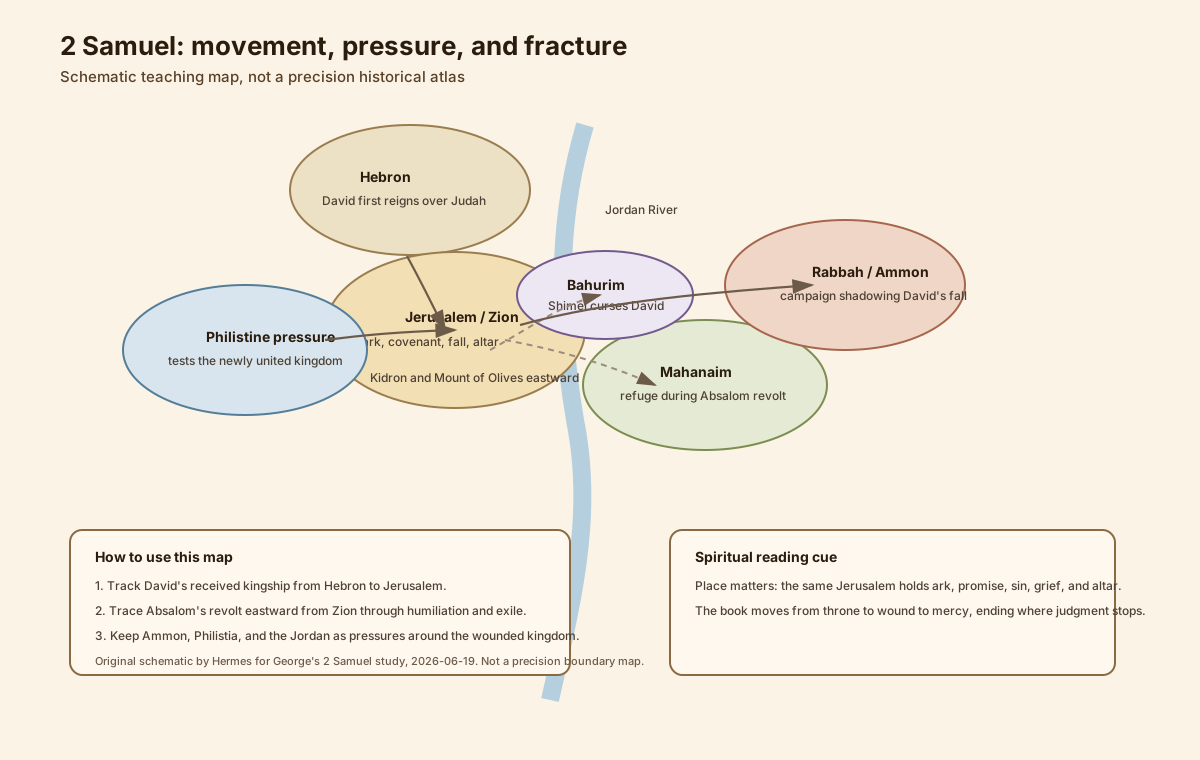 Source: Original schematic by Hermes for this 2 Samuel study guide, 2026-06-19.
Spiritual Fruit 🍇
1. Guard your heart against flattering thieves
Absalom wins hearts by making wounded people feel uniquely seen while quietly teaching them resentment. That temptation is still with us. Not every person who speaks our pain is healing us. Some are training us to distrust, divide, and follow them. A Christian must ask not only, “Does this person understand me?” but also, “Where is this leading my heart?”
2. Never use devotion as camouflage
Absalom cloaks ambition in the language of vows and sacrifice. The same sin can happen in quieter ways now: a holy phrase used to justify a grudge, ministry language used to hide rivalry, “discernment” used to baptize self-will. One of the hardest questions in the spiritual life is this: am I praying for light, or am I using prayer language to make my chosen path sound pure?
3. Do not turn holy things into insurance policies
David’s sending back of the ark is a powerful rebuke to superstition. Many people want the comfort of the holy without the surrender of repentance. They want a blessing, a sacrament, a symbol, or a prayer that secures their preferred outcome. David shows a better way: “Here I am. Let Him do what is good in His eyes.”
4. Loyalty is proved on the road of sorrow
Ittai stays when it becomes costly to stay. That is true of friendship, marriage, ministry, and discipleship. Many stand near blessing. Fewer stand near tears. A useful self-examination is simple: do I love Christ only when He is visibly consoling me, or do I remain with Him when the road passes through the Kidron and up Olivet?
5. Humiliation can become medicine when received before God
Shimei’s accusations are not an exact court transcript of David’s guilt, yet David receives the humiliation without retaliatory fury. Most of us fear being misunderstood more than we fear pride itself. David shows that one can entrust reputation to God. The Christian should not seek humiliation, but when it comes, he can ask whether God is using it to expose the desperate need to be right, admired, or untouchable.
6. Be slow when pain and gifts arrive together
Ziba’s food was useful, but his story also benefited himself. In moments of exhaustion we can become grateful and credulous at the same time. This matters spiritually and pastorally. Relief is good, but it should not suspend discernment. When a report about another person comes wrapped in a timely service, the soul should give thanks and still wait to judge.
Teacher's Notes
Suggested timing
- Opening summary and context: 8 minutes
- Absalom at the gate and false piety: 12 minutes
- David’s flight, Ittai, and Kidron: 15 minutes
- The ark sent back and Mount of Olives tears: 12 minutes
- Ziba, Shimei, and David’s humiliation: 15 minutes
- Absalom in Jerusalem and Ahithophel’s counsel: 10 minutes
- Spiritual fruit and discussion: 15 minutes
Where to linger
Linger over 15:24-26, because David’s refusal to carry the ark as a talisman is one of the purest spiritual moments in the passage. Also linger over 15:30 and 16:10-12. David on the Mount of Olives and David under Shimei’s cursing together form the inner heart of the lesson.
Where to compress
Compress secondary logistical details about the spy network, court communication channels, and some name lists if time is short. Do not compress the gate scene, the Kidron crossing, the ark, the Mount of Olives, or Shimei’s cursing.
Key phrases to say slowly
- “Absalom steals hearts before he seizes a throne.”
- “David will not use the ark to protect himself from God.”
- “The outsider crosses Kidron with the rejected king.”
- “Humiliation can become medicine when offered back to God.”
- “David’s tears on Olivet point forward, but Christ’s obedience fulfills.”
Pastoral warnings
Do not use David’s endurance under Shimei to tell abused or endangered people that holiness requires remaining physically unsafe. That is not what this passage teaches. Also do not turn Absalom into a glamorous rebel figure. His accessibility is manipulative, his piety is false, and his kingship is built on theft and shame. Finally, when teaching the concubines episode, speak clearly about sexual exploitation and public desecration. Do not let the language become clinical or detached.
Accuracy notes
Brenton’s text reads “after forty years” in 15:7, while many modern translations read “after four years” from other witnesses. The guide notes the variant but does not hang its interpretation on the numeral. The Coptic Orthodox lectionary index does not verify an exact liturgical placement for these chapters. Ziba’s accusation against Mephibosheth should be kept provisional until 2 Samuel 19 is read. Shimei’s interpretation of David’s guilt is not exact history, but David’s humble reception of the curse remains spiritually decisive.
Visual / teaching aid
- Show: Use the map to trace David’s exit from Jerusalem through the Mount of Olives and Bahurim toward refuge. Use the court network for Ahithophel, Hushai, Ziba, Mephibosheth, and Shimei.
Glossary
- Kidron / Kedron: The valley and brook east of Jerusalem, crossed in this chapter by David and later by Christ on the night of His betrayal.
- Mount of Olives: The ridge east of Jerusalem associated with prayer, grief, and in the Gospels with crucial moments of Christ’s Passion and teaching.
- Hebron: David’s first royal center in Judah. Absalom uses it as the launch point of revolt because of its political memory.
- Gittite: A man from Gath, a Philistine city. Ittai’s outsider identity makes his loyalty especially striking.
- Ark of the Covenant: The holy sign of God’s presence with Israel. David refuses to use it as political insurance.
- Ahithophel / Achitophel: David’s famed counselor whose wisdom is turned toward revolt.
- Hushai / Chusi: David’s friend who returns to Jerusalem to frustrate Ahithophel’s counsel.
- Bahurim / Baurim: A location associated with Saul’s house where Shimei publicly curses David.
- Concubines: Women attached to the royal household whose public violation in chapter 16 is both sexual exploitation and political desecration.
- Typology: The Orthodox reading of earlier persons, places, and events as real historical foreshadowings that find fulfillment in Christ and the Church.
Translation and Source Notes
Embedded Old Testament Scripture in this guide uses Brenton’s English Septuagint, following the project standard for Orthodox Old Testament study guides. In the Greek / Septuagint tradition, 2 Samuel corresponds to Kings II / 2 Kingdoms.
Brenton’s spellings often differ from familiar English forms, including Abessalom for Absalom, Achitophel for Ahithophel, Ethi for Ittai, Siba for Ziba, Semei for Shimei, Baurim for Bahurim, and Kedron for Kidron. These are normal Septuagint-based spellings, not separate characters.
The numeral in 2 Samuel 15:7 is textually debated. Brenton reads forty years, while many modern translations read four years from other witnesses. The guide notes the issue, but the theological emphasis remains the same: Absalom’s revolt is cultivated and deliberate.
This passage has no established place in the Coptic Orthodox lectionary.
Sources
Primary sources
- Scripture: 2 Samuel 12:10-12; 2 Samuel 15-16; Psalm 3; Psalm 40 (NKJV 41):9; John 18:1; Matthew 26:36-50.
- Brenton, Lancelot C. L., trans. The Septuagint Version of the Old Testament with an English Translation.
- St. Ambrose, Apology of the Prophet David.
- St. Augustine, The City of God, Book XVII.
- Theodoret of Cyrus, interpretive material on Kingdoms / Samuel where available in translation.
Secondary academic sources
- Robert Alter, The David Story: A Translation with Commentary of 1 and 2 Samuel.
- P. Kyle McCarter Jr., II Samuel, Anchor Bible.
- David T. Tsumura, The Second Book of Samuel, NICOT.
- Walter Brueggemann, First and Second Samuel.
- A. Graeme Auld, studies on Samuel and the Deuteronomistic history.
Coptic Orthodox / pastoral sources
- The Orthodox Study Bible, notes on 2 Kingdoms / 2 Samuel.
- Fr. Tadros Y. Malaty, commentary material on Samuel / Kingdoms where available.
- Pope Shenouda III, pastoral teaching on repentance, humility, and Davidic brokenness where exact sources are available.
- Fr. Bishoy Kamel, pastoral teaching on humility, tears, and repentance where exact sources are available.
Web pages and non-academic sources cited
- CCEL and New Advent for public-domain access points to patristic texts.