


These two chapters are among the hardest in all Scripture because the sinner is not a pagan tyrant but David, the Lord’s anointed king. The text gives us no permission to soften what happened. David abuses royal power, takes Bathsheba, engineers Uriah’s death by proxy, and then tries to fold the crime into ordinary palace life. Yet the same chapters also give one of Scripture’s clearest revelations of true repentance: God sends Nathan, truth breaks in, David says, “I have sinned against the Lord,” mercy is given, and consequences still remain.
This is not a lesson in image repair. It is a lesson in judgment, confession, and the terrible mercy of God. David is forgiven, but Bathsheba and Uriah are not erased, the wound in the house is not denied, and the reader is taught to look beyond David to Christ, the true Son of David, the innocent Lamb and King who bears sin openly rather than hiding it behind another man’s blood.
2 Samuel 11-12 - David’s Fall, Nathan’s Rebuke, and Repentance
Historical and Scriptural Context
Where in Scripture
2 Samuel 8-10 has just shown David at the height of royal success. Enemies are subdued, the kingdom is established, covenant mercy is shown to Mephibosheth, and the house of David appears strong. That is exactly why chapters 11-12 strike with such force. Scripture does not let success become a mask. The king who was publicly victorious is privately corrupt, and the sin that begins in secrecy reaches the battlefield, the marriage bed, the nursery, and the prophetic court.
What follows in the rest of 2 Samuel will prove Nathan’s warning true. The sword does not depart from David’s house. Amnon, Tamar, Absalom, public shame, rebellion, and grief all unfold under the shadow cast here. These chapters are therefore not a detachable moral failure inside David’s story. They are the hinge on which the whole second half of the book turns.
Where in history
The narrative stands in the world of ancient monarchy, where the king held immense military, legal, domestic, and sexual power over subjects. Royal abuse could be normalized, concealed, or justified as privilege. Scripture refuses that logic. David’s office does not excuse him. It makes his sin heavier.
The chapter also belongs to a culture of war. Men are out fighting Ammon. The ark is in the field. Honor, loyalty, command, and household order are all bound together. That is why Uriah’s integrity is so devastating. The soldier at the front still knows what fidelity looks like, while the king at home does not.
Geographical Significance ⛰️
Jerusalem and Rabbath form the moral geography of the passage.
- Jerusalem is the royal city, the place of David’s house, roof, chamber, authority, and concealment. From that elevated place David sees, inquires, sends, and takes. The high place of kingship becomes the setting of moral collapse.
- Rabbath of the children of Ammon is the war front. Uriah belongs there, Joab is there, and the real struggle is there. David should have been sharing the burden of kingship in relation to the campaign, but instead he stays behind in comfort.
- The movement between palace and battlefield matters. The king’s private sin is transmitted into public violence by letter. The distance between rooftop desire and battlefield death is closed by command.
- Nathan’s rebuke introduces another kind of space, the contrast between secret and open. “Thou didst it secretly, but I will do this thing in the sight of all Israel, and before this sun” (2 Samuel 12:12, Brenton). The geography becomes moral exposure. What David tried to confine indoors is dragged into the open light.
The Characters 👥
David
David is the anointed king, victorious in war and established in Jerusalem. In these chapters he is not presented as a romantic hero, nor merely as a weak man who stumbled. He is a ruler misusing power, then a sinner confronted by God, then a penitent who truly confesses. What is at stake is whether kingship will become domination or remain answerable to the Lord.
Bathsheba / Bersabee
Brenton names her Bersabee. She is the wife of Uriah. The narrative stresses David’s initiative, not hers: he saw, he inquired, he sent, he took. The text gives no warrant for blaming her. A king’s summons is not an equal social encounter. This is sexual sin bound up with coercive royal power.
Uriah / Urias the Hittite
Brenton names him Urias the Chettite. Uriah is a soldier of integrity, faithful to comrades, ark, covenant people, and military duty. His righteousness exposes David’s corruption. He becomes the innocent man whose loyalty is used against him.
Nathan
Nathan is the prophet sent by the Lord. He is neither court flatterer nor detached commentator. He speaks truth into royal power at personal risk. He is one of the clearest biblical witnesses to the fact that prophetic ministry must not become chaplaincy to the strong.
Joab
Joab is David’s commander. He is not the origin of the sin, but he becomes part of its machinery. He receives the letter, arranges the battlefield conditions, and manages the report back to the king. Hidden sin often spreads by recruiting other capable people into compromised service.
The child born to David and Bathsheba
The child is morally innocent. The child’s suffering must never be preached as if the child personally deserved wrath. In the narrative, the child’s sickness and death reveal the public gravity of David’s sin and the way sin wounds a household beyond the first act.
Solomon / Jedidiah
After judgment and grief, Bathsheba bears Solomon. Nathan also calls him Jeddedi in Brenton, usually rendered Jedidiah, “beloved of the Lord.” This does not cancel the sorrow that came before. It shows that mercy still works in a house that has been judged.
🕯️ Light from the Word
1. The king remains behind, sees, and takes, 2 Samuel 11:1-5
1 And it came to pass when the time of the year for kings going out to battle had come round, that David sent Joab, and his servants with him, and all Israel; and they destroyed the children of Ammon, and besieged Rabbath: but David remained at Jerusalem.
2 And it came to pass toward evening, that David arose off his couch, and walked on the roof of the king’s house, and saw from the roof a woman bathing; and the woman was very beautiful to look upon. 3 And David sent and enquired about the woman: and one said, Is not this Bersabee the daughter of Eliab, the wife of Urias the Chettite?
4 And David sent messengers, and took her, and went in to her, and he lay with her: and she was purified from her uncleanness, and returned to her house. 5 And the woman conceived; and she sent and told David, and said, I am with child.
Literal sense
The chapter opens with a sentence that already sounds wrong: the season has come for kings to go out to battle, but David remains at Jerusalem. That is not yet the whole sin, but it is the setting in which the sin ripens. From the palace roof David sees a woman, learns exactly who she is, then sends for her and takes her. The text does not present this as a mutual romance. It presents the king using his power to possess another man’s wife.
The pregnancy makes concealment impossible. The sentence “I am with child” shatters the illusion that private sin can remain private.
LXX and textual insight
Brenton’s names remind us we are reading the Septuagint form of the story: Bersabee and Urias. The sequence of verbs matters. David saw, sent, enquired, sent, took. Sin is not only an inward impulse here. It becomes administrative. Desire passes through royal channels.
The note that Bathsheba “was purified from her uncleanness” is not a moral stain on her. It helps establish the sequence and underscores that the child is David’s. The narrative is carefully removing excuses.
Patristic voice
The Orthodox ascetical tradition repeatedly treats David as proof that even a chosen and gifted servant of God can fall terribly when watchfulness fails. St. John Chrysostom’s wider teaching on the passions is especially useful here: sin often begins not with a public crime but with a relaxed heart that stops guarding its eyes, imagination, and power. St. Ambrose, in Apology of the Prophet David, treats David’s fall as a warning that no office and no past holiness make a man immune to corruption.
Patristic reading also resists the habit of blaming the visible object rather than the sinful will. The problem is not that Bathsheba existed or was seen. The problem is David’s unruled heart and his misuse of kingly authority.
Christological and typological reading
David remains behind when kings go out to battle. Christ is the opposite kind of King. He goes before His flock, enters the field Himself, and lays down His life for the sheep. David sees a woman and takes her into his house. Christ receives His Bride, the Church, by giving Himself for her, cleansing her, and refusing coercion. David uses another’s body to serve desire. Christ offers His own Body to save the beloved.
This first scene already teaches that a false king uses privilege to consume. The true King pours Himself out.
Lesson Guide
- Key phrases: “The king stayed home.” “He saw, sent, and took.” “This is not romance. It is abused power.”
- Emphasize: The text itself puts initiative and blame on David. Refuse euphemism.
- Avoid: Do not blame Bathsheba. Do not reduce the chapter to generic sexual temptation detached from power.
2. Uriah’s integrity exposes David, 2 Samuel 11:6-13
6 And David sent to Joab, saying, Send me Urias the Chettite; and Joab sent Urias to David.
7 And Urias arrived and went in to him, and David asked him how Joab was, and how the people were, and how the war went on. 8 And David said to Urias, Go to thy house, and wash thy feet: and Urias departed from the house of the king, and a portion of meat from the king followed him. 9 And Urias slept at the door of the king with the servants of his lord, and went not down to his house. 10 And they brought David word, saying, Urias has not gone down to his house. And David said to Urias, Art thou not come from a journey? why hast thou not gone down to thy house? 11 And Urias said to David, The ark, and Israel, and Juda dwell in tents; and my lord Joab, and the servants of my lord, are encamped in the open fields; and shall I go into my house to eat and drink, and lie with my wife? how should I do this? as thy soul lives, I will not do this thing. 12 And David said to Urias, Remain here to-day also, and to-morrow I will let thee go. So Urias remained in Jerusalem that day and the day following.
13 And David called him, and he ate before him and drank, and he made him drunk: and he went out in the evening to lie upon his bed with the servants of his lord, and went not down to his house.
Literal sense
David tries to cover the pregnancy by bringing Uriah home from the front. If Uriah sleeps with Bathsheba, the child can appear to be his. But Uriah refuses the comfort David wants him to take. He will not enjoy home privileges while the ark, Israel, Judah, Joab, and the army remain in tents and exposed fields. David then tries again, even making him drunk, but Uriah still does not go down to his house.
This is one of the chapter’s sharpest ironies. The guilty king urges indulgence. The innocent soldier practices restraint.
LXX and theological insight
Uriah’s speech is built on covenant loyalties: the ark, Israel, Juda, my lord Joab, the servants of my lord. He lives in right relation to worship, people, commander, and duty. David has broken those relations. Uriah’s fidelity becomes an unwitting judgment on David.
The text also shows how sin grows. David’s first evil act does not remain alone. Once he chooses concealment, he begins to manipulate schedules, hospitality, food, drink, and rank. Hidden sin becomes strategized dishonesty.
Patristic voice
Orthodox spiritual tradition often notes that when a man will not accuse himself, God allows the truth to stand before him in another person’s righteousness. Uriah is not preaching at David, yet his conduct becomes a sermon. Chrysostom’s moral world is full of such reversals, where the supposedly weak or ordinary reveal the sickness of the powerful by simple fidelity.
Ambrose’s larger treatment of David also helps here. David’s greatness is not that he never fell beneath others. At this moment he does. The Hittite servant stands morally taller than the king.
Christological and typological reading
Uriah is not Christ, yet his innocence in the face of another man’s calculation points beyond David toward the Righteous One who will be handed over by the schemes of rulers. David uses Uriah’s loyalty as part of a cover-up. Christ, the sinless Son of David, willingly enters the place where the guilty should have stood and does so without deceit.
This unit also unmasks counterfeit kingship. David is enthroned, but Uriah is the one walking in truth. Titles do not create holiness. Communion with God does.
Lesson Guide
- Key phrases: “Uriah’s faithfulness becomes David’s mirror.” “The soldier in the field fears God more than the king in the palace.”
- Emphasize: Covering sin usually requires more sin, more manipulation, and more people drawn into the lie.
- Avoid: Do not sentimentalize Uriah as merely tragic. His integrity is an active moral contrast inside the chapter.
3. Murder by proxy and evil before the Lord, 2 Samuel 11:14-27
14 And the morning came, and David wrote a letter to Joab, and sent it by the hand of Urias. 15 And he wrote in the letter, saying, Station Urias in front of the severe part of the fight, and retreat from behind him, so shall he be wounded and die.
16 And it came to pass while Joab was watching against the city, that he set Urias in a place where he knew that valiant men were. 17 And the men of the city went out, and fought with Joab: and some of the people of the servants of David fell, and Urias the Chettite died also.
18 And Joab sent, and reported to David all the events of the war, so as to tell them to the king. 19 And he charged the messenger, saying, When thou hast finished reporting all the events of the war to the king, 20 then it shall come to pass if the anger of the king shall arise, and he shall say to thee, Why did ye draw nigh to the city to fight? knew ye not that they would shoot from off the wall? 21 Who smote Abimelech the son of Jerobaal son of Ner? did not a woman cast a piece of a millstone upon him from above the wall, and he died in Thamasi? why did ye draw near to the wall? then thou shalt say, Thy servant Urias the Chettite is also dead.
22 And the messenger of Joab went to the king to Jerusalem, and he came and reported to David all that Joab told him, all the affairs of the war. And David was very angry with Joab, and said to the messenger, Why did ye draw nigh to the wall to fight? knew ye not that ye would be wounded from off the wall? Who smote Abimelech the son of Jerobaal? did not a woman cast upon him a piece of millstone from the wall, and he died in Thamasi? why did ye draw near to the wall? 23 And the messenger said to David, The men prevailed against us, and they came out against us into the field, and we came upon them even to the door of the gate. 24 And the archers shot at thy servants from off the wall, and some of the king’s servants died, and thy servant Urias the Chettite is dead also. 25 And David said to the messenger, Thus shalt thou say to Joab, Let not the matter be grievous in thine eyes, for the sword devours one way at one time and another way at another: strengthen thine array against the city, and destroy it, and strengthen him.
26 And the wife of Urias heard that Urias her husband was dead, and she mourned for her husband. 27 And the time of mourning expired, and David sent and took her into his house, and she became his wife, and bore him a son: but the thing which David did was evil in the eyes of the Lord.
Literal sense
David now chooses murder. He sends Uriah carrying the letter that arranges his own death. Joab obeys. Other servants die as well. When the report arrives, David speaks with chilling detachment: “the sword devours one way at one time and another way at another.” After Bathsheba’s mourning, David takes her into his house and makes her his wife.
Then comes the verdict that matters more than all royal arrangements: “the thing which David did was evil in the eyes of the Lord.” Human management has not changed divine judgment.
LXX and textual insight
The narrative keeps tightening. David has moved from seeing, to taking, to plotting, to writing, to killing. The command is not merely to expose Uriah to danger. It is to place him where the fight is fiercest and then withdraw support. This is murder carried out through military command.
Bathsheba is referred to here first as “the wife of Urias.” That is crucial. Even after David takes her, Scripture names the reality he wants forgotten.
Patristic voice
Orthodox spiritual tradition frequently teaches that unrepented lust does not remain lust. It spreads into falsehood, cruelty, and hardness of heart. Here the corruption becomes public and structural. David’s sin is not only that he desired wrongly. He sacrificed truth, justice, loyal servants, and another household in order to preserve himself.
St. Gregory the Great’s wider pastoral teaching is relevant even though he is not directly commenting on this verse: the sins of rulers travel outward. Private corruption in authority never stays private for long. It injures many.
Christological and typological reading
Uriah carrying the letter of his death is one of the darkest images in the history of David’s house. The king uses an innocent man’s obedience to conceal guilt. Christ, the true King from David’s line, does the opposite. He takes our guilt upon Himself in the open, without deceit, and exposes the lie rather than preserving it. David hides behind another man’s death. Christ saves by His own death.
This is one of the strongest Christological contrasts in the book. David is a real type of Christ in some chapters, but here he is a failed king whose sin makes the need for a greater Son of David unavoidable.
Lesson Guide
- Key phrases: “Sin became administration.” “Bathsheba mourned her husband.” “The Lord still saw.”
- Emphasize: This is murder by proxy and abuse of military power, not merely a private moral lapse.
- Avoid: Do not rush to David’s repentance before letting the weight of the harm be felt.
4. Nathan’s parable awakens the conscience, 2 Samuel 12:1-6
1 And the Lord sent Nathan the prophet to David; and he went in to him, and said to him, There were two men in one city, one rich and the other poor. 2 And the rich man had very many flocks and herds. 3 But the poor man had only one little ewe lamb, which he had purchased, and preserved, and reared; and it grew up with himself and his children in common; it ate of his bread and drank of his cup, and slept in his bosom, and was to him as a daughter. 4 And a traveller came to the rich man, and he spared to take of his flocks and of his herds, to dress for the traveller that came to him; and he took the poor man’s lamb, and dressed it for the man that came to him. 5 And David was greatly moved with anger against the man; and David said to Nathan, As the Lord lives, the man that did this thing shall surely die. 6 And he shall restore the lamb seven-fold, because he has not spared.
Literal sense
Nathan does not begin with direct accusation. He tells a parable about a rich man who steals the single cherished ewe lamb of a poor man instead of taking from his own abundance. David, hearing the case as if it were about someone else, burns with anger and pronounces judgment.
The king’s moral vision is not gone. It is displaced. He can still recognize evil when it appears at a distance.
LXX and theological insight
The parable is crafted to expose not only theft but loveless excess. The rich man is not needy. He has “very many flocks and herds.” The poor man’s lamb is described almost as a household member, eating, drinking, and sleeping near him, “as a daughter.” Nathan is forcing David to feel the tenderness of what was taken.
The “traveller” who comes to the rich man has often been read as the sudden movement of passion, appetite, or desire. Whether or not that symbolic layer is pressed, the point is plain: a passing appetite was treated as more important than another household’s life.
Patristic voice
Orthodox spiritual tradition often praises the pedagogical wisdom of divine rebuke. God does not always crush the sinner at once. Sometimes He leads him to pronounce judgment on the evil itself so that conscience can awaken from within. This is not manipulation. It is mercy.
Chrysostom’s larger moral method often works the same way. He makes a listener condemn greed, lust, cruelty, or pride in the abstract, then turns the mirror until the hearer recognizes himself. Nathan stands in that prophetic pattern.
Christological and typological reading
Nathan’s parable shows how the law and the prophetic word work. They do not invent evil. They reveal it. Later, Christ will tell parables that uncover hearts, especially the hearts of the powerful who think themselves secure. The word of God reaches where excuses live.
The lamb in the story also prepares the conscience for a deeper question. David stole the poor man’s lamb. What happens when the guilty world receives the true Lamb of God? In David’s house, an innocent faithful man dies because the king is guilty. In the Gospel, the innocent Lamb dies so the guilty may be forgiven and transformed.
Lesson Guide
- Key phrases: “David can still judge evil, but not yet in himself.” “The prophet lets conscience speak before he names the sinner.”
- Emphasize: Prophetic truth is a mercy because it reopens moral sight.
- Avoid: Do not treat Nathan’s tact as timidity. This is fearless confrontation shaped wisely.
5. “Thou art the man,” confession, and the sentence, 2 Samuel 12:7-15
7 And Nathan said to David, Thou art the man that has done this. Thus says the Lord God of Israel, I anointed thee to be king over Israel, and I rescued thee out of the hand of Saul; 8 and I gave thee the house of thy lord, and the wives of thy lord into thy bosom, and I gave to thee the house of Israel and Juda; and if that had been little, I would have given thee yet more. 9 Why hast thou set at nought the word of the Lord, to do that which is evil in his eyes? thou hast slain Urias the Chettite with the sword, and thou hast taken his wife to be thy wife, and thou hast slain him with the sword of the children of Ammon. 10 Now therefore the sword shall not depart from thy house for ever, because thou hast set me at nought, and thou hast taken the wife of Urias the Chettite, to be thy wife. 11 Thus says the Lord, Behold, I will raise up against thee evil out of thy house, and I will take thy wives before thine eyes, and will give them to thy neighbour, and he shall lie with thy wives in the sight of this sun. 12 For thou didst it secretly, but I will do this thing in the sight of all Israel, and before this sun.
13 And David said to Nathan, I have sinned against the Lord. And Nathan said to David, And the Lord has put away thy sin; thou shalt not die. 14 Only because thou hast given great occasion of provocation to the enemies of the Lord by this thing, thy son also that is born to thee shall surely die.
15 And Nathan departed to his house. And the Lord smote the child, which the wife of Urias the Chettite bore to David, and it was ill.
Literal sense
Nathan now names the crime without softening it. David despised the word of the Lord, killed Uriah with the sword of the Ammonites, took Uriah’s wife, and treated secret evil as if it could remain hidden. The judgment fits the sin. Violence will strike David’s own house, and what he did in secret will become public shame.
David’s confession is short and without excuse: “I have sinned against the Lord.” Nathan immediately declares mercy: “the Lord has put away thy sin; thou shalt not die.” Yet mercy does not erase consequence. The chapter refuses both despair and cheap absolution.
LXX and theological insight
The most devastating phrase in the rebuke may be, “Why hast thou set at nought the word of the Lord?” David’s sin is not only against Bathsheba or Uriah, though it is certainly against them. It is also contempt for God’s word. To use people this way is to treat the Lord’s command as light.
Nathan also repeats the name of Uriah. He does not let the victim disappear into royal narrative. Even in David’s marriage to Bathsheba, Scripture keeps saying, in effect, she was Uriah’s wife.
Patristic voice
St. Ambrose’s treatment of David is especially important here. He does not present David as excused because he repented. He presents David as great because, once exposed, he did not harden himself. There is no bargaining, no self-justifying speech, no blaming of circumstance. Augustine, reading David through the penitential Psalms, sees in this moment the wellspring of Psalm 50, the cry of a heart broken before God rather than cosmetically repaired before men.
Orthodox spiritual tradition therefore reads this confession as the model of true repentance, not because it was emotionally dramatic, but because it was truthful. Repentance begins when the sinner stops negotiating with reality.
Christological and typological reading
David’s words, “I have sinned against the Lord,” are the beginning of healing, but they do not save the world. David cannot undo Uriah’s death, cannot purify Bathsheba’s sorrow, and cannot reverse the fracture of his house. An innocent victim has already died under a guilty king.
This is where the chapters press us toward Christ. The true Son of David does not arrange the death of the innocent. He is the Innocent One who offers Himself. He does not preserve kingship by another’s blood. He establishes the Kingdom by His own blood. He is the Lamb whom no prophet has to expose, because He Himself is the light in whom nothing false is found.
Nathan can say, “the Lord has put away thy sin,” but the full ground of that mercy lies ahead, in the Cross of Christ. Divine forgiveness is real because the true King will bear what David’s repentance alone cannot carry.
Lesson Guide
- Key phrases: “Thou art the man.” “I have sinned against the Lord.” “Forgiveness is real. Consequences are also real.”
- Emphasize: David’s confession is honest and immediate. Repentance is not self-protection.
- Avoid: Do not teach this as if a quick confession makes grave harm small. Do not detach forgiveness from the Cross.
6. Tears, worship, and costly mercy, 2 Samuel 12:16-25
16 And David enquired of God concerning the child, and David fasted, and went in and lay all night upon the ground. 17 And the elders of his house arose and went to him to raise him up from the ground, but he would not rise, nor did he eat bread with them.
18 And it came to pass on the seventh day that the child died: and the servants of David were afraid to tell him that the child was dead; for they said, Behold, while the child was yet alive we spoke to him, and he hearkened not to our voice; and how should we tell him that the child is dead? so would he do himself harm. 19 And David understood that his servants were whispering, and David perceived that the child was dead: and David said to his servants, Is the child dead? and they said, He is dead. 20 Then David rose up from the earth, and washed, and anointed himself, and changed his raiment, and went into the house of God, and worshipped him; and went into his own house, and called for bread to eat, and they set bread before him and he ate. 21 And his servants said to him, What is this thing that thou hast done concerning the child? while it was yet living thou didst fast, and weep, and watch: and when the child was dead thou didst rise up, and didst eat bread, and drink. 22 And David said, While the child yet lived, I fasted and wept; for I said, Who knows if the Lord will pity me, and the child live? 23 But now it is dead, why should I fast thus? shall I be able to bring him back again? I shall go to him, but he shall not return to me.
24 And David comforted Bersabee his wife, and he went in to her, and lay with her; and she conceived and bore a son, and he called his name Solomon, and the Lord loved him. 25 And he sent by the hand of Nathan the prophet, and called his name Jeddedi, for the Lord’s sake.
Literal sense
David fasts, lies on the ground, prays, and begs for mercy while the child is alive. When the child dies, David rises, washes, worships, and eats. His servants cannot understand the sequence, but David explains it clearly: while there was still hope to ask, he asked. Once death had come, he could not reverse it by continued fasting.
Then the narrative moves, with great sobriety, toward consolation. Bathsheba is comforted, Solomon is born, and Nathan gives the child a name tied to divine love. Mercy has not disappeared, but neither has sorrow.
Theological and pastoral caution
This section must be handled with fear and tenderness. The child is not presented as a moral offender. The chapter is revealing the gravity and public scandal of David’s sin in the life of the royal house. It is not handing the Church a neat explanation for every child’s death, every miscarriage, or every family tragedy. Pastoral cruelty often begins when this scene is turned into a formula. It must not be.
David’s worship after the child’s death is also not emotional coldness. It is broken submission before God. He does not say the loss was small. He says it cannot be undone by more frantic striving.
Patristic voice
Orthodox spiritual tradition praises tears that turn into repentance and repentance that turns into worship. Augustine’s reading of David through the penitential psalms helps here. Repentance is not mere collapse. It is the soul returning to God in truth. The desert tradition would add that true mourning is not theatrical despair. It is grief purified by surrender.
There is also a hard but necessary patristic instinct here: one must accept that forgiveness does not mean control. David is pardoned, yet he still must live inside consequences he cannot command.
Christological and typological reading
David’s fasting cannot save the child. A sinner’s tears, however real, cannot by themselves heal the world’s ruin. Scripture is teaching us to look beyond even sincere repentance to a deeper salvation. Only the beloved Son, truly innocent and truly divine, can bear the sin of the world and destroy death from within.
Solomon’s birth after judgment points to mercy continuing in the Davidic line. Yet Solomon is still not the final answer. The beloved son who truly brings peace is Christ. He is not born as a sign that sin was minor. He comes because sin is so grave that only God’s own saving work can overcome it.
Lesson Guide
- Key phrases: “David prayed while prayer could still ask.” “He worshipped after the child died.” “Mercy continues, but sorrow is not denied.”
- Emphasize: Repentance includes tears, prayer, worship, and acceptance of what cannot be undone.
- Avoid: Do not use this passage to explain other people’s family losses in a simplistic or accusatory way.
7. The war concludes, but the shadow remains, 2 Samuel 12:26-31
26 And Joab fought against Rabbath of the children of Ammon, and took the royal city. 27 And Joab sent messengers to David, and said, I have fought against Rabbath, and taken the city of waters. 28 And now gather the rest of the people, and encamp against the city, and take it beforehand; lest I take the city first, and my name be called upon it.
29 And David gathered all the people, and went to Rabbath, and fought against it, and took it. 30 And he took the crown of Molchom their king from off his head, and the weight of it was a talent of gold, with precious stones, and it was upon the head of David; and he carried forth very much spoil of the city. 31 And he brought forth the people that were in it, and put them under the saw, and under iron harrows, and axes of iron, and made them pass through the brick-kiln: and thus he did to all the cities of the children of Ammon. And David and all the people returned to Jerusalem.
Literal sense
The Rabbath campaign, which formed the background to David’s sin, now concludes. Joab secures the key military position and calls David to complete the victory so that the king’s name, not the commander’s, will stand over the capture. David comes, takes the city, receives the crown, and imposes harsh judgment on the Ammonites.
This ending is intentionally uncomfortable. The narrative does not close with a sentimental cleansing of David’s image. Public kingship continues, but the reader has already seen what kind of darkness has been in the king’s house.
Textual and interpretive note
Verse 31 is one of the hard texts in Samuel. Brenton gives a severe reading involving saws, iron harrows, axes, and the brick-kiln. Some interpreters have argued for forced labor language in related textual traditions, but the Septuagint as translated by Brenton preserves a harsh picture. The guide should not pretend the verse is easy.
Theologically, the point here is not that David has returned to moral purity through military activity. It is that public success can continue even while the effects of sin remain. The Bible does not equate outward effectiveness with inward health.
Patristic voice
Patristic commentary on every detail of this ending is not always abundant, but the larger Orthodox moral instinct is clear. Victory after repentance is not the same thing as innocence before repentance. A ruler may continue to act in office, yet the memory of sin remains a warning and the need for humility deepens.
Christological and typological reading
A crown appears again at the end of the story, but now the reader cannot hear of crowns innocently. David can take a crown from a conquered city, but he cannot crown himself righteous. Christ’s crown is of thorns before it is manifest as glory. He conquers not by obscuring bloodguilt, but by taking judgment into Himself and overturning death.
The contrast is decisive. David’s story at this point can still move history. Only Christ can heal history.
Lesson Guide
- Key phrases: “The war ended, but the wound remained.” “Outward success is not proof of inward innocence.”
- Emphasize: The chapter refuses cheap restoration narratives.
- Avoid: Do not use late military success to soften the earlier crimes.
The Church’s Voice in Worship
This passage has no established place in the Coptic Orthodox lectionary.
Even so, the Church’s voice around this passage is unmistakable. Orthodox prayer continually returns to Psalm 50 (NKJV 51), the great penitential psalm bound to David’s repentance after Nathan’s rebuke. In the Coptic Orthodox spiritual life, Psalm 50 is not an occasional text. It is a habitual school of contrition. The faithful learn to say with David not, “I made a mistake,” but, “Have mercy upon me, O God.”
These chapters also resonate with the Church’s sacramental and ascetical life. Confession is truthful naming before God. Fasting without repentance is empty, yet repentance naturally fasts and weeps. Worship after judgment is still possible because mercy is real. The services of Holy Week also help the Orthodox reader here. False kingship, hidden plotting, innocent suffering, and truth dragged into the light all stand close to the Passion, though David here is not Christ but the one who reveals how badly the true King is needed.
Iconography Connection 🖼️
The strongest iconographic links are David the Prophet and King, the Prophet Nathan, and above all Christ the Bridegroom and suffering King. If this guide later becomes a teaching deck, the visual line should move from David’s fall and Nathan’s rebuke toward Christ, not toward sensationalized images of Bathsheba.
That caution matters. Western art has often treated Bathsheba as an excuse for voyeurism, which is the exact opposite of what the text is doing. An Orthodox teaching use should resist that completely. Better visual choices would be:
- David with harp or scroll, as king and prophet who later repents.
- Nathan confronting David.
- Psalm 50 in liturgical or calligraphic form.
- Christ before Pilate, Christ crowned with thorns, or Christ the Bridegroom, as the true King who stands in light rather than hiding in darkness.
Visual reading aid
Use Tissot’s Nathan Rebukes David from the Resources matrix as the preferred external visual because it centers prophetic truth and accountability. Do not embed Bathsheba artwork by default. Rembrandt and Artemisia are listed only as teacher-discretion Western artwork links because they can distract from David’s sin, Bathsheba’s vulnerability, and Uriah’s righteousness.
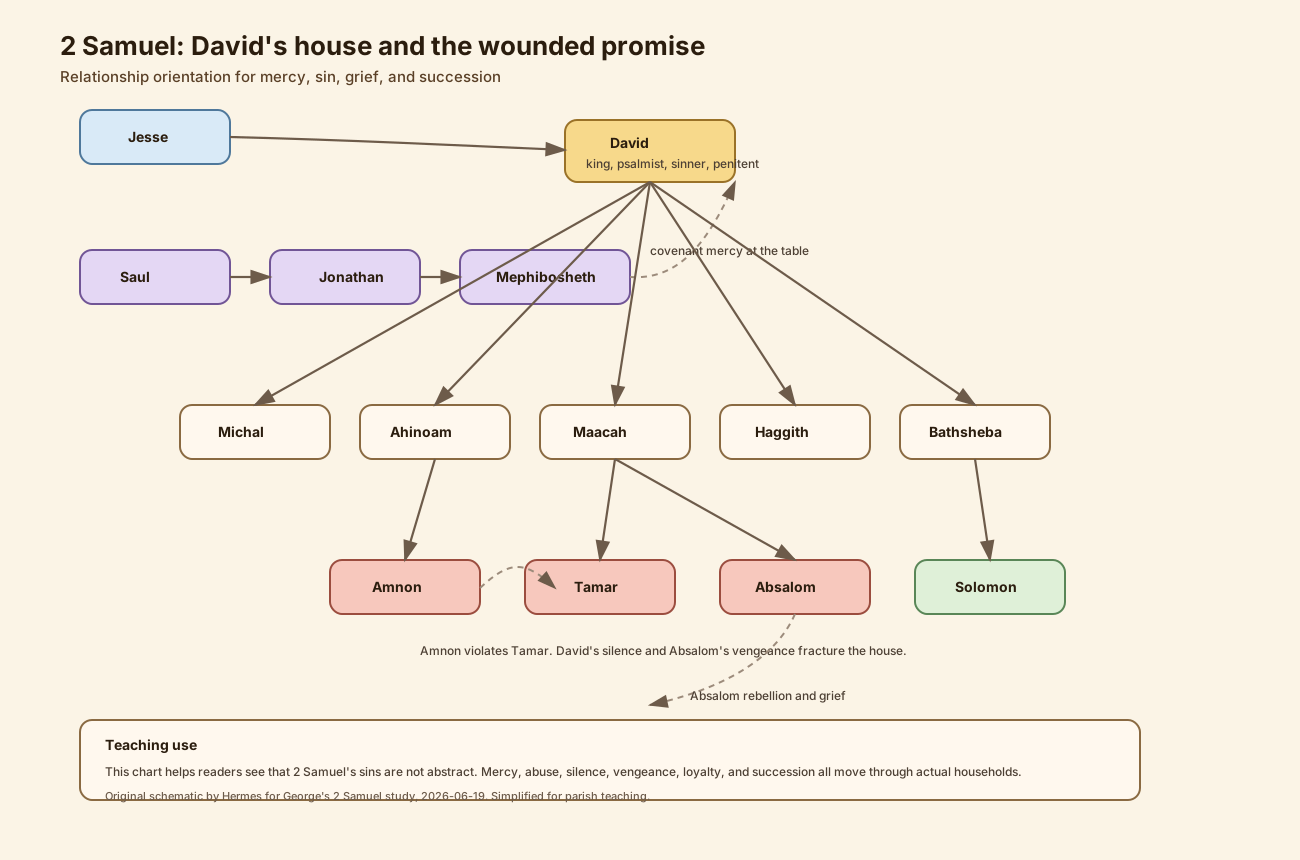 Source: Original schematic by Hermes for this 2 Samuel study guide, 2026-06-19.
Pastoral depth: repentance is truth, not image repair
David’s confession is short, but the chapter refuses to make repentance superficial. The sin harmed Bathsheba, murdered Uriah through another man’s sword, corrupted Joab’s obedience, and brought grief into the house. Forgiveness is real because God is merciful, but repentance is not a strategy for escaping truth. In Orthodox spiritual life, Psalm 50 teaches the same movement: the sinner stops managing appearances and stands uncovered before God, asking for a clean heart.
Spiritual Fruit 🍇
1. Sin often begins where duty is abandoned and the heart grows unguarded
David’s fall does not begin with the pregnancy. It begins with spiritual slackness. He remains behind when kings go out. He is comfortable, unwatchful, and available to appetite. Many grave falls begin that way. The first question is not only, “What did I do?” but, “Where did I stop watching?”
2. Abuse of power must be named plainly
This passage is not only about lust. It is about power. David is king. Bathsheba is a subject. Uriah is a servant-soldier. Joab is drawn into a lethal command chain. When the powerful use position to take, silence, or rearrange truth, the Church must not hide behind soft words. Repentance starts with naming reality.
3. Hidden sin seeks helpers
David’s sin spreads outward. Messengers carry it, Joab administers it, soldiers die around it, Bathsheba suffers under it, and a household is shaken by it. One reason hidden sin is so dangerous is that it rarely stays solitary. It builds systems around itself.
4. True repentance does not defend itself
“I have sinned against the Lord” is short, but it is real. David does not blame loneliness, beauty, stress, or royal privilege. He does not say, “I was in a hard season.” He confesses. In Orthodox repentance, self-knowledge becomes speech before God without cosmetics.
A useful practice here is to pray Psalm 50 slowly and replace vague regret with exact truth.
5. Forgiveness is real, but it is not the cancellation of consequences
Nathan announces that the Lord has put away David’s sin. That is astonishing mercy. But the sword still enters David’s house. Orthodox repentance must never be confused with damage control. God forgives the sinner, but He does not call evil good, nor does He pretend harm was unreal.
6. Christ is the innocent Lamb and the true King David was not
Uriah dies because a guilty king hides behind another man’s blood. Christ dies because the true King stands in the place of the guilty and refuses to save Himself at their expense. When these chapters are read rightly, they do not end in David. They drive the heart toward Jesus Christ.
Summary Table
| Element in the text | Spiritual meaning | Fulfillment in Christ / the Church |
|---|---|---|
| David remains in Jerusalem | Neglected duty opens space for temptation | Christ goes before His flock and enters the battle Himself |
| David sees and takes Bathsheba | Desire armed with power becomes oppression | Christ receives His Bride by self-giving love, not coercion |
| Uriah refuses home comfort | Fidelity exposes corruption | The righteous reveal the disorder of the powerful |
| Uriah carries his death letter | Hidden sin uses the innocent to protect itself | Christ bears judgment willingly to save the guilty |
| Nathan says, “Thou art the man” | The prophetic word brings concealed evil into light | Christ’s word judges and heals the heart |
| David confesses, “I have sinned against the Lord” | Repentance begins in truthful self-accusation | The Church lives this in confession and Psalm 50 |
| Mercy given, consequences remain | Forgiveness is not denial of harm | The Cross alone joins perfect mercy and perfect justice |
Closing Meditation
David could not heal what David had broken. That is why these chapters still wound the reader, and why they also save him from illusion. We need more than remorse. We need a King who tells the truth, bears the sin, loves the violated, remembers the innocent dead, and opens mercy without calling darkness light. That King is Christ.
Teacher's Notes
Timing breakdown
- Opening summary and context: 8 minutes
- David and Bathsheba, 11:1-5: 12 minutes
- Uriah and the failed cover-up, 11:6-13: 10 minutes
- Murder by proxy, 11:14-27: 12 minutes
- Nathan’s parable and rebuke, 12:1-15: 18 minutes
- David’s repentance and the child’s death, 12:16-25: 12 minutes
- Rabbath and final integration: 6 minutes
- Spiritual fruit and discussion: 12 minutes
Where to linger
Linger over 11:1-5 and 12:7-13. Those are the two great hinges: abused power, and then prophetic exposure with genuine confession. Also linger long enough over Uriah and Bathsheba that the group cannot turn David’s repentance into a way of forgetting the harmed.
Where to compress
Compress the military detail around Rabbath unless the group is especially interested in the historical campaign. It is important, but the moral and theological center lies in David’s sin, Nathan’s rebuke, and the shape of repentance.
Pastoral warnings
- Do not blame Bathsheba, imply seduction, or preach this as mutual adultery abstracted from power.
- Do not use David’s repentance to minimize the reality of sexual coercion, abuse of office, or the death of Uriah.
- Do not use the child’s death as a neat explanation for later family tragedy, miscarriage, or infant loss.
- Do not let the lesson become gossip about famous sinners. Keep the mirror turned toward the heart and toward the responsibilities of those in authority.
- Do not preach repentance as public image repair. Scripture does not.
Accuracy notes
- Brenton uses Bersabee for Bathsheba and Urias for Uriah.
- In the Septuagint tradition, 2 Samuel is Kings II / 2 Kingdoms.
- Psalm numbering should use LXX numbering primary. Psalm 50 corresponds to NKJV Psalm 51.
- The Coptic Orthodox lectionary chapter index presently does not give verified chapter placements for 2 Samuel.
- 2 Samuel 12:31 is a hard text, and Brenton preserves a severe reading.
Visual / teaching aid
- Show: Prefer Tissot’s Nathan rebuking David from the Resources matrix. Do not show Bathsheba artwork by default; keep the class focused on David’s abuse of power, Uriah’s integrity, Nathan’s truth, repentance, and real consequences.
Discussion Questions
- Why does Scripture place David’s fall immediately after such visible royal success?
- What changes in our reading when we name David’s sin not only as lust, but as abuse of power and murder by proxy?
- Why is Uriah so important to the chapter’s moral force?
- What makes David’s confession genuine, and what does it still not undo?
- How do these chapters prepare the Church to understand Christ as the true Son of David?
Glossary
- Brenton Septuagint: A public-domain English translation of the Greek Old Testament, often used for Orthodox Old Testament study.
- Bersabee: Brenton’s form of Bathsheba.
- Urias the Chettite: Brenton’s form of Uriah the Hittite.
- Nathan: The prophet sent by God to confront David.
- Psalm 50: The Septuagint numbering of the great penitential psalm, corresponding to NKJV Psalm 51.
- Jeddedi / Jedidiah: A name given through Nathan, meaning “beloved of the Lord.”
- Kings II / 2 Kingdoms: The Septuagint naming tradition for 2 Samuel.
Translation and Source Notes
Embedded Scripture is from Brenton’s English Septuagint, public domain. In the Septuagint tradition, this book is Kings II / 2 Kingdoms. Brief New Testament references in related teaching may use NKJV wording where useful, but the embedded Old Testament text here is Brenton. The Coptic Orthodox lectionary references currently does not verify exact liturgical readings for 2 Samuel, so this guide speaks of thematic resonance rather than fixed chapter placement.
Sources
Primary sources
- Scripture: 2 Samuel 11-12; Psalm 50 (NKJV 51); Psalm 31 (NKJV 32); Matthew 1:6; Luke 1:32-33; John 10:11-18; 1 Peter 2:22-24.
- St. Ambrose, Apology of the Prophet David.
- St. Augustine, City of God, Book XVII.
- St. Augustine, Expositions on the Psalms, especially on the penitential psalms.
Secondary academic sources
- Robert Alter, The David Story: A Translation with Commentary of 1 and 2 Samuel.
- Walter Brueggemann, First and Second Samuel.
- P. Kyle McCarter Jr., II Samuel.
- David T. Tsumura, The Second Book of Samuel.
Coptic Orthodox / pastoral sources
- Orthodox Study Bible notes on 2 Kingdoms / 2 Samuel.
- Fr. Tadros Y. Malaty, commentary on Samuel / Kingdoms where available and source-verified.
- Coptic Orthodox pastoral teaching on repentance and Psalm 50, especially where source-backed.
Web pages and non-academic sources cited
Coptic Orthodox lectionary reference checks did not verify exact chapter placement for this guide.
CCEL and New Advent as public-domain access points for patristic texts when exact work references are verified.