


These three chapters show David near the height of his kingdom. Enemies are subdued, tribute is dedicated, justice and righteousness are named as marks of his rule, and then one of the most moving acts of covenant mercy in the book appears when Mephibosheth is brought to the king’s table. Yet the same section also shows how fragile earthly peace remains. Kindness sent to Hanun is mistrusted, David’s servants are publicly shamed, and suspicion ripens into war. The result is a sobering lesson: power can become a shield for the weak, but when mercy is rejected and honor is ruled by fear, the seeds of future violence are already planted.
2 Samuel 8-10 - Victory, Mercy, and the Seeds of War
Historical and Scriptural Context
Where in Scripture
These chapters come immediately after the covenant promise of 2 Samuel 7. That matters because they show the Davidic kingdom in action after the promise has been spoken. Chapter 8 summarizes victories and administrative order. Chapter 9 slows down and gives a personal scene of covenant mercy. Chapter 10 shows diplomacy collapsing into insult and war. Together they present strength, generosity, and danger in one movement.
They also stand just before 2 Samuel 11 and 12, where David’s grave fall will be exposed. So Scripture lets us see the kingdom in comparative order before revealing how badly the king himself can still misuse power. That contrast must shape how these chapters are taught. The victories are real. They are not the whole truth about David.
Where in history
Historically, this is the period of David’s regional consolidation. Israel now faces surrounding powers and border peoples in a world where tribute, royal envoys, military garrisons, and dynastic diplomacy are ordinary tools of kingship. To insult an embassy is not a minor social offense. It is a public act of dishonor that easily becomes an act of war.
The world of these chapters is therefore politically realistic and morally hard. There are battles, tribute, slain enemies, and forced service. Orthodox reading should neither hide this nor romanticize it. These are Old Covenant kingdom texts, not Christian marching orders. The Church receives them as revelation of God’s work in history, as exposure of the instability of human rule, and as preparation for Christ, whose kingdom is not advanced by the sword.
Geographical Significance ⛰️
The geography of chapters 8 to 10 stretches the map in every direction.
- Philistia lies to the west along the coastal plain, representing old enemy pressure.
- Moab lies east of the Dead Sea, reminding us that David’s kingdom is expanding into tense border relationships.
- Suba / Zobah, Damascus, and Hemath / Hamath push the story northward toward Syria and the Euphrates sphere.
- Idumea / Edom to the south shows David’s influence reaching toward the desert routes.
- Lodabar in chapter 9 is not a royal center at all, but a marginal place east of the Jordan. Mercy reaches there.
- Jericho in chapter 10 becomes a place of temporary shelter for humiliated servants until their shame can be covered.
That spread matters spiritually. The kingdom expands outward in chapter 8, then mercy travels outward in chapter 9, then wounded honor and military response move outward again in chapter 10. Geography here is not background decoration. It shows strength, vulnerability, and covenant memory moving across the land.
The Characters 👥
David
David appears here as conqueror, administrator, covenant keeper, and comforter. He is at his best in chapter 9 when royal strength bends down in mercy. What is at stake for David is whether the kingdom will be used for self-display or for justice, mercy, and protection.
Mephibosheth
Mephibosheth, Brenton’s Memphibosthe, is Jonathan’s son and Saul’s grandson. He is lame in both feet and lives away from the center of power. In human terms he is vulnerable, politically marginal, and easy to forget. In covenant terms he is remembered for Jonathan’s sake.
Ziba
Ziba is a servant of Saul’s house who becomes the practical intermediary in David’s restoration of Mephibosheth. His later role in the Absalom story will complicate how readers view him, but in this chapter he functions as the one through whom royal mercy is administratively enacted.
Hanun
Hanun, Brenton’s Annon, is the son of Nahash king of the Ammonites. He receives an opportunity for peaceful condolence and instead, under bad counsel, treats it as espionage. He becomes the figure of suspicious power that cannot recognize kindness.
Joab and Abishai
Joab, with Abishai beside him, bears military responsibility in chapter 10. Joab is a deeply mixed figure in 2 Samuel, often brave and effective, often spiritually troubling. Here he speaks one of the chapter’s noblest lines about courage for the people and the cities of God, but the reader should not forget that one good line does not erase later bloodguilt.
The surrounding kings
Hadadezer, Brenton’s Adraazar, and Thoü of Hamath frame the wider regional picture. They show that David’s rule is becoming a real geopolitical force, not merely a local tribal kingship.
🕯️ Light from the Word
1. The kingdom is strengthened by war, 2 Samuel 8:1-8
1 And it came to pass after this, that David smote the Philistines, and put them to flight, and David took the tribute from out of the hand of the Philistines.
2 And David smote Moab, and measured them out with lines, having laid them down on the ground: and there were two lines for slaying, and two lines he kept alive: and Moab became servants to David, yielding tribute.
3 And David smote Adraazar the son of Raab king of Suba, as he went to extend his power to the river Euphrates. 4 And David took a thousand of his chariots, and seven thousand horsemen, and twenty thousand footmen: and David houghed all his chariot horses, and he reserved to himself a hundred chariots. 5 And Syria of Damascus comes to help Adraazar king of Suba, and David smote twenty-two thousand men belonging to the Syrian. 6 And David placed a garrison in Syria near Damascus, and the Syrians became servants and tributaries to David: and the Lord preserved David whithersoever he went. 7 And David took the golden bracelets which were on the servants of Adraazar king of Suba, and brought them to Jerusalem. And Susakim king of Egypt took them, when he went up to Jerusalem in the days of Roboam son of Solomon. 8 And king David took from Metebac, and from the choice cities of Adraazar, very much brass: with that Solomon made the brazen sea, and the pillars, and the lavers, and all the furniture.
Literal sense
The chapter opens with conquest on multiple fronts. David defeats the Philistines, subdues Moab, strikes Hadadezer of Zobah, and turns back Syrian support. Tribute and valuable materials flow to Jerusalem. The summary line is decisive: “the Lord preserved David whithersoever he went.”
At the same time, the text is morally hard. Verse 2 especially is severe and should not be softened. The chapter describes real warfare in an ancient kingdom, not symbolic struggle. Orthodox teaching must be honest about that.
LXX and theological insight
Brenton’s place names, Adraazar, Suba, Metebac, press the reader into the Septuagint world and remind us that we are reading Israel’s kingship through the Greek ecclesial text tradition.
The most important theological line in this section is not the list of enemies. It is the repeated preservation of David by the Lord. Victory is not narrated as autonomous human strength. Even at the height of military success, Scripture insists that preservation belongs to God.
Verse 8 also quietly links these campaigns to the future temple furnishings under Solomon. The spoils of war do not remain merely trophies. They become materials later associated with worship.
Patristic voice
Orthodox spiritual tradition often reads Israel’s wars typologically as shadows of spiritual warfare, but it does not thereby erase the literal violence of the text. Christian reading must hold both together. These are historical battles in a kingdom under the old dispensation. They also become figures of the soul’s conflict against passions, false gods, and enemies of covenant faithfulness.
St. Maximus the Confessor and the ascetic tradition regularly transfigure battle language toward the interior life. But that spiritual reading should never be used to sentimentalize what the text actually says. We do not honor Scripture by pretending ancient war is gentle.
Christological and typological reading
David’s kingdom is preserved through battle. Christ’s kingdom is revealed through the Cross. That difference matters deeply. David subdues regional enemies by force. Christ conquers sin, death, and the devil by voluntary suffering, resurrection, and the outpouring of the Spirit.
Even so, the section does prepare the way for Christ in one limited sense: the king’s victories create ordered space in which worship can be established. In Christ, the deepest enemy is not Philistia or Syria, but death itself. He creates the true peace in which the worship of God may flourish.
Lesson Guide
- Key phrases: “The chapter is honest about war.” “Victory is attributed to the Lord, not to royal self-mastery.”
- Emphasize: Do not let military success eclipse theological dependence.
- Avoid: Do not turn this into Christian nationalism or a general defense of sacred violence.
2. Justice, dedication, and ordered rule, 2 Samuel 8:9-18
9 And Thoü the king of Hemath heard that David had smitten all the host of Adraazar. 10 And Thoü sent Jedduram his son to king David, to ask him of his welfare, and to congratulate him on his fighting against Adraazar and smiting him, for he was an enemy to Adraazar: and in his hands were vessels of silver, and vessels of gold, and vessels of brass. 11 And these king David consecrated to the Lord, with the silver and with the gold which he consecrated out of all the cities which he conquered, 12 out of Idumea, and out of Moab, and from the children of Ammon, and from the Philistines, and from Amalec, and from the spoils of Adraazar son of Raab king of Suba.
13 And David made himself a name: and when he returned he smote Idumea in Gebelem to the number of eighteen thousand. 14 And he set garrisons in Idumea, even in all Idumea: and all the Idumeans were servants to the king. And the Lord preserved David wherever he went.
15 And David reigned over all Israel: and David wrought judgment and justice over all his people. 16 And Joab the son of Saruia was over the host; and Josaphat the son of Achilud was keeper of the records. 17 And Sadoc the son of Achitob, and Achimelech son of Abiathar, were priests; and Sasa was the scribe, 18 and Banæas son of Jodaë was councillor, and the Chelethite and the Phelethite, and the sons of David, were princes of the court.
Literal sense
These verses shift from battlefield summary to royal order. Foreign recognition comes from Thoü of Hamath. Precious metals are consecrated to the Lord. Then Scripture gives a crucial summary of David’s reign: “David wrought judgment and justice over all his people.” Administrative offices are named to show the kingdom taking stable shape.
This is one of the book’s most important balancing statements. David is not only a fighter. He is also a ruler whose kingship is measured by justice.
LXX and theological insight
Verse 15 should govern how chapter 8 is read. Judgment and justice are not side notes to victory. They are the real test of victory. A kingdom is not righteous merely because it wins. It must order its strength toward the good of the people.
The dedication of silver and gold is also spiritually revealing. David does not keep all spoil as private magnificence. What comes into his hand is in part consecrated to the Lord. Strength, wealth, and prestige are thus judged by whether they become offerings rather than trophies.
Patristic voice
Orthodox spiritual tradition consistently insists that authority exists for order, righteousness, and care, not for vanity. St. John Chrysostom’s wider teaching on leadership often returns to this theme: office without justice becomes accusation, not glory.
The chapter’s statement about judgment and justice is therefore not bureaucratic filler. It gives the moral criterion for kingship. The patristic instinct is simple: if power does not protect the weak and order the people toward the good, it has already become diseased.
Christological and typological reading
David’s reign at its best reflects an order of justice, consecration, and public peace. But Christ alone unites justice and mercy without fracture. Earthly rulers may dedicate silver and gold. Christ dedicates Himself. Earthly kings establish administration. Christ establishes the Church as His Body and orders all things toward salvation.
This section also prepares for chapter 9. Scripture does not define justice only by law court or military order. It soon shows justice taking the form of remembered mercy toward a forgotten man.
Lesson Guide
- Key phrases: “Judgment and justice are the real measure of rule.” “Spoils become offerings when power is rightly ordered.”
- Emphasize: The kingdom is strongest when it is consecrated and just.
- Avoid: Do not let the list of officials become mere trivia. It shows structured public responsibility.
3. The king seeks the forgotten one, 2 Samuel 9:1-8
1 And David said, Is there yet any one left in the house of Saul, that I may deal kindly with him for Jonathan’s sake? 2 And there was a servant of the house of Saul, and his name was Siba: and they call him to David; and the king said to him, Art thou Siba? and he said, I am thy servant. 3 And the king said, Is there yet a man left of the house of Saul, that I may act towards him with the mercy of God? and Siba said to the king, There is yet a son of Jonathan, lame of his feet. 4 And the king said, Where is he? and Siba said to the king, Behold, he is in the house of Machir the son of Amiel of Lodabar. 5 And king David sent, and took him out of the house of Machir the son of Amiel of Lodabar.
6 And Memphibosthe the son of Jonathan the son of Saul comes to king David, and he fell upon his face and did obeisance to him: and David said to him, Memphibosthe: and he said, Behold thy servant. 7 And David said to him, Fear not, for I will surely deal mercifully with thee for the sake of Jonathan thy father, and I will restore to thee all the land of Saul the father of thy father; and thou shalt eat bread at my table continually. 8 And Memphibosthe did obeisance, and said, Who am I thy servant, that thou hast looked upon a dead dog like me?
Literal sense
David does not merely tolerate the surviving house of Saul. He actively searches for someone to whom he can show covenant kindness for Jonathan’s sake. Mephibosheth is found in Lodabar, brought in fear before the king, and answered not with suspicion, but with mercy, restoration, and table fellowship.
The emotional turn is powerful. A man who might expect elimination instead hears, “Fear not.” That is one of the most beautiful royal sentences in 2 Samuel.
LXX and theological insight
The key phrase is “the mercy of God.” David does not frame this only as private sentiment. He wants to act in a manner consonant with divine covenant mercy. Jonathan’s remembered love becomes the ground of Mephibosheth’s safety.
Lodabar matters spiritually. The forgotten and wounded one is not already near the court. Mercy must seek him. The kingdom is at its healthiest not when it merely defeats enemies, but when it remembers those who cannot advance themselves.
Patristic voice
Orthodox spiritual tradition constantly interprets divine mercy as seeking the fallen before the fallen can secure their own standing. Mephibosheth’s fear and lowliness fit this pattern well. He does not approach as claimant. He comes as one who expects little and receives much.
The patristic tradition also reads remembered covenant love as a real spiritual force. Jonathan is dead, yet love shown in truth still bears fruit. That is not sentimentality. It is fidelity.
Christological and typological reading
Mephibosheth becomes a luminous image of fallen humanity. He is lame, displaced, unable to strengthen his own case, and living far from the center. The king sends for him. He comes in fear. He is received for another’s sake. That is very close to the logic of grace.
The Christian should read this through Christ without forcing every detail. We come to the Father not because we are impressive heirs, but because of the Beloved Son. We are remembered in Christ, restored in Christ, and seated in communion because of covenant mercy not our own worthiness.
Lesson Guide
- Key phrases: “Mercy does not wait to be requested.” “He is received for Jonathan’s sake.”
- Emphasize: Grace remembers the forgotten and speaks peace before demand.
- Avoid: Do not speak of Mephibosheth in a patronizing way. His disability is part of the story, but not the whole of his dignity.
4. Restored inheritance and the king’s table, 2 Samuel 9:9-13
9 And the king called Siba the servant of Saul, and said to him, All that belonged to Saul and to all his house have I given to the son of thy lord. 10 And thou, and thy sons, and thy servants, shall till the land for him; and thou shalt bring in bread to the son of thy lord, and he shall eat bread: and Memphibosthe the son of thy lord shall eat bread continually at my table. Now Siba had fifteen sons and twenty servants. 11 And Siba said to the king, According to all that my lord the king has commanded his servant, so will thy servant do. And Memphibosthe did eat at the table of David, as one of the sons of the king. 12 And Memphibosthe had a little son, and his name was Micha: and all the household of Siba were servants to Memphibosthe. 13 And Memphibosthe dwelt in Jerusalem, for he continually ate at the table of the king; and he was lame in both his feet.
Literal sense
David’s mercy is not symbolic only. It is structured, economic, and durable. Land is restored. Labor is assigned. Provision is secured. Mephibosheth is not merely spared. He is received “as one of the sons of the king.” The text repeats the table fellowship because it wants the reader to feel its permanence.
This is mercy with form. David’s kindness becomes policy, inheritance, and daily bread.
LXX and theological insight
The repetition of “continually at my table” is central. The king’s favor is not a single gesture. It becomes an abiding relation. The final reminder, “he was lame in both his feet,” keeps the grace visible. His weakness has not vanished, but it no longer excludes him from communion and honor.
That detail is pastorally rich. Grace does not always erase the marks of injury at once. Yet those marks do not keep a person outside the king’s presence.
Patristic voice
The Church’s wider spiritual reading often receives table, banquet, and household imagery as signs of adoption, communion, and restoration. One should be careful not to flatten every royal meal directly into Eucharistic language, but the resonance is real. God’s mercy does not merely issue pardon from a distance. It brings near.
The ascetic tradition would also hear here a rebuke to contempt. Those whom the world treats as expendable are often the very ones whom the kingdom of God seats closest to mercy.
Christological and typological reading
Mephibosheth at the king’s table is a strong image of grace and adoption. The Church can receive it as a figure of the sinner restored to the household, no longer living in exile, no longer defined by threat, but fed in the presence of the king.
In Christ this becomes deeper still. He does not merely let us visit. He makes us members of His household. The king’s table in David is shadow. The communion of the saints and the sacramental life of the Church are reality in Christ.
Lesson Guide
- Key phrases: “Mercy becomes structure, not only sentiment.” “Weakness remains visible, but exclusion is gone.”
- Emphasize: True kindness restores belonging.
- Avoid: Do not reduce the table only to material provision. It is also honor, nearness, and covenant inclusion.
5. Kindness is rejected and shame is inflicted, 2 Samuel 10:1-5
1 And it came to pass after this that the king of the children of Ammon died, and Annon his son reigned in his stead. 2 And David said, I will shew mercy to Annon the son of Naas, as his father dealt mercifully with me. And David sent to comfort him concerning his father by the hand of his servants; and the servants of David came into the land of the children of Ammon. 3 And the princes of the children of Ammon said to Annon their lord, Is it to honour thy father before thee that David has sent comforters to thee? Has not David rather sent his servants to thee that they should search the city, and spy it out and examine it? 4 And Annon took the servants of David, and shaved their beards, and cut off their garments in the midst as far as their haunches, and sent them away.
5 And they brought David word concerning the men; and he sent to meet them, for the men were greatly dishonoured: and the king said, Remain in Jericho till your beards have grown, and then ye shall return.
Literal sense
David sends comfort because Nahash had previously shown him kindness. Hanun receives counsel shaped by paranoia and takes condolence as espionage. The result is a calculated public humiliation of David’s servants. Their bodies and garments are made into a political message.
David’s response is significant. He does not first make a speech about honor. He first protects the shamed men. He tells them to remain in Jericho until their beards have grown.
LXX and theological insight
The violence here is not battlefield violence, but humiliation. Public shame is itself a weapon. The chapter understands that dishonor can wound deeply even before swords are drawn.
Jericho becomes a place of covering and recovery. David’s command is tender. He refuses to expose his servants to further embarrassment. Strength shows itself in how shame is handled.
Patristic voice
Orthodox ascetical tradition is relentless about the destructive power of suspicion, bad counsel, and the humiliating treatment of others. Hanun’s advisors interpret mercy through fear, and fear quickly becomes insult. This is a pattern as old as fallen man. A suspicious heart cannot receive peace because it has already decided that every outstretched hand conceals domination.
The pastoral tradition would also note David’s restraint toward the dishonored men. He does not demand immediate public resilience. He gives them time and shelter.
Christological and typological reading
The Lord’s messengers are shamed here, and later the prophets, apostles, and Christ Himself will all be shamed by the powers that cannot bear truthful peace. There is a shadow here of the humiliation Christ suffers openly: stripped, mocked, spat upon, dishonored before men.
Yet there is also a pastoral Christological note in David’s care for the servants. Christ is gentle with the shamed. He does not expose bruised souls for display. He covers, restores, and brings back in due time.
Lesson Guide
- Key phrases: “Rejected kindness becomes public shame.” “David protects the dishonored before he answers the insult.”
- Emphasize: How a ruler treats the shamed reveals his heart.
- Avoid: Do not rush past the humiliation to get to the battle. The shame itself is the turning point.
6. Courage under providence, 2 Samuel 10:6-14
6 And the children of Ammon saw that the people of David were ashamed; and the children of Ammon sent, and hired the Syrians of Bæthraam, and the Syrians of Suba, and Roob, twenty thousand footmen, and the king of Amalec with a thousand men, and Istob with twelve thousand men.
7 And David heard, and sent Joab and all his host, even the mighty men. 8 And the children of Ammon went forth, and set the battle in array by the door of the gate: those of Syria, Suba, and Roob, and Istob, and Amalec, being by themselves in the field. 9 And Joab saw that the front of the battle was against him from that which was opposed in front and from behind, and he chose out some of all the young men of Israel, and they set themselves in array against Syria. 10 And the rest of the people he gave into the hand of Abessa his brother, and they set the battle in array opposite to the children of Ammon. 11 And he said, If Syria be too strong for me, then shall ye help me: and if the children of Ammon be too strong for thee, then will we be ready to help thee. 12 Be thou courageous, and let us be strong for our people, and for the sake of the cities of our God, and the Lord shall do that which is good in his eyes.
13 And Joab and his people with him advanced to battle against Syria, and they fled from before him. 14 And the children of Ammon saw that the Syrians were fled, and they fled from before Abessa, and entered into the city: and Joab returned from the children of Ammon, and came to Jerusalem.
Literal sense
The Ammonites escalate by hiring foreign help. Joab faces a divided battlefield and responds with practical military coordination. His speech to Abishai is brave and sober: fight for the people and the cities of God, then leave the final outcome to the Lord.
The line is noble, but the reader should resist romantic simplification. Joab speaks well here. He does not therefore become a pure moral model for the whole book.
LXX and theological insight
The pressure comes “from in front and from behind.” The text captures encirclement, limited options, and the need for mutual aid. Joab’s response joins human responsibility and divine providence. He does not collapse into passivity, nor does he speak as though success were automatic.
“The Lord shall do that which is good in his eyes” is a crucial line. It names dependence without surrendering action.
Patristic voice
Orthodox spiritual tradition often speaks of courage not as bravado, but as steadfastness under God. Joab’s words fit that pattern more than modern triumphal rhetoric does. Courage is joined to service, mutual aid, and submission to the Lord’s judgment.
Still, the Church reads battle language spiritually. Christian courage is shown most fully in martyrdom, repentance, chastity, truthfulness, and endurance, not in the shedding of blood. So Joab’s line may be spiritually received, but not militarily imitated as Christian norm.
Christological and typological reading
In the old kingdom, courage serves the cities of God through armed defense. In Christ, courage serves the people of God through faithfulness unto death. The battlefield is transfigured. The Church’s warfare is against the passions, lies, demons, and all that resists the life of Christ.
Even so, Joab’s best line survives as spiritual wisdom: act faithfully, help one another, and leave the result to the Lord. That pattern belongs in Christian struggle, though the weapons do not.
Lesson Guide
- Key phrases: “Mutual help, then surrender to the Lord.” “Courage is not control.”
- Emphasize: Joab’s line is spiritually useful when detached from triumphalism.
- Avoid: Do not canonize Joab because of one noble speech.
7. The war widens, but mercy remains the missing thing, 2 Samuel 10:15-19
15 And the Syrians saw that they were worsted before Israel, and they gathered themselves together. 16 And Adraazar sent and gathered the Syrians from the other side of the river Chalamak, and they came to Ælam; and Sobac the captain of the host of Adraazar was at their head.
17 And it was reported to David, and he gathered all Israel, and went over Jordan, and came to Ælam: and the Syrians set the battle in array against David, and fought with him. 18 And Syria fled from before Israel, and David destroyed of Syria seven hundred chariots, and forty thousand horsemen, and he smote Sobac the captain of his host, and he died there. 19 And all the kings the servants of Adraazar saw that they were put to the worse before Israel, and they went over to Israel, and served them: and Syria was afraid to help the children of Ammon any more.
Literal sense
The conflict does not remain local. Syria regroups, David gathers all Israel, and the struggle broadens. The final result is decisive defeat for the Syrian coalition and political isolation for Ammon.
The chapter therefore closes in victory, but not in peace of heart. The memory left by chapter 10 is not only that David won. It is that mercy offered at the beginning was rejected, and war followed.
LXX and theological insight
The widening of the war shows how quickly dishonored kindness can become regional instability. Once mercy is interpreted as threat, escalation takes over. This is one of the chapter’s sharpest insights into fallen politics and fallen human relationships.
These events also cast a shadow forward. The Ammonite conflict will remain in the background of the chapters in which David himself falls. That is why “the seeds of war” is an apt phrase. The battlefield victory does not mean all is spiritually well.
Patristic voice
Orthodox spiritual tradition constantly insists that outward triumph can conceal inward vulnerability. A man may defeat an external enemy and still lose the war of the heart. That is especially important here because 2 Samuel itself soon proves it in David’s own life.
So the Christian should read the ending without intoxication. Victory in chapter 10 does not sanctify everything that follows. Earthly kingdoms can prevail outside and still be weak within.
Christological and typological reading
Rejected mercy and widening conflict reveal the limit of every merely earthly kingdom. Christ comes as the Prince of Peace, yet His peace is refused, mocked, and crucified. The difference is that He answers rejection not by seizing enemies, but by laying down His life and creating peace through His blood.
That does not erase the historical truth of David’s war. It reveals its incompleteness. David can subdue enemies. Christ can reconcile enemies and make them sons.
Lesson Guide
- Key phrases: “War widened because mercy was mistrusted.” “Outward victory does not equal inward health.”
- Emphasize: The chapter’s final military success should leave the group sober, not exhilarated.
- Avoid: Do not teach the ending as though might alone solved the deeper problem.
The Church’s Voice in Worship
This passage has no established place in the Coptic Orthodox lectionary.
Still, the chapters resonate with the Church’s worship in several ways. Chapter 8’s concern for judgment and justice fits the Church’s prayer for righteous rule and peaceful order. Chapter 9’s remembered mercy for Jonathan’s sake resonates deeply with the Church’s sense that we stand before God in the name of Another, not by our own standing. Chapter 10’s shame, protection, and conflict resonate with the Church’s intercessions for the afflicted and the dishonored.
For Orthodox teaching, the safest liturgical language here is thematic. These chapters do not function chiefly as liturgical proof texts. They function as moral and Christological preparation: justice under God, mercy for the forgotten, and the tragedy that follows when peace is treated as threat.
Iconography Connection 🖼️
There is no single universally familiar Orthodox feast icon centered on 2 Samuel 8 to 10, and that is worth saying plainly. The strongest visual anchors are therefore indirect rather than scene-specific.
For chapter 8, David the King and Prophet remains the best iconographic reference, especially when teaching kingship under God rather than heroic conquest. For chapter 9, one may use broader iconographic themes of royal mercy, table fellowship, or Christ receiving the lowly, but care should be taken not to pretend that a general banquet scene is an icon of Mephibosheth. For Christological fulfillment, Christ enthroned or the Tree of Jesse serves better than battle art.
If slides are later created, avoid generic militarized imagery that would distort the tone. The most spiritually useful visual emphasis should fall on David’s remembered mercy and on Christ as the true righteous King.
Visual reading aid
Use the kingdom map for the surrounding nations and the house tree for Mephibosheth. Chapter 9 is the visual and spiritual center of this unit: mercy brings a wounded son to the king’s table for Jonathan’s sake.
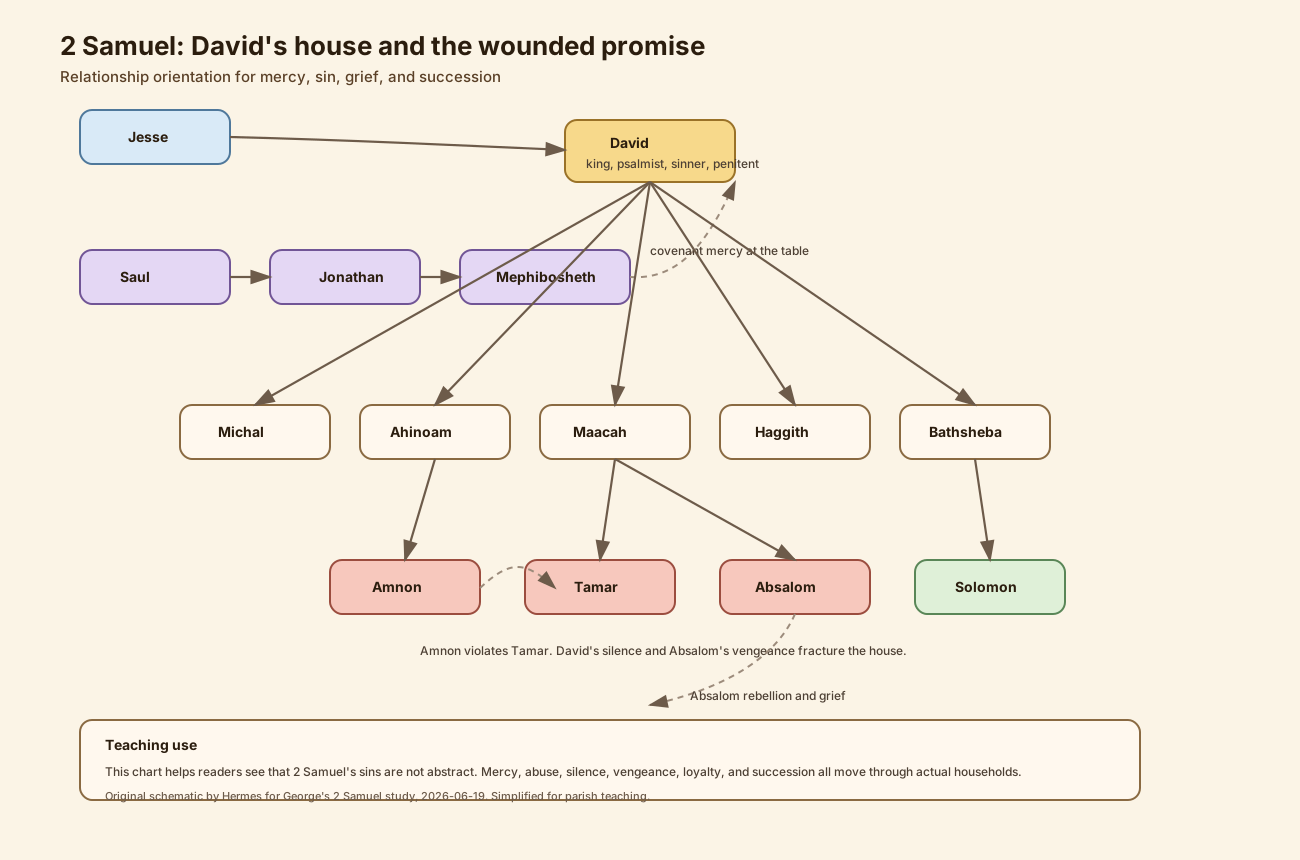 Source: Original schematic by Hermes for this 2 Samuel study guide, 2026-06-19.
Spiritual Fruit 🍇
1. Let strength become justice
The key line in chapter 8 is not the longest list of enemies. It is that David wrought judgment and justice. Any strength you possess, physical, financial, verbal, social, or institutional, is spiritually judged by whether it protects, orders, and serves.
2. Dedicate your gains to God
David dedicates silver and gold to the Lord. Christians may not return from battle with spoils, but we all gather advantages, earnings, influence, and opportunities. The question is the same: do these become private trophies, or offerings ordered toward God and neighbor?
3. Remember the forgotten for the sake of love already promised
Mephibosheth is not useful to David politically. Mercy toward him is covenantal, not strategic. That is a direct challenge to the calculating heart. Much of our kindness is selective because we prefer visible returns. Covenant mercy remembers the person who cannot repay.
4. Do not despise the shamed
David’s servants are dishonored, and David shelters them in Jericho until they can return. This is a tender pastoral image. Christians must learn how to cover shame without hiding truth, how to protect the humiliated without exploiting their vulnerability.
5. Suspicion can turn kindness into war
Hanun receives comfort as threat. Many relationships break this way. A heart ruled by fear or pride cannot recognize peace when it arrives. Before conflict widens, Christians must ask whether they are interpreting every approach through injury and self-protection.
6. Our warfare is no longer by the sword
These chapters belong to an Old Covenant kingdom. The Church reads them with honesty, but she does not imitate their military form as Christian duty. In Christ the real war is against sin, death, lies, hatred, and the passions. That is where courage is now demanded.
Summary Table
| Element in the text | Spiritual meaning | Fulfillment in Christ / the Church |
|---|---|---|
| David’s victories | Strength under God’s providence | Christ conquers the deepest enemies through Cross and Resurrection |
| Dedicated silver and gold | Gains ordered toward worship | Christ offers not trophies but Himself |
| “Judgment and justice” | The true measure of rule | Christ is the perfectly righteous King |
| Mephibosheth sought and seated | Mercy for the powerless, received for another’s sake | Sinners are received in the Beloved Son |
| Shamed servants sheltered in Jericho | Compassion for the dishonored | Christ covers and restores the wounded |
| Kindness rejected by Hanun | Suspicion turning peace into conflict | Christ’s peace is refused by fallen hearts, yet He remains the true Peacemaker |
Closing Meditation
These chapters do not ask whether David was strong. He plainly was. They ask what strength becomes when placed under God, and what happens when mercy is mistrusted. The deepest beauty here is not the map of victories, but the king’s table opened to the forgotten son. The deepest sorrow is that peace was offered and shame answered it. Christ fulfills both lessons. He is the King whose justice is merciful, and the Peace that men still reject.
Teacher's Notes
Timing breakdown
- Opening summary and context: 10 minutes
- Chapter 8, victories and justice: 18 minutes
- Chapter 9, Mephibosheth and covenant mercy: 20 minutes
- Chapter 10, rejected kindness and war: 18 minutes
- Spiritual fruit and discussion: 15 minutes
Where to linger
Linger over 8:15, “David wrought judgment and justice,” over the whole Mephibosheth scene, and over David’s care for the shamed servants in Jericho. Those moments keep the lesson from becoming a military summary.
Where to compress
Compress battle numbers, coalition details, and some place-name complexity if needed for time. Keep enough geography for meaning, but do not let the class drown in troop movements.
Pastoral warnings
- Do not use these chapters to justify Christian violence, state worship of power, or nationalist rhetoric.
- Do not romanticize the harshness of chapter 8. The text is hard and should remain hard.
- Do not patronize Mephibosheth. The point is covenant mercy and restored dignity, not sentimental pity.
- Do not canonize Joab because he speaks one noble line in chapter 10.
- Do not miss that chapter 10 becomes part of the larger atmosphere in which later royal sin appears. External success is not inner health.
Accuracy notes
- Brenton uses forms such as Memphibosthe, Annon, Adraazar, Suba, and Idumea.
- The Coptic Orthodox lectionary chapter index currently marks 2 Samuel 8 through 10 as not indexed.
- “Seeds of war” is an interpretive summary of the narrative dynamic, especially the rejection of mercy and the continuing Ammonite conflict, not a direct biblical phrase.
Visual / teaching aid
- Show: Use the map for chapter 8 and 10, then slow down over the house tree in chapter 9 so Mephibosheth is not lost inside the war material.
Discussion Questions
- Why does Scripture place the line about justice and righteousness at the center of chapter 8?
- What makes David’s mercy to Mephibosheth so spiritually powerful?
- In what ways do people today still misread kindness as hidden threat?
- How does David’s protection of the shamed servants in Jericho challenge the way we respond to public embarrassment or humiliation?
- What does it mean for Christians to read these war texts truthfully without turning them into a model for Christian action?
Glossary
- Covenant mercy: Faithful love shown because of a binding relationship or promise, not because the recipient has earned it.
- Mephibosheth / Memphibosthe: Jonathan’s son and Saul’s grandson, restored by David’s mercy.
- Lodabar: The place where Mephibosheth lives before being brought to the king.
- Judgment and justice: Royal righteousness in public rule, the moral criterion of kingship in chapter 8.
- Tribute: Goods or payments rendered by a subdued people or dependent ruler.
- Old Covenant kingdom context: The historical setting of Israel’s monarchy before the coming of Christ, which Christians read through fulfillment and transfiguration rather than direct political imitation.
Translation and Source Notes
This passage has no established place in the Coptic Orthodox lectionary.
Sources
Primary sources
- Scripture: 2 Samuel 8-10, Psalm 17 (NKJV 18), Psalm 100 (NKJV 101) for royal justice themes, Luke 14:12-24, Luke 1:32-33, Ephesians 2:12-19.
- St. Augustine, City of God, Book XVII, for Davidic kingship and its fulfillment in Christ.
- St. John Chrysostom, homiletic and moral teaching on mercy, humility, and the right use of authority, to be cited directly only where exact sources are verified.
- St. Maximus the Confessor and the ascetic tradition more broadly, for the interior transfiguration of battle imagery toward spiritual struggle.
Secondary academic sources
- Robert Alter, The David Story: A Translation with Commentary of 1 and 2 Samuel.
- Walter Brueggemann, First and Second Samuel.
- P. Kyle McCarter Jr., II Samuel.
- David T. Tsumura, The Second Book of Samuel.
Coptic Orthodox / pastoral sources
- Orthodox Study Bible notes on 2 Kingdoms / 2 Samuel.
- Fr. Tadros Y. Malaty, commentary on Samuel / Kingdoms where available and source-verified.
- Coptic Orthodox pastoral teaching on mercy, humility, and righteousness in leadership, especially where exact sermons or texts can be identified.
Web pages and non-academic sources cited
Coptic Orthodox lectionary reference checks did not verify exact chapter placement for this guide.
CCEL and New Advent as access points for public-domain patristic material where exact references can later be checked.