


These chapters are among the most painful in 2 Samuel because the sword that the prophet announced would not depart from David’s house now enters the family itself. Tamar is violated, Amnon is consumed by diseased desire and then by hatred, David is angry but inert, Absalom hides vengeance under silence, and Joab engineers a return that looks like mercy without requiring repentance. The result is not healing but a deeper fracture. The chapters force the Church to say plainly that hidden sin does not stay private, silence is not the same as wisdom, and reconciliation without truth can become another form of disorder.
The deepest Orthodox reading must not treat Tamar as a narrative device in the stories of men. She is a daughter of the king, a sufferer whose words are some of the clearest moral speech in the whole section. Christ does not stand with the manipulator, the abuser, or the manager of appearances. He identifies with the violated and silenced, judges what is hidden, and heals without lying about what happened.
2 Samuel 13-14 - Sin in the House and Absalom’s Return
Historical and Scriptural Context
Where in Scripture
These chapters follow David’s great fall in 2 Samuel 11 and Nathan’s rebuke in 2 Samuel 12, even though that rebuke is not repeated here. Nathan had already said that the sword would not depart from David’s house and that evil would rise against him from within his own household. Chapters 13 and 14 begin showing what that means in lived history. The royal house is not protected from consequence by rank, charisma, or past victories.
They also prepare the revolt that will dominate the next major movement of the book. Absalom’s rebellion does not appear out of nowhere. It grows out of unaddressed violence, paternal failure, bitterness, and the false peace that comes when a family stops telling the truth. If these chapters are rushed, Absalom’s later revolt can look merely political. Scripture wants us to see that it is also moral and spiritual rot inside the king’s own house.
Where in history
This is palace narrative in an ancient Near Eastern royal court, where succession anxieties, household honor, half-sibling rivalries, and access to the king all matter. The setting is royal, but the sins are painfully recognizable. Power protects the wicked when those around them fear exposure or disruption more than they love truth.
The chapters are also framed by legal and kinship realities from the Old Covenant world. Tamar appeals to what “ought not to be so done in Israel,” naming the act as covenant shame, not private misfortune. Yet the legal world that should protect her does not function cleanly here, because the house itself is compromised. That failure of justice becomes the breeding ground for revenge.
Geographical Significance ⛰️
The geography in these chapters is not as expansive as earlier military sections, but the places still matter.
- Jerusalem is the royal center, the city of David, and therefore the place where justice should have been strongest. Instead, the palace becomes a place of concealment, manipulation, and delayed judgment.
- Baal-hazor / Belasor near Ephraim is where Absalom stages the sheep-shearing feast and arranges Amnon’s murder. Festive space becomes execution space.
- Geshur / Gedsur is Absalom’s place of exile. It is both refuge and distance, a place where unresolved sin is neither healed nor forgotten.
- Tekoa / Thecoe lies in the Judean region south of Jerusalem. Joab draws a wise woman from there to speak a crafted parable into the king’s paralysis.
- The movement between Jerusalem, Geshur, and back again in chapter 14 shows a false restoration. Absalom returns geographically before any real moral reconciliation has taken place.
The spatial pattern matters spiritually. Sin hidden in the center spreads outward. Exile creates distance but not repentance. Return without truth only brings the fracture back into the city.
The Characters 👥
Tamar
Tamar, Brenton’s Themar, is Absalom’s full sister and Amnon’s half-sister. She is introduced as beautiful, but Scripture quickly shows something more important: she is lucid, morally clear, and courageous under threat. She names the act as folly in Israel, pleads for restraint, and later bears visible signs of grief and desolation. What is at stake for her is not only bodily violation but public shame, social vulnerability, and the collapse of trust within the king’s house.
Amnon
Amnon is David’s firstborn and therefore a figure of dynastic weight. His desire is not love but disordered craving fed by entitlement and deceit. After assaulting Tamar, he turns from appetite to disgust, proving that what he called love was possession. What is at stake for him is whether the king’s son will live under truth and restraint or under appetite that destroys both himself and others.
Absalom
Absalom is Tamar’s brother and one of the most dangerous figures in 2 Samuel because he combines real grievance with hidden vengeance, beauty with inward disorder, and patience with calculation. He sees Tamar’s suffering more clearly than David acts upon it, but he does not move toward truthful justice. He moves toward revenge and then toward self-assertion. What is at stake for him is whether brotherly loyalty will become healing protection or avenging ambition.
David
David is still the anointed king, but here he appears as a father whose anger does not become action. In Brenton’s text, the chapter adds that he did not grieve the spirit of Amnon because he loved him as firstborn. That detail matters. David’s affection becomes partiality, and partiality becomes paralysis. What is at stake for David is whether he will exercise righteous judgment inside his own house or let love become indulgence.
Jonadab
Jonadab is Amnon’s friend and cousin, described by Brenton as “a very cunning man.” He is one of the most revealing secondary characters in the book because he gives intelligence without wisdom. He understands how to game a situation, how to read weakness, and how to manipulate access to power. What is at stake in his role is the danger of clever counsel severed from fear of God.
Joab
Joab reenters as the royal fixer. He sees that David longs for Absalom and arranges the intervention of the woman of Tekoa. Joab is politically shrewd, often effective, and morally dangerous. He can solve a court problem without healing the underlying disorder. What is at stake for Joab is whether peace will be built on truth or on management.
The woman of Tekoa
The woman of Tekoa is wise in speech and bold in approach. She delivers Joab’s staged case well, and some of what she says is genuinely profound, especially about God not delighting in perpetual banishment. Yet she is part of a strategy. What is at stake in her role is the mixture of truth and manipulation. A correct sentence can still be used in service of an incomplete end.
🕯️ Light from the Word
1. Desire sickened into deceit, 2 Samuel 13:1-10
1 And it happened after this that Abessalom the son of David had a very beautiful sister, and her name was Themar; and Amnon the son of David loved her. 2 And Amnon was distressed even to sickness, because of Themar his sister; for she was a virgin, and it seemed very difficult for Amnon to do anything to her. 3 And Amnon had a friend, and his name was Jonadab, the son of Samaa the brother of David: and Jonadab was a very cunning man. 4 And he said to him, What ails thee that thou art thus weak, O son of the king, morning by morning? wilt thou not tell me? and Amnon said, I love Themar the sister of my brother Abessalom. 5 And Jonadab said to him, Lie upon thy bed, and make thyself sick, and thy father shall come in to see thee; and thou shalt say to him, Let, I pray thee, Themar my sister come, and feed me with morsels, and let her prepare food before my eyes, that I may see and eat at her hands. 6 So Amnon lay down, and made himself sick; and the king came in to see him: and Amnon said to the king, Let, I pray thee, my sister Themar come to me, and make a couple of cakes in my sight, and I will eat them at her hand.
7 And David sent to Themar to the house, saying, Go now to thy brother’s house, and dress him food. 8 And Themar went to the house of her brother Amnon, and he was lying down: and she took the dough and kneaded it, and made cakes in his sight, and baked the cakes. 9 And she took the frying-pan and poured them out before him, but he would not eat. And Amnon said, Send out every man from about me. And they removed every man from about him. 10 And Amnon said to Themar, Bring in the food into the closet, and I will eat of thy hand.
Literal sense
The narrative opens by naming beauty, desire, cunning, and access. Amnon’s craving becomes physical distress, but Scripture does not treat that distress sympathetically. It is a fever of inward disorder. Jonadab does not correct him. He teaches him how to lie, how to weaponize weakness, and how to draw Tamar into isolation through David’s own paternal trust.
This is one of the chapter’s first hard lessons. Sin rarely begins at the final act. It begins in fantasy, self-pity, rationalization, and the search for a method. By the time Tamar enters the room, the scheme is already built.
LXX and theological insight
Brenton says Amnon “loved” Tamar, but the story itself immediately strips the word bare. What appears at first as love becomes distress, stratagem, coercion, and finally hatred. The chapter therefore exposes false love as desire that cannot bear the freedom or dignity of the other person.
Jonadab is called “very cunning.” In Scripture, cunning intelligence is spiritually dangerous when it is detached from truth. The serpent is subtle. Ahithophel will later be subtle. Here the disease in Amnon is amplified by a counselor who treats another person’s destruction as a solvable problem.
Patristic voice
Orthodox ascetical tradition repeatedly warns that the passions do not stay small once they are entertained inwardly. St. John Chrysostom, in his wider moral teaching, is relentless about the way ungoverned desire first corrupts thought and then action. St. Basil speaks similarly about the need to cut off passion before it becomes embodied deed. The patristic point here is not prudery. It is realism. A heart that refuses watchfulness will soon call evil reasonable.
Christological and typological reading
This opening unit shows the opposite of Christ’s way. Christ sees persons, not objects. He does not manipulate weakness, stage scenes, or exploit trust. The false son of the king uses his place to create vulnerability in another. The true Son of the King empties Himself to protect the vulnerable.
The Church must therefore read this section with moral clarity. Christ identifies with Tamar long before He judges Amnon. He stands with the one drawn into danger by deceit, not with the one who turns desire into entitlement.
Lesson Guide
- Key phrases: “The violence begins before the room is emptied.” “Clever counsel without holiness becomes complicity.”
- Emphasize: Sin matures through inner permission, self-pity, and strategy before it erupts in visible action.
- Avoid: Do not speak of Amnon’s distress as if it excuses him. Do not romanticize this as tragic love.
2. Tamar’s righteous protest and Amnon’s assault, 2 Samuel 13:11-16
11 And she brought them to him to eat, and he caught hold of her, and said to her, Come, lie with me, my sister. 12 And she said to him, Nay, my brother, do not humble me, for it ought not to be so done in Israel; do not this folly. 13 And I, whither shall I remove my reproach? and thou shalt be as one of the fools in Israel. And now, speak, I pray thee, to the king, for surely he will not keep me from thee. 14 But Amnon would not hearken to her voice; and he prevailed against her, and humbled her, and lay with her.
15 Then Amnon hated her with very great hatred; for the hatred with which he hated her was greater than the love with which he had loved her, for the last wickedness was greater than the first: and Amnon said to her, Rise, and begone. 16 And Themar spoke to him concerning this great mischief, greater, said she, than the other that thou didst me, to send me away: but Amnon would not hearken to her voice.
Literal sense
Tamar speaks with startling clarity. She names the act as humiliation, folly, covenant disorder, and reproach. She pleads with moral intelligence while under threat. Amnon refuses her voice, overpowers her, and then turns immediately from appetite to hatred. After the assault, he adds a second cruelty by expelling her in disgrace.
Scripture does not blur responsibility. Amnon prevails against her. Tamar is not ambiguous here. She resists, pleads, argues, and is ignored. The text itself forbids victim-blaming.
LXX and theological insight
The recurring language of being “humbled” names a real violence and its shaming effect in the social world of the text. Tamar’s question, “whither shall I remove my reproach?” is not melodrama. It is the cry of a woman who sees that this act wounds her safety, standing, and future all at once.
Verse 15 is one of Scripture’s sharpest exposures of lust. The hatred becomes greater than the so-called love. This is what passion does when it is not love but consumption. Once it takes what it wants, it resents the person whose presence exposes what it has become.
Patristic voice
Orthodox ascetical tradition regularly distinguishes love from passion by whether it honors the image of God in the other person. Passion bends the other toward the self. Love bows the self toward the good of the other. St. Maximus, in his teaching on the passions, repeatedly shows that misuse of desire turns persons into objects of appetite. St. Ambrose’s reflections on David’s house also help here, because he reads the later sorrows of David as evidence that sin, once welcomed, breeds grief far beyond its first moment.
Christological and typological reading
Christ is never neutral in a passage like this. He is not present as a distant observer of a royal tragedy. He is present as the Judge of hidden sin and the Defender of the wounded. In the Gospels, He consistently hears the voices others ignore, receives the shamed without disgust, and restores dignity without pretending evil did not occur.
There is also a dark anti-typology here. The false son of David humiliates a daughter of the king inside the royal house. The true Son of David gathers the violated, the shamed, and the silenced into His own household and calls them daughters of faith, peace, and healing. He does not demand their silence to preserve appearances.
Lesson Guide
- Key phrases: “The text itself names the violence.” “Tamar is one of the clearest moral voices in the chapter.”
- Emphasize: This is sexual violence, not romance gone wrong, and Tamar’s resistance must be heard plainly.
- Avoid: Do not soften the assault with evasive language. Do not move too quickly away from Tamar toward the reactions of the men.
3. Desolation, silence, and the king’s paralysis, 2 Samuel 13:17-22
17 And he called his servant who had charge of the house, and said to him, Put now this woman out from me, and shut the door after her. 18 And she had on her a variegated robe, for so were the king’s daughters that were virgins attired in their apparel: and his servant led her forth, and shut the door after her.
19 And Themar took ashes, and put them on her head; and she rent the variegated garment that was upon her: and she laid her hands on her head, and went crying continually. 20 And Abessalom her brother said to her, Has thy brother Amnon been with thee? now then, my sister, be silent, for he is thy brother: be not careful to mention this matter. So Themar dwelt as a widow in the house of her brother Abessalom.
21 And king David heard of all these things, and was very angry; but he did not grieve the spirit of his son Amnon, because he loved him, for he was his first-born. 22 And Abessalom spoke not to Amnon, good or bad, because Abessalom hated Amnon, on account of his humbling his sister Themar.
Literal sense
Amnon does not simply end the assault. He pushes Tamar out and has the door shut behind her. The robe, a visible sign of royal daughterhood and protected virginity, becomes a torn sign of grief. Tamar’s public mourning shows that something real has been destroyed.
Absalom recognizes what happened immediately, but his first instruction is, “be silent.” David hears and is very angry, yet he does not discipline Amnon. Absalom then says nothing outwardly, but inwardly hatred hardens. The chapter shows three inadequate responses around Tamar: expulsion, silencing, and inaction.
LXX and theological insight
“Dwelt as a widow” is a devastating phrase. Tamar is not literally a widow, but Scripture uses widow-like desolation to show enduring social ruin and loneliness. The household does not restore her. It absorbs her suffering into its ongoing dysfunction.
Brenton’s fuller verse 21 matters. David’s love for Amnon as firstborn appears to block just action. This is not compassion. It is disordered affection. When fatherly love refuses truth, it becomes one more way evil is protected.
Patristic voice
Patristic teaching on anger often insists that anger is not righteous merely because it is intense. Anger that does not become truthful action often curdles into self-protective emotion. The desert tradition also knows how dangerous false peace can be. Silence can preserve prayer, but it can also preserve rot. That distinction is crucial here.
The chapter’s surrounding responses also illuminate pastoral care. One can say “be silent” in the name of prudence while actually protecting the household from shame rather than protecting the wounded person from further harm. The Church must not imitate that failure.
Christological and typological reading
The Lord Jesus receives the cry of those whose dignity has been torn in public. He does not tell the wounded to bear the whole burden so that the powerful may remain comfortable. The Cross itself exposes the logic of false peace, because the world’s order often requires one innocent sufferer to stay quiet for everyone else’s stability.
Christ breaks that order. In Him, hidden wounds are not made holy by silence alone. They are brought into truth, judgment, lament, and healing. He does not confuse protecting the sinner from scandal with protecting the sufferer from harm.
Lesson Guide
- Key phrases: “Anger without action is not justice.” “Silence can hide compassion, but it can also hide fear.”
- Emphasize: Tamar’s ongoing desolation matters. The damage is not over when the act is over.
- Avoid: Do not praise David’s anger as enough. Do not treat Absalom’s first silence as mature forgiveness.
4. Vengeance matures in silence, 2 Samuel 13:23-39
23 And it came to pass at the end of two whole years, that they were shearing sheep for Abessalom in Belasor near Ephraim: and Abessalom invited all the king’s sons. 24 And Abessalom came to the king, and said, Behold, thy servant has a sheep-shearing; let now the king and his servants go with thy servant. 25 And the king said to Abessalom, Nay, my son, let us not all go, and let us not be burdensome to thee. And he pressed him; but he would not go, but blessed him. 26 And Abessalom said to him, And if not, let, I pray thee, my brother Amnon go with us. And the king said to him, Why should he go with thee? 27 And Abessalom pressed him, and he sent with him Amnon and all the king’s sons; and Abessalom made a banquet like the banquet of the king.
28 And Abessalom charged his servants, saying, Mark when the heart of Amnon shall be merry with wine, and I shall say to you, Smite Amnon, and slay him: fear not; for is it not I that command you? Be courageous, and be valiant. 29 And the servants of Abessalom did to Amnon as Abessalom commanded them.
32 And Jonadab the son of Samaa brother of David, answered and said, Let not my lord the king say that he has slain all the young men the sons of the king, for Amnon only of them all is dead; for he was appointed to death by the mouth of Abessalom from the day that he humbled his sister Themar.
37 But Abessalom fled, and went to Tholmi son of Emiud king of Gedsur to the land of Chamaachad: and king David mourned for his son continually.
39 And king David ceased to go out after Abessalom, for he was comforted concerning Amnon, touching his death.
Literal sense
Two years pass. That detail matters. The household has lived with unhealed wrong for a long time. Absalom arranges a feast, secures David’s permission, and has Amnon killed while his heart is merry with wine. Jonadab, again, appears as the one who understands exactly what has happened. Absalom then flees to Geshur.
This is not justice. It is revenge ripened in silence. Yet Scripture is also honest about why it was able to ripen. David’s refusal to act left a moral vacuum that Absalom filled with blood.
LXX and theological insight
The sheep-shearing setting echoes other biblical scenes where festivity and abundance become occasions for moral testing. Absalom’s feast is not hospitality. It is staged retaliation.
Jonadab’s comment is chilling because he says Amnon “was appointed to death” from the day of Tamar’s humiliation. In one sense he simply names Absalom’s settled intention. In another, the sentence shows how a house without justice slowly trains everyone inside it to expect blood.
Patristic voice
The patristic tradition is uncompromising about vengeance. One person’s sin never gives another permission to become executioner of his own anger. At the same time, the Fathers are realistic that neglected injustice breeds further evil. Where there is no truth, the passions fill the gap. St. John Chrysostom’s preaching on wrath is useful here, because he repeatedly shows how brooded anger becomes more destructive the longer it is fed.
Christological and typological reading
Christ rejects both poles on display here. He does not protect Amnon’s violence under the name of family peace, and He does not sanctify Absalom’s revenge under the name of justice. The Cross reveals another way. Sin must be judged, but not by becoming another sinner in response.
This is where Christian teaching must be exact. Forgiveness is not pretending there is no evil. Justice is not private vengeance. Repentance is not image management. Reconciliation is not safe or true when there is no confession, no accountability, and no change. The Gospel judges all four confusions.
Lesson Guide
- Key phrases: “Delayed truth becomes a school for revenge.” “A moral vacuum invites blood.”
- Emphasize: Absalom’s grievance is real, but grievance alone does not sanctify revenge.
- Avoid: Do not frame Absalom as the true justice-bringer. Do not speak as if David’s failure makes murder righteous.
5. Joab’s parable and the woman of Tekoa, 2 Samuel 14:1-20
1 And Joab the son of Saruia knew that the heart of the king was toward Abessalom. 2 And Joab sent to Thecoe, and took thence a cunning woman, and said to her, Mourn, I pray thee, and put on mourning apparel…
6 And moreover thy handmaid had two sons, and they fought together in the field, and there was no one to part them; and the one smote the other his brother, and slew him. 7 And behold the whole family rose up against thine handmaid… so they will quench my coal that is left.
11 And she said, Let now the king remember concerning his Lord God in that the avenger of blood is multiplied to destroy, and let them not take away my son. And he said, As the Lord lives, not a hair of thy son shall fall to the ground.
13 And the woman said, Why hast thou devised this thing against the people of God?… so that the king should not bring back his banished? 14 For we shall surely die, and be as water poured upon the earth, which shall not be gathered up, and God shall take the life, even as he devises to thrust forth from him his outcast.
19 And the king said, Is not the hand of Joab in all this matter with thee?
Literal sense
Joab knows David’s heart longs toward Absalom, so he arranges a parable. The woman presents a widow’s case in which one son has killed the other and the surviving son is at risk. David speaks mercifully in judgment. She then turns his own ruling back onto him and asks why he will not bring back his banished son.
David eventually detects Joab’s hand, which means he understands that this is not a simple legal petition. It is a crafted intervention designed to move him emotionally and politically.
LXX and theological insight
The woman’s speech is powerful because it contains truth. Human life is brief. Outcasts should not remain perpetually banished if restoration is possible. Yet a truthful sentence can still be used to serve an incomplete solution. That is one of the central difficulties of chapter 14.
Verse 14 is especially beautiful and dangerous at once. Beautiful, because it gestures toward God’s merciful purpose toward the banished. Dangerous, because mercy is being invoked in a case where Absalom has not yet repented, confessed, or sought reconciliation in truth.
Patristic voice
Orthodox spiritual tradition honors mercy deeply, but they do not sever it from repentance and truth. St. Isaac the Syrian speaks magnificently about divine mercy, yet the whole ascetical tradition knows that mercy does not mean moral fog. A person is not healed by being simply repositioned. He is healed by truth, repentance, and grace.
The woman’s speech therefore has a double edge. It rightly exposes how sterile pure retribution can become. But it does not solve the deeper moral problem in Absalom’s heart.
Christological and typological reading
There is a real echo here of the Gospel, because God truly does seek the outcast. Christ came to seek and save the lost. He receives prodigals and eats with sinners. But the Gospel never turns return into mere relocation. The prodigal son returns saying, “I have sinned.” Zacchaeus returns with restitution. The thief returns by confession.
That is why chapter 14 must not be read cheaply. Joab secures return, but not conversion. Christ brings back the banished by opening the way of repentance and communion, not by engineering appearances.
Lesson Guide
- Key phrases: “A true sentence can still serve an incomplete end.” “Return is not the same as healing.”
- Emphasize: Mercy is real, but mercy severed from repentance becomes unstable.
- Avoid: Do not preach chapter 14 as if it simply celebrates unconditional restoration without moral truth.
6. Return without encounter, 2 Samuel 14:21-24
21 And the king said to Joab, Behold now, I have done to thee according to this thy word: go, bring back the young man Abessalom.
23 And Joab arose, and went to Gedsur, and brought Abessalom to Jerusalem. 24 And the king said, Let him return to his house, and not see my face. And Abessalom returned to his house, and saw not the king’s face.
Literal sense
David allows Absalom back into Jerusalem but bars him from personal presence. This is a partial restoration with no direct reconciliation. The king acts, but he does not truly address the wound. Absalom is neither fully outside nor truly received.
This halfway state is one of the most spiritually revealing moments in the narrative. The family problem is not solved. It is suspended.
LXX and theological insight
The tension of verse 24 is severe. Absalom is back in the holy city, but not before the king’s face. Presence is withheld, yet the problem is now inside the city again. Geography changes, but communion does not.
This helps explain why the chapter does not feel peaceful even when Absalom returns. There is no confession, no naming of Tamar’s wrong in this scene, no examination of Absalom’s murder, and no spoken truth between father and son.
Patristic voice
Orthodox spiritual tradition often insists that peace of appearance is not the same as peace of soul. One can stop a quarrel externally and still leave the passions enthroned within. This section is almost a narrative parable of that reality. The house is quieter. It is not healed.
Christological and typological reading
Christ does not restore communion by half-measures. When He forgives, He also illumines. When He receives, He also transforms. He does not merely move the banished closer. He opens the way into the Father’s house through truth and repentance.
This is pastorally vital. There are relationships in which pressure to “move on” or “come back” is placed on the wounded before truth has been told. These chapters warn against that. Not every return is safe. Not every kiss is reconciliation.
Lesson Guide
- Key phrases: “Absalom is returned, but not reconciled.” “Suspended conflict is not peace.”
- Emphasize: The chapter distinguishes physical return from restored communion.
- Avoid: Do not teach this as a model of wise family reconciliation. The narrative is exposing incompleteness.
7. Beauty, pressure, and the final kiss, 2 Samuel 14:25-33
25 And there was not a man in Israel so very comely as Abessalom: from the sole of his foot even to the crown of his head there was no blemish in him. 26 And when he polled his head… he weighed the hair of his head, two hundred shekels according to the royal shekel.
28 And Abessalom remained in Jerusalem two full years, and he saw not the king’s face. 29 And Abessalom sent to Joab to bring him in to the king, and he would not come to him… 30 And Abessalom said to his servants, Behold, Joab’s portion in the field is next to mine… go and set it on fire.
32 And Abessalom said to Joab… Why did I come out of Gedsur? it would have been better for me to have remained there: and now, behold, I have not seen the face of the king; but if there is iniquity in me, then put me to death.
33 And Joab went in to the king… and the king kissed Abessalom.
Literal sense
The chapter closes by emphasizing Absalom’s physical beauty, his cultivated public image, his frustration, and his willingness to use destruction to force access. When Joab will not come, Absalom burns his field. Eventually Absalom appears before David, bows, and receives the king’s kiss.
But the chapter does not give us repentance. It gives us attractiveness, pressure, impatience, and symbolic closure without evidence of inward change.
LXX and theological insight
Absalom’s beauty is narrated as part of his danger. Scripture often warns that external impressiveness can conceal interior ruin. The hair detail, later central to his downfall, already hints that what is displayed outwardly will matter too much.
His line, “if there is iniquity in me, then put me to death,” sounds bold, but it is not confession. It is challenge. He still does not speak openly about Tamar, Amnon, revenge, or his own heart. The kiss at the end therefore carries tension. It closes the scene, not the wound.
Patristic voice
Patristic moral teaching regularly warns about the seduction of appearances, whether beauty, eloquence, office, or charisma. A person may seem whole externally while inwardly governed by pride and wrath. The chapter’s final movement fits that warning exactly.
The tradition also teaches that reconciliation requires more than ceremonial gesture. Without metanoia, outward peace remains brittle. The kiss can be real affection, but affection by itself does not heal what truth has not touched.
Christological and typological reading
By the end of chapter 14, the royal house has produced a counterfeit peace. Christ’s peace is different. “Peace I leave with you” is not a cover over unresolved violence. It is the fruit of truth, repentance, and the Holy Spirit.
This final kiss therefore works as a warning. A household, a parish, or a family can perform reunion while carrying unconfessed grief underneath. Christ heals more deeply. He does not merely create the image of peace. He becomes our peace by slaying falsehood and reconciling us in truth.
Lesson Guide
- Key phrases: “Beauty is not holiness.” “A kiss can close a scene without healing a house.”
- Emphasize: External restoration without inward repentance remains fragile.
- Avoid: Do not end the lesson as if chapter 14 gives a happy resolution. It is a suspended peace before greater disaster.
The Church’s Voice in Worship
This passage has no established place in the Coptic Orthodox lectionary.
Still, these chapters resonate strongly with the Church’s worship in several ways. First, they belong near the Orthodox language of repentance and truth, especially around Psalm 50 (NKJV 51), where David’s own later repentance is prayed by the whole Church. Second, they warn against the false peace that Holy Week repeatedly unmasks: the outwardly ordered world can be full of hidden betrayal, violence, and calculation. Third, they sharpen pastoral hearing when the Church prays for mercy, justice, purity, and the healing of the brokenhearted. These chapters should be taught in the atmosphere of lament and repentance, not as raw intrigue.
Iconography Connection 🖼️
No major Orthodox iconographic cycle centers on Tamar and Amnon, and that absence itself should make the teacher cautious. These chapters should not be illustrated with sensationalized dramatic art or visualized in a way that exploits Tamar’s suffering.
The most useful iconographic connections are indirect and theological: David the Prophet and King, especially when the lesson needs to frame the collapse of the royal house; and above all Christ the true Son of David, whose holiness judges the corruption of earthly kingship and whose mercy receives the shamed without using them. If this lesson later becomes a slide deck, it is better to use restrained royal and Christological iconography than to depict the assault itself.
Visual reading aid
Use the Davidic house tree. Do not visualize Tamar’s assault. The chart is enough: it shows that sin in the royal house moves through real family relationships, and that silence, image-management, and “moving on” are not reconciliation.
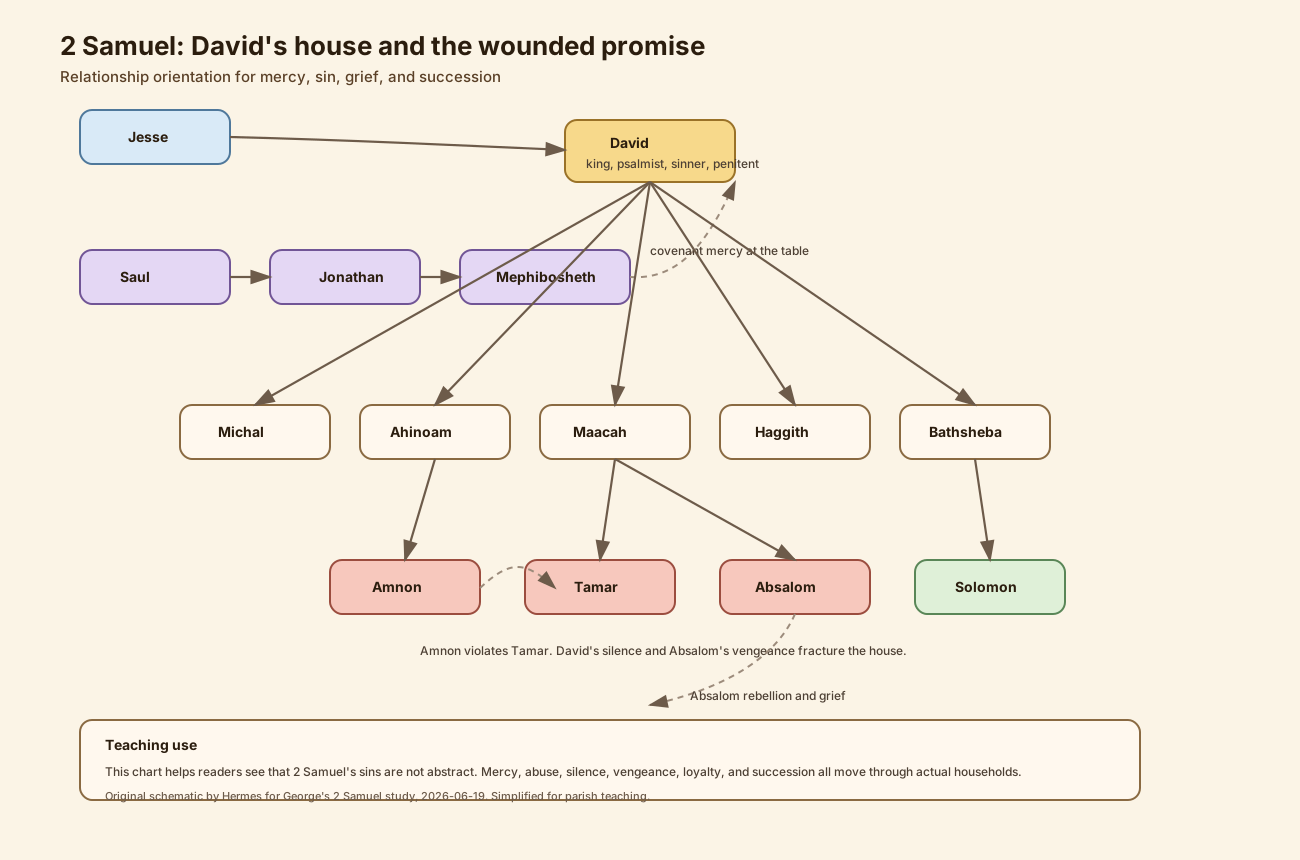 Source: Original schematic by Hermes for this 2 Samuel study guide, 2026-06-19.
Pastoral depth: silence is not peace
These chapters are spiritually dangerous if they are read only as royal-family tragedy. Tamar’s desolation must remain visible. David’s anger without action, Absalom’s vengeance without repentance, and Joab’s managed reunion all show forms of false peace. Christian reconciliation cannot mean erasing the wounded person, protecting the powerful, or rushing the story toward normalcy without truth.
Spiritual Fruit 🍇
1. Hidden sin does not stay hidden
Amnon’s inward desire becomes manipulation, violence, and then hatred. David’s earlier hidden sin had already begun corrupting the house. The spiritual life teaches this relentlessly: what we excuse inwardly will not remain inward. Thoughts become patterns, patterns become acts, and acts shape households.
2. The wounded person must not be erased by the larger family narrative
It is easy in these chapters to rush from Tamar to Absalom, from violation to revolt, from suffering to politics. The Church must resist that habit. Tamar is not a plot device. In every family, parish, or ministry there is a temptation to move quickly to damage control, strategy, or reputation. Christ instead teaches us to see the wounded person first.
3. Anger is not the same as justice
David is angry, but anger that never becomes righteous action leaves the vulnerable unprotected. Some people feel deeply and do nothing. Others do something, but only in the form of revenge. Neither is justice. Justice needs truth, protection, accountability, and courage.
4. Forgiveness, justice, repentance, and reconciliation are not interchangeable
These chapters are a needed correction for confused spiritual language. Forgiveness is the release of hatred before God. Justice is truthful accountability and protection of the vulnerable. Repentance is the sinner’s real turning. Reconciliation is renewed communion, and it cannot be demanded safely where truth and repentance are absent. Orthodox mercy is not moral confusion.
5. Silence can be holy, but it can also be fear dressed as prudence
Tamar is told to be silent. Absalom keeps silence while feeding revenge. David keeps a kind of silence through inaction. A Christian must learn to test silence. Is it prayerful restraint, or is it avoidance? Is it protecting peace, or preserving rot?
6. Christ heals without lying
Some people have learned to call denial mercy and forced reunion forgiveness. Christ does neither. He heals by bringing light into darkness. He identifies with the violated and shamed, judges hidden evil, and gives peace that does not depend on pretending nothing happened. That is the peace these chapters make us hunger for.
Summary Table
| Element in the text | Spiritual meaning | Fulfillment in Christ / the Church |
|---|---|---|
| Amnon’s false love | Passion masquerading as love | Christ loves without possession or coercion |
| Tamar’s protest | Truth spoken under violence | The Church must hear the wounded plainly and protect their dignity |
| David’s anger without action | Partiality and paralysis in authority | Christ judges righteously and protects the vulnerable |
| Absalom’s silent hatred | Revenge ripening under unresolved injustice | Christ rejects vengeance while still exposing evil |
| Joab’s managed return | Political restoration without inward healing | Christ restores through repentance and true communion |
| Absalom’s final kiss | Appearance of peace without transformation | Christ gives peace grounded in truth and the Holy Spirit |
Closing Meditation
The house of David is full of doors, chambers, feasts, fields, and kisses, yet almost every human action in these chapters is wounded by deceit or fear. Tamar cries aloud, and the house cannot bear to answer her truth. That is why we need a greater Son of David. Only Christ can enter the ruined house, name the sin, gather the wounded, judge the false peace, and make a dwelling place where truth and mercy finally meet.
Teacher's Notes
Timing breakdown
- Opening summary and context: 8 minutes
- Amnon, Jonadab, and the deception: 10 minutes
- Tamar’s protest and the assault: 12 minutes
- David’s silence and Absalom’s revenge: 12 minutes
- Joab, Tekoa, and the false restoration of Absalom: 12 minutes
- Spiritual fruit and discussion: 15 minutes
Where to linger
Linger over Tamar’s own words. They are morally and pastorally central. Also linger over the difference between David’s anger and actual justice, and over chapter 14’s false reconciliation. Those are the pressure points most likely to help adults read their own families, churches, and hearts truthfully.
Where to compress
Compress genealogical or dynastic side details, such as later connections in Absalom’s family line, unless the group asks. Compress speculative reconstructions about what legal options Tamar may have imagined in verse 13. The main force of the passage does not depend on solving every legal detail.
Pastoral warnings
- Speak plainly about sexual violence. Do not hide behind vague language.
- Do not blame Tamar, even subtly, by focusing on what she should have done differently. The text itself makes Amnon’s guilt explicit.
- Do not use “honor your family” language to pressure wounded people into silence.
- Do not present Absalom’s revenge as righteous justice.
- Do not present David’s final kiss in chapter 14 as proof that everything is now healed.
- Distinguish forgiveness from unsafe reconciliation. A person may forgive and still need protection, truth, distance, or formal accountability.
- If teaching this in a real group, assume someone present may have known sexual violence or coercive family silence. Teach with gravity, restraint, and care.
Accuracy notes
- Brenton uses Themar, Abessalom, Gedsur, and Thecoe, where many English readers expect Tamar, Absalom, Geshur, and Tekoa.
- Brenton 2 Samuel 13:21 includes a fuller line about David not grieving Amnon’s spirit because he loved him as firstborn. This is a meaningful textual detail and should not be flattened away.
- The Coptic Orthodox lectionary references currently does not index 2 Samuel 13 or 14 for exact reading placement.
Visual / teaching aid
- Show: Use the house tree to keep Tamar visible. Say clearly that silence, image-management, or simply bringing Absalom back is not the same as truth, justice, repentance, and reconciliation.
Discussion Questions
- What does Tamar see and say more clearly than the men around her?
- Why is David’s anger not enough, and what does that expose about authority?
- How do these chapters help us distinguish justice from revenge?
- Where do you see the danger of “managed peace” without truth in family, church, or inner life?
- What would it mean, in a genuinely Christian sense, to seek healing without denying what happened?
Glossary
- Brenton Septuagint: A public-domain English translation of the Greek Old Testament, often preserving names and phrasing different from modern English Bibles.
- Passion: In patristic language, a disordered movement of the soul that enslaves a person rather than serving love and truth.
- Metanoia: Repentance, not mere regret, but a real turning of mind, heart, and life back to God.
- Avenger of blood: An Old Testament kinship-justice role connected to the response to unlawful killing.
- Geshur / Gedsur: The place of Absalom’s exile before his managed return.
- Tekoa / Thecoe: The town from which Joab brings the wise woman who speaks to David.
- False reconciliation: An apparent restoration of relationship without truth, repentance, safety, or real healing.
Translation and Source Notes
Embedded Scripture is from Brenton’s English Septuagint, public domain. In the Septuagint tradition, 2 Samuel is Kings II / 2 Kingdoms. Standard English names are used in the lesson title and main discussion for readability, while Brenton spellings are preserved inside the Scripture quotations.
This passage has no established place in the Coptic Orthodox lectionary.
Sources
Primary sources
- Scripture: 2 Samuel 12-15; Psalm 50 (NKJV 51); Psalm 54 (NKJV 55); Luke 1:32-33; John 8:1-11; Mark 5:25-34; Matthew 18:21-35.
- St. Ambrose, Apology of the Prophet David, especially for David, sin, repentance, and consequence.
- St. Augustine, City of God, Book XVII, for Davidic kingship and its fulfillment in Christ.
- St. John Chrysostom, broader homiletic teaching on anger, lust, repentance, and the governance of the passions.
- St. Maximus the Confessor, ascetical teaching on the passions and the right ordering of desire.
Secondary academic sources
- Robert Alter, The David Story: A Translation with Commentary of 1 and 2 Samuel.
- Walter Brueggemann, First and Second Samuel.
- P. Kyle McCarter Jr., II Samuel.
- David T. Tsumura, The Second Book of Samuel.
- Stephen L. Cook, work on royal household politics and narrative theology in Samuel, where relevant.
Coptic Orthodox / pastoral sources
- Orthodox Study Bible notes on 2 Kingdoms / 2 Samuel.
- Fr. Tadros Y. Malaty, commentary on Samuel / Kingdoms where available and source-verified.
- Coptic Orthodox pastoral teaching on repentance, Psalm 50, and truth-telling before God.
- Modern Orthodox pastoral reflection on abuse, accountability, and the difference between forgiveness and enabling.
Web pages and non-academic sources cited
Coptic Orthodox lectionary reference checks did not verify exact chapter placement for this guide.
CCEL and New Advent as access points for public-domain patristic texts when exact references are checked in later revisions.