


David returns after Absalom’s death, but the kingdom is not healed simply because the rebellion has ended. Joab rebukes David’s paralyzing grief, Shimei begs for mercy, Mephibosheth appears with a tangled account, Barzillai serves without grasping, and Sheba’s revolt exposes the fracture still running through Israel.
The spiritual burden is that restoration is real, but it is not triumphal. Repentance may restore the person before God, yet consequences and broken trust still require humility, patience, repair, and truth.
2 Samuel 19-20 - David Returns to a Fractured Kingdom
Historical and Scriptural Context
Where in Scripture
Chapters 17-18 ended with Absalom’s death and David’s grief. Chapters 19-20 show the painful work of return. The king must face the people who saved him, receive former enemies, weigh ambiguous claims, and confront another rebellion.
Where in history
After civil war, return is rarely simple. Former rebels seek mercy. Loyal servants expect recognition. Tribes argue over who owns the king. Commanders settle scores. The text is realistic about restoration after public rupture.
Geographical Significance ⛰️
The Jordan crossing matters. David fled eastward; now he returns westward toward Jerusalem. The crossing signals restoration, but the river does not wash away all fracture. Gilgal, Bahurim, Abel, and Jerusalem become stages in the difficult movement from exile back toward order.
The Characters 👥
David
David is the returning king, chastened sinner, grieving father, and public servant. He must not use restoration as revenge.
Joab
Joab speaks a hard truth to David, but remains violent. He later murders Amasa as he murdered Abner.
Shimei
Shimei cursed David during the flight and now asks mercy. He tests whether return will become vengeance.
Mephibosheth
Mephibosheth’s appearance and claim complicate the earlier report from Ziba. The text leaves pain and ambiguity.
Barzillai
Barzillai is aged, generous, and free. He serves David without turning service into self-advancement.
Sheba and the wise woman of Abel
Sheba exploits tribal fracture. The wise woman of Abel interrupts destruction with courageous speech.
🕯️ Light from the Word
1. Grief must return to responsibility, 2 Samuel 19:1-15
1 And the king was troubled, and went to the chamber over the gate, and wept: and thus he said as he went, My son Abessalom, my son, my son Abessalom; would God I had died for thee, even I had died for thee, Abessalom, my son, my son!
2 And they brought Joab word, saying, Behold, the king weeps and mourns for Abessalom. 3 And the victory was turned that day into mourning to all the people, for the people heard say that day, The king grieves after his son. 4 And the people stole away that day to go into the city, as people steal away when they are ashamed as they flee in the battle. 5 And the king hid his face: and the king cried with a loud voice, My son Abessalom! Abessalom my son!
6 And Joab went in to the king, into the house, and said, Thou hast this day shamed the faces of all thy servants that have delivered thee this day, and have saved the lives of thy sons and of thy daughters, and the lives of thy wives, and of thy concubines, 7 forasmuch as thou lovest them that hate thee, and hatest them that love thee; and thou hast this day declared, that thy princes and thy servants are nothing in thy sight: for I know this day, that if Abessalom were alive, and all of us dead to-day, then it would have been right in thy sight. 8 And now arise, and go forth, and speak comfortably to thy servants; for I have sworn by the Lord, that unless thou wilt go forth to-day, there shall not a man remain with thee this night: and know for thyself, this thing will indeed be evil to thee beyond all the evil that has come upon thee from thy youth until now. 9 Then the king arose, and sat in the gate: and all the people reported, saying, Behold, the king sits in the gate. And all the people went in before the king to the gate; for Israel had fled every man to his tent.
10 And all the people disputed among all the tribes of Israel, saying, King David delivered us from all our enemies, and he rescued us from the hand of the Philistines: and now he has fled from the land, and from his kingdom, and from Abessalom. 11 And Abessalom, whom we anointed over us, is dead in battle: and now why are ye silent about bringing back the king? And the word of all Israel came to the king.
12 And king David sent to Sadoc and Abiathar the priests, saying, Speak to the elders of Israel, saying, Why are ye the last to bring back the king to his house? whereas the word of all Israel is come to the king to his house. 13 Ye are my brethren, ye are my bones and my flesh: why are ye the last to bring back the king to his house? 14 And ye shall say to Amessai, Art thou not my bone and my flesh? and now God do so to me, and more also, if thou shalt not be commander of the host before me continually in the room of Joab. 15 And he bowed the heart of all the men of Juda as that of one man; and they sent to the king, saying, Return thou, and all thy servants.
Literal sense
David’s grief over Absalom turns victory into mourning. Joab rebukes him, warning that he is shaming those who saved him. David returns to the gate, and Israel and Judah begin negotiating his restoration.
Spiritual insight
David’s grief is real, but it becomes dangerous when it paralyzes his duty to the living. Scripture does not despise grief. It shows that grief must be brought back into vocation.
Patristic voice
The ascetic tradition warns that even legitimate sorrow can become disordered if it turns the soul away from love. Sorrow must become prayer, not a throne.
Christological reading
Christ grieves without abandoning love. He weeps at Lazarus’s tomb and then calls him forth. He weeps over Jerusalem and still goes to the Cross. David must be called back to the gate; Christ goes willingly to the place where His people need Him.
Lesson Guide
- Key phrases: “Real grief can still need correction.” “The king must return to the gate.”
- Emphasize: Responsibility does not cancel grief, but it does call grief back into love.
- Avoid: Do not use this passage to rush people through sorrow.
2. Mercy and ambiguity at the return, 2 Samuel 19:16-30
16 And the king returned, and came as far as Jordan. And the men of Juda came to Galgala on their way to meet the king, to cause the king to pass over Jordan.
17 And Semei the son of Gera, the Benjamite, of Baurim, hasted and went down with the men of Juda to meet king David. 18 And a thousand men of Benjamin were with him, and Siba the servant of the house of Saul, and his fifteen sons with him, and his twenty servants with him: and they went directly down to Jordan before the king, 19 and they performed the service of bringing the king over; and there went over a ferry-boat to remove the household of the king, and to do that which was right in his eyes. And Semei the son of Gera fell on his face before the king, as he went over Jordan; 20 and said to the king, Let not my lord now impute iniquity, and remember not all the iniquity of thy servant in the day in which my lord went out from Jerusalem, so that the king should mind it. 21 For thy servant knows that I have sinned: and, behold, I am come to-day before all Israel and the house of Joseph, to go down and meet my lord the king.
22 And Abessai the son of Saruia answered and said, Shall not Semei therefore be put to death, because he cursed the Lord’s anointed? 23 And David said, What have I to do with you, ye sons of Saruia, that ye as it were lie in wait against me this day? to-day no man in Israel shall be put to death, for I know not if I this day reign over Israel. 24 And the king said to Semei, Thou shalt not die: and the king swore to him.
25 And Memphibosthe the son of Saul’s son went down to meet the king, and had not dressed his feet, nor pared his nails, nor shaved himself, neither had he washed his garments, from the day that the king departed, until the day when he arrived in peace.
26 And it came to pass when he went into Jerusalem to meet the king, that the king said to him, Why didst thou not go with me, Memphibosthe? 27 And Memphibosthe said to him, My lord, O king, my servant deceived me; for thy servant said to him, Saddle me the ass, and I will ride upon it, and go with the king; for thy servant is lame. 28 And he has dealt deceitfully with thy servant to my lord the king: but my lord the king is as an angel of God, and do thou that which is good in thine eyes. 29 For all the house of my father were but as dead men before my lord the king; yet thou hast set thy servant among them that eat at thy table: and what right have I any longer even to cry to the king?
30 And the king said to him, Why speakest thou any longer of thy matters? I have said, Thou and Siba shall divide the land.
Literal sense
Shimei begs for mercy. Abishai wants execution, but David refuses bloodshed on the day of return. Mephibosheth comes in mourning and claims Ziba deceived him. David divides the land, and Mephibosheth says David’s return is enough.
Spiritual insight
Restoration brings complicated cases. Shimei may be repentant, afraid, or both. Mephibosheth’s case remains tangled. David chooses restraint rather than making the day of return a day of revenge.
Patristic voice
Orthodox spiritual tradition praises mercy without making it denial. Mercy refuses vengeance, but it does not call evil good. David’s restraint is partial, political, and imperfect, yet it points toward a kingdom where judgment and mercy must meet.
Christological reading
The risen Christ greets fearful, failed disciples with peace, not revenge. His wounds remain visible. Christian restoration does not deny wounds; it brings peace through the wounded Lord.
Lesson Guide
- Key phrases: “The day of return must not become a day of revenge.” “Mercy is not amnesia.”
- Emphasize: Restoration often requires restraint where facts are tangled.
- Avoid: Do not use mercy language to pressure unsafe reconciliation.
3. Barzillai serves without grasping, and the tribes quarrel, 2 Samuel 19:31-43
31 And Memphibosthe said to the king, Yea, let him take all, since my lord the king has come in peace to his house.
32 And Berzelli the Galaadite came down from Rogellim, and crossed over Jordan with the king, that he might conduct the king over Jordan. 33 And Berzelli was a very old man, eighty years old; and he had maintained the king when he dwelt in Manaim; for he was a very great man. 34 And the king said to Berzelli, Thou shalt go over with me, and I will nourish thine old age with me in Jerusalem. 35 And Berzelli said to the king, How many are the days of the years of my life, that I should go up with the king to Jerusalem? 36 I am this day eighty years old: can I then distinguish between good and evil? Can thy servant taste any longer what I eat or drink? can I any longer hear the voice of singing men or singing women? and wherefore shall thy servant any longer be a burden to my lord the king? 37 Thy servant will go a little way over Jordan with the king: and why does the king return me this recompense? 38 Let, I pray thee, thy servant remain, and I will die in my city, by the tomb of my father and of my mother. And, behold, thy servant Chamaam shall go over with my lord the king; and do thou to him as it seems good in thine eyes. 39 And the king said, Let Chamaam go over with me, and I will do to him what is good in my sight; and whatsoever thou shalt choose at my hand, I will do for thee.
40 And all the people went over Jordan, and the king went over; and the king kissed Berzelli, and blessed him; and he returned to his place. 41 And the king went over to Galgala, and Chamaam went over with him: and all the men of Juda went over with the king, and also half the people of Israel.
42 And behold, all the men of Israel came to the king, and said to the king, Why have our brethren the men of Juda stolen thee away, and caused the king and all his house to pass over Jordan, and all the men of David with him? 43 And all the men of Juda answered the men of Israel, and said, Because the king is near of kin to us: and why were you thus angry concerning this matter? have we indeed eaten of the king’s food? or has he given us a gift, or has he sent us a portion?
Literal sense
Barzillai escorts David and declines the reward of palace life because of his age. He asks blessing for another instead. Immediately after this humble service, Israel and Judah quarrel over their claim to David.
Spiritual insight
Barzillai is one of the cleanest figures in these chapters. He gives when David is weak and does not use loyalty to purchase status. The tribes do the opposite: loyalty becomes competition.
Patristic voice
Detachment in the Fathers is not coldness. It is freedom from possessiveness. Barzillai loves, gives, blesses, and steps back.
Christological reading
Christ teaches His disciples not to compete for nearness as domination. The King belongs to the whole people. In the Church, service near Christ must not become ownership of Christ.
Lesson Guide
- Key phrases: “Barzillai serves without grasping.” “Even restoration can become competition.”
- Emphasize: Mature service can step back without bitterness.
- Avoid: Do not treat the tribal quarrel as merely petty; it reveals a fracture that will later deepen.
4. Sheba’s revolt and Joab’s repeated violence, 2 Samuel 20:1-13
1 And there was a transgressor so called there, and his name was Sabee, a Benjamite, the son of Bochori: and he blew the trumpet, and said, We have no portion in David, neither have we any inheritance in the son of Jessæ: to thy tents, O Israel, every one. 2 And all the men of Israel went up from following David after Sabee the son of Bochori: but the men of Juda adhered to their king, from Jordan even to Jerusalem.
3 And David went into his house at Jerusalem: and the king took the ten women his concubines, whom he had left to keep the house, and he put them in a place of custody, and maintained them, and went not in to them; and they were kept living as widows, till the day of their death.
4 And the king said to Amessai, Call to me the men of Juda for three days, and do thou be present here. 5 And Amessai went to call Juda, and delayed beyond the time which David appointed him. 6 And David said to Amessai, Now shall Sabee the son of Bochori do us more harm than Abessalom: now then take thou with thee the servants of thy lord, and follow after him, lest he find for himself strong cities, so will he blind our eyes. 7 And there went out after him Amessai and the men of Joab, and the Cherethites, and the Phelethites, and all the mighty men: and they went out from Jerusalem to pursue after Sabee the son of Bochori.
8 And they were by the great stone that is in Gabaon: and Amessai went in before them: and Joab had upon him a military cloak over his apparel, and over it he was girded with a dagger fastened upon his loins in its scabbard: and the dagger came out, it even came out and fell.
9 And Joab said to Amessai, Art thou in health, my brother? and the right hand of Joab took hold of the beard of Amessai to kiss him. 10 And Amessai observed not the dagger that was in the hand of Joab: and Joab smote him with it on the loins, and his bowels were shed out upon the ground, and he did not repeat the blow, and he died: and Joab and Abessai his brother pursued after Sabee the son of Bochori. 11 And there stood over him one of the servants of Joab, and said, Who is he that is for Joab, and who is on the side of David following Joab? 12 And Amessai was weltering in blood in the midst of the way. And a man saw that all the people stood still; and he removed Amessai out of the path into a field, and he cast a garment upon him, because he saw every one that came to him standing still. 13 And when he was quickly removed from the road, every man of Israel passed after Joab to pursue after Sabee the son of Bochori.
Literal sense
Sheba calls Israel away from David. David confines the concubines violated during Absalom’s revolt, a tragic reminder of unresolved harm. Amasa delays, and Joab murders him while pretending to greet him.
Hard-text reading
The concubines should not disappear inside political analysis. They were used as public instruments of rebellion and then confined. The text records their suffering without giving a neat repair. A Christian teacher should name the wound.
Joab’s murder of Amasa repeats the pattern seen with Abner. Joab is useful, but not healed. The kingdom survives with him, but it is not made whole by him.
Patristic voice
Unhealed passions repeat. Anger and control do not vanish because circumstances change. Joab shows that usefulness in public work can coexist with deep interior corruption.
Christological reading
Christ does not build His Kingdom by Joab’s kiss and knife. He receives Judas’s kiss without retaliation and founds the Church through His own pierced side.
Lesson Guide
- Key phrases: “The kingdom survives with Joab, but it is not healed by Joab.” “A kiss can hide a knife.”
- Emphasize: Repeated patterns need repentance, not excuses based on usefulness.
- Avoid: Do not gloss over the concubines’ suffering.
5. A wise voice from the wall saves a city, 2 Samuel 20:14-26
14 And he went through all the tribes of Israel to Abel, and to Bethmacha; and all in Charri too were assembled, and followed after him. 15 And they came and besieged him in Abel and Phermacha: and they raised a mound against the city and it stood close to the wall; and all the people with Joab proposed to throw down the wall. 16 And a wise woman cried from the wall, and said, Hear, hear; say, I pray ye, to Joab, Draw near hither, and I will speak to him.
17 And he drew nigh to her, and the woman said to him, Art thou Joab? and he said, I am. And she said to him, Hear the words of thy handmaid; and Joab said, I do hear. 18 And she spoke, saying, Of old time they said thus, Surely one was asked in Abel, and Dan, whether the faithful in Israel failed in what they purposed; they will surely ask in Abel, even in like manner, whether they have failed. 19 I am a peaceable one of the strong ones in Israel; but thou seekest to destroy a city and a mother-city in Israel: why dost thou seek to ruin the inheritance of the Lord? 20 And Joab answered and said, Far be it, far be it from me, that I should ruin or destroy. 21 Is not the case thus, that a man of mount Ephraim, Sabee son of Bochori by name, has even lifted up his hand against king David? Give him only to me, and I will depart from the city. And the woman said to Joab, Behold, his head shall be thrown to thee over the wall.
22 And the woman went in to all the people, and she spoke to all the city in her wisdom; and they took off the head of Sabee the son of Bochori; and took it away and threw it to Joab: and he blew the trumpet, and the people separated from the city away from him, every man to his tent: and Joab returned to Jerusalem to the king.
23 And Joab was over all the forces of Israel: and Banaias the son of Jodae was over the Cherethites and over the Phelethites. 24 And Adoniram was over the tribute: and Josaphath the son of Achiluth was recorder. 25 And Susa was scribe: and Sadoc and Abiathar were priests. 26 Moreover Iras the son of Iarin was priest to David.
Literal sense
Sheba hides in Abel. Joab besieges the city. A wise woman calls from the wall and asks why Joab would destroy a mother city in Israel. She negotiates, the city is spared, and Sheba dies.
Spiritual insight
The wise woman is courageous and practical. She does not avoid conflict. She interrupts destruction with a clear question. In a book full of male violence, her wisdom preserves life.
Patristic voice
Christian peace-making is not passivity. Orthodox spiritual tradition praises peace as a fruit of purity and courage. Sometimes peace requires a word spoken before the wall falls.
Christological reading
Christ blesses the peacemakers because they bear the family likeness of God. The wise woman of Abel shows peace-making as truthful intervention, not sentimental avoidance.
Lesson Guide
- Key phrases: “A wise voice from the wall saves a city.” “Peace-making is courageous speech.”
- Emphasize: Wisdom can interrupt destruction when power is moving too fast.
- Avoid: Do not romanticize Sheba’s execution. Keep the focus on the tragic cost of revolt and the preservation of the city.
The Church’s Voice in Worship
This passage has no established place in the Coptic Orthodox lectionary.
The themes resonate with Orthodox prayers for peace, mercy, reconciliation, good governance, and deliverance from division. David’s return is a public picture of what the soul also needs: return, truth, restraint, repentance, and healing.
Iconography Connection 🖼️
The strongest iconographic contrast is David the King and Prophet with Christ Pantocrator, the true King whose judgment and mercy are perfectly united. David returns with partial mercy and incomplete repair. Christ reigns with truth that heals fully.
Visual reading aid
Use the court/conflict network. It helps readers see that restoration after Absalom is not simple victory. Joab, Amasa, Shimei, Ziba, Mephibosheth, Barzillai, Judah, Israel, and Sheba all reveal unresolved fracture.
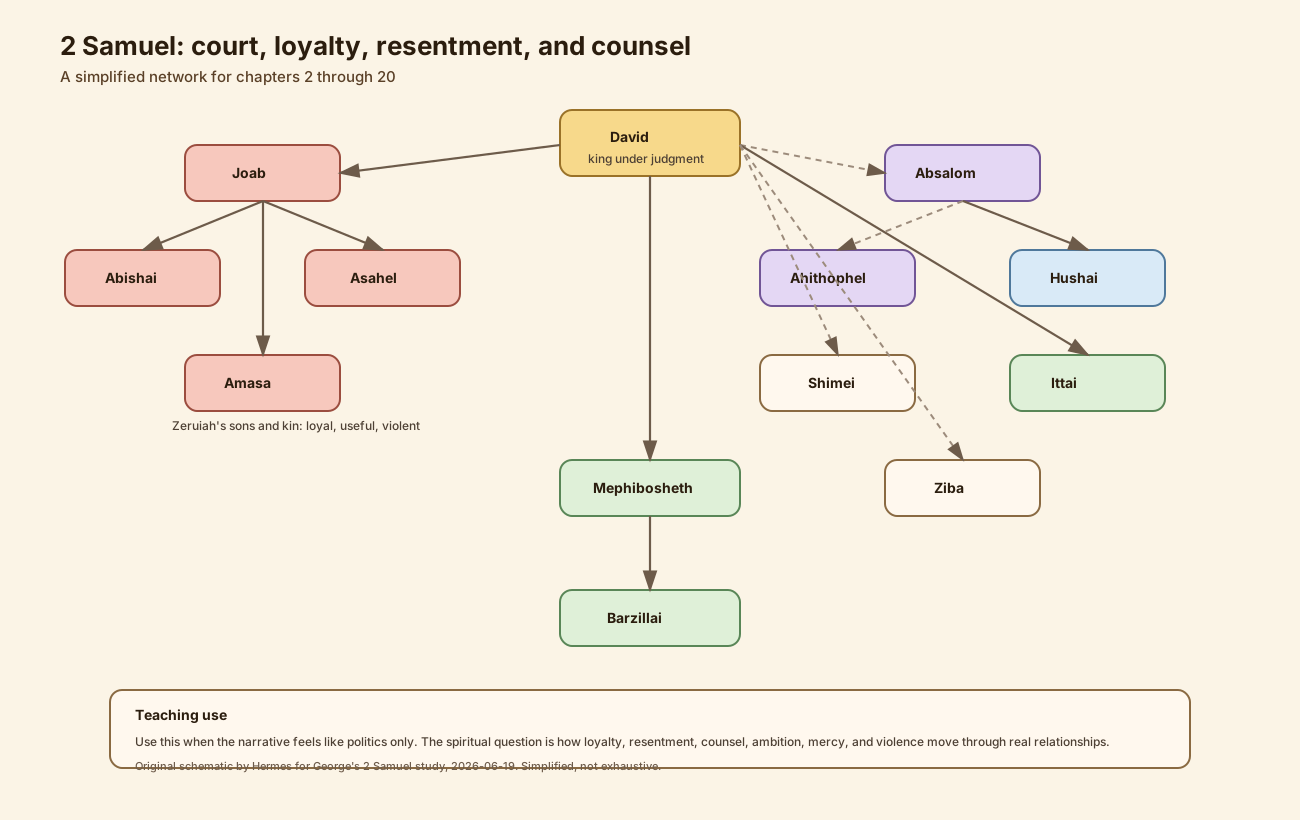 Source: Original schematic by Hermes for this 2 Samuel study guide, 2026-06-19.
Spiritual Fruit 🍇
1. Let grief return to love
Sorrow needs prayer and time, but it must not become abandonment of the living.
2. Do not use restoration as revenge
When God restores you, do not spend the first day settling scores.
3. Serve like Barzillai
Give without needing visibility. Step back without bitterness.
4. Name repeated patterns
Joab repeats violence. Repeated sin needs confession, counsel, and real repentance.
5. Become a wise voice from the wall
In family, church, and work conflicts, ask whether God is calling you to speak a word that saves rather than escalates.
Teacher's Notes
Suggested timing
- Opening and context: 7 minutes
- David’s grief and Joab’s rebuke: 10 minutes
- Shimei and Mephibosheth: 12 minutes
- Barzillai and tribal fracture: 10 minutes
- Sheba, Joab, and the wise woman: 15 minutes
- Spiritual fruit: 10 minutes
Where to linger
Linger over Barzillai and the wise woman of Abel. They give the lesson positive models after many chapters of violence.
Where to compress
Compress administrative details at the end of chapter 20. Explain that the kingdom continues, but the wounds remain.
Key phrases to say slowly
- “Restoration is real, but it is not triumphal.”
- “Mercy is not amnesia.”
- “A wise voice from the wall saves a city.”
Pastoral warnings
Do not use mercy toward Shimei to pressure unsafe reconciliation. Distinguish mercy, justice, safety, and repentance. Do not rush grief in the name of responsibility.
Accuracy notes
Mephibosheth and Ziba’s case remains ambiguous. Teach the ambiguity honestly. This guide does not claim exact Coptic reading placement because the available lectionary references do not support one.
Visual / teaching aid
- Show: Use the court/conflict network to keep the return from becoming only politics. Emphasize restoration after fracture, mercy with order, and the danger of unresolved resentment.
Glossary
- Shimei: Man from Saul’s house who cursed David and later begged mercy.
- Mephibosheth: Jonathan’s son, recipient of David’s kindness, caught in conflict with Ziba.
- Barzillai: Elderly benefactor who helped David and refused self-advancement.
- Sheba: Rebel who exploits tribal fracture after David’s return.
- Amasa: Commander murdered by Joab.
- Abel: City saved by the wise woman’s intervention.
- Restoration: Return after rupture, requiring truth, mercy, and repair.
Translation and Source Notes
Embedded Old Testament Scripture uses Brenton’s English Septuagint. In the Septuagint tradition, 2 Samuel corresponds to Kings II / 2 Kingdoms. The guide avoids invented direct patristic quotations and uses cautious paraphrase unless exact wording and source location are verified.
Sources
Primary sources
- Scripture: 2 Samuel 19-20; Matthew 5:9; Luke 24:36-43; John 20:19-29; Psalm 50 (NKJV 51).
- Brenton, Lancelot C. L., trans. The Septuagint Version of the Old Testament with an English Translation.
- St. John Cassian, Conferences, on discernment and passions.
- St. Augustine, The City of God, on disordered love and civic fracture.
Secondary academic sources
- Robert Alter, The David Story: A Translation with Commentary of 1 and 2 Samuel.
- P. Kyle McCarter Jr., II Samuel, Anchor Bible.
- John Goldingay, 1 and 2 Samuel for Everyone.
Coptic Orthodox / pastoral sources
- The Orthodox Study Bible, notes on Kingdoms / Samuel.
- Fr. Tadros Y. Malaty, pastoral commentary material on Samuel/Kings where available.
Web pages and non-academic sources cited
- CCEL and New Advent for public-domain patristic access.