


These chapters show God’s providence working through counsel, delay, hidden loyalty, battle, and grief. Ahithophel gives strong political counsel, Hushai defeats it by appealing to Absalom’s vanity, messengers escape through quiet courage, and David is preserved. Yet the preservation comes through civil war, and victory becomes mourning when Absalom dies.
The spiritual burden is severe: God may rescue us while still letting us feel the consequences of our sins. David survives the revolt, but he does not survive it untouched. The father who sinned against his own house now grieves over the son who rebelled against him.
2 Samuel 17-18 - Counsel, Battle, and Absalom’s Death
Historical and Scriptural Context
Where in Scripture
2 Samuel 15-16 showed Absalom stealing hearts and David leaving Jerusalem in humiliation. Chapters 17-18 bring the rebellion to its decisive moment: counsel is chosen, David’s friends act quickly, and the battle ends with Absalom dead.
Where in history
In the ancient royal world, counsel could decide whether a rebellion succeeded in one night or collapsed through delay. The narrator is explicit that God overrules the process: the Lord defeats Ahithophel’s counsel so Absalom may fall. This is not clean politics. It is providence working amid treachery, vanity, loyalty, and grief.
Geographical Significance ⛰️
David remains beyond the Jordan, in a vulnerable exile-like position. The battle in the wood of Ephraim matters because the terrain itself becomes part of judgment. Absalom, known for visible beauty and hair, is caught in a tree and suspended helplessly. The place preaches: public glory cannot save a rebellious soul.
The Characters 👥
David
David is king, father, fugitive, commander, and mourner. He wants the kingdom preserved, yet commands mercy toward Absalom.
Absalom
Absalom is charismatic and wounded, but also guilty. His rebellion grows from a damaged house, yet it remains his responsibility.
Ahithophel
Ahithophel is the brilliant counselor whose rejected advice leads him to despair. His betrayal-like role may resonate typologically with Judas, but this guide does not claim a specific Coptic liturgical placement.
Hushai
Hushai is David’s friend inside Absalom’s court. His counsel becomes an instrument of divine providence.
Joab
Joab wins the battle but disobeys David’s command and kills Absalom. He is useful to the throne and dangerous to the soul of the kingdom.
🕯️ Light from the Word
1. Counsel is weighed, and Providence overrules strategy, 2 Samuel 17:1-14
1 And Achitophel said to Abessalom, Let me now choose out for myself twelve thousand men, and I will arise and follow after David this night: 2 and I will come upon him when he is weary and weak-handed, and I will strike him with terror; and all the people with him shall flee, and I will smite the king only of all. 3 And I will bring back all the people to thee, as a bride returns to her husband: only thou seekest the life of one man, and all the people shall have peace. 4 And the saying was right in the eyes of Abessalom, and in the eyes of all the elders of Israel.
5 And Abessalom said, Call now also Chusi the Arachite, and let us hear what is in his mouth, even in his also. 6 And Chusi went in to Abessalom, and Abessalom spoke to him, saying, After this manner spoke Achitophel: shall we do according to his word? but if not, do thou speak.
7 And Chusi said to Abessalom, This counsel which Achitophel has counselled this one time is not good. 8 And Chusi said, Thou knowest thy father and his men, that they are very mighty, and bitter in their spirit, as a bereaved bear in the field, [and as a wild boar in the plain]: and thy father is a man of war, and will not give the people rest. 9 For, behold, he is now hidden in one of the hills or in some other place: and it shall come to pass when he falls upon them at the beginning, that some one will certainly hear, and say, There has been a slaughter among the people that follow after Abessalom. 10 Then even he that is strong, whose heart is as the heart of a lion, it shall utterly melt: for all Israel knows that thy father is mighty, and they that are with him are mighty men. 11 For thus I have surely given counsel, that all Israel be generally gathered to thee from Dan even to Bersabee, as the sand that is upon the sea-shore for multitude: and that thy presence go in the midst of them. 12 And we will come upon him in one of the places where we shall find him, and we will encamp against him, as the dew falls upon the earth; and we will not leave of him and of his men so much as one. 13 And if he shall have taken refuge with his army in a city, then shall all Israel take ropes to that city, and we will draw it even into the river, that there may not be left there even a stone.
14 And Abessalom, and all the men of Israel said, The counsel of Chusi the Arachite is better than the counsel of Achitophel. For the Lord ordained to disconcert the good counsel of Achitophel, that the Lord might bring all evil upon Abessalom.
Literal sense
Ahithophel advises immediate pursuit while David is weary. It is tactically strong. Hushai counters with a slower, grander plan that flatters Absalom and gives David time. The text tells us why Hushai’s counsel wins: the Lord had ordained to defeat Ahithophel’s good counsel.
LXX and theological insight
The counsel is “good” in the sense of strategy, not righteousness. Scripture lets us feel that distinction. A plan can be intelligent, timely, and effective, yet still serve rebellion.
Patristic voice
Orthodox ascetical tradition consistently warns that intelligence must be purified by humility. In the ascetic tradition, thoughts are tested not by how persuasive they feel, but by whether they lead toward obedience, truth, repentance, and love.
Christological reading
Christ stands before councils that believe they are managing history. At the Cross, God reveals that wicked counsel cannot overthrow divine love. Here David is preserved when counsel is overturned. In Christ, salvation comes when human counsel condemns the innocent One and God turns death into victory.
Lesson Guide
- Key phrases: “Effective counsel is not the same as righteous counsel.” “God can defeat a brilliant plan without raising His voice.”
- Emphasize: Providence humbles human control without removing human responsibility.
- Avoid: Do not make this anti-intellectual. The issue is intelligence detached from obedience.
2. Hidden loyalty preserves the king, 2 Samuel 17:15-29
15 And Chusi the Arachite said to Sadoc and Abiathar the priests, Thus and thus Achitophel counselled Abessalom and the elders of Israel; and thus and thus have I counselled. 16 And now send quickly and report to David, saying, Lodge not this night in Araboth of the wilderness: even go and make haste, lest one swallow up the king, and all the people with him.
17 And Jonathan and Achimaas stood by the well of Rogel, and a maid-servant went and reported to them, and they go and tell king David; for they might not be seen to enter into the city. 18 But a young man saw them and told Abessalom: and the two went quickly, and entered into the house of a man in Baurim; and he had a well in his court, and they went down into it. 19 And a woman took a covering, and spread it over the mouth of the well, and spread out ground corn upon it to dry, and the thing was not known. 20 And the servants of Abessalom came to the woman into the house, and said, Where are Achimaas and Jonathan? and the woman said to them, They are gone a little way beyond the water. And they sought and found them not, and returned to Jerusalem. 21 And it came to pass after they were gone, that they came up out of the pit, and went on their way; and reported to king David, and said to David, Arise ye and go quickly over the water, for thus has Achitophel counselled concerning you.
22 And David rose up and all the people with him, and they passed over Jordan till the morning light; there was not one missing who did not pass over Jordan.
23 And Achitophel saw that his counsel was not followed, and he saddled his ass, and rose and departed to his house into his city; and he gave orders to his household, and hanged himself, and died, and was buried in the sepulchre of his father.
24 And David passed over to Manaim: and Abessalom crossed over Jordan, he and all the men of Israel with him. 25 And Abessalom appointed Amessai in the room of Joab over the host. And Amessai was the son of a man whose name was Jether of Jezrael: he went in to Abigaia the daughter of Naas, the sister of Saruia the mother of Joab. 26 And all Israel and Abessalom encamped in the land of Galaad.
27 And it came to pass when David came to Manaim, that Uesbi the son of Naas of Rabbath of the sons of Ammon, and Machir son of Amiel of Lodabar, and Berzelli the Galaadite of Rogellim, 28 brought ten embroidered beds, (with double coverings,) and ten caldrons, and earthenware, and wheat, and barley, and flour, and meal, and beans, and pulse, 29 and honey, and butter, and sheep, and cheeses of kine: and they brought them to David and to his people with him to eat; for one said, The people is faint and hungry and thirsty in the wilderness.
Literal sense
Hushai warns the priests. The priests send messengers. A woman hides them in a well. David crosses safely. Ahithophel sees his counsel rejected, sets his house in order, and dies by his own hand. Friends bring David food and supplies.
Spiritual insight
The kingdom is preserved through hidden faithfulness. Not every saving act looks dramatic. A woman at a well, a messenger on the road, a friend bringing food to the weary: these are not secondary in God’s providence.
Ahithophel’s death must be handled soberly. The text gives no room for contempt. Despair is a terrible darkness, and the Church answers such darkness with mercy, prayer, and urgent care.
Patristic voice
The desert fathers warn that despair can follow wounded pride. When a person’s identity rests on being right, rejection can feel like annihilation. Repentance requires the humility to live after humiliation.
Christological reading
Christ’s Kingdom is carried by hidden servants: those who shelter, feed, warn, intercede, and remain faithful when public power shifts. The Lord sees hidden loyalty.
Lesson Guide
- Key phrases: “The kingdom is preserved by hidden faithfulness.” “Repentance requires the humility to live after humiliation.”
- Emphasize: Small acts of loyalty can become instruments of Providence.
- Avoid: Do not speak lightly of despair or suicide.
3. Absalom is caught in the tree, 2 Samuel 18:1-18
1 And David numbered the people with him, and set over them captains of thousands and captains of hundreds. 2 And David sent away the people, the third part under the hand of Joab, and the third part under the hand of Abessa the son of Saruia, the brother of Joab, and the third part under the hand of Ethi the Gittite. And David said to the people, I also will surely go out with you. 3 And they said, Thou shalt not go out: for if we should indeed flee, they will not care for us; and if half of us should die, they will not mind us; for thou art as ten thousand of us: and now it is well that thou shalt be to us an aid to help us in the city. 4 And the king said to them, Whatsoever shall seem good in your eyes I will do. And the king stood by the side of the gate, and all the people went out by hundreds and by thousands.
5 And the king commanded Joab and Abessa and Ethi, saying, Spare for my sake the young man Abessalom. And all the people heard the king charging all the commanders concerning Abessalom.
6 And all the people went out into the wood against Israel; and the battle was in the wood of Ephraim. 7 And the people of Israel fell down there before the servants of David, and there was a great slaughter in that day, even twenty thousand men. 8 And the battle there was scattered over the face of all the land: and the wood consumed more of the people than the sword consumed among the people in that day. 9 And Abessalom went to meet the servants of David: and Abessalom was mounted on his mule, and the mule came under the thick boughs of a great oak; and his head was entangled in the oak, and he was suspended between heaven and earth; and the mule passed on from under him.
10 And a man saw it, and reported to Joab, and said, Behold, I saw Abessalom hanging in an oak. 11 And Joab said to the man who reported it to him, And, behold, thou didst see him: why didst thou not smite him there to the ground? and I would have given thee ten pieces of silver, and a girdle. 12 And the man said to Joab, Were I even to receive a thousand shekels of silver, I would not lift my hand against the king’s son; for in our ears the king charged thee and Abessa and Ethi, saying, Take care of the young man Abessalom for me, 13 so as to do no harm to his life: and nothing of the matter will be concealed from the king, and thou wilt set thyself against me. 14 And Joab said, I will begin this; I will not thus remain with thee. And Joab took three darts in his hand, and thrust them into the heart of Abessalom, while he was yet alive in the heart of the oak. 15 And ten young men that bore Joab’s armour compassed Abessalom, and smote him and slew him.
16 And Joab blew the trumpet, and the people returned from pursuing Israel, for Joab spared the people. 17 And he took Abessalom, and cast him into a great cavern in the wood, into a deep pit, and set up over him a very great heap of stones: and all Israel fled every man to his tent. 18 Now Abessalom while yet alive had taken and set up for himself the pillar near which he was taken, and set it up so as to have the pillar in the king’s dale; for he said he had no son to keep his name in remembrance: and he called the pillar, Abessalom’s hand, until this day.
Literal sense
David organizes the army and commands the leaders to spare Absalom. The battle turns against Absalom’s forces. The wood devours many. Absalom is caught in a tree, suspended and helpless. Joab kills him despite David’s command, and Absalom is buried under stones.
Hard-text reading
Absalom is guilty, but his death is not simple satisfaction. His rebellion grew in a house already damaged by David’s sin, Amnon’s violation of Tamar, and David’s failures as father and king. Scripture does not ask us to choose between accountability and grief.
Joab again uses violence to solve what he sees as a political necessity. He may understand the danger Absalom poses, but he still disobeys the king and acts according to his hardened pattern.
Patristic voice
The passions deform every major figure here. Absalom is ruled by vainglory and resentment. Joab by harsh pragmatism. David by grief that may cloud judgment. The kingdom is not only politically divided; it is spiritually sick.
Christological reading
Absalom, the rebellious son, hangs helplessly in a tree. Christ, the obedient Son, is lifted willingly on the tree of the Cross. Absalom dies under judgment; Christ dies to save those under judgment. The contrast points us to the true Son of David.
Lesson Guide
- Key phrases: “Accountability and grief are not enemies.” “Absalom hangs helplessly; Christ hangs willingly.”
- Emphasize: Sin’s consequences can be just and still heartbreaking.
- Avoid: Do not make Absalom only a villain or David only a victim.
4. David hears and breaks, 2 Samuel 18:19-32 and Brenton/LXX 19:1
19 And Achimaas the son of Sadoc said, Let me run now and carry glad tidings to the king, for the Lord has delivered him from the hand of his enemies. 20 And Joab said to him, Thou shalt not be a messenger of glad tidings this day; thou shalt bear them another day; but on this day thou shalt bear no tidings, because the king’s son is dead. 21 And Joab said to Chusi, Go, report to the king all that thou hast seen. And Chusi did obeisance to Joab, and went out. 22 And Achimaas the son of Sadoc said again to Joab, Nay, let me also run after Chusi. And Joab said, Why wouldest thou thus run, my son? attend, thou hast no tidings for profit if thou go. 23 And he said, Why should I not run? and Joab said to him, Run. And Achimaas ran along the way of Kechar, and outran Chusi.
24 And David was sitting between the two gates: and the watchman went up on the top of the gate of the wall, and lifted up his eyes, and looked, and behold a man running alone before him. 25 And the watchman cried out, and reported to the king. And the king said, If he be alone, there are good tidings in his mouth. And the man came and drew near. 26 And the watchman saw another man running: and the watchman cried at the gate, and said, And look, another man running alone. And the king said, He also brings glad tidings. 27 And the watchman said, I see the running of the first as the running of Achimaas the son of Sadoc. And the king said, He is a good man, and will come to report glad tidings.
28 And Achimaas cried out and said to the king, Peace. And he did obeisance to the king with his face to the ground, and said, Blessed be the Lord thy God, who has delivered up the men that lifted up their hands against my lord the king. 29 And the king said, Is the young man Abessalom safe? and Achimaas said, I saw a great multitude at the time of Joab’s sending the king’s servant and thy servant, and I knew not what was there. 30 And the king said, Turn aside, stand still here. And he turned aside, and stood.
31 And, behold, Chusi came up, and said to the king, Let my lord the king hear glad tidings, for the Lord has avenged thee this day upon all them that rose up against thee. 32 And the king said to Chusi, Is it well with the young man Abessalom? and Chusi said, Let the enemies of my lord the king, and all whosoever have risen up against him for evil, be as that young man.
Continuation of the lament in the local Brenton/LXX numbering, 2 Samuel 19:1
- And the king was troubled, and went to the chamber over the gate, and wept: and thus he said as he went, My son Abessalom, my son, my son Abessalom; would God I had died for thee, even I had died for thee, Abessalom, my son, my son!
Literal sense
Messengers run to David. David’s question is not first about strategy or the throne, but about Absalom. When he learns the truth, he breaks into one of Scripture’s most piercing cries: “My son Abessalom.” In many English numberings this cry is treated as the end of chapter 18; in the Brenton/LXX text used here it appears at 19:1.
Spiritual insight
David’s victory sounds like mourning. This is the cost of sin ripening in a family. Forgiveness can be real and consequences still bitter. Restoration can begin and grief still remain.
Patristic voice
The Church’s tradition of lament gives room for such grief. The Psalms teach sorrow to stand before God without becoming despair. David’s cry is not a complete theology, but it is truthful sorrow.
Christological reading
David wishes he had died instead of Absalom. Christ fulfills what David cannot. The Father sends the obedient Son, and the Son dies for rebels. The Gospel is not that rebellion has no consequence. It is that the true Son enters death to bring rebels home through repentance.
Lesson Guide
- Key phrases: “David’s victory sounds like mourning.” “The father wishes what only Christ can fulfill.”
- Emphasize: Christ does not merely grieve rebels; He dies for them.
- Avoid: Do not rush wounded families toward tidy conclusions.
The Church’s Voice in Worship
This passage has no established place in the Coptic Orthodox lectionary.
The themes resonate with Orthodox worship through betrayal, counsel against the anointed, grief, and the hope that God rules even when human counsel is corrupt. Ahithophel may be compared cautiously with Judas as a betrayal figure, but the guide does not assert that this passage is read in a specific service.
Iconography Connection 🖼️
The best visual contrast is David the King and Prophet beside Christ Crucified. David’s grief points beyond itself to the King who dies for rebels. Avoid dramatic battle art that glorifies the violence.
Visual reading aid
Use the map for the movement toward Mahanaim and the forest battle. Doré’s Absalom images in the Resources matrix can help only if framed carefully: the lesson is rebellion, grief, and the limits of royal power, not the glorification of violence. Absalom is not a Christ type.
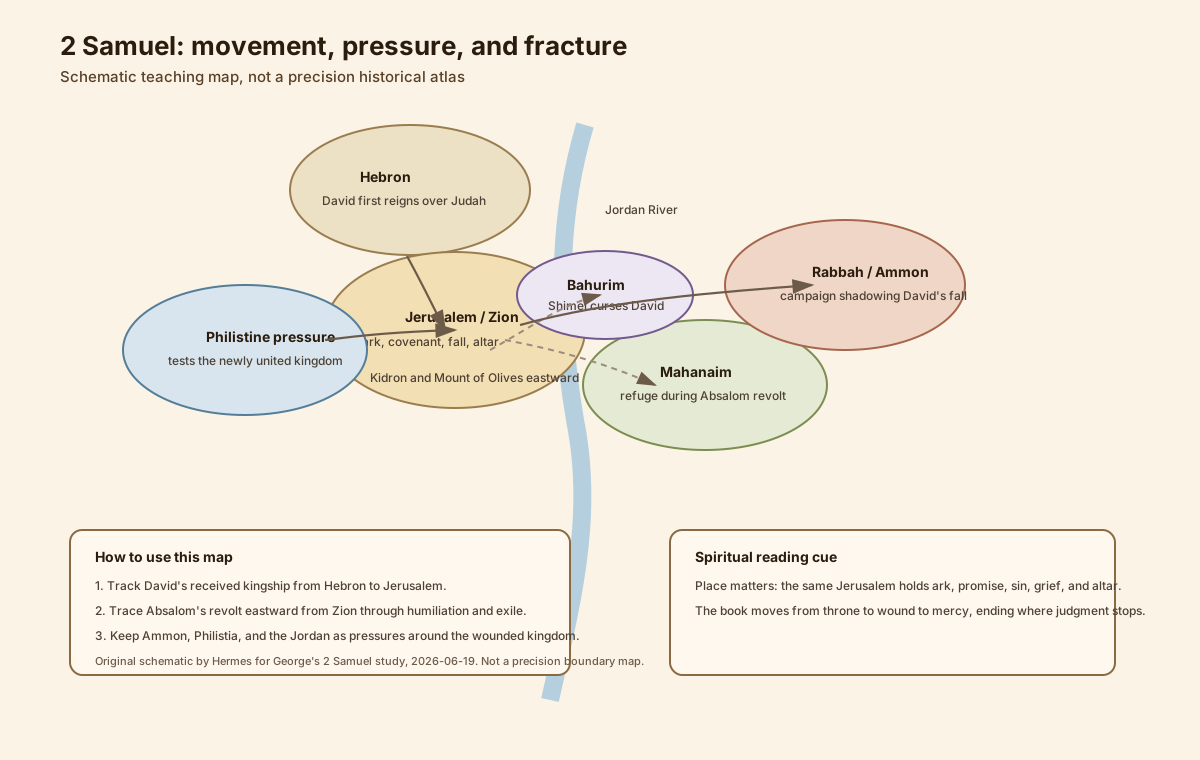 Source: Original schematic by Hermes for this 2 Samuel study guide, 2026-06-19.
Spiritual Fruit 🍇
1. Submit counsel to God
A plan can be clever and still spiritually diseased. Before giving advice, ask whether it serves truth, humility, and salvation.
2. Honor hidden faithfulness
God preserves David through people who do not dominate the story. Hidden loyalty is not wasted.
3. Do not let wounds become rebellion
Absalom’s wounds were real, but rebellion was still sin. Bring injury to God before it becomes identity.
4. Let grief be truthful
Christian hope does not require emotional dishonesty. Bring grief into prayer rather than denial.
5. Look to the Son who dies for rebels
David wishes to die for Absalom. Christ actually dies for the ungodly and calls rebels into repentance.
Teacher's Notes
Suggested timing
- Opening and context: 8 minutes
- Counsel and providence: 12 minutes
- Hidden loyalty and Ahithophel: 10 minutes
- Battle and Absalom’s death: 15 minutes
- David’s grief and Christological reading: 15 minutes
- Spiritual fruit: 10 minutes
Where to linger
Linger over David’s grief and the contrast with Christ. This is the heart of the lesson.
Where to compress
Compress the messenger-running details if needed. Keep enough to preserve David’s anxious fatherly question.
Key phrases to say slowly
- “Effective counsel is not the same as righteous counsel.”
- “Accountability and grief are not enemies.”
- “The father wishes what only Christ can fulfill.”
Pastoral warnings
Be careful with parents of estranged children. Do not speak as if every family wound has one clean cause. Treat Ahithophel’s death with sobriety and compassion.
Accuracy notes
The Brenton/LXX text used here places David’s climactic lament at 2 Samuel 19:1 rather than 18:33. The guide includes the verse here because it completes the 17-18 narrative unit.
Visual / teaching aid
- Show: Use the map for Mahanaim and the battle setting. If showing Doré’s Absalom images, frame them around grief and rebellion, and explicitly avoid making Absalom into Christ.
Glossary
- Ahithophel: Counselor who joins Absalom and whose rejected counsel leads to despair.
- Hushai: David’s friend whose counter-counsel frustrates Ahithophel.
- Providence: God’s wise governance of events without excusing human sin.
- Vainglory: Passion that seeks admiration and display.
- Typology: Reading real Old Testament events as pointing toward Christ without denying their literal meaning.
Translation and Source Notes
Embedded Old Testament Scripture uses Brenton’s English Septuagint. In the Septuagint tradition, 2 Samuel corresponds to Kings II / 2 Kingdoms. This guide notes a Brenton/LXX verse-numbering difference around David’s lament and avoids invented direct patristic quotations.
Sources
Primary sources
- Scripture: 2 Samuel 17-18; 2 Samuel 19:1; Matthew 26-27; Luke 23:34; Romans 5:6-8; Psalm 50 (NKJV 51).
- Brenton, Lancelot C. L., trans. The Septuagint Version of the Old Testament with an English Translation.
- St. John Cassian, Conferences, on discernment and the testing of thoughts.
- St. Augustine, The City of God, on disordered love.
Secondary academic sources
- Robert Alter, The David Story: A Translation with Commentary of 1 and 2 Samuel.
- P. Kyle McCarter Jr., II Samuel, Anchor Bible.
- John Goldingay, 1 and 2 Samuel for Everyone.
Coptic Orthodox / pastoral sources
- The Orthodox Study Bible, notes on Kingdoms / Samuel.
- Fr. Tadros Y. Malaty, pastoral commentary material on Samuel/Kings where available.
Web pages and non-academic sources cited
- CCEL and New Advent for public-domain patristic access.