Wisdom 13-15 teaches that creation’s beauty should lead the mind and heart to the Creator. The stars, waters, winds, fire, and living creatures are not enemies of faith. They are witnesses. The tragedy of idolatry is that fallen worship stops at the beauty, power, and usefulness of created things, then gives them the place that belongs to God alone.
The passage is ancient, but it is not remote. Many people no longer bow before carved wood or painted clay, yet the same spiritual sickness appears when beauty, power, technology, status, romance, nation, body, and self become ultimate. Wisdom calls this madness because the idol cannot save, cannot breathe, cannot walk, and cannot give what the worshiper asks from it.
Romans 1:18-25 and Acts 17:24-31 give the apostolic anchors for this session. Saint Paul says that creation reveals God’s invisible power, yet human beings suppress the truth and serve the creature rather than the Creator. At Athens he proclaims the God who made the world, gives life and breath to all, is not served by human hands, calls all people to repentance, and will judge the world through the risen Christ.
Session Orientation
Wisdom 11:15-12:27 taught God’s measured judgment and His love for the things He made. Wisdom 13-15 now turns to the root sickness behind Egypt and the nations: distorted worship. The argument is sustained. First, the beauty and greatness of creation should have made the Creator visible. Then the text exposes handmade idols, social collapse, and the absurdity of asking breathless objects to give life.
This session must not become a lesson against creation. Wisdom does not despise the world. It honors creation so deeply that it condemns the worshiper who refuses to follow creation’s beauty to its Maker. The sun is not evil. The sea is not evil. Wood, clay, art, craft, ships, tools, and bodies are not evil. They become snares when human desire calls them gods.
The Christian reading is clear. Christ is the true image of the invisible God, the Wisdom of God, and the risen Judge proclaimed by the apostle in Athens. The idols made by hands are dead images. The Son is not an image made by hands. He is the living Word through whom all things were made, who entered creation to heal worship, restore the soul, and bring human beings back to the Father.
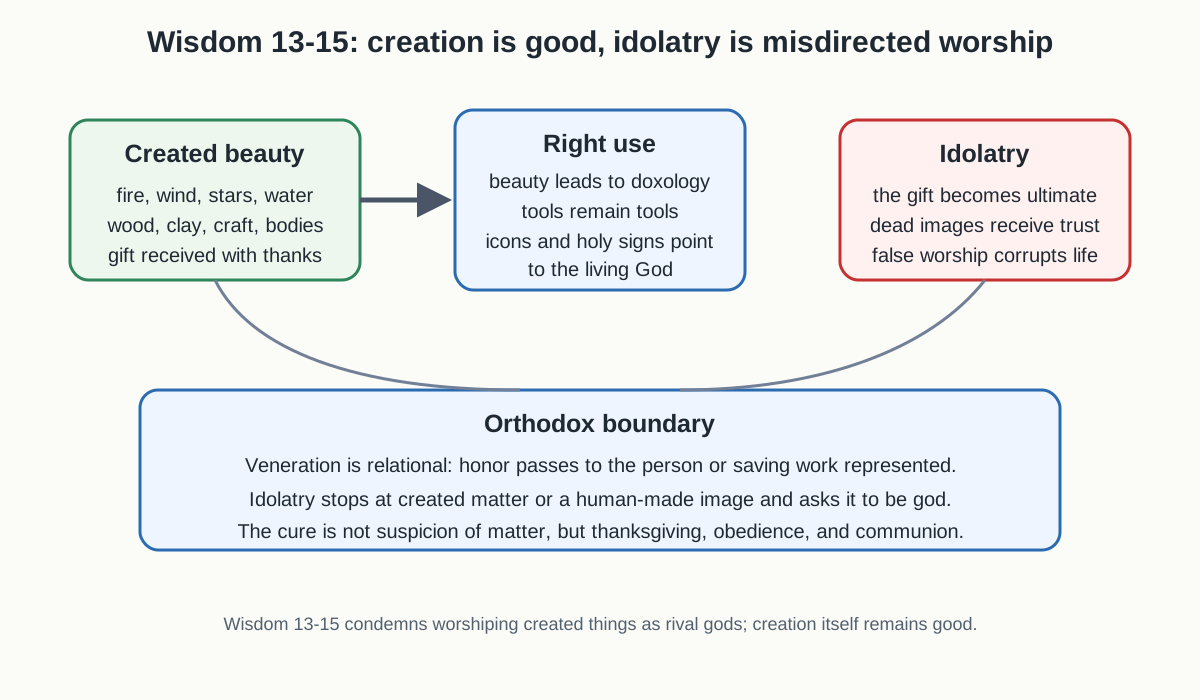
Visual teaching: gift, idol, and holy sign
Source: Project-created schematic from Wisdom 13-15, Romans 1, Acts 17, and the guide’s Orthodox teaching boundary.
The schematic protects the session from two opposite mistakes. The first mistake is anti-material suspicion, as though Wisdom condemns creation, art, craft, wood, clay, technology, or the body. The second mistake is idolatry, where a created gift is treated as ultimate and receives fear, trust, obedience, sacrifice, or worship that belongs to God.
Orthodox veneration belongs on neither side of that error. The Cross, icons, oil, water, relics, and other holy signs are not adored as rival gods and are not treated as self-sufficient powers. They are received relationally, in communion with the living God who sanctifies creation and who, in the Incarnation, truly entered material life. Wisdom 13-15 condemns dead images asked to be gods. It does not condemn creation becoming transparent to the Creator.
The first author of beauty (Wisdom 13:1-9)
1 Surely vain are all men by nature, who are ignorant of God, and could not out of the good things that are seen know him that is: neither by considering the works did they acknowledge the workmaster; 2 but deemed either fire, or wind, or the swift air, or the circle of the stars, or the violent water, or the lights of heaven, to be the gods which govern the world. 3 With whose beauty if they being delighted took them to be gods; let them know how much better the Lord of them is: for the first author of beauty hath created them. 4 But if they were astonished at their power and virtue, let them understand by them, how much mightier he is that made them.
5 For by the greatness and beauty of the creatures proportionably the maker of them is seen. 6 But yet for this they are the less to be blamed: for they peradventure err, seeking God, and desirous to find him. 7 For being conversant in his works they search him diligently, and believe their sight: because the things are beautiful that are seen. 8 Howbeit neither are they to be pardoned. 9 For if they were able to know so much, that they could aim at the world; how did they not sooner find out the Lord thereof?
The passage begins with a generous and severe vision at the same time. It is generous because it admits that some idolaters were seeking God and desirous to find Him. They were moved by fire, wind, air, stars, water, and heavenly lights because these things are genuinely beautiful and powerful. Wisdom does not mock wonder. It says wonder must keep moving upward.
The severity is just as clear. The visible world is good, but it is not ultimate. The one who sees the works should acknowledge the workmaster. The one who delights in beauty should seek the first author of beauty. The one who is astonished by created power should recognize the greater power of the Maker. Creation is a school of worship. It gives signs, not final answers.
Verse 5 gives the theological center: by the greatness and beauty of the creatures, the maker is seen proportionably. This does not mean creation explains God completely. It means creation bears enough witness to make refusal blameworthy. The world is not silent. Its beauty says that beauty has an Author. Its order says that it is not self-originating. Its power says that it is not the highest power.
Romans 1 presses the same burden. Saint Paul says that God’s invisible things are understood from the creation of the world through the things that are made, yet human beings do not glorify Him as God. The result is an exchange: the glory of the incorruptible God is traded for images and created things. Wisdom 13 and Romans 1 together show that idolatry is not simply intellectual error. It is refusal to let truth become worship.
Acts 17 adds the missionary answer. In Athens, Saint Paul does not begin by despising the Athenians. He begins with the God who made the world and all things in it, who does not dwell in temples made with hands, who gives life and breath and all things, and who now calls all people to repentance. The Creator is not far from us, but He is also not one more object inside creation.
This speaks directly to modern idolatry. Beauty becomes an idol when the body, art, attraction, youth, style, or aesthetic experience becomes the measure of life. Power becomes an idol when influence, control, political victory, or institutional strength receives the obedience owed to God. Technology becomes an idol when devices, systems, data, and artificial intelligence are treated as saviors rather than tools. Status becomes an idol when visibility and approval rule the heart. Romance becomes an idol when another person is asked to provide what only God can give. Nation becomes an idol when loyalty to a people, flag, or cause displaces the commandments of Christ. The body becomes an idol when health, strength, sexuality, or self-image becomes the soul’s governing liturgy. The self becomes an idol when personal desire, identity, grievance, or preference is treated as sacred.
Wisdom does not call us to hate these created realities. It calls us to receive them under God. Beauty should become praise. Power should become service. Technology should become stewardship. Status should become humility. Romance should become chastity and covenant love. Nation should become responsibility without worship. The body should become a temple. The self should be offered, not enthroned.
Because creation is good, the cure for idolatry is not suspicion of matter. It is thanksgiving, obedience, and right use. The Christian may paint icons, build churches, study science, use medicine, marry, cultivate beauty, and work with skill, provided the gift remains a gift. The line is crossed when the gift stops opening the heart to gratitude and begins demanding the obedience, fear, sacrifice, and trust that belong to God.
💎 Gems from the Fathers
As a thematic witness, Saint John Chrysostom’s preaching on Romans 1 helps illuminate Wisdom’s argument. He treats creation as a teacher given by God, but says that those who refused this teaching cut out another path for themselves and fell from truth. This is exactly the sickness Wisdom names: sight remained, wonder remained, craft remained, but worship was diverted from the Creator to the creature.
That witness guards the passage from two mistakes. First, the Christian must not despise creation, because creation was meant to teach. Second, the Christian must not worship creation, because creation is a teacher, not the Lord.
The helpless idol made from refuse (Wisdom 13:10-19)
10 But miserable are they, and in dead things is their hope, who called them gods, which are the works of men’s hands, gold and silver, to shew art in, and resemblances of beasts, or a stone good for nothing, the work of an ancient hand. 11 Now a carpenter that felleth timber, after he hath sawn down a tree meet for the purpose, and taken off all the bark skilfully round about, and hath wrought it handsomely, and made a vessel thereof fit for the service of man’s life; 12 and after spending the refuse of his work to dress his meat, hath filled himself; 13 and taking the very refuse among those which served to no use, being a crooked piece of wood, and full of knots, hath carved it diligently when he had nothing else to do, and formed it by the skill of his understanding, and fashioned it to the image of a man; 14 or made it like some vile beast, laying it over with vermilion, and with paint colouring it red, and colouring every spot therein; 15 and when he had made a convenient room for it, set it in a wall, and made it fast with iron: 16 for he provided for it that it might not fall, knowing that it was unable to help itself; for it is an image, and hath need of help.
17 Then maketh he prayer for his goods, for his wife and children, and is not ashamed to speak to that which hath no life. 18 For health he calleth upon that which is weak: for life prayeth to that which is dead: for aid humbly beseecheth that which hath least means to help: and for a good journey he asketh of that which cannot set a foot forward: 19 and for gaining and getting, and for good success of his hands, asketh ability to do of him, that is most unable to do any thing.
The first idolatry section considered the person who looks at the majesty of creation and stops short of the Creator. This second section moves lower. Now the idol is not the sun or stars. It is the work of human hands. The text calls the worshipers miserable because their hope is in dead things.
Wisdom’s satire is precise. The carpenter cuts timber, makes something useful from part of the wood, burns the refuse to cook his food, and then takes another useless piece, crooked and full of knots, to carve an idol. The same created material becomes fuel, tool, and false god. The absurdity is not in wood itself. Wood can serve human life. The absurdity is in a human being making a helpless object and then asking it for help.
Verse 16 is almost painful in its irony. The craftsman must fasten the idol to the wall because it cannot keep itself from falling. He knows this. He provides for the idol because it is unable to help itself. Then he prays to it for goods, wife, children, health, life, aid, travel, profit, and success. The worshiper gives life-support to the object and then asks the object for life.
This is the spiritual pattern of every idol. We build the idol, protect it, fund it, feed it, maintain it, defend it, excuse it, and then ask it to save us. A career can become this. A phone can become this. A public image can become this. A relationship can become this. A political cause can become this. A body ideal can become this. Even a ministry can become this if the servant begins asking the work itself to provide identity, security, and worth.
The passage also exposes the hidden shame of idolatry. The worshiper is “not ashamed” to speak to what has no life. Sin often deadens shame in the wrong direction. We become ashamed to pray honestly to God, ashamed to confess weakness, ashamed to ask for mercy, yet unashamed to pour our fear into lifeless things. Wisdom reverses this. It teaches us to be ashamed of dead hope and unashamed before the living God.
Christ stands opposite the helpless idol. He is not a dead image fastened in place by human support. He is the living Image of the invisible God, the Word through whom all things were made, the One who walked among us, healed the sick, raised the dead, gave life, bore the Cross, and rose from the tomb. The idol cannot set a foot forward. Christ walks toward sinners. The idol cannot give breath. Christ breathes peace upon His disciples. The idol must be guarded from falling. Christ raises the fallen.
For our life, the question is simple and uncomfortable: What do I maintain with all my strength and then secretly ask to save me? Where am I praying, not with words, but with attention, anxiety, money, obedience, and sacrifice? Wisdom wants us to hear the foolishness before it becomes tragedy.
Wood, providence, and the cursed god made by hands (Wisdom 14:1-11)
1 Again, one preparing himself to sail, and about to pass through the raging waves, calleth upon a piece of wood more rotten than the vessel that carrieth him. 2 For verily desire of gain devised that, and the workman built it by his skill. 3 But thy providence, O Father, governeth it: for thou hast made a way in the sea, and a safe path in the waves; 4 shewing that thou canst save from all danger: yea, though a man went to sea without art. 5 Nevertheless thou wouldest not that the works of thy wisdom should be idle, and therefore do men commit their lives to a small piece of wood, and passing the rough sea in a weak vessel are saved.
6 For in the old time also, when the proud giants perished, the hope of the world governed by thy hand escaped in a weak vessel, and left to all ages a seed of generation. 7 For blessed is the wood whereby righteousness cometh.
8 But that which is made with hands is cursed, as well it, as he that made it: he, because he made it: and it, because, being corruptible, it was called God. 9 For the ungodly and his ungodliness are both alike hateful unto God. 10 For that which is made shall be punished together with him that made it. 11 Therefore even upon the idols of the Gentiles shall there be a visitation: because in the creature of God they are become an abomination, and stumblingblocks to the souls of men, and a snare to the feet of the unwise.
Wisdom now turns from the workshop to the sea. A sailor preparing to pass through raging waves calls upon a rotten piece of wood, even though the vessel itself is also wood. The picture is again ironic, but not anti-technology. Ships are not condemned. Skill is not condemned. Human craft is not condemned. The passage says the vessel is built by skill, and people are saved through a weak vessel because God does not want the works of His wisdom to be idle.
The difference is worship. The ship is a tool under providence. The idol is a tool falsely called God. The sailor’s safety does not come from wood as a divine power. It comes from the Father whose providence governs the sea, who makes a way in the sea and a safe path in the waves. The created instrument may be necessary, but it is not ultimate.
This distinction is urgent for modern technology. Medicine, transportation, communication, research, digital tools, and engineering can serve life. Wisdom does not ask Christians to despise them. But when technology is treated as providence, when systems are trusted more than God, when skill becomes a god rather than a servant, the tool becomes a snare. The same object can be used wisely or worshiped foolishly.
Verse 6 recalls Noah. When proud giants perished, the hope of the world escaped in a weak vessel governed by God’s hand. The ark was wood, but it was not an idol. Its weakness became the place of preservation because God governed it. This is the pattern of holy weakness. God can save through a weak vessel when the vessel remains under His command and providence.
Verse 7, “blessed is the wood whereby righteousness cometh,” belongs first to the ark image in the flow of the passage. Yet Christian readers cannot hear blessed wood without remembering the Cross. The Cross is not an idol made by hands and called God. It is the saving wood on which the incarnate Lord offered Himself. The Church venerates the Cross because of Christ crucified upon it, not because wood as material possesses independent divine power.
This distinction also protects the Orthodox use of material signs. The faithful do not adore wood, paint, stone, oil, water, or relics as rival gods. Holy things are received in relation to the living God who acts through creation and who, in the Incarnation, truly entered material life. A created sign becomes dangerous when it is treated as a self-sufficient power. It becomes holy when it remains transparent to the Lord who sanctifies creation.
Verses 8-11 draw the boundary sharply. What is made with hands becomes cursed when it is called God. A created thing becomes an abomination not because creation is bad, but because it has been pulled into false worship. Idols become stumblingblocks to souls and snares to feet. They trip the worshiper precisely because they present themselves as help.
The lesson is not that Christians should avoid tools. The lesson is that every tool must remain in its place. A phone is a tool, not providence. A medical treatment is a gift, not God. A career is stewardship, not immortality. Money is a means, not security. A church program is service, not salvation. The moment a created thing receives the trust due to the Father, it begins to rot inwardly even if it still looks useful.
The social collapse that follows false worship (Wisdom 14:12-31)
12 For the devising of idols was the beginning of spiritual fornication, and the invention of them the corruption of life. 13 For neither were they from the beginning, neither shall they be for ever. 14 For by the vain glory of men they entered into the world, and therefore shall they come shortly to an end. 15 For a father afflicted with untimely mourning, when he hath made an image of his child soon taken away, now honoured him as a god, which was then a dead man, and delivered to those that were under him ceremonies and sacrifices. 16 Thus in process of time an ungodly custom grown strong was kept as a law, and graven images were worshipped by the commandments of kings. 17 Whom men could not honour in presence, because they dwelt far off, they took the counterfeit of his visage from far, and made an express image of a king whom they honoured, to the end that by this their forwardness they might flatter him that was absent, as if he were present.
18 Also the singular diligence of the artificer did help to set forward the ignorant to more superstition. 19 For he, peradventure willing to please one in authority, forced all his skill to make the resemblance of the best fashion. 20 And so the multitude, allured by the grace of the work, took him now for a god, which a little before was but honoured as a man. 21 And this was an occasion to deceive the world: for men, serving either calamity or tyranny, did ascribe unto stones and stocks the incommunicable name.
22 Moreover this was not enough for them, that they erred in the knowledge of God; but whereas they lived in the great war of ignorance, those so great plagues called they peace. 23 For whilst they slew their children in sacrifices, or used secret ceremonies, or made revellings of strange rites; 24 they kept neither lives nor marriages any longer undefiled: but either one slew another traiterously or grieved him by adultery. 25 So that there reigned in all men without exception, blood, manslaughter, theft, and dissimulation, corruption, unfaithfulness, tumults, perjury, 26 disquieting of good men, forgetfulness of good turns, defiling of souls, changing of kind, disorder in marriages, adultery, and shameless uncleanness. 27 For the worshipping of idols not to be named is the beginning, the cause, and the end, of all evil. 28 For either they are mad when they be merry, or prophesy lies, or live unjustly, or else lightly forswear themselves. 29 For insomuch as their trust is in idols which have no life, though they swear falsely, yet they look not to be hurt.
30 Howbeit for both causes shall they be justly punished: both because they thought not well of God, giving heed unto idols, and also unjustly swore in deceit, despising holiness. 31 For it is not the power of them by whom they swear: but it is the just vengeance of sinners, that punisheth always the offence of the ungodly.
The argument now becomes wider and darker. Idolatry is not only a private mistake. It corrupts life. Verse 12 calls it the beginning of spiritual fornication because false worship is covenant betrayal. The soul was made for God, but gives itself to another. Once worship is broken, the rest of life begins to deform around the false center.
Wisdom traces several roots of idolatry. One is grief. A father afflicted with untimely mourning makes an image of a child taken too soon. This line must be read pastorally. The passage is not mocking grief. It is exposing what can happen when grief is not carried before the living God. Love for the departed can become a refusal to receive creaturely limits. Mourning can become a religious system that tries to keep the dead present by making an image divine.
Another root is tyranny. Images of distant rulers are made so the absent king may be flattered as if present. Art and political loyalty then slide into worship. The image that began as honor becomes a god. Wisdom is warning that power often wants religious imagination. It wants to be seen not merely as useful or authoritative, but sacred.
A third root is artistry itself when it becomes seduction. The craftsman’s diligence allures the ignorant to more superstition. Beauty is again at the center, but now beauty has been severed from truth. The work is graceful, impressive, and skillful. Yet its beauty makes the lie more persuasive. This is a permanent danger. Excellent design can sell a false life. Beautiful music can carry corrupt desire. Moving images can make lies feel holy. Emotional force can make false worship feel deep.
Verse 21 gives one of the most important lines in the whole session: men, serving either calamity or tyranny, ascribed to stones and stocks the incommunicable name. Idolatry often comes from pain or pressure. Calamity says, “I need something to save me.” Tyranny says, “Bow, or suffer.” The soul then gives God’s name to what cannot bear it.
The social consequences follow. Secret rites, child sacrifice, adultery, murder, theft, dissimulation, corruption, unfaithfulness, tumults, perjury, and shameless uncleanness are not random. They are the moral fruit of disordered worship. If the god is false, the life around that god becomes false. If the god is appetite, sacrifice will be demanded for appetite. If the god is nation, truth will be bent for national glory. If the god is romance, marriages and bodies will be damaged for emotional possession. If the god is status, speech will become performance and friendship will become competition. If the god is self, every boundary will feel like oppression.
Romans 1 again helps us. Saint Paul does not separate idolatry from moral collapse. Exchanging the glory of God for created images leads to a disordering of desire, judgment, and relationships. Wisdom 14 says the same thing in the language of spiritual fornication and corrupted life. Worship is never isolated. It forms the whole person.
Verse 22 is devastating: they lived in the great war of ignorance, and those so great plagues called they peace. This is still true. A culture can call addiction freedom, exploitation success, lust love, propaganda unity, vanity self-care, and rage justice. The idol names the plague as peace because admitting the truth would require repentance.
💎 Gems from the Fathers
As a thematic witness, Saint John Chrysostom’s homilies on Romans 1 connect false knowledge of God with unrighteous life. He notes that error has many forms while truth is one, and he does not treat ungodliness as merely an idea in the head. It becomes injustice, corruption, and damaged relationships.
This helps us read Wisdom 14 without turning it into a detached catalog of ancient sins. The passage is saying that worship governs life. When the truth of God is held down, the passions are released under religious cover.
Knowing God as the root of immortality (Wisdom 15:1-6)
1 But thou, our God, art gracious and true, long-suffering, and in mercy ordering all things. 2 For if we sin, we are thine, knowing thy power: but we will not sin, knowing that we are counted thine. 3 For to know thee is perfect righteousness: yea, to know thy power is the root of immortality. 4 For neither did the mischievous invention of men deceive us, nor an image spotted with divers colours, the painter’s fruitless labour; 5 the sight whereof enticeth fools to lust after it, and so they desire the form of a dead image, that hath no breath.
6 Both they that make them, they that desire them, and they that worship them, are lovers of evil things, and are worthy to have such things to trust upon.
After the long exposure of idolatry, Wisdom turns to confession: “But thou, our God, art gracious and true, long-suffering, and in mercy ordering all things.” This is not a decorative transition. It is the answer to idolatry. The soul is not healed by hating idols only. It is healed by knowing the true God.
The attributes matter. God is gracious, so He is not like the tyrants who demand flattery. He is true, so He is not like the false images that deceive. He is long-suffering, so He is not driven by panic or wounded pride. He orders all things in mercy, so creation, judgment, correction, and salvation are not random forces. True worship begins by confessing the true God.
Verse 2 must not be twisted into presumption. “If we sin, we are thine” does not mean sin is safe. The same verse says, “but we will not sin, knowing that we are counted thine.” Belonging to God becomes the reason not to sin. The covenant does not excuse betrayal. It deepens responsibility and gives hope for repentance.
Verse 3 is one of the great lines of the passage: to know God is perfect righteousness, and to know His power is the root of immortality. Righteousness is not only rule-keeping. It is knowing God truly. Immortality is not only surviving after death. It is rooted in communion with the living God. Christ says in John 17 that eternal life is to know the Father and Jesus Christ whom He has sent. Wisdom prepares that grammar by joining knowledge of God, righteousness, power, and immortality.
The contrast with idols is vivid. Painted images entice fools to lust after a dead form without breath. The problem is desire fixed on death. The idol has color, shape, and attraction, but no breath. False worship trains the soul to desire lifeless beauty.
This is a hard word for an image-saturated age. Much modern desire is trained by dead images: edited bodies, curated lives, seductive screens, symbols of luxury, fantasies of romance, and projections of self. The image does not breathe. It cannot love back. It cannot forgive, heal, or save. Yet the heart can be trained to desire it until real communion feels less compelling than fantasy.
Wisdom’s remedy is not ugliness. It is living knowledge of God. The person who knows God can love beauty without becoming captive to dead images. The person who knows God’s power can repent without despair. The person counted as God’s own can refuse sin, not because he trusts his own strength, but because he belongs to the gracious and true Lord.
Clay, borrowed breath, and counterfeit life (Wisdom 15:7-19)
7 For the potter, tempering soft earth, fashioneth every vessel with much labour for our service: yea, of the same clay he maketh both the vessels that serve for clean uses, and likewise also all such as serve to the contrary: but what is the use of either sort, the potter himself is the judge. 8 And employing his labours lewdly, he maketh a vain god of the same clay, even he which a little before was made of earth himself, and within a little while after returneth to the same, out of the which he was taken, when his life which was lent him shall be demanded.
9 Notwithstanding his care is, not that he shall have much labour, nor that his life is short: but striveth to excel goldsmiths and silversmiths, and endeavoureth to do like the workers in brass, and counteth it his glory to make counterfeit things. 10 His heart is ashes, his hope is more vile than earth, and his life of less value than clay: 11 forasmuch as he knew not his Maker, and him that inspired into him an active soul, and breathed in a living spirit. 12 But they counted our life a pastime, and our time here a market for gain: for, say they, we must be getting every way, though it be by evil means. 13 For this man, that of earthly matter maketh brittle vessels and graven images, knoweth himself to offend above all others.
14 And all the enemies of thy people, that hold them in subjection, are most foolish, and are more miserable than very babes. 15 For they counted all the idols of the heathen to be gods: which neither have the use of eyes to see, nor noses to draw breath, nor ears to hear, nor fingers of hands to handle; and as for their feet, they are slow to go. 16 For man made them, and he that borrowed his own spirit fashioned them: but no man can make a god like unto himself. 17 For being mortal, he worketh a dead thing with wicked hands: for he himself is better than the things which he worshippeth: whereas he lived once, but they never. 18 Yea, they worshipped those beasts also that are most hateful: for being compared together, some are worse than others. 19 Neither are they beautiful, so much as to be desired in respect of beasts: but they went without the praise of God and his blessing.
The final section returns to craft, but now with clay. The potter can make vessels for clean uses and for other uses. Again, the material is not condemned. Clay is part of creation. Work is not condemned. Craft can serve human life. The sin begins when the maker uses earthly matter to make a vain god, while forgetting that he himself was made of earth and will return to earth.
Verse 8 exposes mortality. The idol-maker was made from earth and will return to it when the life lent to him is demanded. Life is not owned. It is lent. Breath is not self-generated. It is received. The maker who forgets this tries to manufacture a god, but he cannot even keep his own breath.
Verse 10 is severe: his heart is ashes, his hope more vile than earth, and his life of less value than clay. This is not because human life lacks value by nature. Wisdom has just said that God breathed into man a living spirit. The tragedy is that the person made alive by God lowers himself beneath the clay by worshiping what he has fashioned.
Acts 17 speaks directly into this. Saint Paul tells the Athenians that God gives to all life, breath, and all things, and that He is not worshiped with human hands as though He needed anything. Wisdom 15 shows the reverse: a man who borrowed his own spirit fashions a dead thing and then bows before it. The living worshiper becomes less alive by worshiping what never lived.
Verse 12 names another modern idol with frightening clarity: life as a pastime and time as a market for gain. The idol-maker’s creed is, “we must be getting every way, though it be by evil means.” This is not only ancient trade in images. It is the spiritual logic of any life organized around acquisition without holiness. When gain is god, evil means become acceptable. Time becomes merchandise. People become instruments. The soul becomes ashes.
The passage ends by saying the enemies of God’s people are foolish because they count lifeless idols as gods. Their idols have eyes, noses, ears, fingers, and feet, but no true sight, breath, hearing, handling, or movement. The irony deepens in verse 17: the worshiper is better than the thing he worships because he lived once, but the idol never lived. Idolatry degrades the human person by making him bow below his own created dignity.
As a thematic witness, Saint Athanasius uses Paul’s words from Athens, “in Him we live and move and have our being,” to confess dependence on God and the Son as the Father’s living Word and Wisdom. This helps us hear Wisdom 15 correctly. The living spirit in man is not self-owned. It is received from God. To make a god by hand is therefore not only foolish. It is ingratitude against the One who gave breath.
Christ heals this at the root. He does not merely destroy idols from outside. He restores true worship by giving Himself. He enters our clay, assumes our mortality without sin, dies, rises, and breathes His Spirit into the Church. The Christian answer to idols is not a bare command to stop worshiping false things. It is the living Lord who gives breath, calls us to repentance, and makes the heart alive again.
Spiritual Fruit 🍇
-
Let beauty become doxology. When you see beauty in nature, art, another person, the body, music, or created order, do not stop at possession or admiration. Turn the beauty into thanksgiving to the first author of beauty.
-
Name your modern idols concretely. Ask where beauty, power, technology, status, romance, nation, body, or self has begun to demand obedience, sacrifice, anxiety, money, secrecy, or moral compromise.
-
Keep tools in their place. Ships, medicine, phones, work, education, money, planning, and skill can serve life under God’s providence. They become snares when they receive the trust that belongs to the Father.
-
Refuse dead images. Screens, fantasies, curated bodies, public image, and imagined versions of other people can train desire toward what has no breath. Choose real communion, prayer, confession, and embodied love over lifeless projection.
-
Let grief go to God before it becomes an idol. Wisdom’s example of the mourning father is pastorally serious. Grief needs prayer, tears, memory, and hope in God. When grief tries to make the beloved creature ultimate, it becomes captivity.
-
Remember borrowed breath. Life is lent. Breath is given. Time is not merely a market for gain. Begin each day by receiving life from God, and end each day by returning it to Him in repentance and thanksgiving.
-
Come to the risen Christ as the living answer to idols. The idol cannot walk, breathe, hear, forgive, or raise the dead. Christ does all these things. He is the Wisdom of God, the living Image, the Creator made flesh, and the Judge who now calls all people to repentance.
Teaching Notes
The first author of beauty (Wisdom 13:1-9)
- Ask: Why does Wisdom say creation’s beauty should have led people to the Creator?
- Emphasize: The passage is not anti-beauty. It teaches that beauty must become worship of the Maker, not worship of the created thing.
- Watch for: Treating modern idolatry as only literal statues. Name beauty, power, technology, status, romance, nation, body, and self.
- Connect: Romans 1:18-25 shows the same exchange, the creature served instead of the Creator. Acts 17:24-31 shows the apostolic call to repent and turn to the God who made all things.
- Show: Use the gift/idol/holy sign schematic, then ask where beauty becomes a window to God and where it becomes a prison.
The helpless idol made from refuse (Wisdom 13:10-19)
- Ask: What makes the carpenter’s idol so absurd in this passage?
- Emphasize: The worshiper supports the idol, then asks the idol for support.
- Watch for: Laughing only at ancient idol-makers. The same pattern appears whenever we build, maintain, defend, and then seek salvation from a created thing.
- Connect: Christ is the living Image who walks toward sinners, gives life, and raises the fallen.
- Show: Invite the class to identify one thing people maintain anxiously and then expect to save them.
Wood, providence, and the cursed god made by hands (Wisdom 14:1-11)
- Ask: How does the passage distinguish a tool used under providence from an idol falsely called God?
- Emphasize: Skill, craft, ships, and technology can serve life, but providence belongs to the Father.
- Watch for: Teaching suspicion of all technology or craft. The problem is worship, not usefulness.
- Connect: Noah’s weak vessel was governed by God’s hand. The blessed wood also invites Christian remembrance of the Cross, while keeping the passage’s ark context intact.
- Show: Compare a ship, a phone, and a Cross: one tool, one modern temptation, and one saving sign because of Christ.
The social collapse that follows false worship (Wisdom 14:12-31)
- Ask: Why does Wisdom connect false worship with social sins like murder, adultery, theft, perjury, and corruption?
- Emphasize: Worship forms life. A false god creates a false moral world.
- Watch for: Handling the mourning father harshly. The passage exposes idolatry born from grief, but it does not mock grief itself.
- Connect: Romans 1 shows the same pattern from false worship to disordered life.
- Show: Name one modern false peace: calling addiction freedom, exploitation success, lust love, rage justice, or vanity self-care.
Knowing God as the root of immortality (Wisdom 15:1-6)
- Ask: Why does Wisdom answer idolatry by confessing that God is gracious, true, long-suffering, and merciful?
- Emphasize: The soul is healed from idols by knowing the true God, not only by rejecting false gods.
- Watch for: Misreading “if we sin, we are thine” as permission to sin. Belonging to God becomes the reason to refuse sin and repent quickly.
- Connect: John 17:3 fulfills this movement by linking eternal life with knowing the Father and the Son whom He sent.
- Show: Have the class repeat the line “to know thee is perfect righteousness” and ask what kind of knowledge this means.
Clay, borrowed breath, and counterfeit life (Wisdom 15:7-19)
- Ask: What does Wisdom mean by saying the idol-maker borrowed his own spirit?
- Emphasize: Life is lent by God. The one who receives breath must not bow to a breathless thing.
- Watch for: Reducing this to economics only. The market-for-gain line includes money, but also any life where acquisition replaces holiness.
- Connect: Acts 17 teaches that God gives life and breath to all and calls all people to repentance through the risen Christ.
- Show: End with a quiet self-examination: “Where has my heart become ashes because I have trusted a dead thing?”
Glossary
- First author of beauty: Wisdom’s phrase for God as the Creator from whom all created beauty receives its origin and meaning.
- Spiritual fornication: Covenant betrayal through false worship, where the soul gives to idols what belongs to God.
- Incommunicable name: The divine name and honor that belong to God alone and cannot rightly be assigned to stones, stocks, rulers, images, or created things.
- Providence: God’s wise and merciful governance of creation, including the sea, human skill, weak vessels, and the preservation of life.
- Creature and Creator: The central distinction in Romans 1 and Acts 17. Created things are gifts and witnesses, not objects of worship.
- Borrowed spirit: Wisdom’s way of saying that human life and breath are received from God, not self-possessed.
- Dead image: A lifeless representation that may attract the senses but cannot breathe, hear, walk, forgive, or save.
Source Notes
Embedded Scripture is from Brenton’s English Septuagint (LXX).
No direct patristic commentary on Wisdom of Solomon 13-15 surfaced in this study’s sources. Patristic material in the body is thematic: Saint John Chrysostom is used through Romans 1 and the creature-Creator distinction, and Saint Athanasius is used through Acts 17:28 and human dependence on God for life, movement, and being.
Scripture from this study has an established place in the Coptic Orthodox lectionary through documented Church readings.
Primary Scripture cross-references informing the interpretation include Romans 1:18-25, Acts 17:24-31, John 1:1-14, Colossians 1:15-20, 1 Corinthians 1:24, John 17:3, 1 Timothy 4:4-5, and Genesis 1-2.
Saint John Chrysostom sources used thematically: Homilies on Romans, homily on Romans 1:18, and Homilies on John with reference to Romans 1:20 and Romans 1:25, CCEL NPNF1 volumes 11 and 14: https://www.ccel.org/ccel/schaff/npnf111.html and https://www.ccel.org/ccel/schaff/npnf114.html.
Saint Athanasius source used thematically: On Luke 10:22, with reference to Acts 17:28, CCEL NPNF2 volume 4: https://www.ccel.org/ccel/schaff/npnf204.html.