


Nahum 3 is the hardest chapter in the book. It names the city as bloody, deceitful, exploitative, and incurable. The point is not delight in destruction. The point is moral exposure: God brings into the open what predatory power tried to hide.
Why This Passage Matters
Without Nahum 3, judgment can sound arbitrary. This chapter names the reason: violence, deceit, sorcery, exploitation, and the sale of peoples. God is not angry because Nineveh is foreign. God judges because Nineveh devours.
This chapter must be taught soberly. It must never become permission to humiliate women, victims, abused people, or any vulnerable person. The prophetic exposure is aimed at predatory empire.
Placement in the Book
Nahum 1 reveals the Lord’s character. Nahum 2 shows Nineveh’s collapse. Nahum 3 explains the moral cause of that collapse and warns that no city, alliance, defense, or reputation can heal sin that refuses repentance.
The chapter also looks south to No-Amon, Thebes in Egypt. If that great city fell despite water defenses and allies, Nineveh cannot claim exemption from judgment.
Woe to the City of Blood (Nahum 3:1-4)
1 O city of blood, wholly false, full of unrighteousness; the prey shall not be handled. 2 The noise of whips, and the noise of the rumbling of wheels, and of the pursuing horse, and of the bounding chariot, 3 and of the mounting rider, and of the glittering sword, and of the gleaming arms, and of a multitude of slain, and of heavy falling: and there was no end to her nations, but they shall be weak in their bodies 4 because of the abundance of fornication: she is a fair harlot, and well-favoured, skilled in sorcery, that sells the nations by her fornication, and peoples by her sorceries.
Nahum’s accusation is specific. Nineveh is a city of blood, falsehood, unrighteous prey, and the sale of peoples. This is not resentment against a rival nation. It is a prophetic indictment of a system built on human ruin.
The sounds of whips, wheels, horses, chariots, swords, and falling bodies make the reader hear what Nineveh caused. The imagery is violent because the sin was violent.
The language of harlotry and sorcery describes seductive power. Nineveh did not only conquer by force. It enchanted nations with wealth, fear, prestige, and political advantage. Sin often sells itself before it enslaves.
Shame Exposed Without Cruel Delight (Nahum 3:5-7)
5 Behold, I am against thee, saith the Lord God Almighty, and I will uncover thy skirts in thy presence, and I will shew the nations thy shame, and the kingdoms thy disgrace. 6 And I will cast abominable filth upon thee according to thine unclean ways, and will make thee a public example. 7 And it shall be that every one that sees thee shall go down from thee, and shall say, Wretched Nineve! who shall lament for her? whence shall I seek comfort for her?
This is the passage that needs the clearest guardrail. Prophetic shame language must not be used to humiliate women, victims, abused persons, or the vulnerable. The target here is not wounded dignity. The target is predatory Nineveh as an exploitative power.
Exposure means God publicly reveals what violent power tried to hide. The city that made others naked, ashamed, and afraid now has its own disgrace uncovered. This is not cruelty for entertainment. It is truth against a lie.
The final question, “Who shall lament for her?” is not a command to enjoy destruction. It is the moral loneliness of a city that refused mercy and multiplied victims.
No-Amon as a Warning to Nineveh (Nahum 3:8-11)
8 Prepare thee a portion, tune the chord, prepare a portion for Ammon: she that dwells among the rivers, water is round about her, whose dominion is the sea, and whose walls are water. 9 And Ethiopia is her strength, and Egypt; and there was no limit of the flight of her enemies; and the Libyans became her helpers. 10 Yet she shall go as a prisoner into captivity, and they shall dash her infants against the ground at the top of all her ways: and they shall cast lots upon all her glorious possessions, and all her nobles shall be bound in chains. 11 And thou shalt be drunken, and shalt be overlooked; and thou shalt seek for thyself strength because of thine enemies.
No-Amon, commonly identified with Thebes, becomes the proof that Nineveh is not exceptional. Thebes had water, allies, and glory. It still fell.
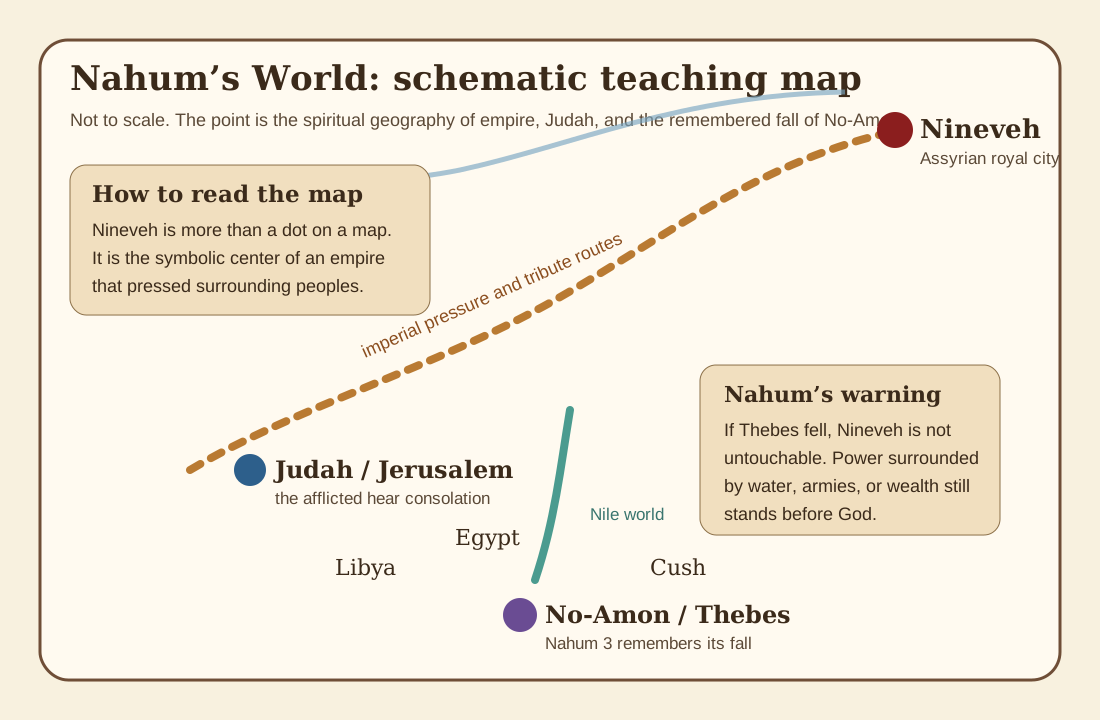 Source: Project-local schematic map for Nahum. Not to scale; it marks Nineveh, Judah, Thebes/No-Amon, Egypt, Cush, and Libya for teaching orientation.
The verse about infants is grievous. Nahum is not asking the reader to savor atrocity. He is naming what conquest does and warning Nineveh that the violence it normalized can return upon it. A faithful teacher should read this with sobriety, especially with younger listeners.
No-Amon warns Nineveh that defenses, alliances, money, and reputation cannot make cruelty secure. This is a warning to predatory power, not an accusation against every person caught in a city’s fall. The slaughtered children are victims, not examples of failed repentance. For us, repentance means turning toward God, not purchasing immunity from suffering.
Fortresses Like Ripe Figs (Nahum 3:12-17)
12 All thy strong-holds are as fig-trees having watchers: if they be shaken, they shall fall into the mouth of the eater. 13 Behold, thy people within thee are as women: the gates of thy land shall surely be opened to thine enemies: the fire shall devour thy bars.
14 Draw thee water for a siege, and well secure thy strong-holds: enter into the clay, and be thou trodden in the chaff, make the fortifications stronger than brick. 15 There the fire shall devour thee; the sword shall utterly destroy thee, it shall devour thee as the locust, and thou shalt be pressed down as a palmerworm. 16 Thou hast multiplied thy merchandise beyond the stars of heaven: the palmerworm has attacked it, and has flown away. 17 Thy mixed multitude has suddenly departed as the grasshopper, as the locust perched on a hedge in a frosty day; the sun arises, and it flies off, and knows not its place: woe to them!
The fortresses are like ripe figs: impressive until shaken. Nahum mocks the illusion that enough preparation can save a city whose moral foundation has collapsed.
Verse 13 uses an ancient military taunt. It must not be repeated as a theological claim about women. Scripture records the rhetoric of humiliation in a war oracle; the Church must teach it with discernment, not weaponize it in family life or parish life.
The locust imagery turns Nineveh’s multiplication against itself. Merchants, officials, and hired strength scatter when warmth returns. What gathered for profit does not remain for love.
No Healing for the Bruise (Nahum 3:18-19)
18 Thy shepherds have slumbered, the Assyrian king has laid low thy mighty men: thy people departed to the mountains, and there was none to receive them.
19 There is no healing for thy bruise; thy wound has rankled: all that hear the report of thee shall clap their hands against thee; for upon whom has not thy wickedness passed continually?
The final diagnosis is terrible: no healing for the bruise. This does not mean God is unable to heal repentant sinners. Jonah already showed Nineveh receiving mercy when it repented. Nahum speaks to hardened violence that will not turn.
The shepherds sleep, the strong are lowered, the people scatter, and no one gathers them. Bad leadership leaves people exposed when judgment comes.
The closing question explains the clapping of hands: “upon whom has not thy wickedness passed continually?” The world is not applauding suffering as entertainment. It is recognizing that a predator has finally stopped devouring.
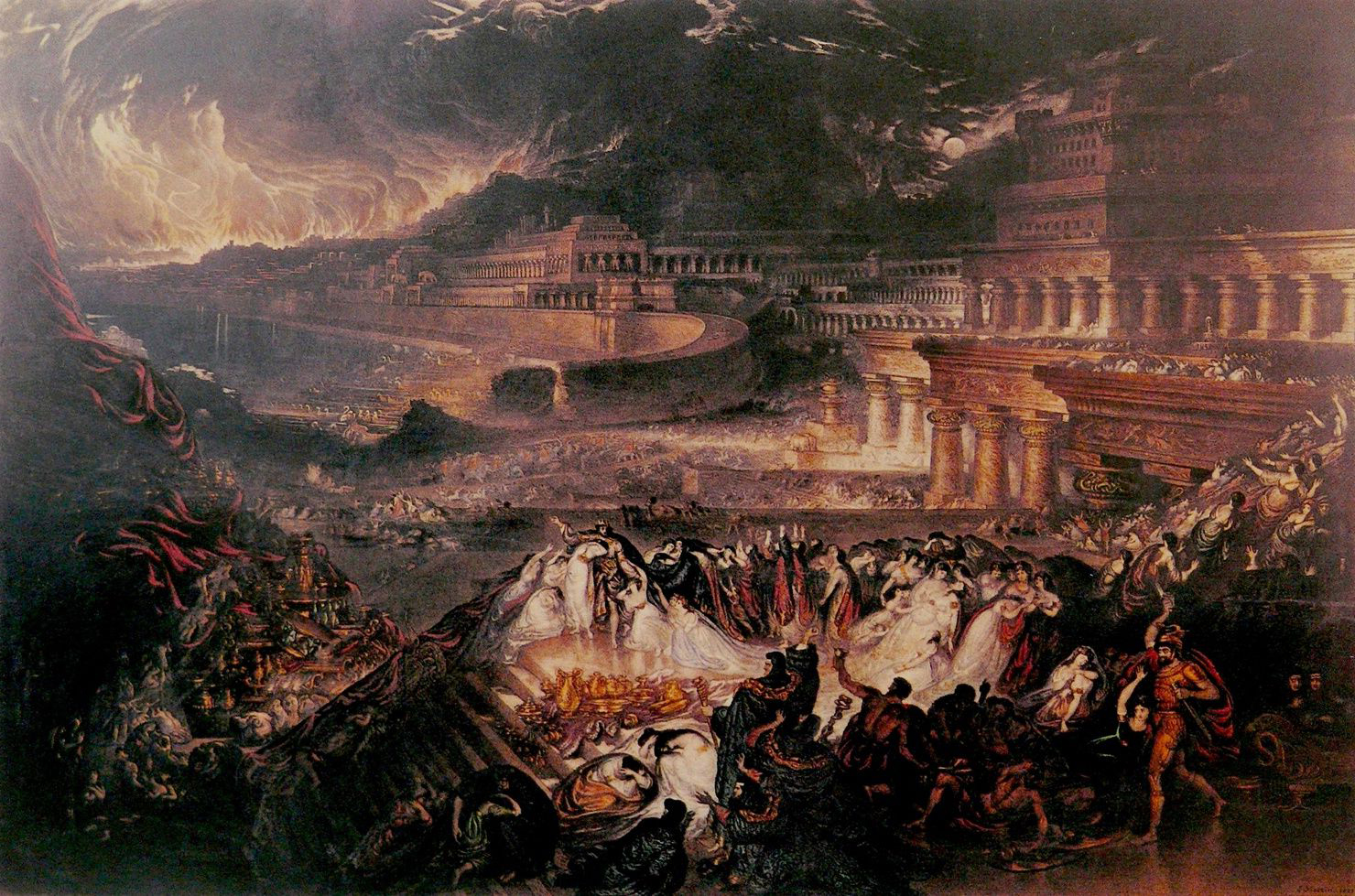 Source: Fall of Nineveh, later imaginative artwork, CC BY-SA 4.0, via Wikimedia Commons. Not an icon or archaeological reconstruction.
Orthodox Theological Reading
Nahum 3 teaches that sin can become social, organized, profitable, and admired. A city can build beauty over blood. A soul can do the same.
The chapter therefore asks hard ascetical questions. Where have I used strength, words, money, position, religious status, or knowledge to make others afraid? Where have I called domination “order” or exploitation “success”?
Judgment in this chapter is also mercy for victims. It says that God does not ask the wounded to pretend their wounds were imaginary.
Christological Reading
Christ stands against Nineveh’s form of power by taking the place of the humiliated, wounded, and killed. He is exposed before nations, mocked, stripped, and crucified, not because He is guilty, but because He enters the place of victims and judges sin from within suffering.
At the Cross, the world’s violent logic is publicly revealed and defeated. The Resurrection is the true answer to Nineveh: predatory power does not have the final word.
The Church’s Voice in Worship ⛪
The Church’s worship teaches how to hear a chapter like this: with repentance, fasting, tears, and hope in God’s righteous judgment, not with cruelty.
In the Pascha mind, judgment is never separated from the Cross. The Judge is the Crucified One. That guards the reader from vengeance and from sentimental denial.
Spiritual Fruit 🍇
Nahum 3 produces sober repentance. Do not celebrate the fall of the wicked with a wicked heart. Do not defend predatory systems because they are impressive. Do not use shame language against wounded people.
Pray instead: Lord, expose what is false in me before it becomes ruin. Heal what can still be healed. Teach me to stand with the afflicted without becoming cruel.
Teaching Notes
Woe to the City of Blood
- Ask: What specific sins does Nahum name in Nineveh?
- Emphasize: The chapter judges violence, deceit, exploitation, and the sale of peoples.
- Watch for: Do not let the discussion become hatred of a people group.
- Connect: Jonah shows that repentance was possible; Nahum shows what hardening becomes.
- Show: The timeline helps show mercy received and then despised.
Shame Exposed Without Cruel Delight
- Ask: What is the difference between moral exposure and cruel humiliation?
- Emphasize: God reveals what predatory power hides.
- Watch for: Never apply this imagery to shame women, victims, or vulnerable people.
- Connect: Christ bears public shame innocently and defeats shame through the Cross.
- Show: Do not lead with artwork here; let the text set the moral frame first.
No-Amon as a Warning to Nineveh
- Ask: Why does Nahum mention No-Amon / Thebes?
- Emphasize: If Thebes fell with water defenses and allies, Nineveh cannot claim exemption.
- Watch for: Read the violent captivity language soberly, especially with younger listeners.
- Connect: External defenses cannot replace repentance.
- Show: The schematic map is the best visual aid for this section.
Fortresses Like Ripe Figs
- Ask: What happens to fortresses, commerce, and officials when judgment comes?
- Emphasize: What gathers for profit scatters under pressure.
- Watch for: Verse 13 is an ancient military taunt, not a Christian claim about women.
- Connect: Christ teaches that houses built on sand fall when storms come.
- Show: A simple board diagram of false securities may help more than another image.
No Healing for the Bruise
- Ask: Why is there no healing here if Jonah showed mercy was possible?
- Emphasize: The text warns hardened violence that refuses repentance.
- Watch for: Do not teach judgment with theatrical relish.
- Connect: The Cross reveals judgment and mercy together.
- Show: The Fall of Nineveh artwork can be shown after the text, with the warning that it is not an icon or reconstruction.
Sources
- Embedded Scripture is from Brenton’s English Septuagint (LXX).
- Brief New Testament references are cited by reference.
- Visual sources: Nahum context schematic and Fall of Nineveh artwork are listed in Resources Used - Nahum.