


Nahum begins by showing the character of God before describing the fall of Nineveh. The afflicted cannot be comforted by a weak God, and sinners cannot be saved by a cruel one. Nahum holds together what we often separate: the Lord is longsuffering, and His power is great.
Why This Passage Matters
This chapter teaches that God’s patience is not absence. He is slow to anger, but He is not indifferent to evil. He is good to those who wait for Him, but He also makes a complete end of affliction.
For Judah, this is consolation. For Nineveh, it is warning. For the reader, it is a summons to seek the Lord, whether we need shelter from cruelty or repentance from our own.
Placement in the Book and Source Shape
Nahum 1 opens the book by revealing the Lord Himself. Only after this theological foundation can the reader understand the siege imagery in chapter 2 and the moral exposure in chapter 3.
A source-shape note matters here. In Brenton’s LXX numbering, the line “Behold upon the mountains the feet of him that brings glad tidings” appears at Nahum 2:1, while many English Bibles following Hebrew chaptering place it at Nahum 1:15. The guide for Nahum 2 treats that line as the seam between God’s judgment and Judah’s peace.
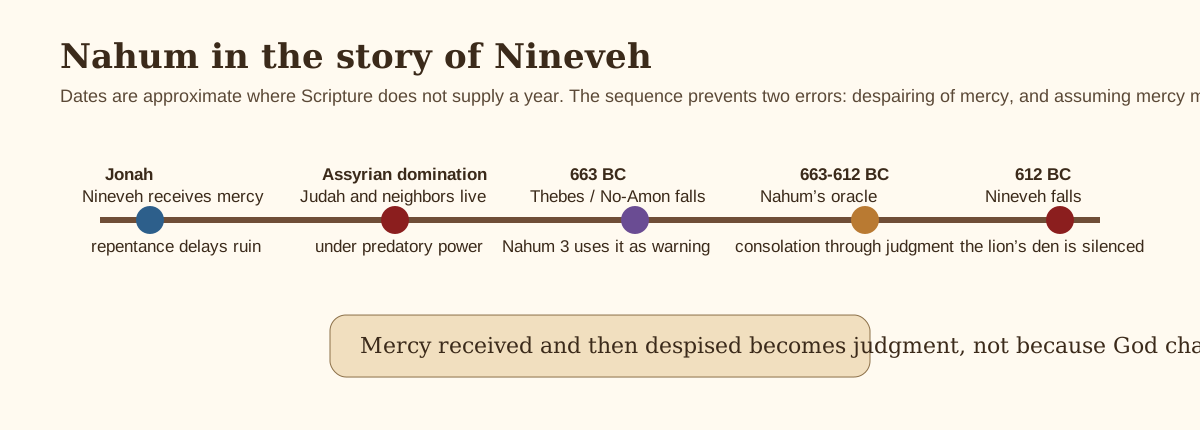 Source: Project-local schematic timeline for Nahum. Dates are approximate where Scripture does not supply a year.
The Burden and the Lord Who Avenges (Nahum 1:1-3)
1 The burden of Nineve: the book of the vision of Naum the Elkesite.
2 God is jealous, and the Lord avenges; the Lord avenges with wrath; the Lord takes vengeance on his adversaries, and he cuts off his enemies. 3 The Lord is long-suffering, and his power is great, and the Lord will not hold any guiltless: his way is in destruction and in the whirlwind, and the clouds are the dust of his feet.
Nahum calls the vision a burden because true prophecy weighs something on the prophet before it becomes speech to others. He does not begin with Assyrian politics. He begins with God.
The Lord’s jealousy is not insecurity. It is covenant faithfulness. God refuses to surrender His people, His holiness, or His truth to violent powers. His vengeance is not human revenge. It is righteous judgment against what destroys life.
The line “long-suffering, and his power is great” is the heart of the chapter. God’s patience makes judgment more morally serious, not less. His delay is not indifference, and His judgment is not an outburst. When He acts, He acts as the One who has seen, waited, warned, and judged truly.
Creation Trembles Before the Judge (Nahum 1:4-6)
4 He threatens the sea, and dries it up, and exhausts all the rivers: the land of Basan, and Carmel are brought low, and the flourishing trees of Libanus have come to nought. 5 The mountains quake at him, and the hills are shaken, and the earth recoils at his presence, even the world, and all that dwell in it. 6 Who shall stand before his anger? and who shall withstand in the anger of his wrath? his wrath brings to nought kingdoms, and the rocks are burst asunder by him.
Nahum expands judgment from Nineveh to creation. Seas, rivers, mountains, fertile regions, and kingdoms all stand before the Lord. This is not nature poetry for effect. It says that no empire can hide inside the world God made.
The sea and rivers also echo the Exodus pattern. God once delivered Israel from Egypt through water. Nahum does not make Nineveh a simple new Pharaoh, but he does show the same Lord opposing oppressive power. The God who dries seas can also dry the false confidence of a city.
The spiritual force is holy fear. If creation recoils before Him, then human strength is never ultimate. The question “Who shall stand?” is answered later in the chapter: only the one who waits for the Lord and reveres Him.
Refuge in the Day of Affliction (Nahum 1:7-8)
7 The Lord is good to them that wait on him in the day of affliction; and he knows them that reverence him. 8 But with an overrunning flood he will make an utter end: darkness shall pursue those that rise up against him and his enemies.
This is the comfort at the center of the storm. The Lord is not only powerful over enemies. He is good to those who wait for Him in affliction. He knows those who revere Him, not as data but as communion, care, and covenant recognition.
The same flood that terrifies the proud becomes consolation to the oppressed, because it says their suffering was not invisible. Judgment is frightening when detached from victims. In Nahum, it is heard as comfort by those crushed by violence.
A Complete End to Affliction (Nahum 1:9-14)
9 What do ye devise against the Lord? he will make a complete end: he will not take vengeance by affliction twice at the same time. 10 For the enemy shall be laid bare even to the foundation, and shall be devoured as twisted yew, and as stubble fully dry.
11 Out of thee shall proceed a device against the Lord, counselling evil things hostile to him.
12 Thus saith the Lord who rules over many waters, Even thus shall they be sent away, and the report of thee shall not be heard any more. 13 And now will I break his rod from off thee, and will burst thy bonds.
14 And the Lord shall give a command concerning thee; there shall no more of thy name be scattered: I will utterly destroy the graven images out of the house of thy god, and the molten images: I will make thy grave; for they are swift.
The enemy’s plans are called devices against the Lord because violence against people is never merely social or political. It is rebellion against the God whose image those people bear.
Beside “he will make a complete end,” the difficult phrase about vengeance “twice” stresses the decisiveness of God’s judgment, not an endless return to the same affliction. It is not a promise that a faithful person can suffer only once, nor a reason to treat every wound as punishment for a personal fault.
The “twisted yew” and dry stubble picture tangled growth consumed rather than protected by its density. What looks entrenched cannot withstand the Lord. And “who rules over many waters” returns us to the sea and rivers of verse 4: the power that shelters the afflicted belongs to the Creator, not to the empire that frightens them.
The promise “I will break his rod from off thee” makes judgment personal for the afflicted. God does not only defeat an empire in the abstract. He breaks the instrument laid on the neck of the oppressed. The point is not that Judah may now hate Assyria. The point is that God will not let affliction define His people forever.
The destruction of idols matters. Nineveh’s power was religious, cultural, military, and economic. The Lord judges not only armies but the false worship that made cruelty appear sacred.
Orthodox Theological Reading
| Divine attribute | What it is not | What it means for Judah | What it asks of us |
|---|---|---|---|
| Jealous | insecurity or mood | God will not surrender His people to evil | Do not make peace with idols. |
| Longsuffering | weakness or absence | God has waited without forgetting | Repent before patience becomes judgment. |
| Great in power | theatrical force | No empire outranks God | Do not envy violent strength. |
| Good refuge | sentimental comfort | God knows those who revere Him | Wait in prayer, not despair. |
| Complete judgment | human revenge | Affliction will not reign forever | Refuse vengeance; entrust judgment to God. |
Orthodox reading begins with God’s freedom from passion. His wrath is not like ours. He is never swept away by resentment. Judgment is the action of holy truth against what destroys communion.
Christological Reading
Christ fulfills Nahum without becoming a violent conqueror in Nineveh’s image. He reveals that divine power is not domination. On Hosanna Sunday, He enters Jerusalem meekly, moving toward the Cross. Yet in that humility He judges sin, death, the devil, and every false kingdom.
The refuge promised in Nahum becomes personal in Christ. He is the place where the afflicted wait on God. He is also the Judge before whom no empire, no idol, and no hidden cruelty can stand.
The Church’s Voice in Worship ⛪
The St. Mary Ottawa Holy Pascha book (2018) appoints Nahum 1:2-8 for Hosanna Sunday, Eleventh Hour, beside Isaiah 48:12-22 and Matthew 20:20-28.1 Isaiah reveals the Creator who redeems Jacob and judges Babylon. In the Gospel, the request for places of honor leads Christ to distinguish service from the domination practiced by earthly rulers.
The Lord whom Nahum calls great in power gives His life for many. The true King does not save by imitating Nineveh’s violence. He enters suffering, judges evil, and becomes refuge. To hear these readings together is to ask not only whether we trust His power, but whether our own use of power resembles His service.
Spiritual Fruit 🍇
Nahum 1 teaches patience without denial. If God has not acted yet, His silence is not indifference. If He warns, His warning is mercy. If He judges, His judgment is not cruelty.
The chapter asks the reader to pray in three directions: wait for God in affliction, repent before patience becomes judgment, and refuse to turn God’s judgment into personal revenge.
Teaching Notes
The Burden and the Lord Who Avenges
- Ask: Why does Nahum reveal God’s character before describing Nineveh’s fall?
- Emphasize: God’s jealousy is covenant faithfulness, not insecurity.
- Watch for: Do not let students confuse divine vengeance with human resentment.
- Connect: Romans 12:19 helps keep judgment in God’s hands.
- Show: The Prophet Nahum icon in the Introduction can frame the prophet as a witness under God’s word.
Creation Trembles Before the Judge
- Ask: Why does Nahum speak about sea, rivers, mountains, and kingdoms?
- Emphasize: Creation imagery makes empire look small before the Creator.
- Watch for: Do not flatten the passage into weather imagery only.
- Connect: The sea language can echo Exodus deliverance without forcing a one-to-one Pharaoh typology.
- Show: The context map in the Introduction helps place Assyria within the wider world God judges.
Refuge in the Day of Affliction
- Ask: How can the same passage be terrifying to the violent and consoling to the afflicted?
- Emphasize: The Lord knows those who revere Him.
- Watch for: Judgment passages can harm wounded people if taught with theatrical relish.
- Connect: Matthew 20:25-28 distinguishes greatness in service from the domination of earthly rulers.
- Show: The timeline can help students see patience, repentance, hardening, and judgment across Nineveh’s story.
A Complete End to Affliction
- Ask: What rods or bonds does God promise to break?
- Emphasize: The target is oppression and idolatry, not permission for hatred.
- Watch for: Keep victims in view. Do not make the discussion abstract.
- Connect: Christ breaks the deepest bondage through His Cross and Resurrection.
- Show: Return to the map only if students need to see why Assyria’s pressure on Judah matters.
Sources
Embedded Scripture is from Brenton’s English Septuagint (LXX).
Brief New Testament references are cited by reference.
Visual sources and licenses are listed in Resources Used - Nahum.
Footnotes
-
St. Mary Ottawa, Holy Pascha (Lent 1734 A.M., 2018 A.D.), pp. 64-69. This is an identified printed witness, not a claim about every current parish usage. ↩