


Nahum 2 turns the camera toward Nineveh’s collapse. The city that made others tremble now trembles. The chapter is not battle spectacle. It is the unraveling of false security.
Why This Passage Matters
Nineveh’s strength had a religious and psychological power. Its chariots, wealth, walls, and royal lion imagery told the world that Assyria was untouchable. Nahum announces that the image is false.
God does not merely comfort Judah by saying, “Feel better.” He comforts by declaring that the destroyer will not destroy forever.
Placement in the Book
Nahum 1 revealed the Lord’s character. Nahum 2 shows that character acting in history. The good news to Judah stands at the seam between divine judgment and restored worship.
In Brenton’s LXX numbering, the good-news line appears as Nahum 2:1. Many English Bibles following Hebrew chaptering place it at Nahum 1:15. The theological point is the same: peace for God’s people comes because the destroyer is being cut off.
Good News for Judah and the End of the Destroyer (Nahum 2:1-3)
1 Behold upon the mountains the feet of him that brings glad tidings, and publishes peace! O Juda, keep thy feasts, pay thy vows: for they shall no more pass through thee to thy decay.
2 It is all over with him, he has been removed, one who has been delivered from affliction has come up panting into thy presence, watch the way, strengthen thy loins, be very valiant in thy strength.
3 For the Lord has turned aside the pride of Jacob, as the pride of Israel: for they have utterly rejected them, and have destroyed their branches.
The first word is not to Nineveh but to Judah: keep the feasts, pay the vows, breathe again before God. True peace is not merely the absence of an enemy. It is worship restored after fear.
The messenger’s feet are beautiful because they carry news of peace to people who had lived under decay. This line also echoes Isaiah’s good-news language and is received apostolically in Romans 10:15. In Christian reading, the deepest proclamation of peace is the Gospel of Christ, who conquers not by becoming Assyria but by disarming evil through the Cross.
The commands in verse 2 need care. In familiar Hebrew-based English translations, they challenge Nineveh to brace for siege. St. Cyril of Alexandria, reading the Septuagint, hears encouragement to the delivered people preparing for the journey home. With Brenton’s “delivered from affliction” following the address to Judah, this guide follows that reading: readiness to receive freedom, not permission to become another Nineveh.1
Verse 3 supplies the reason for courage. Where Brenton says the Lord has “turned aside the pride of Jacob,” Cyril understands the arrogant oppression suffered by Jacob and Israel being removed. The ruined branches name the damage conquest has done. The Lord who ends the destroyer sees what His people have lost; they do not have to look strong before they can receive His help.1
Chariots, Gates, and the City Opened (Nahum 2:4-8)
4 They have destroyed the arms of their power from among men, their mighty men sporting with fire: the reins of their chariots shall be destroyed in the day of his preparation, and the horsemen shall be thrown into confusion 5 in the ways, and the chariots shall clash together, and shall be entangled in each other in the broad ways: their appearance is as lamps of fire, and as gleaming lightnings.
6 And their mighty men shall bethink themselves and flee by day; and they shall be weak as they go; and they shall hasten to her walls, and shall prepare their defences. 7 The gates of the cities have been opened, and the palaces have fallen into ruin, 8 and the foundation has been exposed; and she has gone up, and her maid-servants were led away as doves moaning in their hearts.
Nahum lets the military imagery stand. The chariots flash, the streets shake, the defenses are rushed, and the gates open. The city that once organized violence now experiences confusion inside its own machinery.
The spiritual point is not that war is beautiful. It is that false security eventually turns on itself. The things Nineveh trusted become signs of panic: speed becomes collision, walls become desperation, gates become exposure.
The reader should feel the reversal. Empire often performs invincibility. Nahum shows how quickly the performance fails when God withdraws the illusion.
Spoil Emptied and Hearts Melted (Nahum 2:9-11)
9 And as for Nineve, her waters shall be as a pool of water: and they fled, and staid not, and there was none to look back.
10 They plundered the silver, they plundered the gold, and there was no end of their adorning; they were loaded with it upon all their pleasant vessels. 11 There is thrusting forth, and shaking, and tumult, and heart-breaking, and loosing of knees, and pangs on all loins; and the faces of all are as the blackening of a pot.
Nineveh’s wealth had been gathered through conquest. Nahum shows it emptied. The city that treated other peoples as spoil now becomes spoil itself.
The line about faces blackened like a pot is an image of terror and collapse. The body betrays what propaganda hid. Knees loosen, hearts break, and faces darken because the city finally meets the fear it exported.
Spiritually, wealth taken without righteousness cannot save. Possessions can decorate a collapsing house. They cannot turn it into refuge.
The Lion’s Den Silenced (Nahum 2:12-14)
12 Where is the dwelling-place of the lions, and the pasture that belonged to the whelps? where did the lion go, that the lion’s whelp should enter in there, and there was none to scare him away? 13 The lion seized enough prey for his whelps, and strangled for his young lions, and filled his lair with prey, and his dwelling-place with spoil.
14 Behold, I am against thee, saith the Lord Almighty, and I will burn up thy multitude in the smoke, and the sword shall devour thy lions; and I will utterly destroy thy prey from off the land, and thy deeds shall no more at all be heard of.
This is the sharpest satire in the chapter. Assyrian royal art loved the lion. The king mastering lions projected domination, courage, order, and terror. Nahum turns that image against Nineveh: where is the lion’s den now?
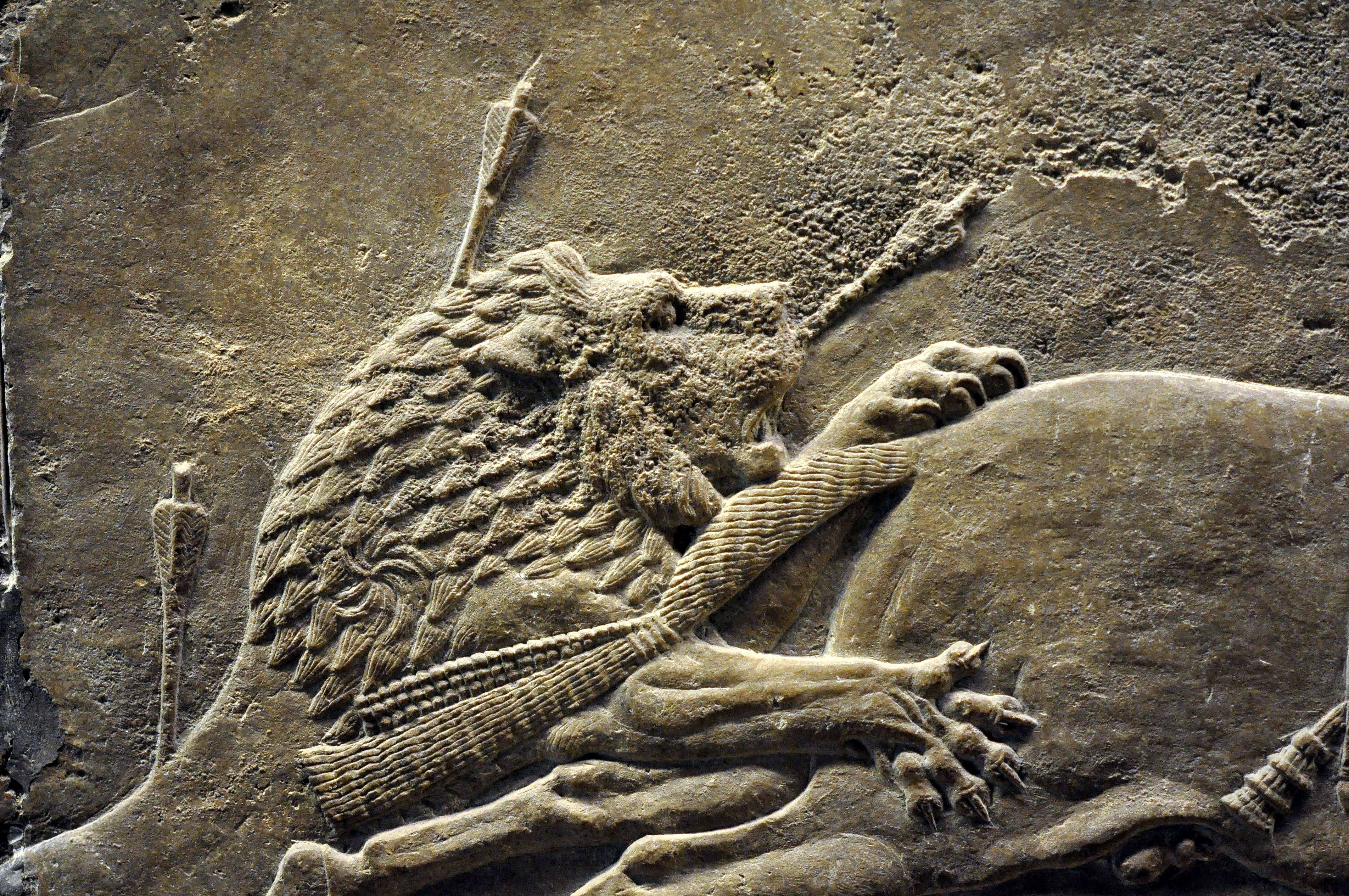 Source: Ashurbanipal lion-hunt relief, North Palace at Nineveh, CC BY-SA 4.0, Osama Shukir Muhammed Amin FRCP(Glasg), via Wikimedia Commons.
Nineveh’s royal symbol is judged by the Lord. The lair full of prey becomes evidence against the city. What looked like royal strength is revealed as predation.
The most sobering words are “Behold, I am against thee.” No human accusation is as serious as the Lord’s opposition. When God rises against predatory power, the sound of its deeds is silenced.
Orthodox Theological Reading
Nahum 2 teaches that God judges propaganda as well as violence. Empires do not only harm through weapons. They also train people to admire power, fear spectacle, and believe cruelty is normal.
Orthodox spiritual reading must therefore ask where the soul builds its own lion’s den: reputation, anger, status, money, religious knowledge, or control used to make others afraid. The chapter is not only about ancient Assyria. It is about every false strength that feeds on others.
Christological Reading
Christ is the true bringer of peace on the mountains. He does not merely announce the fall of an enemy city; He proclaims the Kingdom, defeats death, and restores worship.
The lion imagery also turns toward Him by contrast. Nineveh is the devouring lion. Christ is the Lion of Judah who conquers as the Lamb. His victory does not fill a den with prey. It empties Hades and gathers the wounded.
The Church’s Voice in Worship ⛪
The good-news line at the opening of Brenton Nahum 2 belongs spiritually with the Church’s proclamation of peace. It is not a private optimism. It is worship restored after bondage.
The chapter warns every generation not to mistake visible power for permanence. Its invitation to worship is not an escape from suffering but a refusal to let the destroyer determine whom we adore.
Spiritual Fruit 🍇
Nahum 2 asks the reader to stop envying what God is already judging. Speed, wealth, military confidence, and public image can all collapse when they are built on predation.
The spiritual fruit is sobriety: do not build a life that requires others to be afraid. Do not trust what must keep performing strength. Let Christ be your peace before false security is exposed.
Teaching Notes
Good News for Judah and the End of the Destroyer
- Ask: Why is restored worship the first sign of peace?
- Emphasize: Good news is not abstract comfort. It announces that affliction will not reign forever.
- Watch for: Do not let students turn Judah’s comfort into hatred of Assyria.
- Connect: Romans 10:15 receives the beautiful-feet language in relation to Gospel proclamation.
- Show: Point back to the timeline from the Introduction to show the seam between patience, hardening, and judgment.
Chariots, Gates, and the City Opened
- Ask: What happens to the things Nineveh trusted?
- Emphasize: Speed, walls, and military splendor become signs of confusion.
- Watch for: Avoid making the battle imagery entertaining.
- Connect: False security collapses in the soul the same way it collapses in cities.
- Show: The broad Assyrian map can help students understand why Nineveh seemed untouchable.
Spoil Emptied and Hearts Melted
- Ask: What does plunder reveal about the source of Nineveh’s wealth?
- Emphasize: Wealth gathered without righteousness cannot become refuge.
- Watch for: Keep the suffering of victims in view.
- Connect: Christ warns that treasure on earth can be stolen, corrupted, and lost.
- Show: No additional image is necessary here unless students need the empire context again.
The Lion’s Den Silenced
- Ask: Why does Nahum use lion imagery for Nineveh?
- Emphasize: Assyrian royal strength is exposed as predation.
- Watch for: Do not admire the lion-den image more than the prophetic critique.
- Connect: Contrast the devouring lion with Christ, the victorious Lamb and true Lion of Judah.
- Show: The Ashurbanipal lion-hunt relief is the major visual aid for this chapter.
Sources
Embedded Scripture is from Brenton’s English Septuagint (LXX).
Brief New Testament references are cited by reference.
Visual source: Ashurbanipal lion-hunt relief from Nineveh, CC BY-SA 4.0, listed in Resources Used - Nahum.
Footnotes
-
St. Cyril of Alexandria, Commentary on the Twelve Prophets, vol. 2, trans. Robert C. Hill (2008), Commentary on Nahum, chapter 2, pp. 307-309, on “Keep watch on the road” and the removal of Jacob’s oppression. The account of the commands and Jacob’s oppression paraphrases his Septuagint interpretation; it does not adopt his historical identifications. Consulted translation. ↩ ↩2