


Amos 3-4 is about covenant intimacy becoming covenant accountability. Israel is not judged because God never loved her. Israel is judged because God did love her, knew her, delivered her, warned her, and called her back again and again.
Amos 3-4
Translation: Brenton Septuagint.
- Hear ye this word, O house of Israel, which the Lord has spoken concerning you, and against the whole family whom I brought up out of the land of Egypt, saying,
- You especially have I known out of all the families of the earth: therefore will I take vengeance upon you for all your sins.
- Shall two walk together at all, if they do not know one another?
- Will a lion roar out of his thicket if he has no prey? will a lion’s whelp utter his voice at all out of his lair, if he have taken nothing?
- Will a bird fall on the earth without a fowler? will a snare be taken up from the earth without having taken anything?
- Shall the trumpet sound in the city, and the people not be alarmed? shall there be evil in a city which the Lord has not wrought?
- For the Lord God will do nothing, without revealing instruction to his servants the prophets.
- A lion shall roar, and who will not be alarmed? the Lord God has spoken, and who will not prophesy?
- Proclaim it to the regions among the Assyrians, and to the regions of Egypt, and say, Gather yourselves to the mountain of Samaria, and behold many wonderful things in the midst of it, and the oppression that is in it.
- And she knew not what things would come against her, saith the Lord, even those that store up wrong and misery in their countries.
- Therefore thus saith the Lord God; O Tyre, thy land shall be made desolate round about thee; and he shall bring down thy strength out of thee, and thy countries shall be spoiled.
- Thus saith the Lord; As when a shepherd rescues from the mouth of a lion two legs or a piece of an ear, so shall be drawn forth the children of Israel who dwell in Samaria in the presence of a foreign tribe, and in Damascus.
- Hear, O ye priests, and testify to the house of Jacob, saith the Lord God Almighty.
- For in the day wherein I shall take vengeance of the sins of Israel upon him, I will also take vengeance on the altars of Bæthel: and the horns of the altar shall be broken down, and they shall fall upon the ground.
- I will crush and smite the turreted-house upon the summer-house; and the ivory-houses shall be destroyed, and many other houses also, saith the Lord.
- Hear ye this word, ye heifers of the land of Basan that are in the mountain of Samaria, that oppress the poor, and trample on the needy, which say to their masters, Give us that we may drink.
- The Lord swears by his holiness, that, behold, the days come upon you, when they shall take you with weapons, and fiery destroyers shall cast those with you into boiling caldrons.
- And ye shall be brought forth naked in the presence of each other; and ye shall be cast forth on the mountain Romman, saith the Lord.
- Ye went into Bæthel, and sinned, and ye multiplied sin at Galgala; and ye brought your meat-offerings in the morning, and your tithes every third day.
- And they read the law without, and called for public professions: proclaim aloud that the children of Israel have loved these things, saith the Lord.
- And I will give you dulness of teeth in all your cities, and want of bread in all your places: yet ye returned not to me, saith the Lord.
- Also I withheld from you the rain three months before the harvest: and I will rain upon one city, and on another city I will not rain: one part shall be rained upon, and the part on which I shall not rain shall be dried up.
- And the inhabitants of two or three cities shall be gathered to one city to drink water, and they shall not be satisfied: yet ye have not returned to me, saith the Lord.
- I smote you with parching, and with blight: ye multiplied your gardens, your vineyards, and your fig-grounds, and the cankerworm devoured your oliveyards: yet not even thus did ye return to me, saith the Lord.
- I sent pestilence among you by the way of Egypt, and slew your young men with the sword, together with thy horses that were taken captive; and in my wrath against you I set fire to your camps: yet not even thus did ye return to me, saith the Lord.
- I overthrew you, as God overthrew Sodoma and Gomorrha, and ye became as a brand plucked out of the fire: yet not even thus did ye return to me, saith the Lord.
- Therefore thus will I do to thee, O Israel: nay because I will do thus to thee, prepare to call on thy God, O Israel.
- For, behold, I am he that strengthens the thunder, and creates the wind, and proclaims to men his Christ, forming the morning and the darkness, and mounting on the high places of the earth, The Lord God Almighty is his name.
These chapters hold together covenant intimacy and covenant warning. The commentary below follows the movement from being known by God to refusing to return to God.
Light from the Word 🕯️
”You especially have I known”
Amos 3:2 is the key: “You especially have I known out of all the families of the earth: therefore will I take vengeance upon you for all your sins.” Election is not favoritism without holiness. To be known by God is to be brought near, and nearness makes sin more serious, not less.
This is a hard word for church people. Baptism, liturgy, confession, fasting, hymnology, and Orthodox identity are gifts of mercy. They are not hiding places from repentance. The more God gives, the more love asks for a truthful response.
The lion has roared
Amos piles up questions: will a lion roar without prey, will a trumpet sound without alarm, will the Lord speak without revealing instruction to His prophets? The prophet is not speaking because he enjoys confrontation. “The Lord God has spoken, and who will not prophesy?” (Amos 3:8).
This matters for spiritual life. Sometimes we call correction harsh because we do not want to ask whether God is speaking through it. Not every harsh word is prophetic, but a true word from God must not be dismissed because it disturbs us.
”Yet ye returned not to me”
Amos 4 repeats the refrain: famine, drought, blight, pestilence, sword, fire, and still, “yet ye returned not to me.” The point is not that God delights in calamity. The point is that even severe mercy can be refused.
A person can survive warnings and become softer. A person can survive warnings and become harder. Amos teaches us to ask what suffering, correction, disappointment, and loss are doing in the heart. Are they turning me toward God, or only making me more skilled at self-protection?
LXX insight: “prepare to call on thy God”
Many English translations render Amos 4:12 as “prepare to meet your God.” Brenton’s Septuagint reads, “prepare to call on thy God, O Israel.” The difference should not be exaggerated, but it is spiritually fruitful. The meeting is still solemn. But the LXX wording emphasizes invocation. Judgment is not only collision with God; it is a final summons to call on Him truthfully.
Amos 4:13 also contains striking Brenton wording: God “proclaims to men his Christ.” Orthodox readers should notice this without turning it into a crude proof-text. In the Septuagint, the language allows the Christian reader to hear that the Creator who forms morning and darkness also makes known His Anointed One. In Holy Week, that Anointed One stands before the world in humility and judgment.
Coptic liturgical reading
Local Pascha data confirms Amos 4:4-13 on Great Thursday Eve, Third Hour, and Amos 3:1-11 on Great Thursday Eve, Sixth Hour. This placement is not accidental. On the threshold of the Mystical Supper, betrayal, and the Passion, the Church hears a people who had worship, offerings, and public religion, yet still did not return.
Iconography and Visual Teaching 🖼️
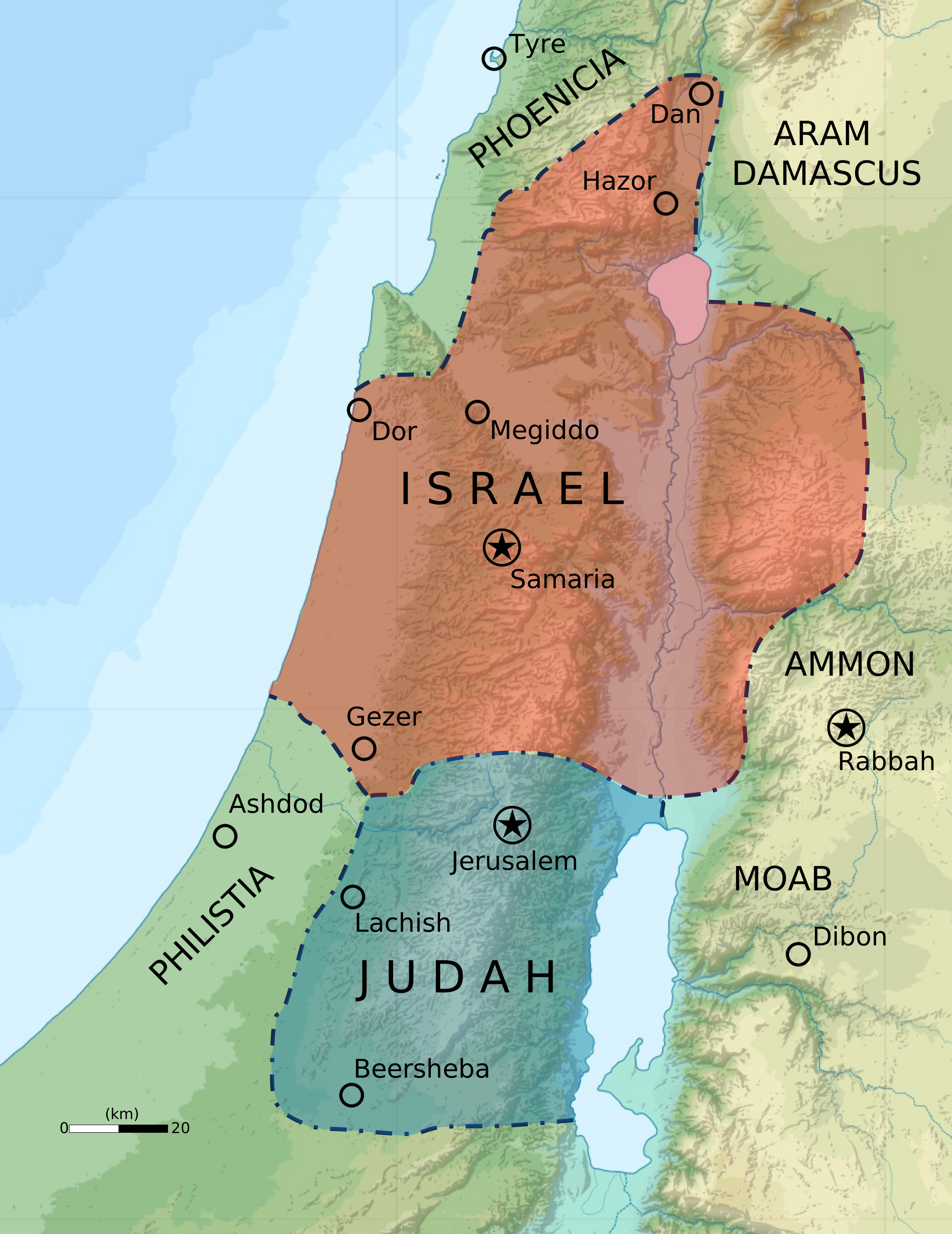 Source: Tobias Schäfer 87, Wikimedia Commons, CC BY 4.0.
The map helps show the tension between Tekoa in Judah and Bethel/Samaria in Israel. Amos is sent across a boundary to confront a royal and religious center that had learned to confuse power with God’s approval.
Spiritual Fruit 🍇
- Treat spiritual privilege as responsibility. The gifts of the Church are not excuses. They are light, and light reveals.
- Return while the warning is still mercy. Amos repeats the tragedy: God acted, but Israel did not return. Do not waste the warnings that are meant to wake you.
- Do not despise the lion’s roar. A disturbing word may be the mercy of God before the heart becomes unable to hear.
- Call on God before you stand before God. The LXX wording presses prayer into judgment: prepare to call on your God.
Teaching Notes
Amos 3-4
- Ask: why does being “known” by God increase accountability?
- Emphasize: Amos 4 is not random disaster theology. The repeated refrain shows refused return.
- Watch for: using suffering to accuse victims. Teach the passage first as a call to self-examination, not as a tool for explaining someone else’s pain.
- Connect: Holy Week, covenant betrayal, and the Crucified Christ as the One before whom all false security is exposed.
- Show: use the map to locate Tekoa, Judah, Israel, Bethel, and Samaria if teaching the historical setting.
Sources
Primary sources
- Scripture: Brenton, The Septuagint Version of the Old Testament, public domain English translation.
- Coptic Orthodox Holy Week/Pascha readings: local lectionary reference data drawn from the St. Mary Ottawa Holy Pascha source text and related Pascha day-hour indexes.
Secondary academic sources
- John Goldingay, Hosea-Micah, used for historical orientation to the Twelve Prophets.
- Standard Bible atlas and historical background resources were used for the 8th-century Israel/Judah setting.
Coptic Orthodox / pastoral sources
- Fr. Tadros Yacoub Malaty, commentary on Amos and the Twelve Prophets, used for Coptic pastoral framing where directly relevant.
- Pope Shenouda III and Fr. Bishoy Kamel, pastoral writings on repentance, worship, mercy, and service, used as modern Coptic spiritual framing rather than patristic proof.
- Septuagint wording in Amos 4:12-13 was checked against Brenton’s English LXX.
Web pages and non-academic sources cited
- Wikimedia Commons, Kingdoms of Israel and Judah (8th century BCE), CC BY 4.0, https://commons.wikimedia.org/wiki/File:Kingdoms_of_Israel_and_Judah_(8th_century_BCE).svg.