


Hosea’s marriage sign is one of Scripture’s hardest prophetic acts. It reveals Israel’s idolatry as adultery, but it also reveals the Lord’s love as wounded, costly, and pursuing. The children named Jezreel, Unpitied, and Not My People become living signs that judgment is real, but not the final word. God speaks again: My people
, Pitied
, and I will betroth thee to myself for ever
.
Historical and Scriptural Context
These opening chapters stand at the doorway of the whole book. Before Hosea confronts kings, priests, sacrifices, and treaties, he shows the heart of the matter: Israel has broken covenant love. Baal worship was not a private spiritual hobby. It was the reassigning of God’s gifts, grain, wine, oil, silver, and safety, to another lover.
The setting is the northern kingdom before its fall. Hosea speaks while prosperity and religious activity still make Israel look alive. The prophet’s household becomes a sign that the nation’s public worship has a private wound: the heart has forgotten who gave every gift.
The Church’s Voice in Worship ⛪
No exact Coptic lectionary row for Hosea 1-3 was confirmed in the local CSV during this pass. The chapters still prepare the Holy Week Hosea readings because they establish the book’s language of wounded love, exposure, judgment, and return. This is the lens through which the later Pascha passages should be heard.
Scripture Reading
1: The word of the Lord which came to Osee the son of Beeri, in the days of Ozias, and Joatham, and Achaz, and Ezekias, kings of Juda, and in the days of Jeroboam son of Joas, king of Israel. 2: The beginning of the word of the Lord by Osee. And the Lord said to Osee, Go, take to thyself a wife of fornication, and children of fornication: for the land will surely go a-whoring in departing from the Lord. 3: So he went and took Gomer, daughter of Debelaim; and she conceived, and bore him a son. 4: And the Lord said to him, Call his name Jezrael; for yet a little while, and I will avenge the blood of Jezrael on the house of Juda, and will make to cease the kingdom of the house of Israel. 5: And it shall be, in that day, that I will break the bow of Israel in the valley of Jezrael. 6: And she conceived again, and bore a daughter. And he said to him, Call her name, Unpitied: for I will no more have mercy on the house of Israel, but will surely set myself in array against them. 7: But I will have mercy on the house of Juda, and will save them by the Lord their God, and will not save them with bow, nor with sword, nor by war, nor by horses, nor by horsemen. 8: And she weaned Unpitied; and she conceived again, and bore a son. 9: And he said, Call his name, Not my people: for ye are not my people, and I am not your God.
1: Yet the number of the children of Israel was as the sand of the sea, which shall not be measured nor numbered; and it shall come to pass, that in the place where it was said to them, Ye are not my people, even they shall be called the sons of the living God. 2: And the children of Juda shall be gathered, and the children of Israel together, and shall appoint themselves one head, and shall come up out of the land: for great shall be the day of Jezrael. 3: Say to your brother, My people, and to your sister, Pitied. 4: Plead with your mother, plead: for she is not my wife, and I am not her husband: and I will remove her fornication out of my presence, and her adultery from between her breasts: 5: that I may strip her naked, and make her again as she was at the day of her birth: and I will make her desolate, and make her as a dry land, and will kill her with thirst. 6: And I will not have mercy upon her children; for they are children of fornication. 7: And their mother went a-whoring: she that bore them disgraced them: for she said, I will go after my lovers, that give me my bread and my water, and my garments, and my linen clothes, my oil and all my necessaries. 8: Therefore, behold, I hedge up her way with thorns, and will stop the ways, and she shall not find her path. 9: And she shall follow after her lovers, and shall not overtake them; and she shall seek them, but shall not find them: and she shall say, I will go, and return to my former husband; for it was better with me than now. 10: And she knew not that I gave her her corn, and wine, and oil, and multiplied silver to her: but she made silver and gold images for Baal. 11: Therefore I will return, and take away my corn in its season, and my wine in its time; and I will take away my raiment and my linen clothes, so that she shall not cover her nakedness. 12: And now I will expose her uncleanness before her lovers, and no one shall by any means deliver her out of my hand. 13: And I will take away all her gladness, her feasts, and her festivals at the new moon, and her sabbaths, and all her solemn assemblies. 14: And I will utterly destroy her vines, and her fig-trees, all things of which she said, These are my hire which my lovers have given me: and I will make them a testimony, and the wild beasts of the field, and the birds of the sky, and the reptiles of the earth shall devour them. 15: And I will recompense on her the days of Baalim, wherein she sacrificed to them, and put on her ear-rings, and her necklaces, and went after her lovers, and forgot me, saith the Lord. 16: Therefore, behold, I will cause her to err, and will make her as desolate, and will speak comfortably to her. 17: And I will give her her possessions from thence, and the valley of Achor to open her understanding: and she shall be afflicted there according to the days of her infancy, and according to the days of her coming up out of the land of Egypt. 18: And it shall come to pass in that day, saith the Lord, that she shall call me, My husband, and shall no longer call me Baalim. 19: And I will take away the names of Baalim out of her mouth, and their names shall be remembered no more at all. 20: And I will make for them in that day a covenant with the wild beasts of the field, and with the birds of the sky, and with the reptiles of the earth: and I will break the bow and the sword and the battle from off the earth, and will cause thee to dwell safely. 21: And I will betroth thee to myself for ever; yea, I will betroth thee to myself in righteousness, and in judgment, and in mercy, and in tender compassions; 22: and I will betroth thee to myself in faithfulness: and thou shalt know the Lord. 23: And it shall come to pass in that day, saith the Lord, I will hearken to the heaven, and it shall hearken to the earth; 24: and the earth shall hearken to the corn, and the wine, and the oil; and they shall hearken to Jezrael. 25: And I will sow her to me on the earth; and will love her that was not loved, and will say to that which was not my people, Thou art my people; and they shall say, Thou art the Lord my God.
1: And the Lord said to me, Go yet, and love a woman that loves evil things, and an adulteress, even as the Lord loves the children of Israel, and they have respect to strange gods, and love cakes of dried grapes. 2: So I hired her to myself for fifteen pieces of silver, and a homer of barley, and a flagon of wine. 3: And I said unto her, Thou shalt wait for me many days; and thou shalt not commit fornication, neither shalt thou be for another man; and I will be for thee. 4: For the children of Israel shall abide many days without a king, and without a prince, and without a sacrifice, and without an altar, and without a priesthood, and without manifestations. 5: And afterward shall the children of Israel return, and shall seek the Lord their God, and David their king; and shall be amazed at the Lord and at his goodness in the latter days.
Light from the Word 🕯️
The names of the children carry the first wound. Jezreel recalls bloodshed and political judgment. Unpitied
says that mercy cannot be presumed while the heart clings to idols. Not My People
is the terrifying language of covenant rupture. Yet even here, mercy interrupts judgment. In the place where the people were told, Ye are not my people
, they will be called sons of the living God
.
That reversal is not cheap. Hosea 2 exposes the heart’s false accounting: my lovers… give me my bread and my water
. The soul begins to heal when it admits that the idol did not feed it. God gave the grain, wine, oil, clothing, and breath. Sin is ingratitude before it becomes rebellion.
The valley of Achor, the place associated with trouble, becomes a door of hope
in the Hebrew tradition and in Brenton, a place where God will open her understanding
. That is a beautiful source-shape difference. The hope is not only a changed circumstance; it is opened understanding. Repentance begins when God lets the soul see clearly.
Apostolic and Patristic Reception
St. Paul uses Hosea’s not My people
language in Romans 9:25-26 to speak of God’s mercy reaching those once outside the visible covenant boundary. Eusebius of Caesarea, in Proof of the Gospel, treats this apostolic use as part of the witness that the calling of the nations is not an afterthought. Hosea’s wounded marriage opens into the Church gathered from Jews and Gentiles under one Bridegroom.
This is why Hosea must not be read as religious romance. The Bridegroom does not deny betrayal. He heals it through truth, ransom, and renewed covenant. The Church is not loved because she is pure. She becomes pure because Christ loves her and gives Himself for her.
Christological and Liturgical Reading
Christ is the Bridegroom who bears betrayal without ceasing to call the bride home. Hosea 3, where the woman is brought back at a cost, quietly prepares the Christian reader to understand redemption as costly love. The Cross is not sentimental forgiveness. It is the Bridegroom entering the shame and debt of the beloved to restore communion. In John 3:29 the Forerunner names that same Lord and rejoices as the bride is gathered to Him.
Iconography and Visual Teaching 🖼️
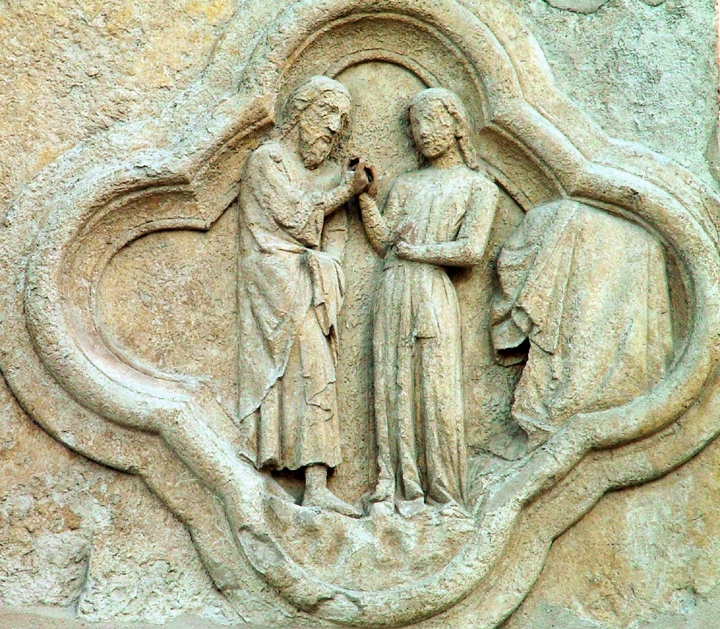 Source: Anne C. Richardson and Jim Womack,
 Hosea Takes Gomer to Be His Wife
, Jean and Alexander Heard Libraries, public domain, Wikimedia Commons. https://commons.wikimedia.org/wiki/File:Hosea_Takes_Gomer_to_Be_His_Wife_-_Vanderbilt_ACT_-_00001406.jpg
Use this image soberly. It is illustrative artwork, not an Orthodox icon. Its teaching value is that Hosea’s sign involves public shame, obedience, and cost. It should not be used to romanticize betrayal or pressure wounded spouses. The prophetic sign points to God’s covenant mercy; it is not a rule for unsafe human relationships.
Spiritual Fruit 🍇
First, ask where you have renamed God’s gifts as the gifts of your idols. Time, money, food, attention, health, success, family, and ministry can all be received from God or seized as fuel for another lover.
Second, do not confuse being exposed with being abandoned. Hosea shows that God may block the road to the idol because He is making return possible.
Third, let repentance become truth before it becomes feeling. The returning bride says, I will go, and return to my former husband
. That is not poetic emotion. It is clear speech after deception.
Teaching Notes
- Linger over the reversal of names: Not My People to My People, Unpitied to Pitied.
- Emphasize that the marriage sign is unique prophetic symbolism, not pastoral instruction for abuse or betrayal cases.
- Avoid sentimentalizing Gomer or reducing Israel to
bad people. The reader must find his own divided heart here.
Discussion Questions
- What gift from God have I credited to something else?
- Why is
opened understandingan act of mercy?- How does St. Paul’s use of Hosea in Romans 9 deepen the meaning of
My people?- Where does Christ reveal Himself as the costly Bridegroom in these chapters?
Closing Meditation
The Lord does not call the unfaithful bride home because betrayal was small. He calls her because His mercy is greater. The name over the repentant soul is no longer Not My People
. It is Mine
.
Sources
Primary sources
- Scripture: Hosea in Brenton, The Septuagint Version of the Old Testament, public domain English LXX.
- New Testament cross-references are brief NKJV references only.
- John 3:22-36, The Friend of the Bridegroom, for the Forerunner’s joy when the Bridegroom has the bride.
- Eusebius of Caesarea, Proof of the Gospel, Book 2, Chapter 3, on Romans 9 and Hosea. https://www.tertullian.org/fathers/eusebius_de_04_book2.htm#C3
Secondary academic sources
- John Goldingay, Hosea-Micah, used for historical and literary orientation, not as theological authority.
- Standard critical introductions to the Twelve Prophets used for date, setting, and divided-kingdom background.
Coptic Orthodox / pastoral sources
- Fr. Tadros Yacoub Malaty, patristic commentary on Hosea, used as Coptic Orthodox pastoral orientation where relevant.
- Pope Shenouda III, pastoral teaching on repentance, purity, prayer, and return to God, used only for broad spiritual framing.
- Fr. Bishoy Kamel, pastoral witness on repentance, prayer, service, and love for God, used cautiously as spiritual framing.
Web pages and non-academic sources cited
- CCEL and Tertullian Project links are used as public access points for patristic texts where cited.
- St. Mary Ottawa Holy Pascha Katameros PDF and prior project source notes preserve the Hosea Pascha placement findings; this pass did not find matching Hosea rows in the local lectionary CSV.
- Hosea and Gomer artwork, public domain. https://commons.wikimedia.org/wiki/File:Hosea_Takes_Gomer_to_Be_His_Wife_-_Vanderbilt_ACT_-_00001406.jpg
Source and Translation Notes
- Full embedded Old Testament Scripture text is from Brenton’s English Septuagint.
- Brief New Testament references are NKJV references only.
- LXX and source-shape comments are included only where the wording materially affects interpretation.
- Coptic lectionary claims are stated only where preserved from prior source-backed Hosea/Pascha research; no new Hosea rows were found in the local lectionary CSV during this revision pass.
- Hosea 2:17 in Brenton,
open her understanding, is treated as spiritually significant because it sharpens repentance as illumination, not merely changed circumstances.