
The Bottom Rung Is the Only Way Up
Poor in spirit
“Blessed are the poor in spirit, for theirs is the kingdom of heaven.”
Matthew 5:3
Main burden
Poverty of spirit is the truthful recognition that everything good in us is received from God and that we cannot heal, justify, or save ourselves. It is not self-hatred, passivity, or pretending that our gifts do not exist. It is standing before God without a résumé and without comparison, asking for mercy with open hands. Christ does not shame that person. He gives him the Kingdom.
Opening: two men bring their résumés to God
Imagine two people walking into church.
The first has been fasting. He gives regularly. He serves. He knows the prayers. He has stayed away from the obvious sins that have wrecked other lives. If you were choosing someone for a ministry, you might choose him.
The second man carries public disgrace because he belongs to a tax system notorious for exploitation. He cannot point to a clean record. He remains at the back, lowers his eyes, beats his breast, and says only, “God, be merciful to me a sinner.”
Jesus says the second man goes home justified.
That should unsettle us. Even if everything the first man reports is true, as Saint John Chrysostom reads it, his tragedy remains: he turns God’s gifts into evidence that he no longer needs mercy.1 He comes to prayer carrying a résumé. The Publican comes carrying only his wound.
The first Beatitude asks us a dangerous question: When I stand before God, what am I relying on?
1. Why Jesus begins here
The Sermon on the Mount opens with a blessing, not a demand:
“Blessed are the poor in spirit, for theirs is the kingdom of heaven.”
Jesus does not begin, “Try harder.” He announces whom God calls blessed. The Beatitudes describe the life of the Kingdom, a life fulfilled perfectly in Christ and formed in us by His grace.
The word translated “blessed,” makarioi, means more than feeling cheerful. Jesus is declaring a person favored under God’s reign, even when that person’s outward life does not look successful by the world’s standards.
The word translated “poor,” ptōchoi, can describe real destitution. The image of a beggar can help us see the force of the word: empty hands, no leverage, no claim of self-sufficiency. But Jesus says “poor in spirit.” He is not romanticizing material deprivation, and He is not saying that poverty, abuse, failure, or humiliation is good in itself. He blesses the person who knows, at the deepest level, “I live from God. I cannot manufacture grace. I cannot cure my own soul.”
Matthew’s phrase “in spirit” does not erase Christ’s blessing of the materially poor in Luke 6:20. A heart that truly depends on God cannot remain indifferent to people in need. Poverty of spirit bears fruit in generosity, almsgiving, solidarity, and freedom from the false security of wealth.
Saint John Chrysostom asks why Christ did not simply say “the humble.” His answer is that “poor” presses the meaning further. Christ means those who are “humble and contrite in mind,” those who tremble before God’s word rather than treating it as material for judging somebody else.1
Chrysostom then makes a severe claim: fasting, prayer, almsgiving, and self-control can all collapse if humility is missing. This is why Christ places poverty of spirit first. Humility is not one decorative virtue among many. It keeps every other virtue turned toward God.
A person can fast and become proud of fasting. A person can serve and resent being unnoticed. A person can defend Orthodox teaching and enjoy humiliating people more than bringing them to Christ. A church servant can do something beautifully and begin listening for admiration instead of listening to God. Even obedience can become a private claim to superiority: “I am the faithful one. Why are these people not like me?”
The first Beatitude pulls boasting out by the root.
2. The Publican: prayer with empty hands
Saint Luke tells us why Jesus spoke the parable:
“Also He spoke this parable to some who trusted in themselves that they were righteous, and despised others.”
Those two actions belong together. The moment I trust in my own righteousness, I need somebody beneath me. Comparison becomes the oxygen of pride.
The Pharisee stands and prays “to himself.” His prayer contains the word “God,” but it never seems to leave the closed circle of his own self-regard. He reports his achievements, names the failures of other people, and uses the Publican as a dark background against which his own life looks bright.
Notice how religious his pride sounds:
“God, I thank You that I am not like other men.”
He gives God verbal credit while keeping the glory. Even if everything he reports is true, his spiritual blindness lies in what he cannot see: every good act was already grace, and his own heart still needed mercy.
The Publican stands far off. He will not raise his eyes. He beats his breast and says:
“God, be merciful to me a sinner!”
His prayer is short because he has stopped negotiating. He does not offer excuses. He does not compare himself with someone worse. He does not promise a performance in exchange for forgiveness. He tells the truth and places that truth inside God’s mercy.
This is poverty of spirit.
It is not saying, “I am worthless.” The Publican comes to the temple because he believes God is merciful. Despair says, “My wound is greater than God’s mercy, so there is no point coming.” Pride says, “I have no serious wound, so I do not need mercy.” Humility rejects both lies. It says, “My sin is real, and God’s mercy is greater. I will come.”
Saint John Chrysostom says:
“If then we pray with humility, smiting our breast as the publican, if we utter what he did, if we say, ‘Be merciful to me a sinner,’ we shall obtain all.”2
But Chrysostom refuses to let humility become theatre. It is easy to call ourselves sinners in prayer and then become furious when anyone suggests we may actually be wrong. He warns that if we speak lowly words about ourselves but cannot bear correction, our confession may be another way of seeking the reputation of humility.
Here is one honest test: What happens inside me when I am corrected?
Do I become curious, or do I immediately build a defense? Do I need to explain my intention before I hear the other person’s pain? Can I say, “I was wrong,” without adding, “but you also…”?
The Publican stops defending himself and asks for healing.
3. Poverty of spirit is truth, not self-contempt
Humility is often misunderstood in two opposite ways.
The first counterfeit is low self-esteem. A person speaks harshly about himself, refuses every compliment, denies every ability, and assumes that confidence must be pride. But denying a gift that God has given is not humility. If God has given you intelligence, leadership, musical ability, endurance, or compassion, the truthful response is gratitude and stewardship, not denial.
Saint Mary gives us the clearest example. In the Magnificat she says:
“For He has regarded the lowly state of His maidservant; for behold, henceforth all generations will call me blessed. For He who is mighty has done great things for me.”
She does not deny that all generations will call her blessed. She names the glory and gives its source: “He who is mighty has done great things for me.” Humility does not say, “There is no grace here.” It says, “This grace is gift.”
The second counterfeit is passivity. Some people use humility to avoid responsibility, hard conversations, leadership, or protection of the vulnerable. “Who am I to speak?” can sound spiritual while functioning as fear. Christ was humble, yet He confronted hypocrisy, overturned tables, protected the dishonored, and went freely toward the Cross. Poverty of spirit removes self-reliance; it does not remove courage.
True humility is agreement with reality. God is God, and I am not. I am created in His image, deeply loved, and entrusted with real gifts. Sin has wounded my judgment and desires. I need grace at every moment, and my neighbor needs mercy just as I do.
Humility is not thinking about ourselves with disgust. It is becoming free enough to stop making ourselves the center.
4. Christ is the content of the Beatitude
If poverty of spirit means dependence, how can we connect it to Christ, who is truly God and possesses all things?
We must speak carefully. The Son is not poor in divinity. He is eternally one in essence with the Father. He does not lack divine glory. Yet the eternal Son freely reveals divine humility by taking our nature and descending into our condition.
Saint Gregory of Nyssa calls poverty of spirit “voluntary humility” and immediately points to the Lord’s self-emptying in Philippians 2. In other words, humility is not only what Christ commands. It is what Christ reveals in Himself and shares with us.3
Saint Paul writes:
“Let this mind be in you which was also in Christ Jesus, who, being in the form of God, did not consider it robbery to be equal with God, but made Himself of no reputation, taking the form of a bondservant… He humbled Himself and became obedient to the point of death, even the death of the cross.”
Because equality with the Father is eternally His, the Son does not cling to divine privilege against us. He empties Himself, not by ceasing to be God, but by assuming the form of a servant and pouring out His life in love. At the Cross, the One through whom all things were made accepts nakedness, mockery, wounds, and death for us.
Saint Paul continues:
“Therefore God also has highly exalted Him and given Him the name which is above every name, that at the name of Jesus every knee should bow… and that every tongue should confess that Jesus Christ is Lord, to the glory of God the Father.”
This exaltation is not the Son being promoted into divinity. He is eternally true God, one in essence with the Father. Saint Paul is revealing the victory and universal lordship of the one incarnate Son in the economy of our salvation: the Jesus who humbled Himself to the Cross is confessed by all creation as Lord.
The world imagines greatness as the power to avoid dependence, service, and vulnerability. Christ reveals greatness as self-giving love.
This changes the lesson. Poverty of spirit is not a technique by which we climb into heaven. Christ descends to us. He takes the lowest place, heals our human nature, and brings us into His Kingdom. We can release our claim to self-sufficiency because our life is held by Him.
The Beatitude is proclamation and gift, and that gift summons us into Christ’s humility. He gives us His own life in which humility becomes possible.
5. Adam grasped; Christ humbled Himself and gave
The old human story begins with grasping. The serpent tells Adam and Eve that they can seize what belongs to God and become “like God” on their own terms. They receive life as gift, but they try to possess it independently of the Giver. Pride is not merely thinking highly of yourself. It is treating life, identity, virtue, and even salvation as self-created possessions.
Christ reverses that movement. Adam reaches upward in disobedience; Christ descends in obedience. Adam grasps; Christ gives. Adam hides after sin; Christ exposes Himself to shame to bring us home.
This is why the Church does not cure pride by humiliating people into worthlessness. She brings us to repentance, where we stop hiding and return to communion. The goal is not a smaller, frightened self. The goal is a healed person who receives everything from God and gives thanks.
Psalm 50 gives us the language:
“The sacrifices of God are a broken spirit, a broken and a contrite heart; these, O God, You will not despise.”
A broken and contrite heart is not a destroyed personality. Its hard shell has opened enough to receive grace, truth, and another person’s pain. God can finally be God.
6. Saint Mary in the Fast: strength that receives
This Sunday falls during Saint Mary’s Fast, and her response at the Annunciation shows poverty of spirit without weakness:
“Behold the maidservant of the Lord! Let it be to me according to your word.”
She does not understand every detail of what lies ahead. She cannot control Joseph’s response, public suspicion, the journey, the sword that will pierce her soul, or the Cross. Yet she offers God her freedom. Her humility is not inert. It is brave consent.
We receive this example inside the Church’s common fast, her praise of the Theotokos, and our request for her intercessions. Luke 1 is our thematic lens for this lesson, not a claim about this Sunday’s appointed Gospel.
Then she goes “with haste” to serve Elizabeth. The woman who has received the greatest announcement does not become preoccupied with her own importance. Grace moves her outward in service.
Saint Mary gives us a practical definition of humility: receive God’s word, consent to His will, and carry Christ to another person.
During this fast, we do not honor her by praising humility in the abstract. We imitate her receptivity:
- “Let it be to me according to Your word” when obedience is costly.
- “He who is mighty has done great things for me” when we are praised.
- Going with haste to serve when grace could have become self-importance.
7. The Church teaches us to come needy
The Church places the Publican’s prayer into our spiritual vocabulary. The Jesus Prayer, “Lord Jesus Christ, Son of God, have mercy on me, a sinner,” trains the heart to live before Christ without disguise.
The prayer is not groveling. We name Jesus as Lord and Son of God. We name ourselves as sinners. Then we put the two truths together with the strongest word: mercy.
We come to confession in the same way. Confession is not a courtroom performance in which we explain why our sins were understandable. It is a hospital encounter. We uncover the wound so Christ may grant absolution and healing through the priestly ministry of His Church. Truthful confession also accepts concrete repentance, spiritual guidance, and restitution where our sin has harmed another person. A vague confession protects the image. A truthful confession surrenders it.
We come to the Eucharist with the same poverty. We cannot make ourselves worthy; we ask God to make us worthy. We prepare seriously, repent honestly, reconcile where possible, fast, and pray, then approach with repentance, faith, the fear of God, and the Church’s preparation and blessing. After all preparation, communion remains gift because Christ gives Himself for the life of the world.
This is also why poverty of spirit makes community possible. The person who knows he lives by mercy can apologize. He can learn from someone younger. She can rejoice in another person’s gift without feeling erased. A servant can share credit. A parent can admit fault to a child. A spouse can listen without preparing a counterargument.
Pride has to protect an image. Humility is free to love.
8. Four places poverty of spirit becomes concrete
In prayer
Stop giving God a report and give Him your heart. Begin one prayer each day with the Publican’s sentence. Say it slowly enough to mean it:
“God, be merciful to me a sinner.”
Then name one place where you need His mercy now, not in theory.
When corrected
When correction is offered in good faith and safety, listen before defending yourself and ask, “What part of this do I need to hear?” When it is manipulative, abusive, or false, humility does not require surrendering truth or remaining in danger. Even an imperfect messenger may expose something real, but no accusation becomes holy merely because it wounds us.
In service
Do one good act that nobody is likely to notice. Do not mention it later. Hidden service starves the appetite for recognition and teaches the heart to live before the Father who sees in secret.
In comparison
Catch the Pharisee’s sentence when it appears in your mind: “At least I am not like…” Replace it with the Publican’s prayer. The weakness you see in another person is not permission to feel superior. It is a call to intercede, help, set a truthful boundary if needed, and remember your own dependence on mercy.
Personal contemplation
Place yourself in the temple scene.
Where are you standing?
What are you carrying into prayer as proof that you are all right with God? Your years of service? Your sacrifice for your family? Your theological knowledge? The sins you avoided? The fact that another person failed more visibly?
Now put the résumé down.
[Pause for 15–20 seconds.]
You do not have to deny the good that God has done in you. Give thanks for it. Then stand with empty hands and tell the truth about the place that still needs healing.
Christ does not despise the empty hands. He gives them the Kingdom.
Conclusion
The bottom rung is the only way up because there is no other place where we can meet grace. As long as we present ourselves as self-sufficient, we leave no room to receive.
The Pharisee had virtues but used them to hide from mercy. The Publican had nothing to display, so he asked for mercy and went home justified. Saint Mary received everything as gift and returned everything as praise and service. Christ Himself descended in love, took the form of a servant, and opened the Kingdom to us through His Cross.
Poverty of spirit is the courage to stop pretending. It is the freedom to say:
Lord, everything good in me is from You. Everything wounded in me needs You. I have no claim except Your mercy, and Your mercy is enough.
Closing prayer
Lord Jesus Christ, Son of God, You humbled Yourself and became obedient to the death of the Cross for our salvation. Deliver us from the pride that hides our wounds and from the despair that doubts Your mercy. Give us the truthful heart of the Publican and the receptive obedience of Your holy mother. Teach us to receive every gift with gratitude, every true correction with repentance, and every person without comparison. Create in us a broken and contrite heart that You will not despise. Lord, have mercy on us and make us poor in spirit, for Yours is the Kingdom, the power, and the glory, forever. Amen.
Teaching Guide
30-minute teaching plan
Time Section Aim 0:00–3:00 Opening: two men bring their résumés Let the reversal in Luke 18 unsettle the room. 3:00–8:00 Why Jesus begins here Define makarioi and ptōchoi without reducing the Beatitude to vocabulary. 8:00–14:00 The Publican Expose religious comparison and distinguish humility from despair. 14:00–19:00 Truth, not self-contempt Correct low self-esteem and passivity counterfeits. Use Saint Mary. 19:00–23:00 Christ and Adam Keep the lesson Christological. Poverty of spirit is grace, not self-improvement. 23:00–27:00 Church and adult life Connect the Jesus Prayer, confession, Eucharist, correction, service, and comparison. 27:00–30:00 Contemplation and prayer Leave silence after “Now put the résumé down,” then close in prayer.
- Ask: Use one or two questions below rather than rushing through all four.
- Emphasize: Keep returning to truthful dependence on God, not self-contempt.
- Watch for: Correct any suggestion that humility means remaining unsafe or denying God-given gifts.
- Connect: Move from the Publican’s prayer to confession, the Eucharist, and daily relationships.
- Show: Display the Ravenna mosaic while reading Luke 18:9–14.
The discussion questions below are optional after the 30-minute teaching; do not rush through all four inside the talk.
Ask:
- What is the difference between admitting weakness and despising yourself?
- Why does self-righteousness almost always produce contempt for another person?
- Which is harder for you: asking for mercy, receiving correction, or allowing another person to receive credit?
- What would “empty hands” look like in one situation you are facing this week?
Emphasize:
- Poverty of spirit means truthful dependence on God, not worthlessness.
- The Pharisee’s disciplines were not the problem. He converted gifts into grounds for superiority.
- Christ is not merely an example of humility. His Incarnation and Cross heal our grasping, self-protective human life.
- Saint Mary can acknowledge that all generations call her blessed because she knows the blessing is God’s work in her.
Watch For:
- Do not romanticize economic poverty or imply that deprivation and abuse are spiritually good.
- Do not teach that humility requires accepting false accusations, remaining in danger, or refusing leadership.
- Do not describe Christ as lacking divine glory. His self-emptying is the free assumption of servanthood, not the loss of divinity.
- Do not let “we are all sinners” become a way to avoid specific repentance or accountability.
Connect:
- Connect the Publican’s prayer to the Jesus Prayer and honest confession.
- Connect Saint Mary’s humility to the current fast through Luke 1:38 and 1:46–49.
- Connect Philippians 2 to the Cross, where divine humility is revealed as self-giving love.
- Connect this session to next week: poverty of spirit opens the eyes to sin and suffering, which leads naturally to “Blessed are those who mourn.”
Show:
Use the sixth-century mosaic of the Pharisee and the Publican from Sant’Apollinare Nuovo when reading Luke 18. The Publican bows with a hand to his chest; the Pharisee stands upright with his hands raised, and a curtained opening separates them. The image keeps the focus on their contrasting postures before God rather than turning the story into a personality comparison. Pause on the physical distance and gestures, then ask: “Which man is trying to be seen, and which man is asking to be healed?”
Iconography connection
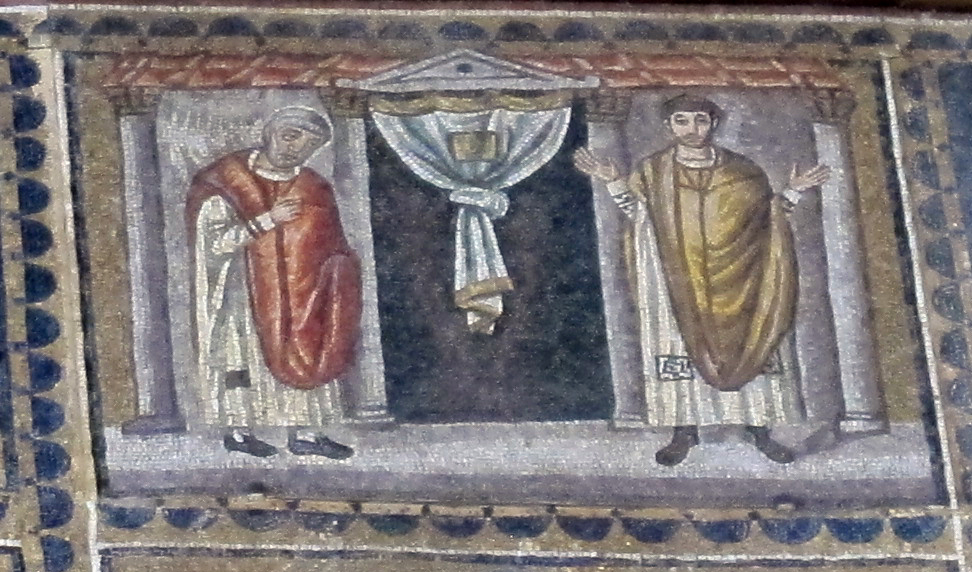
Source: Sailko, photograph of the Pharisee and the Publican mosaic at Sant’Apollinare Nuovo, Ravenna, CC BY-SA 3.0 / Wikimedia Commons
This sixth-century mosaic is not a Coptic icon, but it is an early Christian visual witness to the parable. It does not depict Christ. Instead, the Publican bows with a hand to his chest while the Pharisee stands upright with his hands raised; a curtained opening separates them. The composition corrects the way pride reads the scene. The decisive question is not which man looks more respectable, but what each posture reveals about the heart standing before God.
Follow-Up Assets
- NotebookLM slide deck: Blessed Are the Poor in Spirit — Empty Hands Before God
- PowerPoint deck with speaker notes
- PDF export
- Google Doc source used by NotebookLM
Glossary
- Beatitude: A declaration by Christ of who is blessed under God’s reign and what promise belongs to that life.
- Makarioi: The Greek word translated “blessed.” It describes divine favor or blessedness, not merely a passing emotion.
- Ptōchoi: The Greek word translated “poor.” It can carry the force of destitution; in Matthew 5:3 it describes poverty “in spirit.”
- Contrition: Sorrow and inward brokenness before God that lead to repentance rather than despair.
- Publican: A tax collector in the Roman system, often regarded as corrupt and socially compromised.
- Justified: Declared or set right before God. In Luke 18, Jesus says the Publican goes home justified rather than the Pharisee.
- Kenosis: “Self-emptying,” from Philippians 2:7. The Son does not cease to be God; He freely takes the form of a servant and humbles Himself to the Cross.
- Jesus Prayer: “Lord Jesus Christ, Son of God, have mercy on me, a sinner,” a traditional prayer of repentance and continual remembrance of Christ.
Sources
Primary sources
- Scripture: Matthew 5:3; Luke 6:20; Luke 18:9–14; Philippians 2:5–11; Luke 1:38, 46–49; Psalm 50:17 (NKJV 51:17). Scripture is from NKJV.
- Saint John Chrysostom, Homily 15 on Matthew, especially sections 2–3, New Advent.
- Saint John Chrysostom, Homilies on Hebrews, Homily 27 on Hebrews 11:28–31, §§9–10, CCEL, NPNF 1.14.
- Saint Gregory of Nyssa, Homily 1 on the Beatitudes, in Eight Homilies on the Beatitudes.
Secondary academic sources
- Hubertus R. Drobner and Albert Viciano, eds., Gregory of Nyssa: Homilies on the Beatitudes: An English Version with Commentary and Supporting Studies, Supplements to Vigiliae Christianae 52 (Brill, 2000).
Coptic Orthodox and pastoral sources
- “The Fast of Saint Mary,” St Mark Coptic Orthodox Church, Sydney, stmark.com.au.
Iconography and image sources
Sailko, photograph of the sixth-century Pharisee and Publican mosaic, Sant’Apollinare Nuovo, Ravenna, Wikimedia Commons, CC BY-SA 3.0. The photograph’s Commons page also notes Italian cultural-heritage reuse restrictions beyond copyright licensing.
Footnotes
-
Saint John Chrysostom, Homily 15 on Matthew, sections 2–3, https://www.newadvent.org/fathers/200115.htm. ↩ ↩2
-
Saint John Chrysostom, Homilies on Hebrews, Homily 27 on Hebrews 11:28–31, §§9–10, https://www.ccel.org/ccel/schaff/npnf114.v.xxxi.html#v.xxxi-p69. The same homily continues: “if we say ten thousand evil things of ourselves, and are vexed when we hear them from others, then there is no longer humility, nor confession, but ostentation and vainglory.” ↩
-
Saint Gregory of Nyssa, Homily 1 on the Beatitudes, in Hubertus R. Drobner and Albert Viciano, eds., Gregory of Nyssa: Homilies on the Beatitudes (Brill, 2000), 26–27. Gregory identifies “poor in spirit” with voluntary humility and connects it to 2 Corinthians 8:9 and Philippians 2:5–7. ↩