
The Sorrow That Carries Hope
Those who mourn
“Blessed are those who mourn, for they shall be comforted.”
Matthew 5:4
Main burden
Christ does not call pain good, command emotional misery, or ask us to pretend that every loss has an easy explanation. He blesses the heart that refuses to become numb: the heart that grieves its own sin, carries the suffering of others, and aches for the world God intended. Blessed mourning brings that sorrow to Christ rather than turning it into despair. The One who wept at Lazarus’s tomb enters our grief, forgives the repentant, and promises that death and sorrow will not have the final word.
Opening: the tear we keep trying to erase
We know how to make pain disappear from view.
We stay busy. We scroll. We eat. We work longer. We make a joke before the conversation becomes too honest. We say, “Everything happens for a reason,” because another person’s grief makes us uncomfortable. We rush someone toward closure because we do not know how to sit beside a wound we cannot fix.
We can do the same thing with sin. We rename it, explain it, compare it with something worse, or confess it vaguely enough that it never becomes concrete. We feel bad for a moment, but we do not let sorrow become repentance.
Then Christ says something the world cannot understand:
“Blessed are those who mourn, for they shall be comforted.”
He does not say that every sad feeling is holy. He does not say that depression is a virtue or that grief should be prolonged for display. He says that there is a kind of mourning that belongs to the Kingdom because it sees truthfully, loves deeply, and waits for God.
The question for this Beatitude is not simply, “What makes me sad?” It is:
What have I learned not to grieve anymore?
1. Why mourning follows poverty of spirit
Last week, poverty of spirit meant standing before God with empty hands. We stopped presenting a spiritual résumé and prayed with the Publican, “God, be merciful to me a sinner.”
Once the heart stops defending itself, it begins to see.
It sees sin without excuse. It sees the pain our words and choices have caused. It sees suffering that we previously kept at a safe distance. It sees how far human life has fallen from the beauty for which God created it. Poverty of spirit opens the eyes; mourning is what those opened eyes feel.
The Greek word in Matthew 5:4 is penthountes, “those who mourn.” It describes substantial mourning, not mild regret. In the Fathers, the Beatitude’s center is spiritual mourning: repentance over sin, grief over the sins of others, and sorrow at humanity’s loss of communion with God. From that center, the rest of Scripture shows what such a tender heart becomes: it enters the suffering of others rather than becoming numb. These dimensions belong together, but not every experience of sadness is itself the blessed mourning Christ names.
Saint John Chrysostom emphasizes repentance, but he does not stop there. He says that Christ calls us to mourn “not only for our own, but also for other men’s misdoings,” as Moses, David, and Paul did.1
Saint Gregory of Nyssa opens the meaning further. Mourning arises when a person has begun to recognize the true good and therefore feels the tragedy of what humanity has lost through sin: incorruption, freedom, communion with God, and the unhindered beauty of His image in us.2
This mourning is blessed not because sorrow is valuable by itself. Gregory states the point carefully: the Beatitude does not end with mourning; it moves toward comfort. Sorrow is blessed because it turns the soul toward the true good it has lost and toward the God who restores it.
2. Mourning our sin: sorrow that moves
Saint Paul distinguishes two kinds of sorrow:
“For godly sorrow produces repentance leading to salvation, not to be regretted; but the sorrow of the world produces death.”
2 Corinthians 7:10
Both can hurt. The difference is not the intensity of the feeling but its direction.
Worldly sorrow curves inward. It says:
- “I cannot believe I did that.”
- “What will people think of me?”
- “I have ruined the image I had of myself.”
- “I feel terrible, so I must already have repented.”
It may produce shame, self-punishment, hiding, defensiveness, or despair. It is preoccupied with the wounded ego. A person may cry sincerely and still refuse to confess specifically, repair the harm, accept a consequence, or change direction.
Godly sorrow turns toward God and toward the person harmed. Saint Paul says it produces diligence, zeal, desire, and a clearing of what was wrong. In other words, it moves.
Peter and Judas both grieved after betraying Christ. Judas’s grief closed into despair. Peter went out and wept bitterly, but those tears eventually returned him to the risen Lord. On the shore of the Sea of Tiberias, Christ did not pretend Peter’s denial had not happened. Three times He asked, “Do you love Me?” He healed the wound truthfully and restored Peter to love and service.
This contrast teaches us to remain within reach of Christ’s mercy. It is not permission to judge those who die by suicide or to burden the people who grieve them. Severe depression, trauma, and mental illness cannot be reduced to a simple verdict about someone’s faith.
Repentance is not measured by how badly I can make myself feel. It becomes visible in what I do next.
If I lied, do I tell the truth? If I humiliated someone, do I apologize without explaining away the injury? If I stole, do I restore? If I keep returning to the same hidden sin, do I bring it honestly to confession and accept a concrete rule of struggle? If I have grown cold in prayer, do I return today rather than waiting to feel spiritual?
Saint John Climacus calls blessed mourning a “joy-grief” because repentance contains pain and hope at the same time. He also gives a severe test: if our tears leave us proud, angry, or condemning toward other sinners, they are not yet healthy. Genuine compunction makes the heart humbler and more compassionate.3
A person who has truly mourned his own sin becomes slower to crush somebody else.
3. The old story: exile, bitter herbs, and the hope of return
The Old Testament gives the Church a language for mourning.
After David’s sin, Psalm 50 does not offer vague regret. David asks for cleansing, a renewed spirit, restored joy, and a heart able to teach transgressors God’s ways. His sorrow moves toward healing and renewed service:
“The sacrifices of God are a broken spirit, a broken and a contrite heart; these, O God, You will not despise.”
Psalm 50:17 (NKJV 51:17)
Israel also learned to lament in exile. The Psalms and Lamentations refuse to call devastation normal. They remember Zion, confess sin, protest suffering, and ask God to act. Biblical lament is not unbelief. It is pain still addressed to God.
Saint Gregory of Nyssa connects blessed mourning with the bitter herbs of Passover. Israel ate bitterness beside the unleavened bread of deliverance. The meal held slavery and rescue together. Christian life also tells the truth about bitterness while moving toward the feast.2
That movement reaches its fulfillment in Christ. He enters our exile, tastes death, and leads humanity home. Our mourning is therefore never a closed circle. It belongs to Passover, to Pascha, to passage.
4. Mourning real loss: Jesus did not hurry past the tomb
Matthew 5:4 should never be used to dismiss ordinary grief. The Beatitude’s primary patristic center is godly mourning, but the Christ who blesses that mourning also enters human bereavement.
When Lazarus died, Martha told Jesus, “Lord, if You had been here, my brother would not have died.” Later Mary said the same words and fell at His feet. Their faith and grief were tangled together. They believed in Him, loved Him, and still could not understand why He had not come sooner.
Jesus knew what He was about to do. He had already told Martha, “I am the resurrection and the life.” He would call Lazarus from the tomb within minutes.
Still, when He saw Mary and the others weeping, “He groaned in the spirit and was troubled.” Then Scripture gives us two words:
“Jesus wept.”
He did not stand outside grief and lecture them about resurrection. He did not say, “Stop crying; this will all make sense soon.” He entered the sorrow.
This is not an embarrassing pause before the miracle. It reveals Christ. The eternal Son truly became man. His humanity is not a costume. As man He weeps; as God He commands the dead man to come out. The same Person sheds tears and shatters the tomb.
This guards us from two errors.
The first error is despair, as though the tomb is ultimate. Christ stands before it as the Resurrection and the Life.
The second is denial, as though faith makes tears unnecessary. Christ knows He will raise Lazarus and still weeps. Resurrection hope does not make love less tender. It makes tenderness fearless.
Some grief cannot be solved in a sentence. The death of a spouse, parent, child, or friend; a diagnosis; infertility; the collapse of a marriage; betrayal; a child’s suffering; displacement from home; a long season of loneliness; or the loss of a future we expected can remain painful for years. The Beatitude does not impose a timetable. It promises a Person.
Faithful comfort often begins by doing what Christ did before the tomb: come, see, be troubled, weep, remain, and then act in love where action is possible.
We should also say this plainly: depression, trauma, and complicated grief are not proof of weak faith. Prayer, confession, and the sacramental life are central to healing, but receiving help from a qualified counselor or physician is not a rejection of grace. God cares for the whole person, body and soul.
5. Mourning for others: a heart that has not gone numb
Jesus also wept over Jerusalem:
“Now as He drew near, He saw the city and wept over it.”
Luke 19:41
The city would reject the things that make for peace. Christ’s tears were not sentimental. He saw the violence, blindness, and destruction ahead. His grief did not become contempt for the people who opposed Him. He loved them enough to lament what sin was doing to them.
This is very different from outrage.
Outrage can enjoy the failure of the other side. It can turn another person’s sin into content, entertainment, or evidence of our superiority. Blessed mourning refuses that pleasure. It tells the truth about evil without delighting in anyone’s ruin.
Saint John Chrysostom points to Moses, David, and Paul as people who mourned sins not their own. Moses pleaded for Israel after the golden calf. Paul said that for three years he warned the Ephesian elders “night and day with tears.” The saints did not observe the world from a safe moral distance. Love made another person’s danger personal.
What would it mean to recover that heart?
- To grieve a child’s wandering without turning every conversation into control.
- To grieve addiction without enabling it.
- To grieve injustice without becoming cruel.
- To grieve division in the Church without feeding gossip.
- To grieve people living on the street without reducing them to a problem to solve.
- To grieve a relative’s sin while remembering that Christ seeks his salvation, not our vindication.
Mourning does not eliminate boundaries. Love may require truth, consequences, distance, reporting abuse, or protecting someone vulnerable. Compassion is not permission for evil to continue. The difference is that even a necessary boundary is set without hatred and without taking pleasure in punishment.
The opposite of mourning is not happiness. Often it is numbness.
6. What does Christ mean by “comforted”?
We often use “comfort” to mean distraction, relief, or reassurance that everything will quickly improve. The Gospel promise is deeper.
The verb in Matthew 5:4 is related to parakaleō, to call near, encourage, console, or strengthen. The promised comfort is not God shouting explanations from a distance. He draws near.
Saint John Chrysostom writes:
“When God does comfort, though sorrows come upon you by thousands like snow-flakes, you will be above them all.”1
He says that God comforts “both here and there.” There is real consolation now, but its fullness is still coming.
Comfort begins now
God comforts the repentant through forgiveness and reconciliation. In confession, sin is not excused; it is uncovered before Christ so that absolution, counsel, and healing may be received. Godly sorrow is not supposed to become permanent self-condemnation. Once we repent, we learn to trust the mercy we asked for.
God comforts the grieving through His presence, Scripture, prayer, the Eucharist, and the Body of Christ. Often His consolation comes through a person who listens without trying to explain the wound.
God comforts by giving suffering a place inside communion with Christ. He does not call every event good, but no wound offered to Him is beyond redemption. The risen Christ still bears the wounds of the nails. Resurrection does not erase the history of love and suffering; it transfigures it.
Comfort will be completed in the Kingdom
Revelation gives the final horizon:
“And God will wipe away every tear from their eyes; there shall be no more death, nor sorrow, nor crying. There shall be no more pain, for the former things have passed away.”
Revelation 21:4
Notice who wipes the tears: God Himself.
Christian comfort is not the promise that we will eventually become detached enough not to care. It is that God will make all things new. Death will be destroyed. The broken communion of creation will be healed. The person who mourns now does not worship sorrow; he refuses false consolation because he is waiting for the true one.
7. The Church teaches sorrow without despair
The Church does not give us only words for celebration. She gives us Psalms of lament, fasting, prostrations, confession, funeral prayers, Holy Week hymns, and seasons in which tears are not treated as interruptions.
Great Lent is often described in Orthodox spiritual life as bright sadness or joyful sorrow. We mourn sin, yet we move toward Pascha. On Good Friday we stand before the Cross and sing in hope because the Crucified One is already the Victor over death. At an Orthodox funeral, the body is honored, grief is voiced, and resurrection is proclaimed. The Church neither denies the tomb nor leaves us inside it.
This lesson falls during Saint Mary’s Fast. Saint Mary’s life teaches us that deep faith does not remove deep sorrow. Simeon told her that a sword would pierce her own soul. She stood at the Cross when many disciples fled. The mother who had received the angel’s promise also watched her Son suffer and die.
Yet she remained. Her sorrow did not become abandonment of God. During this fast, she teaches us a faithful posture: receive Christ, carry Christ, stand near Christ, and wait for His resurrection even when a sword passes through the soul.
John 19 is a thematic connection to her witness, not a claim about this Sunday’s appointed Gospel.
8. Four practices for this week
Name one sorrow before God
Do not begin by solving it. Name it plainly in prayer: “Lord, this is what hurts.” If the sorrow includes anger, confusion, or disappointment with God, bring that honestly too. The Psalms teach us that reverence and honesty can live together.
Turn regret into one act of repentance
Choose one sin you have been feeling bad about. Ask what godly sorrow would do next. Make the apology, tell the truth, remove the access point, schedule confession, restore what you can, or ask for help. Feeling guilty is not the same as returning.
Sit with someone without explaining the pain
Call or visit someone who is grieving. Do not begin with advice, a theological explanation, or a story about your own loss. Ask, “How are you carrying this today?” Listen. Pray with the person if welcomed. Bring food, help with a practical burden, or remain quietly present.
Recover one sorrow you have numbed
What suffering have you trained yourself not to see? A strained relationship, a neighbor in need, someone isolated at church, a pattern of gossip, an injustice, or your own spiritual coldness? Ask God for a heart that can feel without becoming paralyzed. Then take one concrete step in love.
Personal contemplation
Place yourself outside Lazarus’s tomb.
Mary is weeping. The crowd is weeping. The stone is still in place. Jesus has not yet called Lazarus out.
What sorrow are you carrying to that place?
Is it a sin you keep excusing? A person you miss? A wound you cannot repair? Fear for a child? Anger at what was taken from you? Shame you have hidden? Grief over somebody who seems far from God?
Now notice Christ.
He does not mock the tears. He does not stand at a distance. He is troubled, and He weeps.
[Pause for 15–20 seconds.]
Then hear Him say, “Take away the stone.”
What stone can you move in obedience, even though only Christ can give life? A confession? A phone call? A boundary? An apology? Asking for help? Returning to prayer?
We cannot raise the dead. We can move the stone He tells us to move and trust the voice that calls life out of the tomb.
Conclusion
“Blessed are those who mourn” does not mean blessed are the miserable, the emotionally crushed, or those who make sadness their identity.
It means blessed are those whose hearts remain alive before God.
They grieve sin enough to repent. They grieve suffering enough to draw near. They grieve the wounds of the world without becoming hateful. They long for the true good rather than accepting numbness as peace.
Their hope is not that time will make them stop caring. Their hope is Christ.
He wept at the tomb. He bore our grief and sin in His Passion. He rose from the dead. He sends the Comforter. He forgives the repentant, strengthens the grieving, and promises a Kingdom where God Himself will wipe away every tear.
The Christian does not choose between tears and hope. In Christ, the tear itself begins to face the resurrection.
Closing prayer
Lord Jesus Christ, You wept at the tomb of Lazarus and wept over Jerusalem. Deliver us from the hardness that refuses to grieve and from the despair that refuses to hope. Give us godly sorrow for our sins, courage to repent, compassion for those who suffer, and patience with wounds that cannot be hurried. Comfort those among us who carry death, illness, loneliness, betrayal, fear, or hidden pain. Through the prayers of Your holy mother, who stood faithfully at Your Cross, keep us near You when the sword passes through the soul. Send us the grace of Your Holy Spirit, the Comforter, and fix our hope in Your resurrection. Make us faithful until the day when You wipe away every tear and make all things new. Amen.
Teaching Guide
30-minute teaching plan
Time Section Aim 0:00–3:00 Opening: the tear we keep trying to erase Expose numbness and rushed consolation without glorifying sadness. 3:00–6:00 Why mourning follows poverty of spirit Connect the second Beatitude to last week and establish its patristic center. 6:00–10:00 Mourning our sin Distinguish godly sorrow from shame and show that repentance moves. 10:00–12:00 Biblical lament, Passover, and return Place repentance and lament inside the scriptural movement toward Pascha. 12:00–17:00 Jesus at Lazarus’s tomb Let Christology carry the lesson: the One who weeps is the One who raises the dead. 17:00–20:00 Mourning for others Contrast compassion with outrage, numbness, enabling, and control. 20:00–24:00 The promise of comfort Explain present consolation and final resurrection hope. 24:00–27:00 Church, Saint Mary, and weekly practices Connect the lesson to worship, the current fast, and concrete adult life. 27:00–30:00 Contemplation, conclusion, and prayer Leave silence at the tomb, then close with resurrection hope.
- Ask: Use one or two discussion questions. Do not force personal disclosure from grieving people.
- Emphasize: Christ blesses truthful, hope-bearing mourning, not pain for its own sake.
- Watch for: Do not imply that grief has a timetable, depression is weak faith, abuse must be endured, or every loss has an easy explanation.
- Connect: Return repeatedly to John 11: Christ weeps and Christ raises.
- Show: Display the Raising of Lazarus icon while teaching John 11 and during the silent contemplation.
Ask
- What is the difference between godly sorrow and shame that only turns inward?
- Which is more tempting for you when another person suffers: explaining, fixing, avoiding, or quietly remaining present?
- What have you learned not to grieve anymore, and what might spiritual numbness be protecting?
- What “stone” can you move this week while trusting Christ to do what only He can do?
- How does “Jesus wept” change the way you understand God’s response to your grief?
Emphasize
- Mourning follows poverty of spirit because a defended heart cannot see clearly enough to grieve.
- Repentance is not measured by emotional intensity. Godly sorrow produces movement toward God, truth, restitution, and healing.
- Jesus does not hurry Mary and Martha past grief, even though He knows resurrection is moments away.
- Christian comfort is God’s presence now and the final destruction of death in the Kingdom.
- A tender heart tells the truth, sets necessary boundaries, and refuses hatred.
Watch for
- Do not teach that all sadness is spiritually virtuous. Some sorrow turns inward toward despair and needs pastoral and clinical care.
- Do not make tears a test of repentance. People express sorrow differently; the fruit of repentance matters more than visible emotion.
- Do not say that grief should end quickly because a Christian believes in resurrection.
- Do not use “forgive” or “mourn for the sinner” to pressure someone into unsafe access to an abuser.
- Do not use the Judas-and-Peter contrast to pass judgment on people who die by suicide or on families carrying that grief.
- Do not claim that Saint Gregory of Nyssa follows the NKJV order of mourning before meekness. His received order places meekness before mourning.
Connect
- Connect Matthew 5:3 to 5:4: empty hands become open eyes.
- Connect 2 Corinthians 7 to confession and concrete amendment of life.
- Connect John 11 to Christ’s full divinity and full humanity: He truly weeps and truly gives life.
- Connect Luke 19 to compassion for people whose choices are destroying them.
- Connect Revelation 21 to the Eucharistic and eschatological hope of the Church.
- Connect Saint Mary’s Fast to her faithful presence at the Cross, without claiming John 19 as the appointed Gospel for this Sunday.
Show
Use the fifteenth-century Novgorod icon of the Raising of Lazarus when reading John 11:32–44. Christ stands before the dark mouth of the tomb and extends His hand toward Lazarus. The darkness is real, the grave clothes remain visible, and the mourners are present. Yet the movement of the icon comes from Christ toward the dead man. During the contemplation, leave the icon on screen and ask the room to identify the sorrow they are bringing to Christ. End by drawing attention away from the tomb’s darkness and toward Christ’s commanding gesture.
Iconography connection
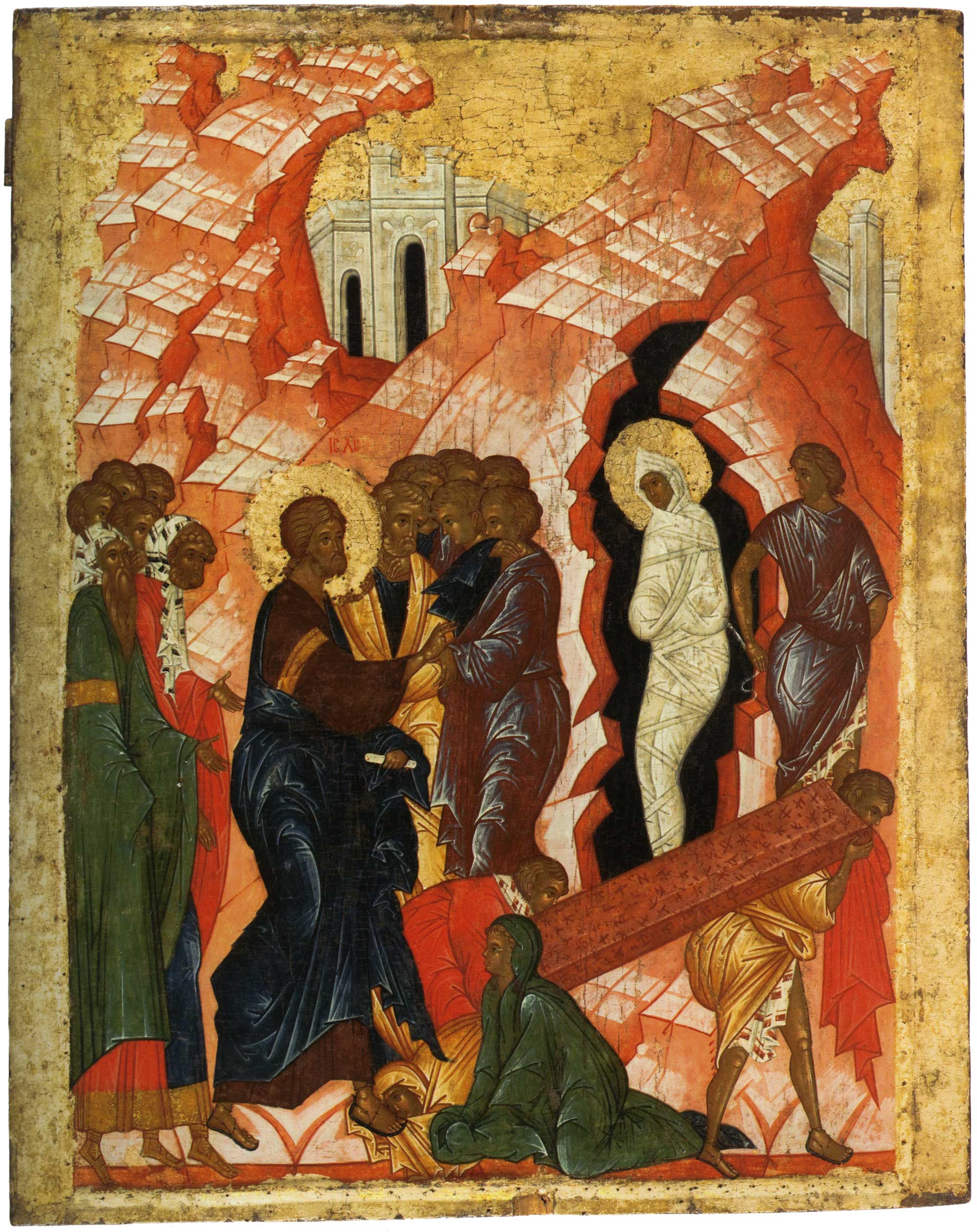
Source: The Raising of Lazarus, Novgorod icon-painting school, fifteenth century, The Russian Museum, public domain / Wikimedia Commons
The Raising of Lazarus is the natural iconographic center of this lesson. The icon does not hide death. Lazarus emerges still bound in grave clothes; the tomb is a black opening; Martha, Mary, the disciples, and mourners stand before the reality of loss. Christ does not enter the tomb’s darkness as one more helpless mourner. He stands before it and calls the dead man out.
The icon does not define Matthew 5:4 by itself. It shows the Lord toward whom all Christian mourning turns. Mourning is not blessed because the tomb is beautiful. It is blessed because sorrow has been brought before the Lord of life. The icon holds lament and hope in one scene: the grave is real, love weeps, and Christ’s word is stronger than death.
Glossary
- Beatitude: A declaration by Christ of who is blessed under God’s reign and what promise belongs to that life.
- Penthountes: The Greek expression in Matthew 5:4 translated “those who mourn.” It describes real, substantial mourning rather than mild regret.
- Godly sorrow: Sorrow that turns toward God and produces repentance, truth, and changed action, as distinguished from shame that closes into despair.
- Compunction: A heart pierced by awareness of sin and God’s mercy, producing humble repentance rather than self-hatred.
- Joyful sorrow: An Orthodox ascetical expression for repentance that is painful because sin is real and hopeful because God is merciful. It is broader spiritual vocabulary, not a literal translation of Matthew 5:4.
- Parakaleō: A Greek verb meaning to call near, encourage, console, or strengthen; it is related to the promise “shall be comforted.”
- Paraklētos: “Comforter,” “Advocate,” or “Helper,” a title Christ uses for the Holy Spirit in John 14–16.
- Eschatological: Concerning the fulfillment of God’s Kingdom, resurrection, judgment, and the life of the age to come.
Sources
Primary sources
- Scripture: Matthew 5:4; 2 Corinthians 7:8–11; John 11:17–44; Luke 19:41–44; Revelation 21:1–5; John 19:25–27; Psalm 50:17 (NKJV 51:17). Scripture is from NKJV.
- Saint John Chrysostom, Homily 15 on Matthew, §4, New Advent.
- Saint Gregory of Nyssa, Oration 3 on the Beatitudes, especially the interpretation of blessed mourning as knowledge of the true good and longing for restoration, Catholic Library synchronized text.
- Saint John Climacus, The Ladder of Divine Ascent, rev. ed. (Boston: Holy Transfiguration Monastery, 2012), Step 7, “On Mourning Which Causes Joy,” especially §§4, 9, 29, 44–45.
Secondary academic sources
- Hubertus R. Drobner and Albert Viciano, eds., Gregory of Nyssa: Homilies on the Beatitudes: An English Version with Commentary and Supporting Studies, Supplements to Vigiliae Christianae 52 (Brill, 2000).
- Michael Glerup, trans., Gregory of Nyssa: Sermons on the Beatitudes, Popular Patristics Series 52 (St Vladimir’s Seminary Press, 2012).
Coptic Orthodox and pastoral sources
- Coptic Orthodox liturgical and pastoral themes used here: Psalm 50 in repentance; Saint Mary standing at the Cross during her fast; confession as healing; and resurrection hope in the Church’s funeral and Holy Week prayer. No claim is made that John 19 is the appointed Gospel for August 16.
Iconography and image sources
The Raising of Lazarus, Novgorod icon-painting school, fifteenth century, from the feast tier of the iconostasis of the Dormition Cathedral, Kirillo-Belozersky Monastery; now in The Russian Museum, St. Petersburg. Wikimedia Commons, public domain.
Orthodox Church in America, “The Raising of Lazarus (Lazarus Saturday),” for the icon’s emphasis on Christ, the four-day-dead Lazarus, the tomb, grave clothes, and universal resurrection, https://www.oca.org/saints/lives/0578/04/02/19-the-raising-of-lazarus-lazarus-saturday.
Footnotes
-
Saint John Chrysostom, Homily 15 on Matthew, §4, https://www.newadvent.org/fathers/200115.htm#4. Chrysostom interprets mourning first as godly sorrow for sin, then explicitly includes mourning for the sins of others, and says God’s consolation is given “both here and there.” ↩ ↩2
-
Saint Gregory of Nyssa, Oration 3 on the Beatitudes, in Eight Orations on the Beatitudes, synchronized direct text at https://catholiclibrary.org/library/view?docId=/Fathers-Synchronized-EN/Gregory_of_Nyssa__Orationes_viii_de_beatitudinibus.en.html&chunk.id=00000023. Gregory’s received Gospel order places meekness before mourning; this lesson follows the NKJV order without claiming that Gregory establishes that sequence. ↩ ↩2
-
Saint John Climacus, The Ladder of Divine Ascent, rev. ed. (Boston: Holy Transfiguration Monastery, 2012), Step 7, §§4, 9, 29, 44–45. The lesson paraphrases his tests for mourning: it should bear humility, compassion, non-condemnation, and consolation rather than pride or despair. ↩