
Strength Surrendered to God
The meek
“Blessed are the meek, For they shall inherit the earth.” Matthew 5:5
Main burden
Meekness is not weakness, silence, or the refusal to confront evil. It is strength that has been handed back to God: the power to answer, to win, to punish, and to control an outcome, offered instead of used as a weapon. Christ is meek, and He still speaks the truth, protects the wounded, and goes freely to the Cross. The person who will not let go of domination cannot receive the earth God gives. The person who surrenders that demand begins to inherit what grasping always loses.
Opening: the argument we refuse to lose
Most of us can name the moment.
A spouse uses a tone we cannot stand. A child talks back. A colleague takes credit. A driver cuts us off. Someone at church repeats a story that is only half true. Heat rises in the chest. The mind writes the winning sentence before the other person has finished speaking. We tell ourselves we are defending the truth. Often we are defending the throne.
The world blesses that reflex. It calls it honesty, leadership, self-respect, or “not being a doormat.” It treats the person who must win as the adult in the room.
Then Christ says:
“Blessed are the meek, For they shall inherit the earth.”
He does not bless the person who has no strength. He blesses the person who has strength and will not spend it on domination.
The question for this Beatitude is not, “Do I have a personality that avoids conflict?” It is:
Where does my strength become a demand that another person submit to me?
1. Why meekness follows mourning
Two weeks ago, poverty of spirit meant standing before God with empty hands. Last week, those opened eyes began to mourn: sin, loss, and the wounds of the world.
A heart that has mourned honestly is less eager to crush someone else. It has seen its own need of mercy. It has stood near a tomb and learned that some things cannot be forced. Meekness is what that heart does with its remaining power.
This is not a rigid ladder. Saint Gregory of Nyssa’s received Gospel order places meekness before mourning, while the text we are reading places mourning first. The Beatitudes form one life. They do not become a machine in which one virtue unlocks the next like a password. Still, the sequence in Matthew 5 is pastorally true: empty hands see, seeing hearts grieve, and grieving hearts stop using force as their first language.
The Greek word is praeis, “the meek.” It is related to praus, the word Christ uses of Himself: “I am gentle and lowly in heart.” It does not mean spineless. In ordinary Greek it could describe a war horse that has been trained: the strength is still there, but it answers the rider. The meek person is not without force. The meek person is no longer ridden by force.
Saint Gregory refuses to let the word collapse into slowness. Runners, boxers, and apostles are not praised for being sluggish. Paul runs to obtain the prize. Meekness is not delay as a personality trait. It is a heart that has become “slow and difficult to move” toward the impulses that drag us downward, especially anger.1
2. What meekness is not
If we do not clear the counterfeits, this Beatitude will harm people.
Meekness is not low self-esteem. A person can hate himself and still be violent in small ways: sarcasm, withdrawal, self-pity used as leverage, or the quiet need to make others feel guilty.
Meekness is not conflict avoidance. “I just don’t like drama” can sound spiritual while functioning as fear. Christ was meek, and He overturned tables, named hypocrisy, and refused to let the crowd make Him a political king.
Meekness is not permission for abuse. A spouse, parent, or church member who uses “be meek” to keep a victim quiet is not teaching the Gospel. Love may require a boundary, a report, a separation, or the protection of a child. The meek person can do those things without hatred and without needing the other person’s ruin.
Meekness is not the absence of anger. Anger can tell the truth that something sacred has been violated. The issue is what we do with the heat. Saint Gregory says the Beatitude does not command a passionless life that flesh and blood cannot live. The impulse may rise even against our will. Virtue is not never feeling the surge. Virtue is refusing to be carried away by it “like a torrent.”1
Meekness is not calling uncontrolled anger honesty. “I just say it like it is” often means, “I will not accept the cost of patience.”
3. Moses: the strong man who would not seize the argument
Scripture’s first great portrait of meekness is not a timid man.
“Now the man Moses was very humble, more than all men who were on the face of the earth.” Numbers 12:3
The setting is not a personality quiz. Miriam and Aaron speak against Moses. The issue is mixed with family, race, and spiritual rivalry: “Has the Lord indeed spoken only through Moses? Has He not spoken through us also?” Moses has led a nation, confronted Pharaoh, and stood in the cloud. He has enough authority to crush the insult.
He does not.
The text says the Lord heard. God summons the three of them, defends Moses, and Miriam becomes leprous. Then Moses does the meek thing a second time. He does not enjoy being vindicated. He cries, “Please heal her, O God, I pray!”
This is the pattern. The meek person does not have to occupy the judge’s seat. He can tell the truth, remain in his calling, and leave the verdict with God. He can also intercede for the person who wounded him.
Adult life is full of Numbers 12 rooms. A sibling revises the family story. A ministry partner implies that God speaks more clearly through them. A relative questions your marriage, your parenting, or your place in the church. The temptation is to win the room. Moses shows another way: stay faithful, refuse the spectacle, and pray for the person whose words were meant to diminish you.
4. Christ is the meekness the Beatitude names
If meekness were only self-control, it would remain a moral achievement. The Beatitude is first a portrait of Christ.
He says:
“Come to Me, all you who labor and are heavy laden, and I will give you rest. Take My yoke upon you and learn from Me, for I am gentle and lowly in heart, and you will find rest for your souls. For My yoke is easy and My burden is light.” Matthew 11:28–30
The rest He promises is not a life without a yoke. It is a life under His yoke instead of under our own need to manage everyone. We labor and are heavy laden because we are carrying outcomes that do not belong to us: other people’s repentance, our children’s image, a reputation, a score that must be settled. Christ does not invite us to drop responsibility. He invites us to stop being god.
The same word appears when He enters Jerusalem:
“Tell the daughter of Zion, ‘Behold, your King is coming to you, Lowly, and sitting on a donkey, A colt, the foal of a donkey.’” Matthew 21:5
The crowd wants a king who seizes the city. He comes as a King who will be seized. He has legions of angels at His disposal and will not use them to win the week. This is not weakness. It is the strongest Person in the scene refusing to turn salvation into domination.
This Sunday’s Catholic Epistle in the Coptic lectionary places the same mystery before the Church:
“who, when He was reviled, did not revile in return; when He suffered, He did not threaten, but committed Himself to Him who judges righteously.” 1 Peter 2:23
He does not return the insult. He does not threaten. He hands the case to the Father. That is meekness in its pure form: not because nothing was at stake, but because the world’s repair would come through the Cross, not through retaliation.
If our meekness is not learned from this Christ, it will become either cowardice or a technique for looking holy.
5. The old promise: the meek inherit what the violent cannot keep
The Beatitude is not a new proverb. It is Psalm 37 becoming flesh in the mouth of Christ.
“But the meek shall inherit the earth, And shall delight themselves in the abundance of peace.” Psalm 37:11 (LXX 36:11)
Psalm 37 watches wicked people flourish and tells the faithful not to fret. The evildoer looks like the owner of the land. The meek look like they are losing. The psalm insists that the apparent owners are tenants on a short lease.
Saint John Chrysostom hears people asking what kind of earth this can be. Some want to dissolve the promise into a mere figure of speech. He refuses that escape. Christ holds out a real prize, not only a later spiritual mood. The meek man is thought to lose everything. Christ says the opposite: the rash and boastful man often loses his goods and even his life, while the one who is not rash possesses what he has in safety.2
Saint Gregory reads the same promise toward its final horizon. David’s “land of the living” is not merely this soil that grows mortal things and takes them back again. It is a land “on which death has not set foot,” a land that has not received the trace of evil.1
These two readings belong together. Chrysostom will not let us evaporate the promise. Gregory will not let us shrink it into real estate, career security, or national triumph. The meek inherit the earth because the earth belongs to Christ, and those who are being formed into His gentleness will share His reign in a creation death cannot keep.
The counterfeit blessing is simple: take it now. Control the meeting. Win the divorce. Hold the grudge as property. Make the child yield, not because it is good for the child, but because we cannot bear not to be obeyed. That kind of earth slips through the fingers. The person who must possess everything ends by possessing almost nothing that can last.
Luke’s woes remain the shadow text of this series. The world calls blessed the one who is full, well spoken of, and able to make others move. Christ calls blessed the one who can be wronged without becoming cruel, and who can wait for an inheritance he does not have to steal.
6. The Church trains the body not to seize the throne
Meekness is not an idea we admire. It is a habit the Church practices on us.
In the Agpeya Sixth Hour the Church reads Matthew 5:1–16 at midday, when the Crucified King is remembered. The One who blesses the meek is hanging with His hands open. The hour will not let us define power apart from the Cross.
Yesterday the Church kept Saint Mary’s Feast. She is not the center of this Beatitude, but she is a living icon of surrendered strength. She receives a word that will pierce her soul and answers, “Let it be to me according to your word.” She magnifies the Lord rather than herself. She stands at the Cross when force has apparently won. Her strength is not the strength that rearranges the scene. It is the strength that remains faithful inside it.
Confession is a school of meekness. We stop prosecuting our own case. We name the sin without the closing argument. The Eucharist is a school of meekness. The strong God gives Himself as food, and we come with open hands. Even a bow, a prostration, or standing silent while another person is commemorated in the litany trains the body to occupy less space than the ego wants.
If our Christianity never interrupts the need to win, we have not yet let the services do their work.
7. Four practices for this week
Delay the first defense
Choose one recurring conflict: a marriage argument, a work email, a church disagreement, a child’s tone. When the heat rises, do not send the first sentence. Wait long enough to ask, “What am I trying to protect?” If it is only my image, let the sentence die.
Hand back one outcome
Name one result you have been trying to force: someone’s apology, a child’s choice, a decision at work, a relative’s opinion of you. Pray, “Lord, this is Yours. Show me the next faithful act, and keep me from playing God.” Then do the next faithful act, not the whole campaign.
Use strength to protect, not to diminish
Meekness is not the refusal to act. If someone is being gossiped about, stop the story. If a child is unsafe, intervene. If a wrong needs to be named, name it without humiliation. The test is whether the other person is left smaller so that you can feel larger.
Take Christ’s yoke for seven days
Pray Matthew 11:28–30 once each day, slowly. Ask where you are laboring under a yoke He never gave you. Replace one hour of mental rehearsal, the argument you keep winning in your head, with that prayer.
Personal contemplation
See Him on the donkey.
The city is in front of Him. Palms are in the air. The crowd is already trying to write a different ending. He knows the Cross is inside the praise.
What throne are you trying to keep this week?
Is it the last word at home? Control of a child’s future? A reputation at church? The need to be seen as the reasonable one? A grudge that has become a form of property?
Now see His hands. They are not clenched on the reins of the world. They are open.
[Pause for 15–20 seconds.]
Hear Him say, “Learn from Me.”
What would it mean, in one concrete relationship, to come as this King comes: truthful, strong, and unwilling to seize what the Father has not given?
Conclusion
“Blessed are the meek” does not mean blessed are the timid, the silent, or those who let evil do what it wants.
It means blessed are those whose strength has a Master.
They can feel anger without becoming a beast. They can tell the truth without needing a corpse on the floor. They can protect the weak without becoming cruel. They can lose an argument and still keep their soul. They wait for an earth they do not have to steal.
Their hope is not that they will finally become impressive enough to hold the world together. Their hope is Christ.
He is gentle and lowly in heart. He entered the city on a donkey. He was reviled and did not revile. He committed Himself to the Father who judges righteously. He will inherit all things, and He will not inherit them as a tyrant.
The Christian does not choose between strength and gentleness. In Christ, strength kneels, and the earth is given to those who stopped grabbing it.
Closing prayer
Lord Jesus Christ, You are gentle and lowly in heart, yet You spoke the truth and went resolutely to the Cross. Deliver us from the false meekness that will not protect the wounded, and from the false strength that must make others yield. Bridle our anger. Unclench our need to win. Teach us the rest of Your yoke. Through the prayers of Your holy mother, who surrendered her strength to Your word and stood near You when force seemed to triumph, make us faithful in the hidden conflicts of this week. Give us a share in the land where death has not set foot, and make us inheritors of the earth You are renewing. Amen.
Teaching Guide
30-minute teaching plan
Time Section Aim 0:00–3:00 Opening: the argument we refuse to lose Expose the reflex to dominate without shaming people who are already timid. 3:00–6:00 Why meekness follows mourning Connect the series and define praeis without turning Gregory’s order into a law. 6:00–10:00 What meekness is not Clear cowardice, abuse-enabling, and “honesty” that is only uncontrolled anger. 10:00–14:00 Moses in Numbers 12 Show meekness as refused self-vindication and intercession. 14:00–20:00 Christ the lowly King Let Matthew 11, Matthew 21, and 1 Peter 2 carry the lesson. 20:00–24:00 Inherit the earth Hold Chrysostom’s concrete prize with Gregory’s land of the living. 24:00–27:00 Church, Saint Mary, practices Connect worship, the feast just kept, and adult life. 27:00–30:00 Contemplation, conclusion, and prayer Leave the room with Christ on the donkey, not with a self-help rule.
- Ask: Use one or two discussion questions. Do not force people in unsafe homes to narrate the conflict.
- Emphasize: Meekness is strength surrendered to God, not the absence of strength.
- Watch for: Do not tell an abused person to remain available. Do not baptize passivity. Do not make anger itself the sin.
- Connect: Return to Christ: the yoke, the donkey, the silence before unjust power.
- Show: Display the Entry into Jerusalem icon while teaching Matthew 21 and during the silent contemplation.
Ask
- Where does your strength most easily become a demand that another person submit?
- What is the difference between meekness and simply avoiding the hard conversation?
- When you are insulted, what would it mean to commit the case to the Father rather than to win the room?
- Which “earth” are you trying to inherit early: control, reputation, the last word, or someone else’s repentance?
- How does Christ on the donkey change what you think power looks like?
Emphasize
- Poverty of spirit empties the hands; mourning softens the eyes; meekness governs the remaining force.
- Gregory’s point is not slowness. It is a heart no longer swift toward the passions, especially anger.
- Moses is meek and still a leader. He does not seize the argument, and he prays for Miriam.
- Christ has all power and will not use it to dominate. That is the content of the Beatitude.
- The inheritance is real, and it is not a license to grab this world’s thrones.
Watch for
- Do not claim that Saint Gregory follows the NKJV order. His received order places meekness before mourning.
- Do not use this lesson to keep a victim quiet. Meekness may require a boundary, a report, or leaving an unsafe situation.
- Do not treat depression, trauma, or a quiet temperament as automatic holiness.
- Do not reduce “inherit the earth” to prosperity, property, or national triumph.
- Do not present anger as always sinful. The sin is being carried away by it, enjoying another person’s humiliation, or using force to play God.
- Do not claim Matthew 5:5 is this Sunday’s Gospel. The confirmed liturgical links are the Agpeya Sixth Hour for Matthew 5:1–16, Saint Mary’s Feast on August 22, and 1 Peter 2:18–3:7 as this Sunday’s Catholic Epistle.
Connect
- Connect Matthew 5:3–4 to 5:5: empty hands and a grieving heart should change how we use power.
- Connect Numbers 12 to ordinary family and church rivalry.
- Connect Matthew 11:29 to the exhaustion of people who are managing everyone.
- Connect Matthew 21:5 to the icon: the King who comes lowly.
- Connect 1 Peter 2:23 to this Sunday’s lectionary and to the Cross.
- Connect Psalm 37 to people who feel they are losing while the arrogant appear to own the land.
- Connect Saint Mary’s Feast to surrendered strength, without making her the governing text.
Show
Use the fifteenth-century Kirillo-Belozersky feast-tier icon of the Entry into Jerusalem when reading Matthew 21:4–5. Christ rides toward the city on a donkey. The crowd and the city fill the scene with motion and expectation; He does not enter as a general taking a capital. During the contemplation, leave the icon visible and ask the room what throne they are trying to keep. End by drawing attention to His unclenched approach, not to the crowd’s excitement.
Iconography connection
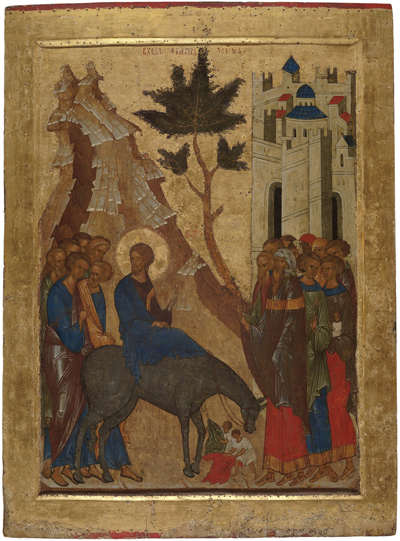
Source: Entry into Jerusalem, feast tier of the Kirillo-Belozersky iconostasis, fifteenth century, Kirillo-Belozersky Museum-Reserve, public domain / Wikimedia Commons
The Entry into Jerusalem is the natural iconographic center of this lesson. The prophecy fulfilled in Matthew 21 names the King as lowly. The icon does not hide the city’s energy. People come out. Branches are raised. The destination is real. Yet the theological center is not the crowd’s volume. It is the manner of the King’s arrival.
He does not come on a war horse. He does not scatter enemies by force. The same Lord who will cleanse the temple and go to the Cross enters first as one who can be received or refused. Meekness here is not the absence of kingship. It is kingship that will not become tyranny.
The icon does not define Matthew 5:5 by itself. It shows the Lord from whom meekness is learned. The blessed person is not the one who never approaches a conflict. The blessed person approaches as this King approaches: with real authority, and without the need to seize what the Father has not given.
Glossary
- Beatitude: A declaration by Christ of who is blessed under God’s reign and what promise belongs to that life.
- Praeis / praus: The Greek words behind “meek” and “gentle.” They describe strength under control, not spinelessness. Christ uses the same word of His own heart in Matthew 11:29.
- Meekness: Strength surrendered to God: the refusal to dominate, retaliate, or play judge, without abandoning truth or the protection of the vulnerable.
- Yoke: A wooden bar joining animals for work. In Matthew 11 it becomes an image of shared life under Christ’s rule rather than under self-rule.
- Land of the living: David’s phrase in Psalm 27:13 (LXX 26:13), used by Saint Gregory for the inheritance death cannot enter.
- Impassibility: A state beyond the disordered passions. Gregory says the Beatitude does not command this as a present human achievement.
- Eschatological: Concerning the fulfillment of God’s Kingdom, resurrection, and the life of the age to come.
Sources
Primary sources
- Scripture: Matthew 5:5; Matthew 11:28–30; Matthew 21:4–5; Numbers 12:1–13; Psalm 37:11 (LXX 36:11); 1 Peter 2:21–24; Luke 6:20–26. Scripture is from NKJV.
- Saint John Chrysostom, Homily 15 on Matthew, §5, New Advent. Local corpus segment 43305, quote-eligible NPNF text, deep link CCEL Homily XV.
- Saint Gregory of Nyssa, Oration 2 on the Beatitudes, especially the refusal to reduce meekness to slowness, the bridle of reason over anger, and the land of the living. Online-direct synchronized text, not yet in the local corpus: Catholic Library.
Secondary academic sources
- Hubertus R. Drobner and Albert Viciano, eds., Gregory of Nyssa: Homilies on the Beatitudes: An English Version with Commentary and Supporting Studies, Supplements to Vigiliae Christianae 52 (Brill, 2000).
- Michael Glerup, trans., Gregory of Nyssa: Sermons on the Beatitudes, Popular Patristics Series 52 (St Vladimir’s Seminary Press, 2012).
Coptic Orthodox and pastoral sources
- Coptic Agpeya, Sixth Hour Gospel: Matthew 5:1–16, confirmed in the local lectionary package.
- Coptic lectionary for 22 Mesra / 16 August 2026, Saint Mary’s Feast, and for 23 August 2026, third Sunday of Mesra, Catholic Epistle 1 Peter 2:18–3:7. No claim is made that Matthew 5:5 is the appointed Sunday Gospel.
Iconography and image sources
Entry into Jerusalem, feast tier of the Kirillo-Belozersky iconostasis, fifteenth century, Kirillo-Belozersky Museum-Reserve. Wikimedia Commons, public domain.
Footnotes
-
Saint Gregory of Nyssa, Oration 2 on the Beatitudes, synchronized text at https://catholiclibrary.org/library/view?docId=/Fathers-Synchronized-EN/Gregory_of_Nyssa__Orationes_viii_de_beatitudinibus.en.html&chunk.id=00000015 and the following chunk. Gregory’s received Gospel order places meekness before mourning. He distinguishes meekness from slowness, describes reason as a bridle on anger, and reads the inherited earth as the land of the living on which death has not set foot. ↩ ↩2 ↩3
-
Saint John Chrysostom, Homily 15 on Matthew, §5, https://www.newadvent.org/fathers/200115.htm. Local verified wording also at https://www.ccel.org/ccel/schaff/npnf110.iii.XV.html#iii.XV-p47. Chrysostom refuses a merely figurative earth, says the meek man possesses his goods in safety while the rash often lose even their life, and joins present consolation to future gifts. ↩