
“And seeing the multitudes, He went up on a mountain, and when He was seated His disciples came to Him. Then He opened His mouth and taught them, saying: ‘Blessed…’” Matthew 5:1–3
Main burden
The Beatitudes are Christ’s authoritative verdict on the good life. They do not call pain good, divide Christians into eight personality types, or give us a ladder by which we earn God’s favor. They reveal the life of the Kingdom, fulfilled perfectly in Christ and formed by grace in those who come near to Him. Matthew shows the inner character of that life; Luke exposes the false consolations that compete with it. Before asking whether we are humble, merciful, pure, or brave enough, we must ask whose judgment defines blessing for us. The series begins with Christ looking upon people whose lives do not appear enviable and declaring that God’s Kingdom, comfort, fullness, mercy, vision, sonship, and final vindication belong to them in Him.
Opening: what tells you that life is going well?
Imagine that someone asks, “How are you doing?”
Most of us do not answer by examining the deepest condition of the heart. We scan the surface.
- Is the family healthy?
- Is work stable?
- Is the bank account safe?
- Are people pleased with me?
- Did my plans work?
- Is conflict under control?
- Do I feel productive, respected, and spiritually competent?
If most answers are yes, we say, “I’m blessed.” If several answers are no, we may still use the word, but inside we wonder whether something has gone wrong.
Then Jesus sits on a mountain and calls different people blessed.
He names the poor in spirit, those who mourn, the meek, those who hunger and thirst for righteousness, the merciful, the pure in heart, the peacemakers, and those persecuted for righteousness. Luke makes the reversal even harder to avoid: the poor, the hungry, those who weep, and those hated for the Son of Man’s sake are blessed, while the rich, full, laughing, and universally praised receive woes.
Christ is not romanticizing poverty, grief, hunger, or rejection. He is overthrowing our assumption that visible comfort can tell us the final truth about a life.
The central question for the whole series is:
What do I presently use to decide whether my life is going well?
If the answer is comfort, control, recognition, wealth, invulnerability, or freedom from interruption, the Beatitudes will feel like bad news. If Christ is Lord, they become an invitation to let Him teach us what life truly is.
1. The Physician sees the crowd before the Teacher speaks
Matthew does not begin the Sermon on the Mount in an empty classroom.
At the end of Matthew 4, Jesus teaches, proclaims the Gospel of the Kingdom, and heals “all kinds of sickness and all kinds of disease among the people.” Crowds come from Galilee, the Decapolis, Jerusalem, Judea, and beyond the Jordan.
Then Matthew says:
“And seeing the multitudes, He went up on a mountain.”
The One who speaks the Beatitudes has already looked upon real bodies, wounds, poverty, oppression, fear, and hope. He is not giving detached advice about positive attitudes. The Physician who heals the body now addresses the heart. Saint John Chrysostom says Christ passes from caring for bodies to “amending their souls,” revealing that He is Maker and healer of the whole human person.1
This matters because the Beatitudes can be misused when removed from Christ’s mercy.
“Blessed are those who mourn” must never become pressure to remain miserable.
“Blessed are the meek” must never become permission for abuse.
“Blessed are those who are persecuted” must never become a reason to call violence good or correction persecution.
The words come from the One who sees the multitude and heals. Every Beatitude must be interpreted inside His desire to restore human beings to communion with God.
The mountain does not lift Jesus away from suffering people. It gives the disciples a vantage point from which to see those people under God’s reign.
2. The disciples come near
Jesus sees the multitudes, but the disciples come to Him.
“And when He was seated His disciples came to Him. Then He opened His mouth and taught them.”
Their first action is not teaching, organizing, serving, correcting, or changing the culture. They come near and listen.
That order challenges a common religious temptation: wanting to become useful before becoming teachable.
We may want a ministry before a hidden life with God. We may want language for correcting others before Christ has exposed our own heart. We may want to become light without allowing Him to reveal the darkness we protect.
The Beatitudes begin by placing disciples under the word of the King.
Chrysostom notes that Jesus addresses the disciples without restricting the blessing to them. His words were spoken through them “with all the world,” and He applies the blessings without restriction.2
The disciples come near for the sake of the crowd still within Christ’s sight. Formation and mission remain joined. We listen so that our life may become mercy, truth, peace, and light for others.
Before asking, “How do I apply the Beatitudes?” ask a prior question:
Am I willing to let Christ contradict my present definition of success?
3. What does “blessed” mean?
The word translated “blessed” is makarios; in Matthew’s repeated form it is makarioi. The English word “happy” is too thin if it means a pleasant emotional state.
Jesus does not say that mourners enjoy grief, hungry people feel satisfied, or persecuted people experience constant cheerfulness. He pronounces a verdict that outward circumstances cannot always verify.
To be blessed is to stand under God’s favor and reign, to possess a life whose truth is secured by His promise even before its fullness becomes visible.3
The authority of the Beatitudes therefore rests in the Speaker.
Anyone can look at poverty, mourning, meekness, hunger, mercy, purity, peacemaking, or persecution and offer an opinion. Christ speaks as King. He does not merely observe that these lives may eventually feel meaningful. He declares what the Father recognizes, what the Kingdom contains, and what eternity will reveal.
This is why the Beatitudes are not advice for improving our mood. They are an unveiling.
A person may be financially secure, admired, entertained, and inwardly enslaved.
Another may be grieving, overlooked, and faithful, yet deeply held by God.
The visible condition matters. Hunger should be fed, wounds treated, injustice resisted, and sorrow carried in community. But the visible condition is not the whole verdict.
Christ speaks the final word over a life.
4. Blessedness is participation in God’s own life
Saint Gregory of Nyssa begins his first oration by asking what blessedness itself is.
His answer moves beyond circumstances. True blessedness belongs first to God: pure life, inexhaustible goodness, beauty, wisdom, power, light, and joy. Human beings are blessed by participation, by being restored to the divine likeness for which they were created.4
Gregory compares this to an image reflecting the beauty of its living original. Sin has disfigured the image in us, but Christ washes and renews it so the marks of blessed life become visible again.
This gives the whole series its theological center.
The Beatitudes are not eight achievements placed between us and God. They describe what happens when human life shares, by grace, in God’s life:
- We become humble because the Son reveals divine greatness as self-giving love.
- We mourn because God does not call sin, death, or another person’s suffering unimportant.
- We become meek because God’s power is not insecurity demanding domination.
- We hunger for righteousness because His will is life.
- We become merciful because He is merciful.
- We seek purity because the heart was made to behold Him.
- We make peace because the Son reconciles us to the Father and one another.
- We endure because the risen Christ has removed death’s claim to finality.
This is theosis in practical form. We do not become God by nature. We participate by grace in the life given through the incarnate Son and the Holy Spirit.
The Beatitudes are not self-improvement with religious language. They are restored likeness.
5. Christ is the blessed life in person
Before the Beatitudes describe us, they reveal Christ.
Poor in spirit
The eternal Son lacks nothing in His divinity. Yet He freely takes the form of a servant and humbles Himself in the Incarnation. His poverty is voluntary self-giving, not divine deficiency.
Those who mourn
Jesus weeps at Lazarus’s tomb. He grieves over Jerusalem. He enters our sorrow without becoming hopeless and carries death toward resurrection.
The meek
He says, “I am gentle and lowly in heart.” His meekness is not passivity. He confronts hypocrisy, protects the dishonored, and offers His strength to the Father.
Those who hunger and thirst for righteousness
His food is to do the will of the Father and finish His work. He seeks neither applause nor comfort above obedience.
The merciful
He touches lepers, receives sinners, feeds crowds, forgives enemies, and offers His life for those who cannot repay Him.
The pure in heart
There is no division between His hidden love, spoken word, and action. “He who has seen Me has seen the Father.”
The peacemakers
He does not preserve peace by denying evil. He makes peace through the blood of His Cross, healing the separation sin created.
Those persecuted for righteousness
He is the Righteous One falsely accused, reviled, crucified, and raised. Opposition does not make Him false, retaliatory, or hateful.
Philippians 2, the appointed Pauline reading for August 2, gathers this portrait in Christ’s self-emptying and obedience unto the Cross. The Beatitudes do not point toward a virtue system beside Him. They unfold the mind and life that are His and that He shares with His Body.
Christ gives what He commands.
6. Matthew and Luke must be heard together
Matthew 5 and Luke 6 are not identical versions.
Matthew says:
“Blessed are the poor in spirit.”
“Blessed are those who hunger and thirst for righteousness.”
Luke says:
“Blessed are you poor.”
“Blessed are you who hunger now.”
Matthew gives eight Beatitudes, with verses 11–12 expanding the final one. Luke gives four blessings followed by four woes.
We should not flatten the differences.
Matthew reaches deeply into the heart: dependence, desire for righteousness, mercy, purity, and peacemaking. Luke makes material and social realities impossible to ignore: poverty, hunger, grief, exclusion, riches, fullness, laughter, and praise.
Matthew must not be used to spiritualize away real poverty. A church that praises poverty of spirit while ignoring people who lack food, housing, safety, or medical care has separated what Christ joins.
Luke must not be used to imply that deprivation saves automatically or that every person with wealth is condemned simply for possessing money. Zacchaeus’s wealth becomes mercy through repentance. Joseph of Arimathea uses status and resources in service to Christ.
Heard together, the Gospels expose both inward self-sufficiency and outward indifference.
The first four Beatitudes may be heard both as virtues formed by grace and as promises of reversal for those in wounded conditions. The later Beatitudes name the merciful, pure, peacemaking, and faithful lives through which God’s goodness also reaches those who suffer.3
The poor need more than our admiration of their spiritual potential. They need mercy.
The merciful need more than activity. They need poverty of spirit so help does not become superiority.
7. Luke’s woes: the anti-ladder of false consolation
Luke’s woes will serve as the shadow text for the entire series:
“Woe to you who are rich, for you have received your consolation.
Woe to you who are full, for you shall hunger.
Woe to you who laugh now, for you shall mourn and weep.
Woe to you when all men speak well of you, for so did their fathers to the false prophets.” Luke 6:24–26
The woes are not arbitrary punishments for having food, joy, resources, or friends. They diagnose consolations that close the heart to God and neighbor.
Wealth can imitate security
Money is a gift and responsibility, but it can whisper, “You do not need anyone.” It can protect us from the knowledge of dependence and from contact with people whose needs might disturb our plans.
Fullness can silence hunger
We can be full of entertainment, consumption, religious activity, or certainty and lose our desire for righteousness. A full schedule can conceal an empty heart.
Laughter can refuse mourning
Joy is holy. Christ rejoices, and the Kingdom is a feast. The woe falls on laughter that numbs sorrow, mocks weakness, avoids repentance, or treats the suffering of others as an interruption.
Praise can purchase unfaithfulness
A good reputation is not evil. Universal approval becomes dangerous when it decides which truths we may speak, which wrongs we may name, and which forms of obedience we will hide.
This is the anti-ladder: false wealth, false fullness, false cheerfulness, and false approval. It rises socially while the soul descends into self-sufficiency.
Each lesson will therefore ask two questions:
- What does Christ call blessed?
- What counterfeit consolation am I tempted to call blessed instead?
8. Gregory’s mountain and the ordered ascent
Gregory reads Jesus’s movement up the mountain spiritually. The disciple ascends with the Word from low and shadowed thoughts toward a clearer vision of the good things Christ reveals.5
The image is powerful, but it needs guardrails.
This is not a ladder by which the competent earn heaven. Gregory says that the One found at the summit is the Physician “who heals every disease and every infirmity,” who bears our weakness. We climb only because Christ calls, heals, strengthens, and leads.5
The ascent is an ordered healing:
- Poverty of spirit breaks the illusion of self-sufficiency.
- Mourning tells the truth about sin, death, and wounded creation.
- Meekness frees strength from domination.
- Hunger and thirst turn desire toward righteousness.
- Mercy carries remembered need toward another’s need.
- Purity gathers the divided heart toward one love.
- Peacemaking brings healed love into broken relationships.
- Faithfulness keeps the whole life open to Christ when obedience becomes costly.
Gregory’s received textual order places meekness before mourning, unlike the order followed in the NKJV and this series. His ascent supports a coherent movement, but we should not claim that he taught a rigid mechanism in our exact sequence.
Saint John Chrysostom similarly sees each Beatitude preparing the next and later calls the sequence a “golden chain.”6
A chain is not a collection of isolated ornaments. Break mercy away from poverty of spirit and it can become superiority. Break purity away from mercy and it can become contempt. Break peacemaking away from hunger for righteousness and it can become avoidance. Break persecution away from meekness and it can become grievance.
The whole life belongs together because the whole life belongs to Christ.
9. The promises form a Kingdom-shaped horizon
The promises matter as much as the qualities:
- theirs is the Kingdom of Heaven;
- they shall be comforted;
- they shall inherit the earth;
- they shall be filled;
- they shall obtain mercy;
- they shall see God;
- they shall be called sons of God;
- theirs is the Kingdom of Heaven.
The first and eighth Beatitudes carry the same present promise: “theirs is the kingdom of heaven.” The sayings between them use future language.7
This creates a frame.
The disciple belongs to the Kingdom now, while still awaiting its fullness. Mourning has not yet ended, but comfort is promised. Righteous hunger has not yet been fully satisfied, but the King pledges fullness. The pure do not comprehend God’s essence, yet communion and vision are their promised end. Peacemakers may appear to lose, yet the Father names them His children.
Christian blessedness therefore holds present belonging and future fulfillment together.
This protects us from two errors.
The first is prosperity thinking: if God favors me, life should now be painless, successful, and admired.
The second is vague postponement: nothing of the Kingdom can be experienced until after death.
Christ gives the Kingdom now in Himself, His Spirit, His Church, His mysteries, His word, and the life of grace. Its final comfort, justice, resurrection, and vision remain ahead.
The Beatitudes teach us to live from a future secured by Christ without pretending every wound has already healed.
10. The fourth Sunday of Abib: humility, resurrection, and living stones
This introductory meeting falls on August 2, 2026, the fourth Sunday of Abib. Matthew 5:1–16 is not the appointed liturgy Gospel that day. It is the confirmed Gospel of the Sixth Hour. The appointed readings offer three strong supporting connections.
The mind of Christ
The Pauline Epistle is Philippians 1:27–2:11. It calls the Church to one spirit, one mind, humility, concern for others, and the mind of the incarnate Son.
This gives the Beatitudes their Christological center. The blessed life is not an abstract ethic. It is the mind of Christ taking form in a community.
Lazarus called from the tomb
The liturgy Gospel is John 11:1–45.
Jesus weeps, enters the grief of Martha and Mary, names Himself “the resurrection and the life,” and calls Lazarus from death. This prevents a cruel reading of blessing. Christ does not tell the mourners that death should feel blessed. He weeps and defeats it.
The Beatitudes declare that grief does not possess the ending because the One speaking them is Resurrection.
Living stones
The Catholic Epistle includes 1 Peter 2:1–10. Christians come to Christ as the Living Stone and are built together into a spiritual house.
Gregory’s ascent is therefore not solitary spiritual achievement. Christ forms a people. We come near together, receive one life, and become a dwelling of God in the Spirit.
These readings answer the question, “How can anyone live the Beatitudes?”
Not by individual willpower. The humble Christ descends. The Resurrection calls the dead. The Living Stone builds us together.
11. The Sixth Hour: hearing blessedness beneath the Cross
The Coptic Agpeya appoints Matthew 5:1–16 as the Gospel of the Sixth Hour, the hour in which the Church remembers the Crucifixion.
This placement interprets the Beatitudes.
At the Cross:
- Christ possesses nothing and opens the Kingdom.
- He carries the grief and sin of the world.
- His strength refuses retaliation.
- He completes the Father’s will.
- He forgives His enemies.
- His undivided love remains pure through suffering.
- He makes peace through His blood.
- He is persecuted falsely and remains faithful.
The Cross is not the defeat of the blessed life. It is its clearest revelation. The Resurrection is the Father’s vindication of the Son and the future hidden inside every promise.
When we pray the Beatitudes at the Sixth Hour, we do not admire a distant ideal. We stand before the Crucified One and ask Him to form His mind and life within us.
The Church’s prayer protects us from converting the Beatitudes into self-help. We receive them beneath the Cross, inside repentance, worship, and communion.
12. Four false ways to use the Beatitudes
As a personality test
One person calls himself merciful, another a peacemaker, another courageous under opposition. The Beatitudes are not types from which we select our natural strength. Christ intends to form the whole life in every disciple.
As a scorecard
We may evaluate ourselves or others: humble enough, pure enough, brave enough. This turns blessing into merit and comparison. The Beatitudes expose our need and announce Christ’s promise before they become our obedience.
As praise of suffering itself
Poverty, grief, hunger, abuse, and persecution are not holy merely because they hurt. Christ blesses people whom the world misjudges and promises restoration. Christian mercy should relieve suffering, seek justice, and protect the vulnerable.
As permission to remain passive
Meekness is not cowardice. Mercy does not deny harm. Peacemaking does not preserve unsafe access. Purity is not avoidance of the world. Poverty of spirit does not refuse responsibility. The Beatitudes form active love under God’s reign.
A faithful series must keep these guardrails near every application.
13. A diagnostic for adult life
The Beatitudes reach ordinary decisions.
At work
What makes a good week? Praise, promotion, control, and visible success? Can we still call truthfulness blessed when it costs influence? Can we remain meek without becoming silent about harm?
In marriage and family
Do we define peace as the absence of difficult conversation? Does being right matter more than reconciliation? Can a parent ask forgiveness from a child without feeling authority disappear?
With money
Does security free us to give, or make us increasingly afraid to lose? Does another person’s need awaken compassion, suspicion, superiority, or avoidance?
In church service
Do we feel blessed when Christ is served or only when our service is noticed? Can we receive correction? Do we confuse influence with fruit?
In grief
Do we believe sorrow means God has left? Can we lament without treating grief as a spiritual failure? Can we let the Church carry us rather than performing strength?
In conflict
Do we seek truth and restoration, or the satisfaction of defeating another person? Can we establish a necessary boundary without hatred?
In hidden life
What do our attention, imagination, spending, browsing, resentment, and private speech reveal that we call good?
The Beatitudes do not add religious pressure to these areas. They bring them under Christ’s healing light.
Practice for the week: audit your definition of blessing
1. Read Matthew 5:1–12 each day
Read slowly. Do not begin by trying to perform every line. Hear Christ’s verdict.
2. Circle one Beatitude that attracts you
What promise or quality awakens hope?
3. Name one Beatitude that resists you
Which one sounds impractical, threatening, unfair, or too costly? Resistance often reveals the consolation we fear losing.
4. Identify one false measurement
Complete this sentence honestly:
I usually decide that life is going well when __________.
Possible answers include control, money, family harmony, productivity, recognition, health, moral certainty, comfort, or being needed.
5. Pray one sentence
Lord Jesus Christ, teach me to receive Your verdict over my life.
Do not force a dramatic change. Begin by allowing Christ to name what you have allowed comfort, fear, or approval to name.
Personal contemplation: come up the mountain
Place yourself among the crowd.
You have brought a real life with you: responsibilities, hopes, sins, grief, achievements, wounds, and fears.
Jesus sees the multitude.
He sees you before He teaches you.
Now watch the disciples come near.
What measurement of blessing are you carrying up the mountain?
Whose approval tells you that you are safe?
What loss makes you assume that God has withdrawn His favor?
Which visible success are you asking to give you a verdict only Christ can give?
Set that measurement before Him.
Hear the first word from His mouth:
Blessed.
He is not flattering you or calling every circumstance good. He is opening His Kingdom and teaching you how to recognize life.
Ask Him:
Lord, what do You see that I cannot yet see?
[Pause for 20–30 seconds.]
Conclusion
The Beatitudes begin with Christ seeing the crowds and the disciples coming near.
That is where this series must begin too.
We do not approach as people ready to master eight virtues. We come as people whose measurements have been trained by wealth, fullness, distraction, praise, fear, and the need for control.
Christ does not begin with condemnation. He begins with blessing.
His word overturns what the world calls enviable. His life reveals every Beatitude in perfect unity. His Cross shows that suffering cannot be read apart from love. His Resurrection guarantees that death, grief, hunger, injustice, and rejection do not own the final word.
Gregory invites us up the mountain, but the One waiting there is the Physician. Chrysostom gives us a golden chain, but every link is held by grace. Luke gives us woes, not to make us suspicious of every gift, but to expose gifts converted into substitutes for God.
Over the coming weeks, one question will keep returning:
Will I trust Christ enough to let Him redefine the good life?
The path begins next week at the bottom rung, with the poor in spirit and the Kingdom received in empty hands.
Closing prayer
Lord Jesus Christ, King, Physician, and Teacher of our souls, You see us before You speak to us and know every wound, desire, fear, and false consolation we carry. Forgive us for measuring blessing by comfort, control, wealth, fullness, laughter that refuses sorrow, and praise purchased through compromise. Open our ears to Your word. Form in us Your own humility, holy mourning, meek strength, hunger for righteousness, mercy, purity, peacemaking, and faithful endurance. Keep us from romanticizing suffering, neglecting the poor, or using Your Beatitudes to judge others. By Your Holy Spirit, restore Your likeness in us and build us together as Your Church. At the Sixth Hour, beneath Your life-giving Cross, teach us that Your Kingdom is already near and that Your Resurrection will fulfill every promise. Give us grace to come near, listen, repent, and follow. Amen.
Teaching Guide
30-minute teaching plan
Time Section Aim 0:00–3:00 What tells you life is going well? Surface the room’s real measurements of blessing. 3:00–7:00 The Physician, crowd, and disciples Establish mercy and teachability before moral application. 7:00–11:00 What “blessed” means Present blessedness as Christ’s verdict, not an emotion or visible ease. 11:00–15:00 Gregory and participation Root the series in restored likeness and grace rather than self-improvement. 15:00–19:00 Christ as the whole portrait Preview every Beatitude in the life of Christ. 19:00–23:00 Matthew, Luke, and the anti-ladder Hold inner formation, material need, blessings, and woes together. 23:00–26:00 Ascent, promises, and liturgy Introduce the series spine and its Cross-and-Resurrection horizon. 26:00–30:00 Diagnostic, practice, contemplation Move toward one honest measurement and one week of listening.
- Ask: What do you use, in practice, to decide whether your life is going well?
- Emphasize: Christ’s authoritative verdict and His own life come before effort. Grace speaks and heals before the disciple bears fruit.
- Watch for: Romanticizing deprivation, treating wealth as automatic condemnation, turning the ascent into merit, or reducing the Beatitudes to personality types.
- Connect: Keep Matthew’s inner formation beside Luke’s material and social reversal; connect the day’s Philippians and Lazarus readings to Christ’s humility and Resurrection.
- Show: Use the Sinai Pantocrator icon to center the Speaker before explaining His sayings.
Ask
- When do you most naturally say, “I am blessed,” and what does that reveal?
- Which Beatitude sounds least believable under ordinary cultural measurements?
- Why must Matthew’s “poor in spirit” and Luke’s “you poor” remain together?
- Which woe names the consolation most likely to close your heart?
- How does seeing every Beatitude in Christ change the way you hear the passage?
- What is the difference between an ascent of grace and a ladder of merit?
Emphasize
- The One speaking is the Physician who sees and heals the whole person.
- Makarios names God’s verdict and favor, not uninterrupted pleasant emotion.
- Blessedness belongs first to God; human blessedness is participation by grace in His life.
- Christ is the content and giver of the Beatitudes.
- Matthew and Luke illuminate rather than erase one another.
- The woes expose false consolation, not every legitimate possession, meal, laugh, or good reputation.
- Gregory’s ascent is toward the Physician, not away from dependence.
- The present Kingdom promise frames future comfort, fullness, mercy, vision, and recognition.
Watch for
- Do not call suffering, hunger, poverty, abuse, or persecution good in themselves.
- Do not make Matthew’s spiritual language an excuse to ignore material poverty.
- Do not imply that every wealthy, joyful, fed, or respected person is condemned.
- Do not present Christ as deficient in divinity when describing voluntary humility.
- Do not make the Beatitudes conditions by which people purchase God’s favor.
- Do not claim Gregory’s textual sequence exactly matches the NKJV series order.
- Do not claim Matthew 5:1–16 is the appointed August 2 liturgy Gospel. It is the confirmed Sixth Hour Gospel; the liturgy Gospel is John 11:1–45.
- Do not turn the series into self-diagnosis without prayer, sacraments, community, mercy, and concrete obedience.
Connect
- Connect Christ seeing the crowd to His healing ministry in Matthew 4.
- Connect the disciples coming near to listening before usefulness.
- Connect Gregory’s account of blessedness to image, likeness, Baptism, and theosis.
- Connect each Beatitude directly to Christ before previewing later sessions.
- Connect Luke’s woes to wealth, fullness, numbness, and approval as rival consolations.
- Connect the Kingdom frame in Matthew 5:3 and 5:10 to present belonging and future fulfillment.
- Connect Philippians 1:27–2:11 to one communal mind shaped by Christ’s humility.
- Connect John 11 to mourning held inside Resurrection rather than denied.
- Connect First Peter’s living stones to a shared ascent in the Church.
- Connect the Sixth Hour Gospel to the Cross as the clearest revelation of the blessed life.
Show
Display the sixth-century Sinai Pantocrator icon at the beginning. Point first to the blessing hand and Gospel book. Ask, “Who has authority to tell us which life is blessed?” Return to the icon when presenting Christ as the entire portrait.
Do not make speculative claims about the icon’s facial asymmetry. Some modern viewers associate the contrasting sides with mercy and judgment or divinity and humanity, but those meanings are not established by surviving evidence. The icon confesses the one undivided Christ, perfect God and perfect man.
For a board or slide, draw two columns:
Christ’s blessing False consolation Kingdom received Security possessed Comfort promised Sorrow avoided Righteous hunger Fullness without God Mercy and purity Image and superiority Peace made truthfully Conflict merely hidden Faithfulness under cost Approval purchased End by circling Christ rather than either column. The lesson is not merely choosing a harder list. It is receiving His life.
Iconography connection
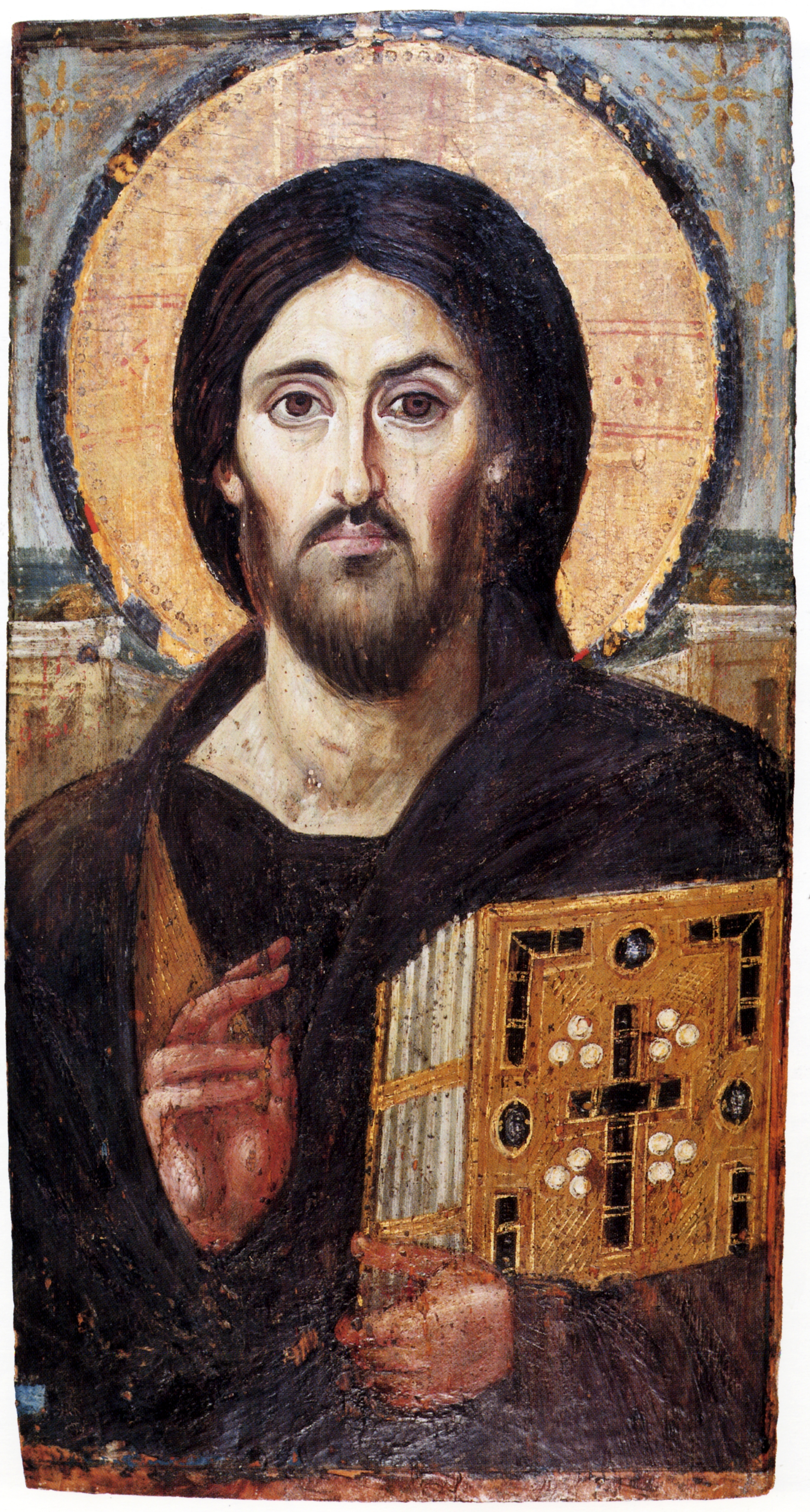
Source: Christ Pantocrator, sixth century, Saint Catherine’s Monastery, Sinai, public domain / Wikimedia Commons
The series begins with Christ’s face because the Beatitudes receive their authority and unity from Him. His right hand blesses and teaches; His left holds the Gospel. The first word of the Sermon is not detached wisdom but the speech of the incarnate King.
The icon also guards the series from moralism. We do not place eight ideals beside Christ and ask Him to help us reach them. He is the blessed life in person. The saints and faithful shine only by communion with Him.
The gold ground removes the image from ordinary narrative time and directs the viewer toward the Kingdom horizon of the promises. Yet Christ holds a book and looks toward the worshipper. The Kingdom is not vague spirituality. The King addresses us through His word and calls for a real response.
Glossary
- Beatitude: A declaration by Christ of who is blessed under God’s reign and what promise belongs to that life.
- Makarios / makarioi: The Greek word translated “blessed,” singular and plural respectively. It indicates blessedness or favor, not merely a passing emotion.
- Kingdom of Heaven: God’s active reign, present in Christ and received now, with its full manifestation still to come.
- Theosis: Participation by grace in God’s life through union with Christ and the Holy Spirit. It does not mean becoming God by nature.
- Sermon on the Mount: Jesus’s major teaching discourse in Matthew 5–7, beginning with the Beatitudes.
- Sermon on the Plain: Jesus’s teaching in Luke 6, including four blessings and four corresponding woes.
- Woe: A prophetic warning and lament that exposes a condition opposed to life under God’s reign.
- Ascent: Gregory of Nyssa’s image for growth toward clearer participation in blessedness. It is a movement of grace and healing, not self-earned status.
- Fourth Sunday of Abib: The verified Coptic calendar placement of August 2, 2026.
Sources
Primary sources
- Scripture: Matthew 4:23–5:16; Luke 6:17–26; Philippians 1:27–2:11; John 11:1–45; 1 Peter 1:25–2:10; Psalm 1; Jeremiah 17:5–8. Scripture is from NKJV.
- Saint Gregory of Nyssa, Oration 1 on the Beatitudes, on ascending the mountain with the Word, blessedness as participation in divine life, restored likeness, and voluntary humility in Christ. Online-direct synchronized text: opening and mountain, blessedness and participation, and voluntary humility in Christ.
- Saint John Chrysostom, Homilies on the Gospel of Matthew, Homily XV on Matthew 5:1–16, especially Christ healing body and soul, the universal scope of the blessings, humility as foundation, and the Beatitudes as an ordered “golden chain.” New Advent; CCEL.
Secondary academic sources
- Hubertus R. Drobner and Albert Viciano, eds., Gregory of Nyssa: Homilies on the Beatitudes: An English Version with Commentary and Supporting Studies, Supplements to Vigiliae Christianae 52 (Brill, 2000).
- Michael Glerup, trans., Gregory of Nyssa: Sermons on the Beatitudes, Popular Patristics Series 52 (St Vladimir’s Seminary Press, 2012).
- Mark Allan Powell, “Matthew’s Beatitudes: Reversals and Rewards of the Kingdom,” The Catholic Biblical Quarterly 58, no. 3 (1996): 460–479. JSTOR.
- Mark Allan Powell, “The Beatitudes,” Bible Odyssey / Society of Biblical Literature. https://www.bibleodyssey.org/articles/the-beatitudes/.
- Dale C. Allison Jr., “The Sermon on the Mount,” Bible Odyssey / Society of Biblical Literature. https://www.bibleodyssey.org/articles/the-sermon-on-the-mount/.
Coptic Orthodox and liturgical sources
- Coptic Agpeya, Sixth Hour Gospel: Matthew 5:1–16.
- Coptic lectionary for August 2, 2026, the fourth Sunday of Abib: Pauline Epistle Philippians 1:27–2:11; Catholic Epistle 1 Peter 1:25–2:10; Acts 19:11–22; liturgy Gospel John 11:1–45. These readings shape section 10; the lesson does not claim Matthew 5:1–16 as the appointed Sunday liturgy Gospel.
Iconography and image source
Christ Pantocrator, sixth century, encaustic icon from Saint Catherine’s Monastery, Sinai. Wikimedia Commons, public domain.
Footnotes
-
Saint John Chrysostom, Homilies on the Gospel of Matthew, Homily XV on Matthew 5:1–2. Chrysostom says Christ was not healing bodies only but “amending their souls,” showing His care for the whole human person. CCEL deep link. ↩
-
Saint John Chrysostom, Homilies on the Gospel of Matthew, Homily XV, §2. He says Christ applies the blessings “without restriction” and addresses all humanity through the disciples. CCEL deep link. ↩
-
Mark Allan Powell, “The Beatitudes,” Bible Odyssey / Society of Biblical Literature, https://www.bibleodyssey.org/articles/the-beatitudes/; see also Powell, “Matthew’s Beatitudes: Reversals and Rewards of the Kingdom,” Catholic Biblical Quarterly 58, no. 3 (1996): 460–479. ↩ ↩2
-
Saint Gregory of Nyssa, Oration 1 on the Beatitudes. Gregory describes true blessedness as belonging to the divine life and human blessedness as participation in it through restored likeness. Catholic Library direct text. Online-direct mirror, not yet in the local corpus. ↩
-
Saint Gregory of Nyssa, Oration 1 on the Beatitudes. Gregory invites the disciple to ascend the spiritual mountain with the Word, then identifies the One at the summit as the healer who bears human weakness. Catholic Library direct text. Online-direct mirror, not yet in the local corpus. ↩ ↩2
-
Saint John Chrysostom, Homilies on the Gospel of Matthew, Homily XV on Matthew 5:3–12. After describing how one Beatitude prepares for the next, he says Christ has “woven a sort of golden chain for us.” CCEL deep link. ↩
-
Matthew 5:3 and 5:10 use the present promise “theirs is the kingdom of heaven,” while Matthew 5:4–9 state future promises. See BibleHub, Matthew 5 interlinear text and morphology, https://biblehub.com/interlinear/matthew/5.htm. ↩