

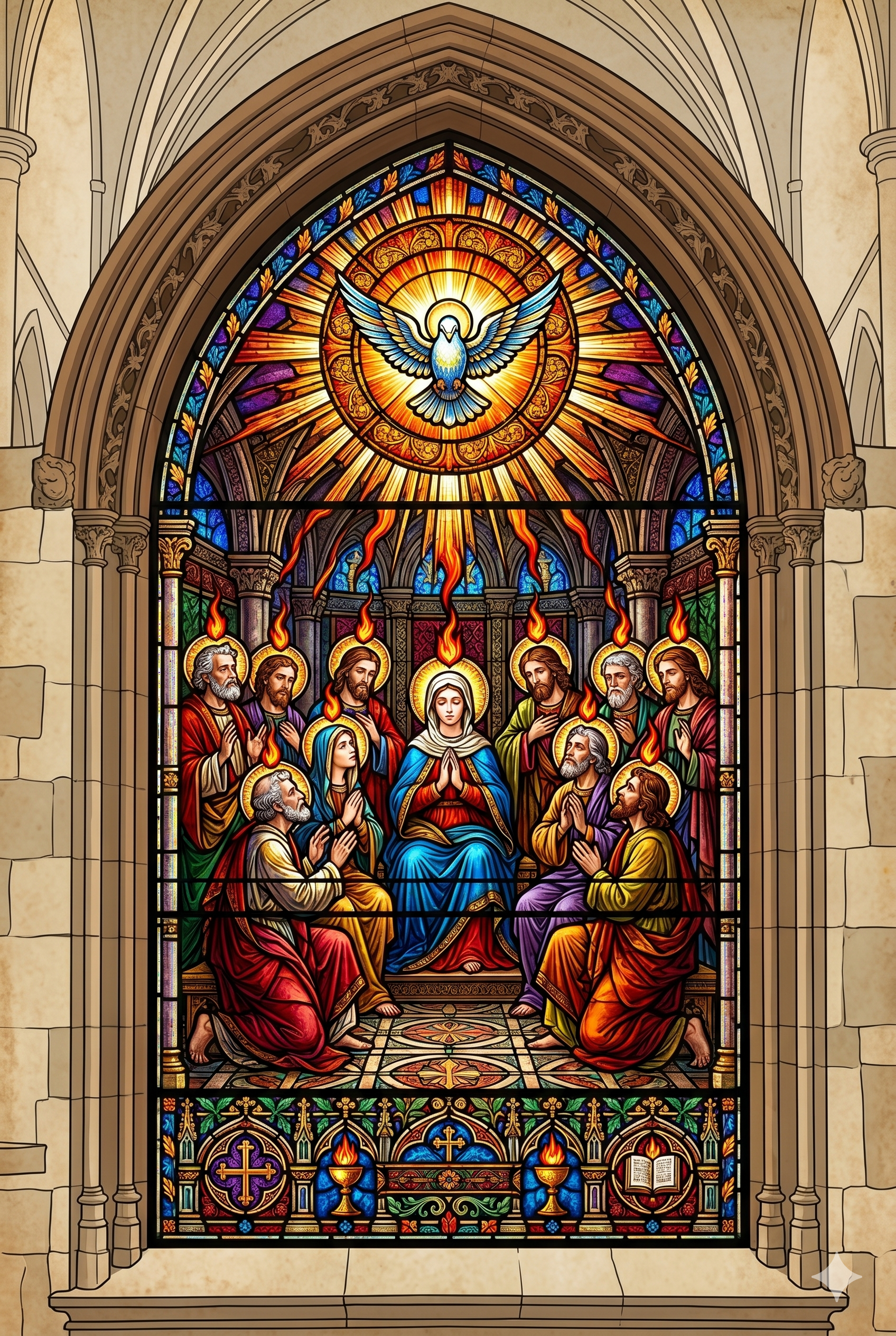
Pentecost / The Descent of the Holy Spirit on the Apostles, Novgorod School. Public-domain image via PICRYL / Wikimedia Commons. The lower crowned figure is Kosmos, representing the world awaiting the apostolic preaching of the Gospel.
Lesson aim
To understand the Coptic Orthodox Prostration Prayer service of Pentecost, not as an isolated rite, but as the Church’s bodily confession that the risen and ascended Christ has poured out the Holy Spirit. The lesson should help the hearer see why the Church stands through the Holy Fifty Days, why she bows at their completion, and how the three Sagda prayers move the soul from resurrection joy into repentance, mission, and life in the Holy Trinity.
Opening thought
Pentecost is not the end of the Resurrection season in the sense of leaving joy behind. It is the completion of Pascha. Christ is risen, Christ has ascended, and now Christ sends the Comforter. The Church does not kneel because Resurrection joy has failed. She kneels because the Resurrection has entered the body.
For fifty days the Church stands in the light of the empty tomb. At the Ninth Hour on Pentecost, she bows. That movement teaches something important: the Holy Spirit does not make us less humble. He makes true humility possible. He does not replace repentance with excitement. He turns repentance from despair into communion.
1. Overview of the Feast of Pentecost
Pentecost means “the fiftieth.” In the Old Testament it is the Feast of Weeks, counted after Passover and connected with firstfruits and harvest. Israel was commanded to remember deliverance, to rejoice before the Lord, and to include the stranger, the orphan, and the widow in that joy. In later Jewish memory, Pentecost was also associated with the giving of the Law at Sinai. The Coptic Sagda service intentionally brings those two worlds together: the Old Testament readings come from Deuteronomy, where Israel remembers Sinai, covenant obedience, Passover, and the feast cycle.
In the New Testament, Pentecost becomes the day when the risen and ascended Christ pours out the Holy Spirit upon the Church. Acts 2 gives the core event:
- The disciples were gathered together in one accord.
- A sound came from heaven like a rushing mighty wind.
- Tongues as of fire appeared and rested upon each of them.
- They were all filled with the Holy Spirit.
- They began to speak with other tongues as the Spirit gave them utterance.
- Peter preached Christ crucified, risen, and exalted.
- Thousands were added to the Church.
Pentecost is therefore not merely the birthday of Christian preaching. It is the revelation that the crucified and risen Lord has not left His Church orphaned. He sends the Spirit of truth, the Comforter, the One who makes Christ present in us, sanctifies us, unites us, empowers witness, and makes worship possible.
St. Gregory the Theologian opens his Pentecost homily with this spiritual weight: “We are keeping the feast of Pentecost and of the Coming of the Spirit, and the appointed time of the Promise, and the fulfilment of our hope.” He says that the “dispensations of the Body of Christ” are fulfilled, and “that of the Spirit is beginning.” This does not divide Christ from the Spirit. It means the one economy of salvation has reached its next revelation: the Son has ascended in the flesh, and the Spirit now forms Christ in the Church.
St. John Chrysostom explains why the Spirit comes after the Ascension, not immediately after the Resurrection. He says Christ allowed the disciples to long for the promised gift, because “our desires towards God are then most raised, when we stand in need.” Pentecost is grace given to people who know they cannot continue in their own strength.
That is the right starting place for Sagda. The Church bows because she knows she cannot be the Church without the Holy Spirit.
2. What is the Prostration Prayer service?
The Coptic Prostration Prayer service is commonly called Sagda, from the Arabic root connected with bowing or prostrating. It is prayed on Pentecost Sunday at the Ninth Hour, around 3:00 PM. Although the Holy Spirit descended at the Third Hour, as Peter says in Acts 2:15, the Church prays the Sagda at the Ninth Hour to connect the gift of the Spirit to the sacrifice of Christ, who gave up His spirit on the Cross at the Ninth Hour.
A current Coptic service book, The Book of Prostration, states:
“The holy fathers, the teachers of the Orthodox Church, have established the Book of Prostrations with details of what ought to be read in the three Prostrations on the Day of Pentecost, which is the completion of the holy Fifty Days.”
The same book gives the practical shape of the rite:
- The faithful gather at the Ninth Hour, 3:00 PM.
- They pray the Ninth, Eleventh, and Twelfth Hours from the Agpeya.
- They chant Psalm 116, “Praise the Lord, all you nations,” with its known tune.
- They pray the Fourth Hoos and continue the praise.
- The service is divided into three prostrations.
- The first and second prostrations are prayed in the second chorus, the area associated with the Pascha place.
- The third prostration is prayed in the first chorus, closer to the altar, with the curtain opened, in annual tune.
The first two prostrations retain the joy of the feast. The third moves closer to the sanctuary and takes on a more solemn annual tone. This movement matters. The Church does not rush from joy into sadness. She carries joy into reverence.
3. Why kneel after fifty days of standing?
The Coptic Church, following ancient Christian practice, avoids prostrations on Sundays and throughout the Holy Fifty Days. The reason is not that humility becomes inappropriate. It is that the Church’s bodily posture confesses the Resurrection.
This is very ancient. Tertullian wrote that Christians counted “fasting or kneeling in worship on the Lord’s day” unlawful, and that they rejoiced in the same privilege “from Easter to Whitsunday,” meaning Pentecost. The First Ecumenical Council at Nicaea, Canon 20, also says that because some kneel on the Lord’s Day and in the days of Pentecost, prayer should be made to God standing so that the practice may be uniform.
St. Basil the Great gives the theology behind this practice. He says that on the first day, the Church teaches her children to pray standing as a reminder of endless life. He adds that “all Pentecost is a reminder of the resurrection expected in the age to come.” Then he gives the other half of the theology:
“Every time we fall upon our knees and rise from off them we show by the very deed that by our sin we fell down to earth, and by the loving kindness of our Creator were called back to heaven.”
This is the key to Sagda. Standing and kneeling are not enemies. Standing confesses Resurrection. Kneeling confesses repentance. Rising again confesses mercy. The whole movement is Paschal.
So why kneel on Pentecost afternoon? Because the Holy Fifty Days have reached their completion. The Church has stood in the light of the risen Christ. Now, filled with the promise of the Spirit, she bends before God and asks that the Resurrection become repentance, holiness, mission, and love.
4. Historical context and development
Biblical roots
Prostration is biblical before it is liturgical. Abraham bows. Moses falls before the Lord. Israel bows in worship. The Psalms command, “Oh come, let us worship and bow down; let us kneel before the Lord our Maker” (Psalm 95:6). In Scripture, the body does not merely decorate prayer. The body tells the truth.
Pentecost also has biblical depth. In Israel, it is a harvest feast and a feast of counted fullness. In Christian fulfillment, the harvest becomes human souls. St. John Chrysostom says Pentecost is the time when the sickle is put to the harvest, and the Spirit comes like a sharp sickle of the word. The firstfruits are no longer only grain. The firstfruits are people gathered into Christ.
Early Christian posture
The earliest evidence emphasizes standing during the Lord’s Day and Pentecost season. This is not a small rubrical point. It shows that the Church’s posture was a theological confession. Resurrection changed how Christians stood before God.
The Pentecost kneeling transition
Within the wider Orthodox tradition, Pentecost becomes the point where the Church returns from the long Paschal standing to kneeling prayer. The Coptic Sagda service expresses this with particular richness: three prostrations, prophecies from Deuteronomy, Pauline readings from 1 Corinthians, Gospel readings from John and Luke, litanies for the living and departed, doxologies, the Creed, and the final dismissal.
The rite is not a random collection. It is a bridge. It carries the Church from the Holy Fifty Days into the rest of the year. It says: we have celebrated Resurrection, Ascension, and Pentecost. Now let this life descend into our actual knees, thoughts, homes, speech, memory, and repentance.
What changed over the years?
The stable core is ancient: Pentecost, no kneeling during the Paschal season, the return to kneeling at Pentecost, Trinitarian worship, and prayer for the Spirit’s sanctifying work.
The Coptic service as prayed now shows later liturgical development and standardization:
- The service is codified into three prostrations. Modern Coptic rite books present a structured order with assigned readings, litanies, tunes, and locations in the church.
- Local rubrical details can vary. Some online summaries list the third Gospel as John 4:1-26, while the service book used here gives John 4:1-24. Some parishes abbreviate or expand doxologies according to local practice and pastoral direction.
- The service now commonly appears in bilingual or trilingual editions. The current printed forms often include Coptic, Arabic, and English, making the rite teachable to diaspora congregations.
- Modern editorial revision exists, but should be taught carefully. Some Coptic rite discussions mention modern revisions to wording concerning the departed in the third prostration. I did not verify official Holy Synod minutes in this research pass, so I would not present a specific revision date as certain without a diocesan or official Arabic source.
A necessary caution: it is tempting to assign the whole Coptic Sagda service to one named father or one exact century. The sources checked here do not justify that. Some Orthodox traditions associate Pentecost kneeling prayers with St. Basil, and St. Basil certainly gives the classic patristic theology of standing and kneeling. But the current Coptic service book simply says the holy fathers established the Book of Prostrations. Teach that with humility. The rite is patristic in spirit and Orthodox in structure, but its textual history deserves more careful source work before making precise claims.
5. The current rite at a glance
| Part | Location and tone | Main readings | Main prayer emphasis |
|---|---|---|---|
| Opening praise | Church gathers at Ninth Hour | Ninth, Eleventh, Twelfth Hours; Psalm 116; Fourth Hoos | The nations praise God; the day turns toward evening; the Church enters prayer with thanksgiving |
| First Prostration | Second chorus, festive tune | Deuteronomy 5:23-33; 6:1-3; 1 Corinthians 12:28-31; 13:1-12; Psalm 97:7-8,1; John 17:1-26 | Awe before God, repentance, cleansing, protection, Christ’s high-priestly prayer, gifts ordered by love |
| Second Prostration | Second chorus, festive then annual tone | Deuteronomy 6:17-25; 1 Corinthians 13:13; 14:1-17; Psalm 115:12-13; Luke 24:36-53 | The gift of the Spirit, enlightenment, true speech, remembrance, Ascension, promise of power from on high |
| Third Prostration | First chorus near the altar, annual tone, curtain opened | Deuteronomy 16:1-18; 1 Corinthians 14:18-40; Psalm 66:4 and 72:11; John 4:1-24 | Worship in spirit and truth, order in the Church, prayer for the living and departed, Trinitarian fullness, final doxology |
Note on Psalm numbering: Coptic books may reflect Greek/LXX and Arabic numbering in ways that differ from English Bibles. The table above follows the English references printed in the service book where available.
6. The first prostration: awe, repentance, and love
Readings
Prophecy: Deuteronomy 5:23-33; 6:1-3
Israel stands at Sinai. The people hear the voice of God from the fire and are afraid. They ask Moses to mediate: “You go near and hear all that the Lord our God may say.” The passage then calls Israel to obedience, that it may go well with them.
Pentecost fulfills Sinai without erasing it. At Sinai, the people fear the divine voice from the fire. At Pentecost, fire rests upon the disciples and the divine word is preached in every tongue. The Law is no longer only heard from outside. The Spirit writes the life of God within.
Pauline: 1 Corinthians 12:28-31; 13:1-12
The Church hears about apostles, prophets, teachers, miracles, healings, helps, administrations, and tongues. But then St. Paul says there is a “more excellent way.” Without love, tongues become noise, prophecy becomes nothing, knowledge becomes pride, and sacrifice becomes empty.
This reading is perfect for Pentecost. The Spirit gives gifts, but the sign of the Spirit is not display. The sign is love.
Psalm and Gospel: Psalm 97:7-8,1 and John 17:1-26
The Psalm calls all angels to worship and Zion to rejoice because the Lord reigns. The Gospel is Christ’s high-priestly prayer: “Father, the hour has come. Glorify Your Son, that Your Son also may glorify You.” Christ prays for His disciples, for those who will believe through them, and for unity: “that they all may be one.”
The first Sagda begins with Christ praying for us before we bow to Him. This matters. Our repentance is not an attempt to convince an unwilling God. We kneel inside the intercession of the Son.
Components and contemplation
Before the kneeling litany, the Church has prayed thanksgiving, Psalm 50, the prophecy, the Pauline, the Trisagion, the Gospel, the exposition, and litanies for the sick, travelers, waters, plants, fruits, and the place. This is wide prayer. The Church does not kneel only for private emotion. She brings the whole creation and the needs of all people before God.
The deacon then calls: “Worship God in fear and trembling.” The priest prays while the people kneel.
The first litany begins by addressing God as eternal, invisible, incomprehensible, unchangeable, omnipresent, and immortal. Then it turns to Christ’s economy: He descended from heaven, was incarnate of the Holy Spirit and the Virgin Mary, taught us, saved us by His holy sufferings, ascended, sat at the right hand of the Father, and sent the Holy Spirit upon His disciples.
Then the prayer becomes deeply penitential:
- “Grant us… to raise our prayers to You, and bow down our heads and our knees before You for our sins and for the ignorances of Your people.”
- “Free our captive souls by Your great compassion.”
- “Do not remember the sins of our youth and the time of our ignorance.”
- “Cleanse us, O Lord, from our hidden impurities.”
- “Grant us repentance before we return to dust.”
- “Cleanse us all by the good power of Your Holy Spirit. Untie us from the bondage of Satan.”
The first prostration teaches that the Holy Spirit is not given to decorate an unchanged life. He is given to free captive souls.
Patristic anchor
St. Isaac the Syrian, as quoted in Coptic spiritual writings on prostration, says: “Compel yourself to kneel down before God, for this invigorates the spirit of prayer.” That sentence fits the first Sagda. Sometimes the soul does not feel humble until the body tells the truth first.
Spiritual takeaway
The first prostration asks: if Christ has prayed that we may be one with Him, what captivity still keeps us divided inside? Pride, old sins, hidden impurity, fear, anger, distraction, spiritual laziness. The Spirit comes as fire, but the first fire He burns is the false self.
7. The second prostration: the Spirit who gives light and speech
Readings
Prophecy: Deuteronomy 6:17-25
Israel is commanded not to tempt the Lord, but to keep His commandments. When children ask, “What is the meaning of the testimonies, the statutes, and the judgments?” the answer is memory: we were slaves, the Lord brought us out, and He commanded us these things for our good.
Pentecost is not forgetfulness. The Spirit does not make the Church anti-historical. He makes memory alive. The Church remembers deliverance, Cross, Resurrection, Ascension, and the promise of the Father.
Pauline: 1 Corinthians 13:13; 14:1-17
The reading begins with faith, hope, and love, and the greatest is love. Then St. Paul discusses prophecy and tongues. His concern is edification. Speech in the Church must build up the Church.
This is directly Pentecostal. The miracle of tongues is not noise. It is communion. At Babel, language divided the proud. At Pentecost, the Spirit makes diverse languages serve one Gospel.
Psalm and Gospel: Psalm 115:12-13 and Luke 24:36-53
The Psalm says the Lord remembers and blesses. The Gospel shows the risen Christ appearing to His disciples, giving peace, opening their understanding to the Scriptures, commanding witness, promising “power from on high,” and ascending into heaven.
Luke 24 is the perfect bridge between Resurrection and Pentecost: peace, Scripture opened, mission given, promise awaited, Ascension accomplished.
Components and contemplation
The second prostration includes litanies for the leader, the departed, the oblations, and the catechumens. This set is pastoral and ecclesial. The Church prays for authority, for the dead, for offerings, and for those still being formed in the faith. The Spirit is not private electricity. He is the life of the whole Body.
The second Sagda litany directly asks for the Pentecost gift:
- “O Lord our God, who gave peace to people and gave them the gift of the Holy Spirit… make us also worthy to be counted among Your inheritance.”
- “May You send us Your Holy Spirit whom You sent upon Your holy disciples and pure apostles on this Day of Pentecost.”
- “And we were filled with the light of the fire of Your Holy Spirit.”
- “When You called us to the true faith, we believed and spoke of the glory of Your Divinity with the Father and the Holy Spirit, One Godhead and One Dominion.”
- “Teach me how to supplicate to You for all our needs.”
- “Send the Spirit of Your wisdom upon my thoughts… May Your Good Spirit direct me to the right path.”
- “Look to Your people who are kneeling down bowing before You.”
Notice the movement: the Spirit descends on the apostles, the Church receives the knowledge of God through apostolic preaching, the individual asks for purified thoughts and true prayer, then the whole people are presented as kneeling before God.
This is not individualism. It is personal repentance inside apostolic faith.
Patristic anchor
St. Cyril of Alexandria comments on John 20:22, where Christ breathes on the apostles and says, “Receive the Holy Spirit.” He says Christ sanctified them “through the outward sign of His Breath” so that we might know the Spirit is not alien to the Son but consubstantial with Him. St. Cyril then wrestles with the relation between John 20 and Acts 2. His answer is that Christ truly gave the Spirit when He breathed on them, while Pentecost openly proclaimed and manifested the grace with the gift of tongues.
That helps us read the second prostration. Pentecost is not a theatrical event. It is the public manifestation of the inner life Christ gives to His Church.
St. John Chrysostom adds that when the Spirit sat upon each of them, the sitting showed “settledness and continuance.” The Spirit is not a passing mood. He rests, abides, and forms.
Spiritual takeaway
The second prostration asks: what does the Spirit need to heal in my speech?
Not only profanity or obvious sin. More deeply: speech without love, knowledge without edification, prayer without attention, opinions without humility, words that do not build the Church. Pentecost heals language. The Spirit does not only make us speak. He teaches us when speech is love.
8. The third prostration: worship in Spirit and truth
Readings
Prophecy: Deuteronomy 16:1-18
This reading recalls Passover, Weeks, and Tabernacles. Israel is told to remember deliverance, rejoice before the Lord, include the vulnerable, and appoint judges who do not pervert justice.
This gives the third Sagda an ethical weight. The Spirit-filled life is not only liturgical. It becomes justice, memory, generosity, and ordered communal life.
Pauline: 1 Corinthians 14:18-40
St. Paul continues teaching about tongues, prophecy, understanding, peace, and order in the assembly. “God is not the author of confusion but of peace.” The Spirit does not create chaos. He creates ordered worship.
This matters for Orthodox spirituality. A service can be full of movement, incense, chant, readings, and prostrations, yet still be deeply ordered. The Spirit is freedom, but not disorder. He is fire, but not self-display.
Psalm and Gospel: Psalm 66:4; 72:11 and John 4:1-24
The Psalm announces universal worship: all the earth shall worship and sing to God; kings and nations bow before Him. The Gospel is Christ’s conversation with the Samaritan woman: living water, true worship, and the revelation that “God is Spirit, and those who worship Him must worship in spirit and truth.”
This is why the third prostration moves closer to the altar. Worship is no longer confined by rivalry over mountain or temple. In Christ, through the Spirit, the Father seeks true worshipers.
Components and contemplation
The third prostration includes the litanies of peace, the fathers, those who asked us to remember them, the assemblies, “Graciously accord, O Lord,” the Trisagion, doxologies, the Creed, and the final kneeling litany. It is the most ecclesial of the three. It gathers heaven and earth, clergy and people, living and departed, dogma and prayer.
The third Sagda litany is especially rich:
- It addresses Christ as the Giver of light and life.
- It remembers His Cross, His defeat of death, His crushing of Hades, and His victory over the evil spirits.
- It asks repose for the departed Orthodox Christians.
- It declares that on Pentecost God taught us “the fullness of the mystery of the Holy Trinity who are equal, unseparable and unchangeable.”
- It remembers the Spirit poured out as tongues of fire.
- It asks God to accept the prayers of the Church on this sacred day.
- It prays for the living to be forgiven, to walk in the day, and to be clothed with the weapons of light.
The final canon proclaims:
“The Spirit, the Paraclete that came down from the heaven appeared on the apostles on Pentecost, filled them of all knowledge and wisdom through His power.”
Then the priest dismisses the faithful with the apostolic blessing: the love of God the Father, the grace of the only-begotten Son, and the communion and gift of the Holy Spirit.
The service ends where all Orthodox prayer ends: in the Holy Trinity.
Patristic anchor
St. Gregory the Theologian says the Holy Spirit “always existed, and exists, and always will exist.” He is not a creature and not an afterthought. He is “everlastingly ranged with and numbered with the Father and the Son.” This is why Pentecost is Trinitarian to its core. The Spirit’s descent does not reveal a lesser power. It reveals the life of God given to the Church.
St. Basil’s theology of kneeling also belongs here: when we kneel and rise, we show that by sin we fell to earth, and by God’s loving kindness we are called back to heaven. The third prostration is the whole Gospel in bodily form: fall, mercy, rising, communion.
Spiritual takeaway
The third prostration asks: is my worship becoming “spirit and truth”?
Not emotion without truth. Not correctness without spirit. Not ritual without repentance. Not freedom without order. The Spirit forms true worshipers: people who know the Father through the Son, in the Holy Spirit, and whose lives begin to match their bowing.
9. Why the service includes prayers for the departed
The Sagda service does not treat Pentecost as a private experience for the living only. The third litany prays for those who have departed in the Orthodox faith, asking rest in the place where grief, sorrow, and groaning have fled away.
This is not an interruption. It is part of Pentecost’s meaning. The Spirit unites the Church. The living and the departed are not two Churches. Christ has crushed death, and the Spirit gathers all in Christ. When the Church bows on Pentecost, she brings before God not only her present needs, but also her fathers, mothers, brethren, and all who have fallen asleep in the true faith.
This should be taught carefully. We do not imagine the departed as outside God’s care until we remind Him. Rather, we stand in the communion of saints and ask mercy from the One who is already “the God of the living.”
10. The spiritual logic of the whole rite
The Sagda service can be summarized in five movements.
1. From Resurrection standing to Spirit-filled kneeling
We stand for fifty days because Christ is risen. We kneel at Pentecost because the risen Christ gives the Spirit who teaches us repentance.
2. From Sinai’s fire to Pentecost’s fire
At Sinai the people tremble before the fire and ask for mediation. At Pentecost the fire rests on the Church and the apostolic word goes to the nations. God is still holy. But now His holiness is poured into the Church as gift.
3. From Babel’s confusion to the Church’s confession
Many tongues once revealed human pride and division. At Pentecost, many tongues confess one Lord. The Spirit does not erase difference. He heals division.
4. From individual feeling to ecclesial prayer
The service prays for the sick, travelers, waters, plants, fruits, the place, leaders, departed, oblations, catechumens, fathers, assemblies, and those who asked to be remembered. Pentecost makes the heart larger, not narrower.
5. From rite to life
If Sagda ends when we stand up, we missed it. The service is meant to continue as a posture of life: humility without despair, boldness without pride, repentance without self-hatred, speech ordered by love, worship in spirit and truth.
11. Teaching outline
Opening question
If we have been standing for fifty days because Christ is risen, why does the Church choose to bow at the completion of Pentecost?
Let the class answer before explaining. Likely answers: repentance, humility, end of Holy Fifty, receiving the Spirit. Affirm these, then deepen the answer: we kneel because the Spirit makes repentance possible inside Resurrection joy.
Main teaching points
- Pentecost completes Pascha. The Son ascends and sends the Spirit. The Church is not orphaned.
- The body confesses theology. Standing and kneeling are not empty gestures. They teach Resurrection, repentance, and mercy.
- The service has three prostrations because it is Trinitarian and ecclesial. It is not a private prayer added to the calendar.
- The readings are deliberate. Deuteronomy gives covenant and feast memory; Corinthians gives gifts ordered by love and understanding; the Gospels give Christ’s prayer, Ascension, and true worship.
- The Spirit gives both power and order. Pentecost is not chaos. St. Paul insists on edification, love, and peace.
- Sagda is a bridge into the rest of the year. We leave the Holy Fifty Days not by losing Resurrection joy, but by carrying it into repentance and mission.
Discussion Questions
- What is the difference between kneeling out of shame and kneeling out of hope?
- Why does St. Paul place love above tongues, prophecy, knowledge, and sacrifice?
- What does John 17 teach us about the unity the Holy Spirit forms in the Church?
- How does Luke 24 connect Resurrection, Scripture, Ascension, and Pentecost?
- What would change in our parish life if Pentecost healed our speech?
- What does it mean to worship the Father “in spirit and truth” in a Coptic Orthodox way?
12. Closing contemplation
At Sagda, the Church kneels after fifty days of standing. She has not forgotten the Resurrection. She has finally understood what Resurrection asks of her.
A dead man cannot repent. A slave cannot worship freely. A frightened disciple cannot preach Christ to the nations. But the risen Christ breathes His Spirit into the Church. He gives peace. He opens the Scriptures. He sends power from on high. He turns fear into witness, language into communion, and sinners into temples of the Holy Spirit.
So the Church bows.
She bows because God is holy.
She bows because Christ has interceded for her.
She bows because the Spirit has descended.
She bows because her sins are real.
She bows because mercy is more real.
She bows because the body too must learn the Gospel.
And then she rises.
That is Sagda: the whole Christian life in one movement. We fell through sin. We bow in repentance. We rise by the love of the Father, the grace of the Son, and the communion and gift of the Holy Spirit.
Sources checked
-
The Book of Prostration / Rites of the Prayers of Prostration, Fr. Jacob Nadian, St. Bishoy Coptic Orthodox Church. Local research file:
/Users/ga/workspace/research/sagda/Rites_Prostration_Sagda.txt. -
“Prostration prayers,” St. Mary Coptic Orthodox Church, Seattle. https://www.stmaryseattle.org/ArticlePages/SagdaPrayers.aspx
-
“Prostration Prayers (Sagda),” St. Mary Coptic Orthodox Church of East Brunswick, Hidden Treasures. https://www.saint-mary.net/hidden-treasures/prostration-prayers-sagda
-
“Prostrations According to the Coptic Orthodox Church Rite,” Coptic Orthodox Diocese of Los Angeles. https://www.lacopts.org/story/prostrations-according-to-the-coptic-orthodox-church-rite/
-
Tertullian, On the Crown, chapter 3. https://www.newadvent.org/fathers/0304.htm
-
First Ecumenical Council, Nicaea, Canon 20. https://www.newadvent.org/fathers/3801.htm
-
St. Basil the Great, On the Holy Spirit, chapter 27. https://www.newadvent.org/fathers/3203.htm
-
St. Gregory the Theologian, Oration 41: On Pentecost. https://www.newadvent.org/fathers/310241.htm
-
St. Cyril of Alexandria, Commentary on John, Book 12, on John 20:22-23. https://www.tertullian.org/fathers/cyril_on_john_12_book12.htm
-
St. John Chrysostom, Homilies on Acts, especially Acts 1 and Acts 2, via the local patristic corpus and CCEL source links.
-
Icon image embedded inline: The Descent of the Holy Spirit Novgorod, public-domain Orthodox Pentecost icon, sourced via PICRYL from Wikimedia Commons. Local vault attachment:
Hermes/04-Reference/Coptic Orthodox Lessons/Assets/Icons/Pentecost-Novgorod-Descent-of-the-Holy-Spirit.jpg. Source page: https://picryl.com/media/the-descent-of-the-holy-spirit-novgorod-f75c06
Teaching caution
Do not overstate the exact textual origin of the Coptic Sagda service unless a primary Coptic/Arabic liturgical source is in hand. The tradition is ancient in theology and posture, and the current Coptic service is clearly patristic and Orthodox in structure, but the exact redaction history of the present service book needs more specialized liturgical source work.