
Feast: Pentecost (عيد العنصرة) Season: The seal of the Holy 50 Days Reading anchor: Acts 2; John 20:22; Genesis 2:7; Genesis 11
What the Feast Is
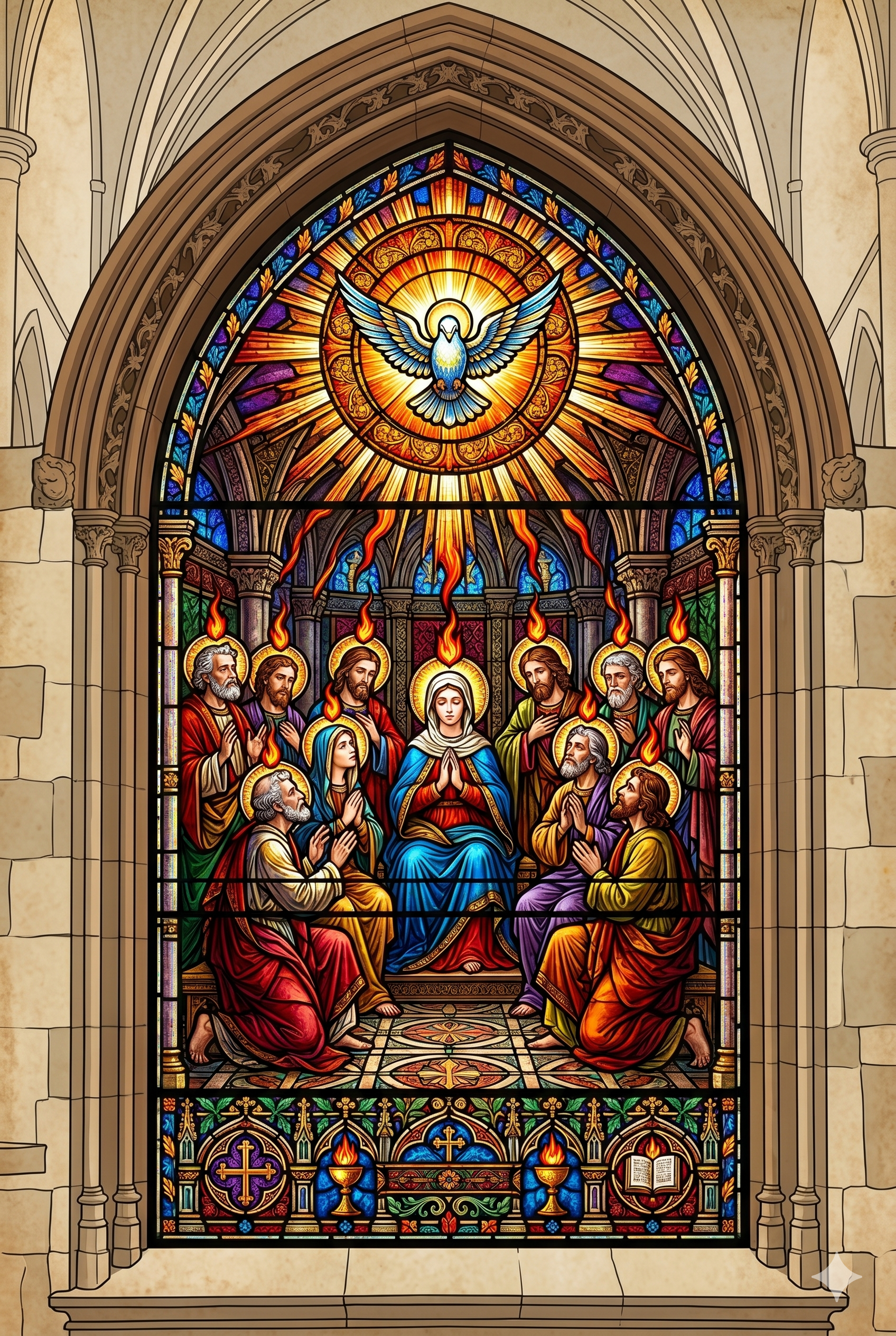
Pentecost is the fiftieth day, the seal of the whole Paschal season. The event is Acts 2: the Holy Spirit descends as tongues of fire on the apostles, and they begin to speak so that every nation present hears the wonders of God in its own tongue. The Coptic Church calls this the birthday of the Church. The Son paid the price for her salvation, He ascended to prepare a place for her, and now He sends His Holy Spirit to give her life, guidance, and sanctification as the heavenly Bride.
The feast gathers three things into one. The resurrection of Christ, His ascension, and the indwelling of the Spirit are not three separate stories. They are one movement of God toward us, completed when the Spirit comes to stay.
Why We Kneel Again
Watch the rite change at the liturgy. For fifty days the Church has not knelt. There is no prostration during the Holy 50 Days, because the standing posture confesses the risen Lord who has lifted us up with Him. At this feast that changes. The three Kneeling Prayers (صلوات السجدة), composed by St. Basil the Great in the fourth century, are prayed, and the whole congregation goes to the ground again. The Coptic Office of Kneeling gives the reason plainly: at the appearing of the Spirit in tongues of fire we bend our knees upon the earth, confessing that through the coming of the Holy Spirit we have been taught the worship of the life-giving Trinity.
So the kneeling is not defeat. You stood for fifty days to confess that Christ raised you. You kneel today to confess that the One you cannot bear to look upon has chosen to live inside you. Both postures say the same thing from two directions: standing says He has lifted me, kneeling says He has filled me.
The prayers carry petitions for the whole world, the sick, the travelers, the winds, and they give special attention to the departed. One point of precision worth holding, especially for those of us who serve the rite: the Church commends the departed and prays for God’s mercy on them. She does not absolve them. In 1999 the Holy Synod removed three phrases from the Third Litany that had implied otherwise. We pray in hope, not in presumption.
The Contemplation: The Second Breathing
What is striking about Pentecost is the reversal it performs.
At Babel, in Genesis 11, one language became many and the nations scattered. At Pentecost, many languages become one understanding and the nations are gathered back. The fire that once guarded the gate of Eden now rests on human heads and does not consume. Everything that sin had broken open, the Spirit begins to close and heal.
St. Gregory the Theologian, in his oration on Pentecost, refuses any idea that the Spirit is a lesser gift. The Spirit is God, of one essence with the Father and the Son, the very Trinity your knees confess today. If the Spirit were a creature, He could not give divine life. A creature cannot unite us to God. Only God can.
St. Cyril of Alexandria takes this to the wound in Adam. When man sinned, the Spirit who rested on him withdrew, and human nature was left cold and unstable, like a house with no fire in it. In Christ the Spirit returns, and this time not as a visitor but as a permanent inhabitant. This is why John 20:22 matters so much: Christ breathes on the disciples, deliberately echoing Genesis 2:7, when God breathed into the dust and man became a living soul. Pentecost is the second breathing. The first breath made man alive. The second breath makes him a temple.
So bring one question to the floor with you when you kneel. Where in my life and ministry have I been carrying in my own strength what was given to be carried by Him? The Spirit is not handed to the Church as an idea to be admired. He is given to you as a Person to be obeyed and a presence to live within.
A Prayer for Pentecost
O Heavenly King, Comforter, Spirit of truth, You did not leave the apostles as orphans but came as fire that warms and does not burn. Come now and rest on me. Breathe into me a second time, as You breathed into Adam, and make this clay a temple. Where I am scattered, gather me. Where I have grown cold, kindle me. Where I have served You in my own strength, take the work into Your own hands. Teach me the worship of the life-giving Trinity, and let every neighbor I meet today be a brother in whom Christ is waiting. For You are the Giver of life, and to You with the Father and the Son belongs all glory, now and unto the ages. Amen.
Standalone feast reflection. Not tied to a series. Patristic anchors: St. Basil the Great (Kneeling Prayers and Canon on posture), St. Gregory the Theologian (Oration 41, On Pentecost), St. Cyril of Alexandria (the indwelling Spirit and the restoration of Adam).