
Pope Kyrillos VI, also called Cyril VI, was the 116th Coptic Orthodox Pope of Alexandria, serving from 1959 until his death in 1971. The Church honors him as a saint and remembers him as a man of prayer. People ask his intercession because they trust that his fatherly love continues in Christ: they are asking him to pray to God for them, not treating him as another savior.12
Which Pope Cyril?
Kyrillos and Cyril are forms of the same name. This saint is not St. Cyril of Alexandria, the fifth-century theologian and 24th patriarch. Nor is he the present Coptic pope, Pope Tawadros II, the 118th patriarch. Kyrillos VI belongs to modern Egyptian history. Pope Shenouda III succeeded him.13
For the office itself and its apostolic inheritance, see Who Is the Coptic Pope?. Here the question is more personal: how did a monk accustomed to solitude become a father whom so many people still approach in prayer?
From Azer to Father Mina to Pope Kyrillos
The main outline of his life is recorded in the Coptic Church’s official history:4
- 1902: Born Azer Youssef Atta.
- 1927: Entered the Monastery of El-Baramous, also called Paromeos, in Wadi el-Natrun.
- February 25, 1928: Became a monk with the name Mina el-Baramosy.
- July 18, 1931: Was ordained a priest. His later solitary life brought the name Father Mina the Solitary.
- 1936–1941: Lived in a windmill on the Mokattam hills, according to the official history’s chronology.
- 1947: Built a church dedicated to St. Mina in Old Cairo, with accommodation for students from outside the city.
- April 19, 1959: Was chosen through the altar lot, following the election of three patriarchal candidates.
- May 10, 1959: Was enthroned as Pope Kyrillos VI.
- November 27, 1959: Laid the foundation stone of St. Mina’s Monastery at Mariout, near Alexandria.
- March 9, 1971: Departed in the Lord.
- June 2013: The Holy Synod formally recognized his sainthood.
His death occurred on 30 Amshir 1687 in the Coptic calendar. His annual commemoration is 30 Amshir, also spelled Meshir. That is the fixed Coptic date; check the relevant year’s calendar for its Gregorian equivalent.4
Was the windmill real?
Yes. The windmill belongs to the Church’s recorded biography, not merely to an appealing illustration of a hermit’s life. Before becoming patriarch, Father Mina lived in a windmill on the Mokattam hills near Old Cairo. This was one stage of a longer monastic journey that included communal life at El-Baramous and solitude in a cave near that monastery.4
The setting matters because his public ministry did not begin with a throne. People sought the prayers of a priest who had learned to live without prominence. A diocesan account remembers visitors seeking his blessing and describes the student accommodation associated with his Old Cairo ministry.5
His solitude was therefore not indifference to others. The same life that made room for silence also made room for people. The church and student residence give that love a concrete shape: prayer did not make ordinary human needs beneath his notice.
Why is he called a man of prayer?
The Church remembers Kyrillos for prayer, praises, and the regular celebration of the Divine Liturgy, the Church’s Eucharistic service. The Southern United States diocese’s account emphasizes that this liturgical life continued after he became pope.45
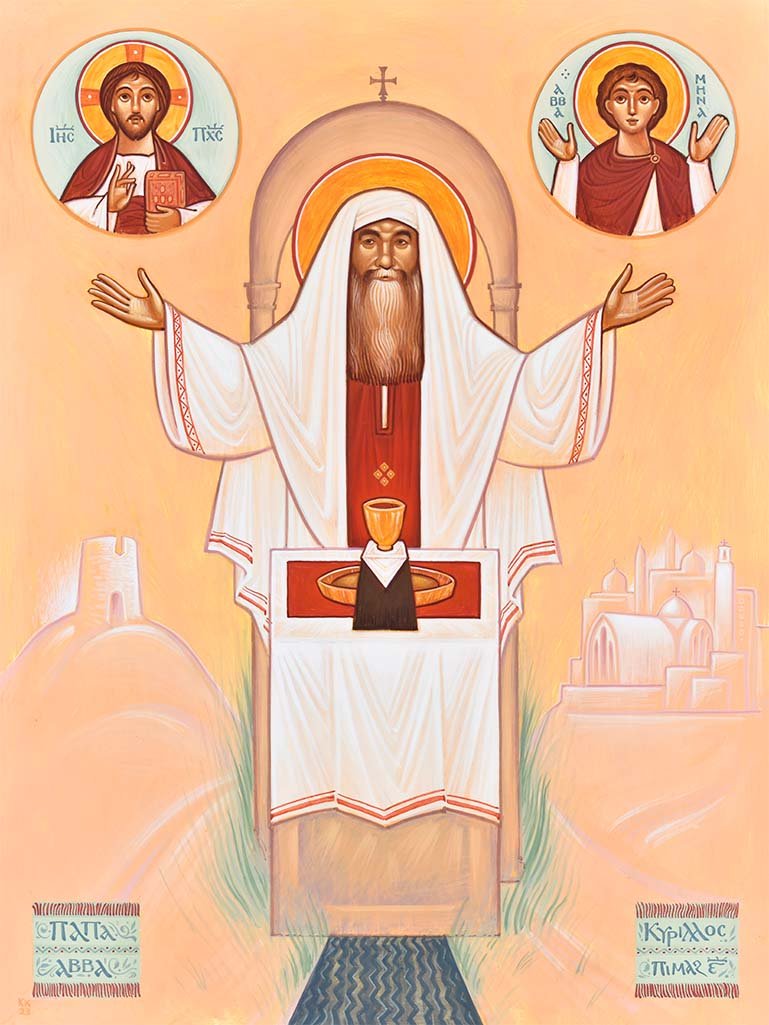 Pope Kyrillos VI celebrates the Divine Liturgy, the Eucharistic service at the heart of his life of prayer. Icon by Kirollos Kilada, used with permission.
This is more important than collecting impressive totals of services or hours awake. He did not graduate from dependence on God into ecclesiastical self-sufficiency. The monk’s need for Christ remained the patriarch’s need for Christ.
In John 15:5, Jesus describes Himself as the vine and His disciples as branches. Fruitfulness comes through abiding in Him, not through spiritual independence. St. John Chrysostom expresses that closeness beautifully: Christ desires “our soul to be a dwelling for Himself.”6 Kyrillos’s prayerful life can be understood within that older Christian vision, rather than as an extraordinary personality’s private technique.
The Divine Liturgy also prevents his story from becoming a celebration of solitary achievement. At the altar, the Church receives Christ’s gifts together. A saint’s life points us toward repentance, Communion, and love for others, not away from the parish into a private search for wonders.
What was his friendship with St. Mina?
Father Mina’s monastic name already linked him to St. Mina the martyr, also called Mari Mina. The diocesan biography describes the saint as his beloved intercessor. Kyrillos built the Old Cairo church bearing St. Mina’s name and later established the modern monastery at Mariout, near the ancient pilgrimage site of Abu Mina.54
The windmill was his dwelling; the Old Cairo church and the monastery at Mariout were two later, separate foundations.
The monastery’s official account records its foundation in 1959 and the transfer of Kyrillos’s body there in 1972, in accordance with his wishes. His shrine remains part of that monastery.7
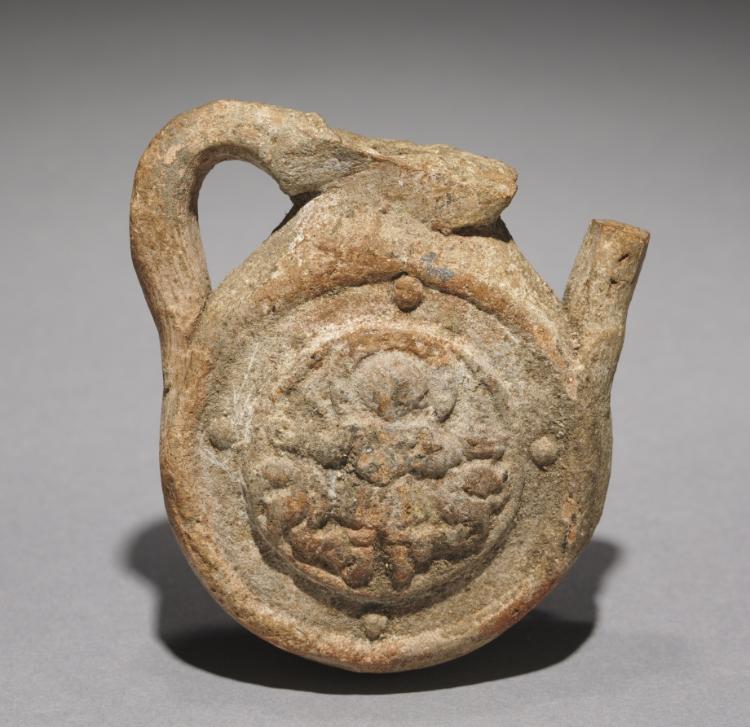 Source: Pilgrim’s Flask with Saint Menas, The Cleveland Museum of Art, CC0.
This pilgrim’s flask bears the image of St. Mina the martyr. It comes from the much older tradition of pilgrimage to his shrine, which Pope Kyrillos’s modern foundation helped renew. The Louvre’s icon of Christ and Abbot Mena depicts a different figure, an abbot, not this martyr.
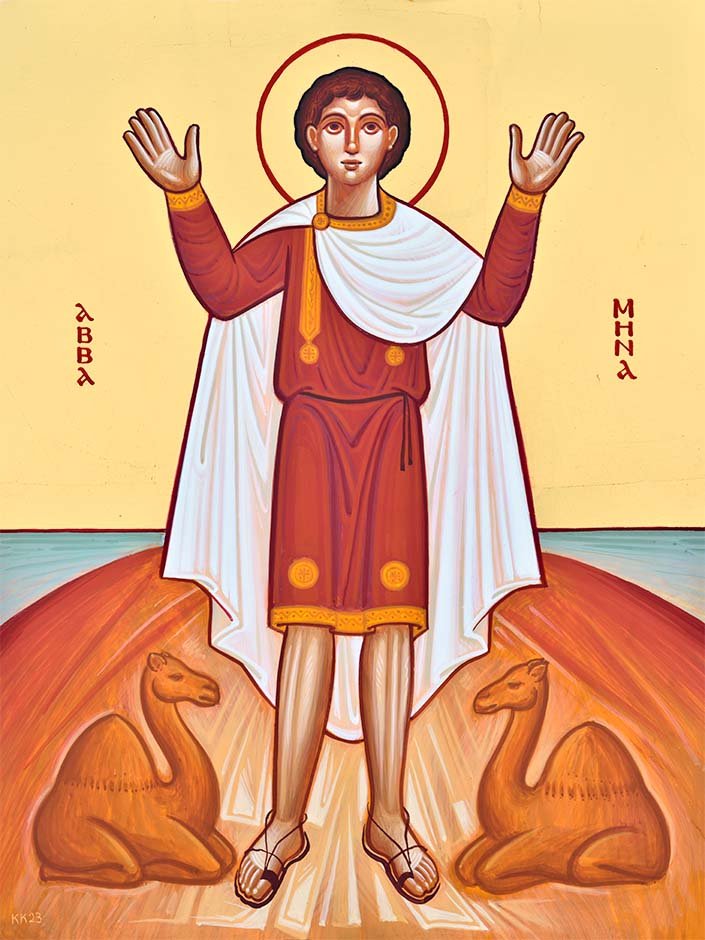 St. Mina the Martyr in Coptic iconography, with two kneeling camels. Icon by Kirollos Kilada, used with permission.
Calling this a friendship means communion in Christ and the intercession of the saints. It does not mean two contemporaries sharing an ordinary earthly friendship. Hebrews 12:22–24 describes the faithful approaching the heavenly Jerusalem, the assembly of the firstborn, the spirits of the righteous made perfect, and Jesus, Mediator of the new covenant. The Church on earth is not cut off from those living in Him.
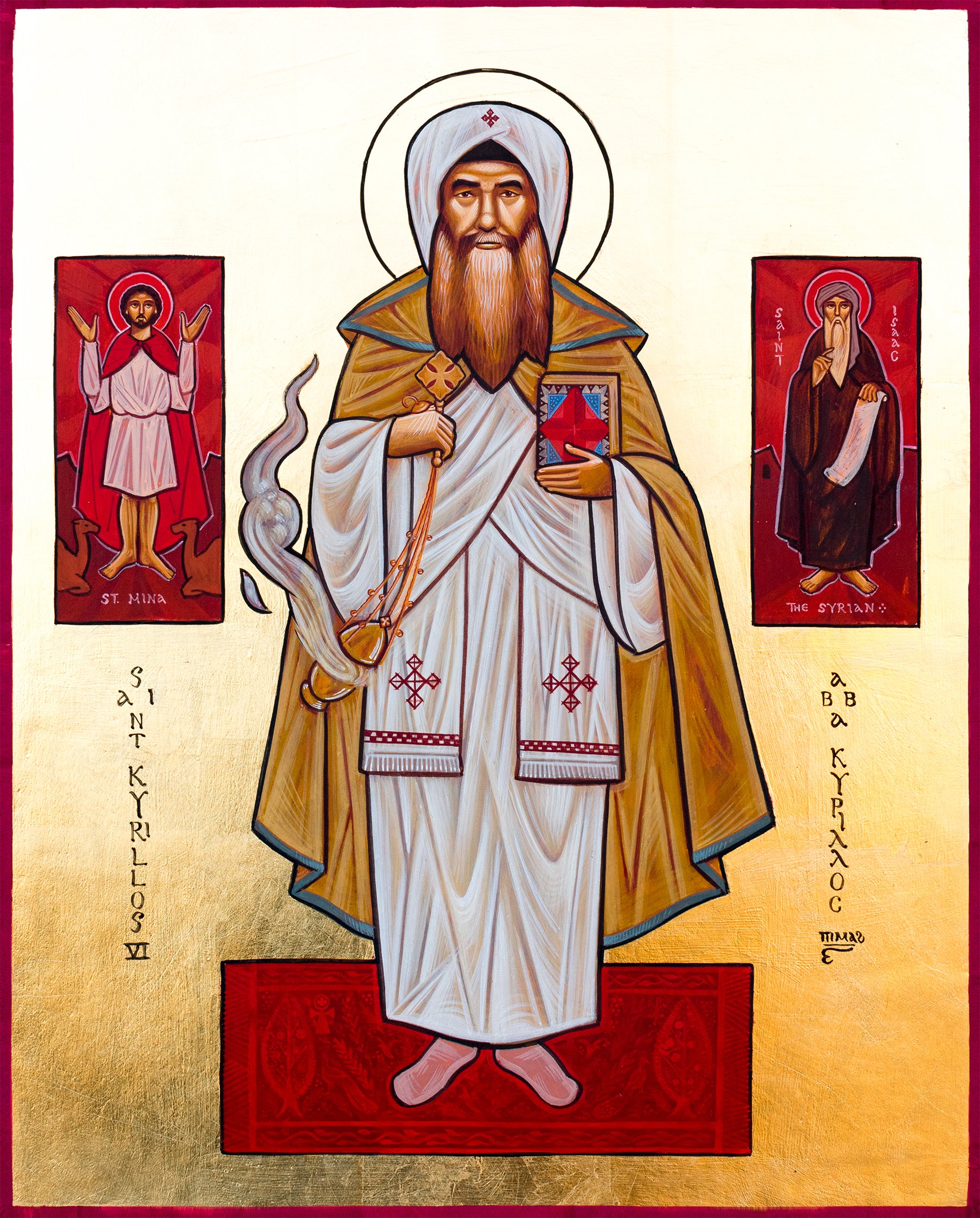 Pope Kyrillos VI with St. Mina and St. Isaac the Syrian. The inset of Mina recalls the pope’s devotion to the martyr. Icon by Kirollos Kilada, used with permission.
St. Mina does not replace Christ, and neither does Kyrillos. Their prayers are offered to the Lord whose mercy sustains the whole Church.2
Miracles, memory, and the Church’s recognition
Coptic families and church publications preserve many testimonies of healings, unexpected help, and answered prayer associated with Kyrillos, both before and after his death. The diocesan biography explicitly speaks of books collecting these accounts.5
Three kinds of evidence should remain distinct. Recorded chronology establishes the broad course of his life. The Church’s reception, including the Synod’s recognition, establishes his place in Coptic veneration. Remembered miracle testimonies tell how particular people experienced God’s help through his prayers. Recognizing his sainthood does not make every circulating anecdote equally documented.
Nor does any testimony promise that invoking his name guarantees recovery, a successful exam, a job, or the answer we prefer. A person whose illness continues has not thereby failed a test of devotion. Prayer is communion with God, not a transaction with a saint.
How to ask his prayers
You can begin simply: “St. Pope Kyrillos, pray to the Lord for me.” Then bring your need directly to Christ with honesty and trust. This is suggested wording, not a compulsory formula.
Let asking his prayers lead into the life he loved. Keep a modest, faithful prayer rule. The Agpeya, the Coptic Book of Hours, offers a beginning. Attend the Divine Liturgy, seek pastoral guidance, and make room for another person’s burden rather than asking only for relief from your own.
You do not need a dramatic experience to honor him. His enduring invitation is to seek Christ faithfully in the ordinary day. Explore the Saints series for other lives shaped by that same communion.
Sources
Footnotes
-
Coptic Orthodox Church, Pope Cyril VI, patriarchal numbering, dates, and church remembrance. ↩ ↩2
-
Coptic Orthodox Diocese of the Southern United States, Q&A on saints’ intercession and commemoration in the Liturgy. ↩ ↩2
-
Coptic Orthodox Church, Pope Tawadros II, official biography. ↩
-
Coptic Orthodox Church, Coptic History, section “Pope St. Cyril VI, the 116th Patriarch.” ↩ ↩2 ↩3 ↩4 ↩5
-
Coptic Orthodox Diocese of the Southern United States, “Pope Kirillos VI,” Mighty Arrows, vol. 2, no. 3. ↩ ↩2 ↩3 ↩4
-
St. John Chrysostom, Homilies on Romans, Homily 24, on putting on Christ, trans. J. B. Morris and W. H. Simcox, NPNF1, vol. 11. ↩
-
Coptic Orthodox Church, St. Mina’s Monastery, Mariout, Alexandria, foundation and shrine sections. ↩