
Gold lies in the street, but the greater scandal is what has happened to the people. The precious sons of Zion are valued like pottery that can be discarded. Children ask for bread, and no one breaks it for them. Lamentations 4 measures Jerusalem’s ruin by the lives that its splendor should have sheltered. Its question reaches beyond a fallen city: what becomes of a community when the things it treasures remain impressive, while the people entrusted to it become expendable?
The poem follows that question from starving households to bloodstained religious leaders, from failed foreign help to a captured king. The shadow in which the people expected to live has failed them. Yet the chapter ends with a limit placed upon Zion’s captivity, and the Church hears in its captured anointed one a deeper mystery: Christ enters the suffering that earthly power cannot overcome, and His wounded humanity becomes shelter for the nations.
Gold tarnished and children starving (Lamentations 4:1-10)
1 Aleph. How will the gold be tarnished, and the fine silver changed! the sacred stones have been poured forth at the top of all the streets.
2 Beth. The precious sons of Zion, who were equalled in value with gold, how are they counted as earthen vessels, the works of the hands of the potter!
3 Gimel. Nay, serpents have drawn out the breasts, they give suck to their young, the daughters of my people are incurably cruel, as an ostrich in a desert.
4 Daleth. The tongue of the sucking child cleaves to the roof of its mouth for thirst: the little children ask for bread, and there is none to break it to them.
5 He. They that feed on dainties are desolate in the streets: they that used to be nursed in scarlet have clothed themselves with dung.
6 Vau. And the iniquity of the daughter of my people has been increased beyond the iniquities of Sodoma, the city that was overthrown very suddenly, and none laboured against her with their hands.
7 Zain. Her Nazarites were made purer than snow, they were whiter than milk, they were purified as with fire, their polishing was superior to sapphire stone.
8 Heth. Their countenance is become blacker than smoke; they are not known in the streets: their skin has cleaved to their bones; they are withered, they are become as a stick.
9 Teth. The slain with the sword were better than they that were slain with hunger: they have departed, pierced through from want of the fruits of the field.
10 Jod. The hands of tender-hearted women have sodden their own children: they became meat for them in the destruction of the daughter of my people.
The fourth poem begins with tarnished gold. The precious sons of Zion, once valued like gold, are now counted as earthen vessels. The image is not only about social fall. It is about the disfiguration of human dignity. Those formed for communion with God are treated like broken pottery. The lament protests the way they are counted. Their worth has not vanished because the city no longer knows how to recognize it.
The sacred stones scattered through the streets and the children asking for bread belong together. Worship cannot be defended by reverence for beautiful things while hunger becomes someone else’s concern. Verse 4 makes the failure painfully small: there is no one to break bread for a child. A community may imagine faithfulness in grand terms while overlooking the hand that needs to be fed. Here the test is within reach of an ordinary person, and the absence of that ordinary mercy becomes part of the city’s desolation.
The poem strips away distinctions that once appeared permanent. Those fed on delicacies lie in the streets; scarlet clothing gives way to filth. The radiant figures of verse 7 become unrecognizable in verse 8. Famine has consumed the beauty that prosperity displayed. This is why the gold image cuts more deeply than a warning about lost wealth. The people had names, faces, households, and habits of life. Their misery must never become an anonymous illustration of a national lesson.
Verse 6 compares Zion’s iniquity with Sodom’s and remembers how suddenly Sodom fell. Jerusalem’s catastrophe unfolds with a terrible slowness. By verse 9, hunger has become so prolonged that death by the sword seems preferable. Verse 10 brings the lament to the shattering of a mother’s natural tenderness under siege. These lines call for mourning, not sensational retelling or accusations against the starving. The poet makes us remain before suffering that a comfortable observer might prefer to pass over.
For a Christian, the plea for someone to break bread cannot remain only an image. Christ feeds the hungry and gives Himself as the Bread of Life. Communion with Him forms hands ready to serve those whose need interrupts our plans. The Eucharist does not make the child’s material hunger less urgent. It makes our refusal to see that hunger harder to excuse.
Corrupt leaders, failed help, and the captured anointed one (Lamentations 4:11-20)
Before the reading: At verse 20 Brenton has “our anointed Lord,” while the NKJV has “the anointed of the LORD.” The text printed by Swete has christos Kyrios, “Christ [or Anointed] Lord,” whereas NETS follows Ziegler’s critical reconstruction, “the Lord’s anointed.” This is a textual difference, not simply a modern preference in English: the critical edition reconstructs an earlier form behind the received “anointed Lord” reading. Brenton’s wording helps explain why early Christian writers hear Christ named here. The historical lament over Judah’s captured ruler remains the starting point.1
The names Tsade and Koph inside verses 17 and 18 are Hebrew-letter labels retained through the Greek tradition. In Brenton’s printing they fall within the numbered verses rather than neatly at each verse’s beginning. They mark the poem’s alphabetic structure; they are neither additional speakers nor missing verse numbers. At verse 18, Brenton’s Greek-based reading gives the people’s own action, “We have hunted for our little ones,” where the NKJV’s Hebrew-based reading speaks of enemies tracking “our steps.” These are different construals of the line, not two English descriptions of the same action.2
11 Chaph. The Lord has accomplished his wrath; he has poured out his fierce anger, and has kindled a fire in Sion, and it has devoured her foundations.
12 Lamed. The kings of the earth, even all that dwell in the world, believed not that an enemy and oppressor would enter through the gates of Jerusalem.
13 Mem. For the sins of her prophets, and iniquities of her priests, who shed righteous blood in the midst of her,
14 Nun. her watchmen staggered in the streets, they were defiled with blood in their weakness, they touched their raiment with it.
15 Samech. Depart ye from the unclean ones: call ye them: depart, depart, touch them not: for they are on fire, yea, they stagger: say ye among the nations, They shall no more sojourn there.
16 Ain. The presence of the Lord was their portion; but he will not again look upon them: they regarded not the person of the priests, they pitied not the prophets.
17 Phe. While we yet lived our eyes failed, while we looked in vain for our help. Tsade. We looked to a nation that could not save.
18 We have hunted for our little ones, that they should not walk in our streets. Koph. Our time has drawn nigh, our days are fulfilled, our time is come.
19 Our pursuers were swifter than the eagles of the sky, they flew on the mountains, in the wilderness they laid wait for us.
20 Rechs. The breath of our nostrils, our anointed Lord, was taken in their destructive snares, of whom we said, In his shadow we shall live among the Gentiles.
The fire reaches Zion’s foundations. Verse 12 remembers a confidence so absolute that even the kings of the earth could scarcely imagine an enemy entering Jerusalem. Verse 13 then names what that confidence concealed: prophets and priests had shed righteous blood. Those charged with guarding the people’s life had helped to make the city unsafe from within. Sacred office could not make violence holy or turn the sanctuary into insurance against judgment.
The cries of uncleanness in verse 15 reverse the leaders’ standing. The people who should have guarded holiness now stagger in bloodstained garments. The poem gives religious authority a searching test. It is possible to speak about purity while refusing to answer for the people one’s actions have wounded. The stain that matters here is righteous blood. Reverence for ministry requires truth about its betrayal, because the office exists to serve God’s people, not to shield its holder from accountability.
Then the voice becomes “we.” The community has watched for a nation that could not save. Its failing eyes give false hope a bodily form: people keep looking toward the horizon until even looking becomes exhaustion. Political help may be necessary, but no alliance can bear the weight of salvation. The same confusion survives when money, influence, or a powerful personality becomes the condition upon which we believe our future depends. Prudence uses human help; idolatry asks it to guarantee life.
In Brenton’s verse 18 the people search for their little ones to keep them from the streets. By verse 19 the pursuers have reached mountain and wilderness. There is no safe direction left. Finally the king himself is caught. Calling him “the breath of our nostrils” shows how closely the people had bound their continued life to his survival. They expected to live under his shadow even among the nations. The capture takes away more than a ruler: it destroys the shelter they had imagined for the future.
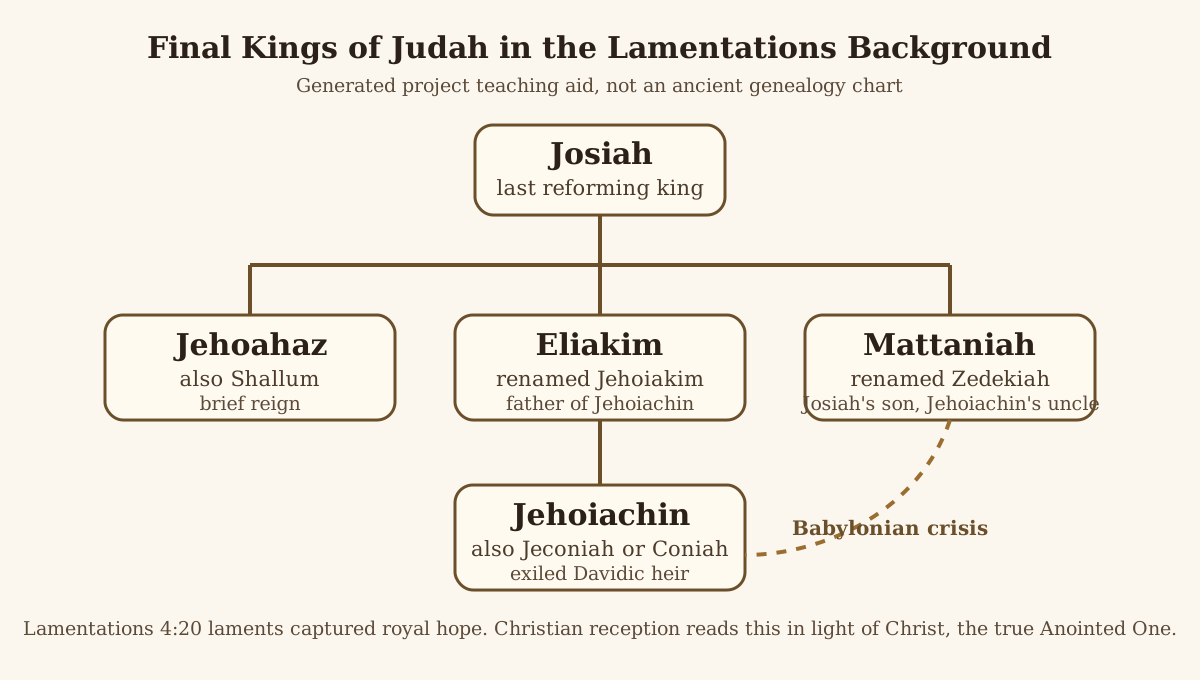 Source: Final kings of Judah, generated relationship schematic for this study, 2026-06-20; not an ancient genealogy chart.
The chart places the final royal crisis within Josiah’s family. Jehoiachin is Jehoiakim’s son; Zedekiah is Jehoiachin’s uncle. In the setting of Jerusalem’s fall, the captured royal hope recalls Zedekiah. The lament lets us feel what the loss of a king meant to people whose homes and future were already collapsing.
💎 Gems from the Fathers
St. Irenaeus of Lyons reads Lamentations 4:20 directly of Christ in section 71 of the Demonstration of the Apostolic Preaching. He pauses over the astonishing contrast: the One under whose shadow people expect to live becomes a suffering man, taken in snares. He interprets the shadow as Christ’s body. A shadow lies upon the earth and can be trampled; in the Passion the Lord’s body undergoes humiliation and violence. Yet the Spirit’s glory rests upon that very body. Irenaeus writes:
“But, further, the humiliation and contemptibility of His body he indicates by the shadow. For, as the shadow of bodies standing upright is upon the ground and is trodden upon, so also the body of Christ fell upon the ground by His sufferings and was trodden on indeed. And he named Christ’s body a shadow, because the Spirit overshadowed it, as it were, with glory and covered it.”3
Here “shadow” does not mean that Christ only appeared to have a body. Irenaeus is contemplating the real body in which the Son suffers for us. The glory of the Spirit and the humiliation of the Passion meet in the same humanity. We are therefore brought before a Lord whose saving presence can be hidden beneath the appearance of defeat. Those who despise Him because He suffers have failed to recognize the shelter they seek.
The difference from the fallen royal hope is decisive. Judah’s king is taken, and his people lose their shelter. Christ is taken, and through His voluntary Passion He opens life to those who take refuge in Him. His wounds do not cancel His kingship. They reveal how the King gives Himself for His people. To live under His shadow is to entrust oneself to the crucified Lord, including when fidelity to Him carries no appearance of success.
Eusebius of Caesarea also quotes the verse directly in Proof of the Gospel, Book IV, chapter 16:
“The breath of our countenance, the Lord Christ was taken in their destructions, of whom we said, In his shadow we shall live among the Gentiles.”4
Eusebius draws a precise distinction between Christ’s two comings. Being taken in snares belongs to His first coming in suffering, not to His return in glory. He also hears the prophets speaking in the words “we shall live”: their testimony will remain alive among the nations through the knowledge of God brought by Christ. The Passion and the spread of the Gospel belong together. The Lord who is caught and dishonored is the Lord through whom the nations come to know God. This reading turns the verse toward gratitude and mission, not contempt for any people.
Edom, the cup, and the end of captivity (Lamentations 4:21-22)
21 Chsen. Rejoice and be glad, O daughter of Idumea, that dwellest in the land: yet the cup of the Lord shall pass through to thee: thou shalt be drunken, and pour forth.
22 Thau. O daughter of Sion, thine iniquity has come to an end; he shall no more carry thee captive: he has visited thine iniquities, O daughter of Edom; he has discovered thy sins.
The command to Edom to rejoice has a terrible edge. The cup will reach the one who celebrates Zion’s fall. Watching another people suffer does not place the spectator outside God’s judgment. Gloating is a form of blindness: it recognizes another’s humiliation but cannot see the evil taking root in one’s own pleasure.
Zion, by contrast, hears that her iniquity has come to an end and that she will no longer be carried captive. The promise places a boundary around this judgment. Ruin has not acquired the right to define God’s people forever. The contrast with Edom is especially searching because Zion’s hope and Edom’s exposure are spoken together. Mercy for the fallen gives no permission to the triumphant to despise them.
For the Christian reader, the cup also recalls Christ’s prayer in Gethsemane and His willing Passion. This is a Christian resonance rather than the immediate subject of the verse. The Lord enters judgment to save sinners. Following Him means surrendering the pleasure of seeing another person brought low, even when that person has wronged us. We may ask for justice with a clean conscience; we cannot nurse delight in another’s destruction and call it zeal for God.
The next chapter, Lamentations 5, will bring this hope before God as prayer. The promise of a limit to captivity does not remove the need to ask Him to turn and renew His people.
Spiritual Fruit 🍇
Learn to see the gold beneath the ruin. The sons of Zion remain precious while they are counted as pottery. Notice someone whose need has made others impatient: a family under financial strain, an elderly person who repeats a request, a child whose distress is inconvenient. Give help that honors a person rather than merely disposing of a problem. The bread of verse 4 asks for a hand, not an opinion about hunger.
Examine the shelter in which you have placed your future. The waiting eyes of verse 17 reveal how much of the heart can be surrendered to an imagined rescuer. Name before God the person, position, or financial outcome without which you feel you cannot live. Thank Him for whatever help is good, then ask for the freedom to obey Him even if that support fails. This is especially necessary when defending a leader has begun to matter more than telling the truth.
Remain near Christ when His glory is hidden. Irenaeus’s shadow brings us to the body that was humiliated and still overshadowed by the Spirit. Bring to the crucified Lord the fear that weakness makes a life worthless. Offer one act of patient service that will bring no recognition. Such obedience trains the heart to recognize the King whose victory first appeared as defeat.
The child is still asking for bread, and the anointed one has been taken. Let both images remain before Christ as you pray. Ask for hands that feed and a heart that takes refuge in Him. Under the shadow of His Cross, learn to recognize the preciousness that suffering cannot erase.
Teaching Notes
Gold tarnished and children starving (Lamentations 4:1-10)
- Ask: Does the loss of public esteem change the value of Zion’s children, or expose the failure of those who count them as pottery?
- Emphasize: Trace the poem’s concrete contrasts: gold and clay, delicacies and hunger, radiance and emaciation. Allow the text’s grief to carry the discussion.
- Connect: Relate the bread no one breaks in verse 4 to material mercy formed by communion with Christ.
Corrupt leaders, failed help, and the captured anointed one (Lamentations 4:11-20)
- Ask: How does verse 13 challenge the confidence remembered in verse 12? What changes when the voice becomes “we” in verse 17?
- Emphasize: Establish the historical lament over Judah’s captured king before unfolding the Christian reading. Explain “anointed” and the differing title in verse 20 without treating all Greek editions as identical.
- Watch for: Eusebius’s ancient polemical language is not a warrant for collective blame against Jewish people. His specific exegetical contribution here is the distinction between Christ’s suffering first coming and glorious return, together with the prophets’ living testimony among the nations.
- Connect: Irenaeus interprets the shadow as Christ’s real body in the Passion. His image concerns humiliation and the Spirit’s glory, not an unreal body.
- Show: Use the final-kings chart beside this passage to clarify the family relationships, then distinguish the historical royal crisis from the Christological fulfillment.
Edom, the cup, and the end of captivity (Lamentations 4:21-22)
- Ask: Where can a desire for justice become pleasure in another person’s humiliation?
- Emphasize: The promise limits Zion’s captivity; it does not make the preceding suffering unreal.
- Watch for: Edom’s judgment must not become ethnic contempt. Distinguish the cup’s immediate role in the poem from its Christian resonance with Gethsemane.
- Connect: Carry the promise into the prayer for renewal in Lamentations 5.
Sources
Embedded Scripture is from Brenton’s English Septuagint (LXX). The reading follows the 1879 printed edition, Lamentations, pp. 972-979.
St. Irenaeus of Lyons, Demonstration of the Apostolic Preaching, section 71, on Lamentations 4:20 and the body of Christ in His Passion.
Eusebius of Caesarea, Proof of the Gospel, Book IV, chapter 16, subsection “From the Lamentations of Jeremiah,” on Christ’s suffering first coming and the prophetic witness among the nations.
NETS, Lamentations, introduction and chapter 4, for the Greek tradition’s alphabetic labels and the wording “the Lord’s anointed.”
Footnotes
-
Compare Brenton, Lamentations 4:20, Swete’s Greek text, Lamentations 4:20, and NETS, Lamentations 4:20, p. 941. NETS identifies Ziegler’s edition as its Greek base in its introduction, p. 932. Herrie F. van Rooy, “The Ancient Versions of Lamentations”, p. 234, reports that the surviving Greek manuscripts read christos Kyrios and explains Ziegler’s reconstructed christos Kyriou, “anointed of the Lord.” ↩
-
NETS, “To the Reader of Lamentations”, p. 932, explains the Hebrew-letter labels transmitted in Greek; compare Brenton, Lamentations 4:17-18 for their placement within these verses. ↩
-
St. Irenaeus of Lyons, Demonstration of the Apostolic Preaching, section 71, primary text. ↩
-
Eusebius of Caesarea, Proof of the Gospel, Book IV, chapter 16, subsection “From the Lamentations of Jeremiah,” primary text. ↩