


This narration is from a previous version of the study and may include a combined recording of multiple chapters.
A full hand cannot guarantee a restful night. Ecclesiastes places the servant who sleeps beside the owner who cannot, and then asks what ownership has really achieved. The goods are there. So are the people consuming them, the fear of losing them, and the appetite that keeps asking for more.
But the passage also describes a person who eats, drinks, works, and rejoices. The difference is not simply that one has possessions and the other has none. Possessions and the power to enjoy them are distinct gifts. Wealth can be counted; joy must be received. The chapter’s tender discovery is that a finite portion, received before God, may contain more real good than an abundance we cannot rest in.
Historical and Scriptural Context
The preceding study, Ecclesiastes 5:1-7 ended by commanding the worshipper to fear God. The next words return to the oppression of the poor. Reverence cannot remain inside the sanctuary while injustice and covetousness govern the rest of life. The person who speaks truthfully before God must learn to acquire, keep, and share truthfully as well.
Chapter 6 completes the argument of chapter 5. First comes wealth that fails to satisfy, then wealth lost in misfortune, then the gift of enjoyment, and finally the painful possibility of having everything except the ability to receive good. The questions at the end concern the whole human condition: who knows what is good for us, and who can command what comes after us?
Here “under the sun” names our mortal life and its visible limits. Faithful people also suffer loss, injustice, illness, and bewilderment. Ecclesiastes is exposing the limits of wealth, not declaring that every painful life has been caused by greed.
Numbering and the Shape of the Passage
The title and passage headings use NKJV numbering. The retained Brenton labels count differently because Brenton places NKJV 5:1 at Ecclesiastes 4:17. Thus NKJV 5:8-20 corresponds to Brenton 5:7-19; chapter 6 resumes the same verse numbering in both editions.1 The first verse below is the warning about oppression, Brenton 5:7, corresponding to NKJV 5:8.
Geographical Significance ⛰️
The tilled field is the passage’s most important place. Even the king depends on it. Palace, treasury, and household cannot make themselves independent of the earth or the people who cultivate it. Later the womb and the grave mark the boundaries that no accumulated wealth can move.
The Characters 👥
- The oppressed poor: People harmed by distorted justice and the misuse of power.
- The lover of silver: Someone whose desire grows rather than rests as possessions increase.
- The servant and sleepless owner: A contrast between simple rest and wealth that cannot secure it.
- The heir and stranger: Reminders that goods may pass beyond the owner’s plans.
- The person unable to enjoy abundance: An image of the gap between outward provision and the experience of good.
- God: The giver of days, possessions, and enjoyment, and the Judge before whom every earthly hierarchy stands.
Iconography and Visual Teaching 🖼️
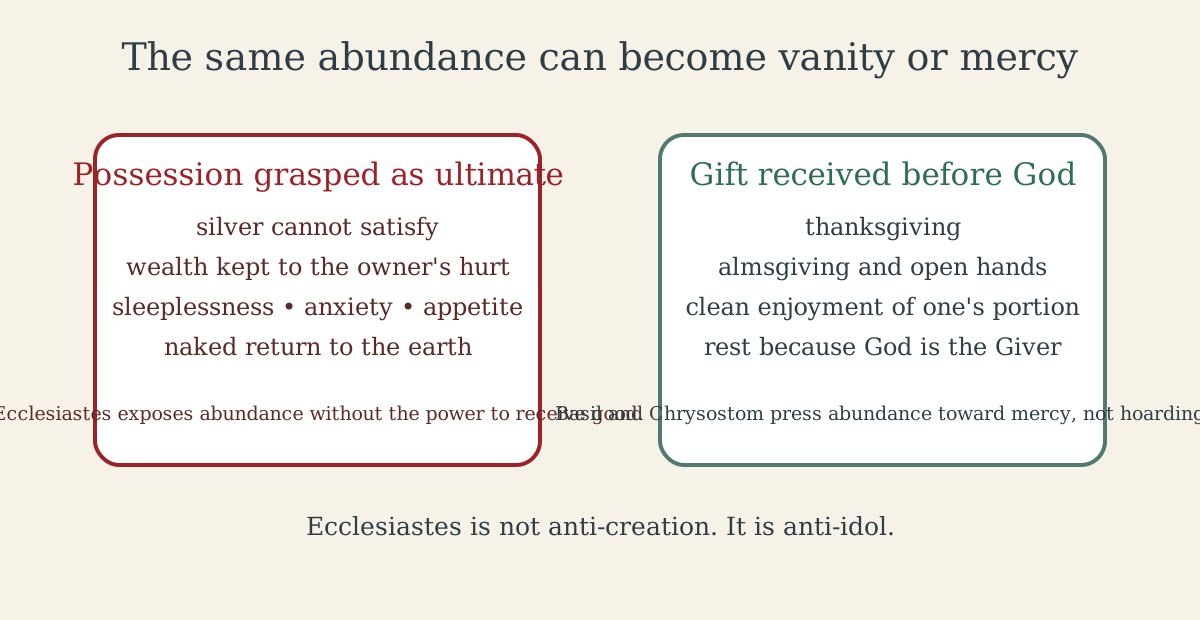
Generated schematic: abundance grasped as final security, contrasted with gifts received in thanksgiving and shared in mercy.
Ecclesiastes 5:8-12 - Oppression, silver, and the sleepless heart
NKJV 5:8-12 corresponds to Brenton 5:7-11.
7 If thou shouldest see the oppression of the poor, and the wresting of judgment and of justice in the land, wonder not at the matter: for there is a high one to watch over him that is high, and high ones over them. 8 Also the abundance of the earth is for every one: the king is dependent on the tilled field.
9 He that loves silver shall not be satisfied with silver: and who has loved gain, in the abundance thereof? this is also vanity. 10 In the multitude of good they are increased that eat it: and what virtue has the owner, but the right of beholding it with his eyes? 11 The sleep of a servant is sweet, whether he eat little or much: but to one who is satiated with wealth, there is none that suffers him to sleep.
“Wonder not” does not mean that oppression is acceptable. The Preacher has already wept over it. He now describes a world in which authority is layered: above the high official stands another, and above them are others still. Such hierarchies can help explain why an injured person struggles to find redress. They also prevent any ruler from claiming to be the final authority. Read with the promise of God’s judgment in Ecclesiastes 3:17, the warning becomes a summons to accountability: above every earthly watcher stands the judgment of God.
The next verse brings the powerful down to the ground. The king depends on the field. Whatever his title, someone must cultivate the earth from which he eats. Wealth often hides dependence behind the appearance of independence. Ecclesiastes restores the people, labor, and created world that status tempts us to forget.
The lover of silver then discovers a different dependence. He needs the next increase to feel secure, but increase does not satisfy the love he has given it. The text speaks precisely of loving silver. Money can buy necessary things; it cannot answer a heart that has made possession its hope.
As goods multiply, so do those who consume them. The owner may find himself watching abundance pass through his household while his own enjoyment shrinks. Then the contrast with sleep exposes the failure. A servant may receive the rest the rich owner cannot buy. This is no claim that poverty or servitude is good in itself, or that every sleepless person is greedy. It is a searching example of wealth’s inability to provide the good it promises.
Gems from the Fathers 💎: What money cannot purchase
St Gregory Thaumaturgus retains the social wound: “Wherefore thou oughtest not to wonder though thou seest the poor oppressed, and the judges misinterpreting the law.”2 He then turns toward the unrest of greed, describing “the kind refreshment of sleep”2 available to the poor man, while “the lust of riches is attended by sleepless nights and anxieties of mind.”2 The outward abundance conceals an inward cost.
His reading brings the passage close to a familiar evening: work has stopped, but the mind is still calculating, protecting, comparing. Responsible provision has become captivity when the heart can no longer leave its goods in God’s care. The first step toward freedom may be to name honestly what the calculations cannot secure.
Ecclesiastes 5:13-17 - Wealth kept to the owner’s hurt
NKJV 5:13-17 corresponds to Brenton 5:12-16.
12 There is an infirmity which I have seen under the sun, namely, wealth kept for its owner to his hurt. 13 And that wealth shall perish in an evil trouble: and the man begets a son, and there is nothing in his hand. 14 As he came forth naked from his mother’s womb, he shall return back as he came, and he shall receive nothing for his labour, that it should go with him in his hand. 15 And this is also an evil infirmity: for as he came, so also shall he return: and what is his gain, for which he vainly labours? 16 Yea, all his days are in darkness, and in mourning, and much sorrow, and infirmity, and wrath.
Wealth may wound while it is kept, and it may vanish despite the care spent keeping it. These are different sorrows, joined by the failure of possession to guarantee a future. The father imagines something remaining for his son; misfortune leaves nothing in his hand. The Preacher lets the loss remain a loss. He does not tell us that every financial disaster proves a moral failure.
Death makes the limit universal. A person returns as naked as he came. Job 1:21 and 1 Timothy 6:7 make the same comparison between entrance and departure. The goods entrusted to us are real, but our control over them is temporary. That truth can release generosity now, before death makes relinquishment unavoidable.
Gems from the Fathers 💎: A hoard can grow inside us
St Gregory Thaumaturgus asks what benefit there is in gathering and guarding wealth if a person is “maintaining the occasion of countless evils to himself”2. The harm includes the habits that gathering can cultivate: suspicion, fear, falsehood, and the reluctance to let another person’s need interrupt our plans.
St John Cassian gives a thematic ascetical diagnosis in Institutes 7.6-7. Covetousness becomes “a regular nest of sins”3, and “with the increase of wealth the mania of covetousness increases.”3 His immediate setting is a monk concealing money and finding increasingly plausible reasons to keep it. The principle reaches beyond that setting: the repeated claim that one more reserve will finally quiet fear can train fear to demand more.
Gems from the Fathers 💎: The neighbor’s claim
St Basil the Great begins section 7 of I Will Pull Down My Barns with the same naked entrance and naked return. He asks why we received what we have, and answers the hoarder’s claim of harmless ownership with the needs of the hungry, unclothed, and barefoot. His homily on Luke 12 is a thematic witness here: goods received for stewardship cannot be made an excuse for withholding help.4
St John Chrysostom’s second discourse on Lazarus makes the same point through the rich man’s neglect. In F. Allen’s translation, he says that “not to share our own riches with the poor is a robbery of the poor, and a depriving them of their livelihood”.5 His words concern wealth as a responsibility toward a neighbor, not merely a source of private unhappiness. Opening the hand does more than relieve the owner’s anxiety. It feeds a person who actually needs food.
Ecclesiastes 5:18-20 - The gift of humble enjoyment
NKJV 5:18-20 corresponds to Brenton 5:17-19.
17 Behold, I have seen good, that it is a fine thing for a man to eat and to drink, and to see good in all his labour in which he may labour under the sun, all the number of the days of his life which God has given to him: for it is his portion. 18 Yea, and as for every man to whom God has given wealth and possessions, and has given him power to eat thereof, and to receive his portion, and to rejoice in his labour; this is the gift of God. 19 For he shall not much remember the days of his life; for God troubles him in the mirth of his heart.
After the darkness comes an ordinary meal. The Preacher sees good in eating, drinking, and receiving the fruit of labor during the days God gives. The modest word “portion” matters. We receive a share, not mastery of the whole. We can enjoy today’s bread without requiring it to answer every fear about tomorrow.
“God has given” governs both possession and enjoyment. The second gift cannot be forced out of the first. Gratitude begins to distinguish having from receiving: I can look at a meal as something to which I am entitled, or receive it with wonder that God has sustained me through another day.
LXX insight: “God troubles him in the mirth of his heart”
Brenton’s final line can sound as though God is spoiling the person’s happiness. The Greek text has perispaō (περισπάω; the verse uses περισπᾷ), a verb that can mean drawing away or distracting. Here the object is the man and the surrounding phrase is the joy of his heart. In this context, God occupies his attention with joy, drawing him away from continual brooding over his brief days. Compare the NKJV: “God keeps him busy with the joy of his heart.”6
The contrast is gentle and exact. The sleepless owner is absorbed by protecting wealth; this person is absorbed by the good God gives. He remains mortal. His days have not become endless, but their shortness no longer consumes all his attention.
Gems from the Fathers 💎: Joy without injustice
St Gregory Thaumaturgus describes possessions “bestowed by God, and not acquired by force.”2 That qualification keeps the thanksgiving honest. We cannot oppress someone in acquiring wealth and then use gratitude to excuse its origin. Received rightly, a portion gives room for good deeds and a good heart. The joy of the passage belongs with justice and mercy.
Ecclesiastes 6:1-6 - Having everything except the power to receive good
1 There is an evil which I have seen under the sun, and it is abundant with man: 2 a man to whom God shall give wealth, and substance, and honour, and he wants nothing for his soul of all things that he shall desire, yet God shall not give him power to eat of it, for a stranger shall devour it: this is vanity, and an evil infirmity.
3 If a man beget a hundred children, and live many years, yea, however abundant the days of his years shall be, yet if his soul shall not be satisfied with good, and also he have no burial; I said, An untimely birth is better than he. 4 For he came in vanity, and departs in darkness, and his name shall be covered in darkness. 5 Moreover he has not seen the sun, nor known rest: there is no more rest to this one than another. 6 Though he has lived to the return of a thousand years, yet he has seen no good: do not all go to one place?
Chapter 6 reverses the hopeful picture just given. The man has wealth, honor, and the things he desires, but he cannot enjoy them. A stranger consumes what seemed securely his. The verses insist on our dependence upon God, but do not explain every reason why enjoyment is withheld. They are not permission to diagnose an ill or grieving person as ungrateful. An inability to feel joy may call for patient care and practical help, not an accusation of hidden greed.
The hundred children and many years make the example extreme. Even the largest imaginable collection of outward blessings cannot substitute for the good that a human life is meant to receive. The absence of burial deepens the humiliation: after so much abundance, even the ordinary honor of being laid to rest is missing.
The comparison with an untimely birth is a severe lament over frustrated life, not a verdict on the worth of a child lost before birth or on the worth of the parents who grieve. Readers carrying that loss need not hear an accusation in these words. The Preacher is bringing supposed prosperity to judgment. Length of days and size of household cannot, by themselves, tell us whether a person has known good.
St Gregory Thaumaturgus gives this a moral reading when he speaks of “the wicked man not to know what is good, even though he measure his life by thousands of years.”7 That is his interpretation of the example, not a warrant to identify all who suffer deprivation with the wicked. His warning presses us to ask what our abundance is doing for either ourselves or our neighbors.
Beside the line “he have no burial,” the Gospel places a striking contrast. Christ, who lived without grasping after possessions, received burial in the new tomb of the rich Joseph of Arimathea (Matthew 27:57-60). The One who became poor for us was honored by a rich man’s gift, and the tomb could not hold Him (Matthew 28:1-6). Here is a use of wealth that serves love, and a life that death cannot reduce to frustrated accumulation.
Ecclesiastes 6:7-12 - Appetite, limits, and the shadow of life
7 All the labour of a man is for his mouth, and yet the appetite shall not be satisfied. 8 For what advantage has the wise man over the fool, since even the poor knows how to walk in the direction of life? 9 The sight of the eyes is better than that which wanders in soul: this is also vanity, and waywardness of spirit.
10 If anything has been, its name has already been called: and it is known what man is; neither can he contend with him who is stronger than he. 11 For there are many things which increase vanity.
12 What advantage has a man? for who knows what is good for a man in his life, during the number of the life of the days of his vanity? and he has spent them as a shadow; for who shall tell a man what shall be after him under the sun?
The mouth receives the labor, and soon the appetite returns. That is an ordinary bodily limit; it also exposes the folly of expecting consumption to become a final answer to desire. More praise, novelty, comfort, or reassurance can be consumed in the same restless way. The soul has to learn something other than taking in.
Brenton 6:8 makes a small opening within this severity: “even the poor knows how to walk in the direction of life.” Poverty does not exclude a person from the knowledge needed to live. The question cuts down the wise person’s claim to superiority. Neither education nor possessions entitle us to look past a poor neighbor as though that person had nothing to teach us about receiving the day.
The next contrast is between what lies before the eyes and what wanders in the soul. The restless imagination is always elsewhere, rehearsing the life that would finally satisfy it. The present portion can be neglected while desire enjoys an imaginary future. Receiving an actual good has a sobriety that endless wanting lacks.
The final questions leave us small. We cannot contend successfully with the One stronger than we are, nor tell the future what it must contain. The good news of Christ does not replace these limits with secret control. It gives us the risen Lord to whom the unknown can be entrusted. The future remains hidden from us; it is not hidden from Him.
Christological and Typological Reading
Christ became poor for our sake, though He is rich (2 Corinthians 8:9). His poverty is the freedom of self-giving love. He teaches that life does not consist in abundant possessions (Luke 12:15), receives Joseph’s burial gift, and rises beyond the reach of death. In Him, receiving and giving belong together.
This also opens a Eucharistic resonance, distinct from the passage’s immediate counsel about ordinary meals. At the Eucharist we receive Christ’s Body and Blood as a gift beyond anything we could purchase. Thanksgiving should then make ordinary bread and money available for love. Communion with the Lord who gave Himself cannot be reconciled peacefully with indifference toward a hungry neighbor.
The Church’s Voice in Worship ⛪
Ecclesiastes is not appointed in the Coptic readings indexed by this site’s lectionary data.
The connections here are thematic. Great Lent’s fasting and almsgiving put appetite and possessions under a common discipline: food saved from self-indulgence can become food shared with another. Funeral and memorial prayer likewise bring possessions before the fact of death. These resonances do not make this passage an appointed reading, but they help us hear its summons to receive, share, and relinquish before God.
Spiritual Fruit 🍇
Examine the cost of keeping. Name one possession or financial concern that repeatedly takes your attention from prayer or your family. Responsible planning may be necessary; endless inward rehearsal is not the same thing. Give the concern a measured time, and entrust what remains beyond your control to God.
Let abundance meet a real need. Instead of making generosity a future intention, identify someone or some trustworthy work of mercy you can help now. St Basil and St John Chrysostom bring the absent neighbor back into the room where the owner is counting goods.
Receive today’s portion without shaming sorrow. Give thanks for one concrete good: a meal, honest work, another person’s faithfulness. If joy is difficult to feel, offer that truth to Christ as well. Gratitude need not pretend that grief or illness has disappeared.
The owner in Ecclesiastes can look at his goods and still be unable to sleep. Christ teaches another way to hold what has been given: receive it, use it faithfully, and let it pass into love. We do not know how many days remain. There is bread to receive today and a neighbor whose hunger need not wait for our final sense of security.
Teaching Notes
- Timing: 45-55 minutes.
- Show: Use the retained schematic to distinguish stewardship from hoarding. Its references to Basil and Chrysostom are thematic, not claims that either wrote direct commentary on this passage.
- Numbering: Discussion references use NKJV numbers. The opening blocks display Brenton 5:7-11, 5:12-16, and 5:17-19 respectively.
- Where to linger: NKJV 5:8, 5:10, 5:13, 5:19-20, and Ecclesiastes 6:2, 6:8.
- Pastoral care: Loss of wealth, inability to enjoy life, miscarriage, and lack of burial must never be used as easy evidence of personal wickedness. The paragraph makes wealth answer for its promises; it does not authorize blaming every sufferer.
Ecclesiastes 5:8-12 - Oppression, silver, and the sleepless heart
- Ask: What does the king’s dependence on the field reveal about the people we overlook?
- Emphasize: The higher officials do not remove accountability to God.
- Watch for: Treating a servant’s sleep as an endorsement of servitude or a rich person’s insomnia as a universal moral diagnosis.
Ecclesiastes 5:13-17 - Wealth kept to the owner’s hurt
- Ask: What can be harmed in us by the way we keep something good?
- Connect: Naked entrance and departure expose the limits of ownership and create room for mercy now.
- Watch for: Condemning prudent provision for dependents as though it were identical to greed.
Ecclesiastes 5:18-20 - The gift of humble enjoyment
- Ask: What is the difference between having a gift and receiving it?
- Emphasize: Brenton’s “God troubles him” belongs to the context of gladness, not divine sabotage of joy.
Ecclesiastes 6:1-6 - Having everything except the power to receive good
- Ask: Which apparent measures of success does the extreme example expose as inadequate?
- Emphasize: Keep the child-loss safeguard in the body. Gregory Thaumaturgus’s moral reading does not explain every painful life.
- Connect: Joseph’s tomb is a concrete example of wealth placed at the service of Christ.
Ecclesiastes 6:7-12 - Appetite, limits, and the shadow of life
- Ask: What does the poor person’s knowledge of life challenge in our assumptions about wisdom?
- Watch for: Promising that faith removes uncertainty about the future.
Sources
Embedded Scripture is from Brenton’s English Septuagint (LXX).
Ecclesiastes 5 and Ecclesiastes 6, Brenton; compared with Ecclesiastes 5, NKJV.
St Gregory Thaumaturgus, A Metaphrase of the Book of Ecclesiastes, chapters 5-6, translated by S. D. F. Salmond, Ante-Nicene Fathers 6. Direct commentary.
St John Cassian, Institutes 7.6-7, translated by C. S. Gibson, NPNF, second series, 11. Thematic ascetical witness.
St Basil the Great, I Will Pull Down My Barns, Homily 6, §7; St John Chrysostom, Second Discourse on Lazarus. Thematic witnesses on stewardship and mercy; the consulted translations and exact locations are in the footnotes.
Job 1:21; 1 Timothy 6:6-10; Matthew 27:57-60; Matthew 28:1-6; Luke 12:13-21; 2 Corinthians 8:9.
Footnotes
-
Compare the actual contents of Brenton’s Ecclesiastes 4, Brenton’s Ecclesiastes 5, and NKJV Ecclesiastes 5. The opening chapter-boundary difference, not an absent verse, accounts for the numbering offset. ↩
-
St Gregory Thaumaturgus, A Metaphrase of the Book of Ecclesiastes, chapter 5, translated by S. D. F. Salmond, Ante-Nicene Fathers 6: complete chapter. ↩ ↩2 ↩3 ↩4 ↩5
-
St John Cassian, Institutes 7.6, “How difficult the evil of covetousness is to drive away,” and 7.7, “Of the source from which covetousness springs,” translated by C. S. Gibson, NPNF, second series, 11: Book 7, chapters 6-7. ↩ ↩2
-
St Basil the Great, I Will Pull Down My Barns, Homily 6, §7, PG 31, 276B-277A; paraphrased from the Greek and accompanying English translation published as “St. Basil on stealing from the poor,” De unione ecclesiarum. This is commentary on Luke 12, used thematically here. ↩
-
St John Chrysostom, Four Discourses, Chiefly on the Parable of the Rich Man and Lazarus, Discourse II, §6, printed pp. 57-58, translated by F. Allen (1869): concluding appeal. ↩
-
Greek Septuagint, Ecclesiastes 5:19; perispaō, Thayer’s Greek Lexicon, entry 4049, “to draw away, distract”; compared with NKJV Ecclesiastes 5:20. The joyful sense here follows the sentence’s context, not the verb in isolation. ↩
-
St Gregory Thaumaturgus, A Metaphrase of the Book of Ecclesiastes, chapter 6, translated by S. D. F. Salmond, Ante-Nicene Fathers 6: complete chapter. ↩