


This narration is from a previous version of the study and may include a combined recording of multiple chapters.
“Remember thy Creator” is the word Ecclesiastes leaves in our hands before it describes what our hands will one day be unable to do. Strength bends, sight dims, and the familiar house grows quiet. Yet the chapter’s last concern is larger than decline: the life received from God must be lived before Him. The book that opened with vanity ends with a summons to reverent obedience, and with the assurance that no work is finally overlooked.
The call continues directly from chapter 11’s joy and judgment. Remembering God belongs to youth, while choices are still forming habits; it also belongs to age, when strength must be received differently. The poem, the wise teacher’s words, and the final judgment all ask the same thing of us: to turn toward the One who gave us life.
Historical and Scriptural Context
Ecclesiastes 11 ended by warning the young that God will bring all things into judgment. Chapter 12 begins exactly there: therefore remember thy Creator in the days of thy youth. The logic is deliberate. Judgment is not meant to produce panic, but early remembrance.
Ecclesiastes began with vanity of vanities, and the refrain returns in 12:8. The book has faced both the illusions we choose and the losses we never chose: death, injustice, and the passing of good days. Its answer does not make those wounds unreal. It teaches us to receive mortal life from God, obey Him within it, and trust that His judgment reaches what human judgment has missed.
Geographical Significance ⛰️
There is no major geography in the ordinary sense. The chapter’s movement is from the house of the body to the eternal home, from the market and mill to the grave, and finally from earthly life to divine judgment. It is a geography of human mortality.
The Characters 👥
- The young person: The one called to offer life to God while habits and desires are being formed.
- The aging person: The one whose bodily powers become the chapter’s great living parable.
- The Preacher: The teacher who has searched for acceptable words and now drives the matter to its true end.
- The wise: Those whose words pierce, steady, and guide.
- The one Shepherd: The source from whom true wise teaching ultimately comes.
- God the Creator and Judge: The One to be remembered now, not later, and the One before whom every work is brought into judgment.
Iconography and Visual Teaching 🖼️
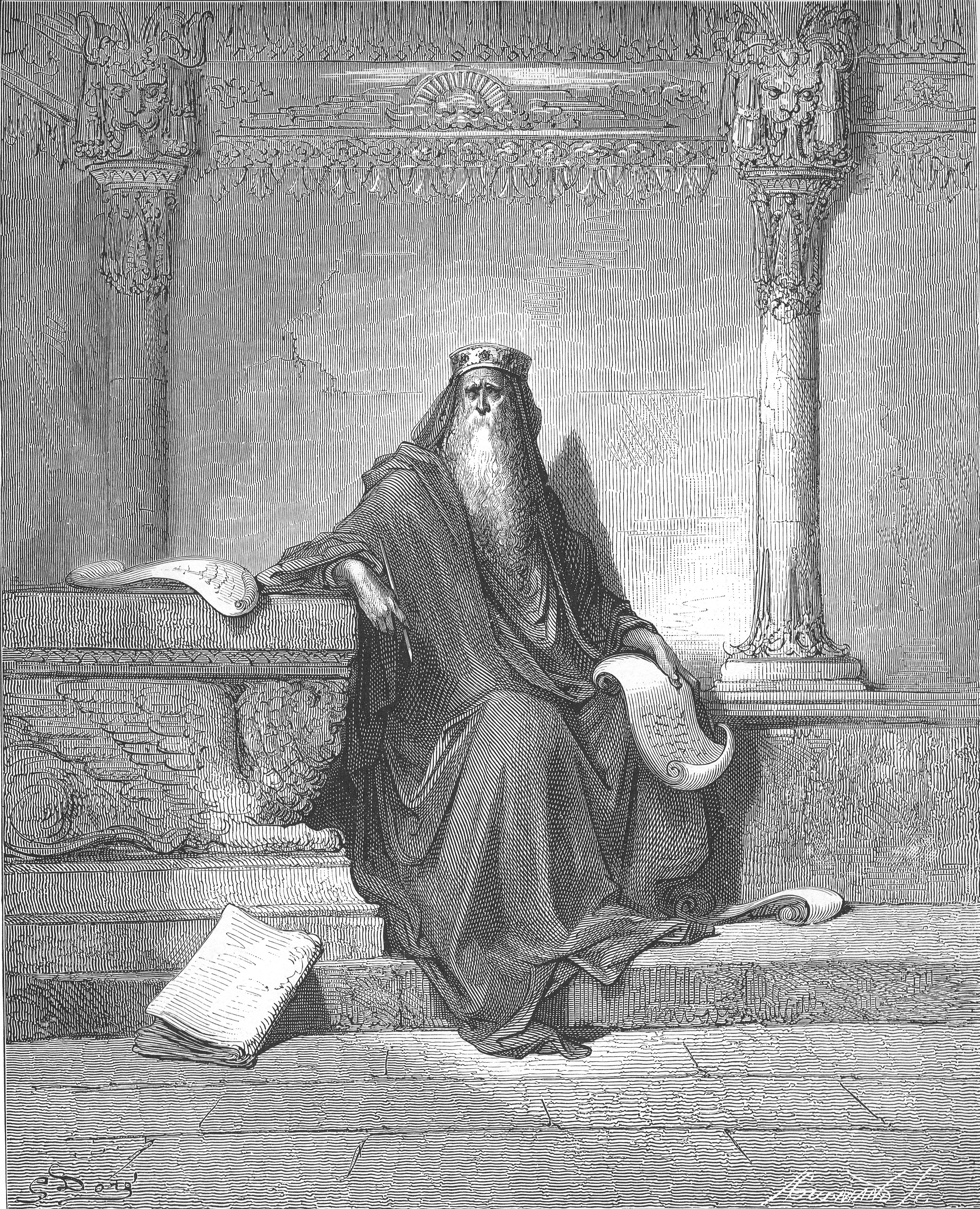
Source: Gustave Doré, King Solomon in Old Age, Doré’s English Bible, 1866. Wikimedia Commons, public domain. Western biblical art, not Orthodox iconography.
The aged Solomon is a fitting companion to the chapter’s royal wisdom, but the picture does not determine the meaning of the poem. Bodily weakness is neither shameful nor a sign that God has withdrawn His love. The call to remember Him early leaves the door of repentance open to the elderly as well.
Ecclesiastes 12:1-7 - Remember before the days grow dark
1 And remember thy Creator in the days of thy youth, before the days of evil come, and the years overtake thee in which thou shalt say, I have no pleasure in them. 2 While the sun and light are not darkened, nor the moon and the stars; nor the clouds return after the rain: 3 in the day wherein the keepers of the house shall tremble, and the mighty men shall become bent, and the grinding women cease because they have become few, and the women looking out at the windows be dark; 4 and they shall shut the doors in the market-place, because of the weakness of the voice of her that grinds at the mill; and he shall rise up at the voice of the sparrow, and all the daughters of song shall be brought low; 5 and they shall look up, and fears shall be in the way, and the almond tree shall blossom, and the locust shall increase, and the caper shall be scattered: because man has gone to his eternal home, and the mourners have gone about the market: 6 before the silver cord be let go, or the choice gold be broken, or the pitcher be broken at the fountain, or the wheel run down to the cistern; 7 before the dust also return to the earth as it was, and the spirit return to God who gave it.
To remember the Creator is more than recalling that God exists. It is to receive life as His gift and order the day in His presence. Youth has its own temptation to postpone this: there seems to be time enough to become serious later. The command asks for the present life, with its energy and possibility, to be given to God now.
The poem makes decline visible through a house whose keepers tremble, grinders grow few, and windows darken. On the familiar bodily reading, these images suggest weakening limbs, failing teeth, and dimming sight. Their force exceeds a list of anatomical equivalents. Ordinary powers once taken for granted become fragile, and the world that seemed so available begins to close. Compassion belongs beside this truth: an aging person remains fully worthy of love when productivity and pleasure diminish.
Gems from the Fathers 💎: The day beyond our last day
St Gregory Thaumaturgus hears more than individual aging in this darkness. He reads it toward “the great and terrible day of God”, when the sun, moon, and stars no longer shine and the powers above are moved.1 His is an eschatological reading: an interpretation concerning the last things and the judgment of the world. It stands beside the old-age reading rather than merely repeating it. The wisdom of remembering God reaches beyond preparation for my death to preparation for meeting the Lord of all.
Gregory’s answer to the world’s passing is the soul’s return to its Maker. He writes, “And for men who lie on earth there is but one salvation, that their souls acknowledge and wing their way to Him by whom they have been made.”1 The image expresses conversion toward the Creator. It does not make escape from the body the Christian hope; the risen Christ will raise the dead.
LXX Insight: “the caper” and “the choice gold” (Ecclesiastes 12:5-6)
Brenton retains “the caper shall be scattered,” where the NKJV gives “desire fails.” The Hebrew noun is identified as the caperberry by Brown–Driver–Briggs; the Greek in Swete likewise names the caper plant. The NKJV interprets the image in terms of waning desire, while Brenton preserves the plant itself.2 It is better to hear the poem’s gathering picture of decline than to force one certain bodily equivalent onto every image.
In verse 6, Brenton’s “the choice gold be broken” differs from the NKJV’s “the golden bowl is broken.” The Greek noun behind “choice” can have floral senses elsewhere, but Liddell–Scott–Jones explicitly gives the sense “the purest quality” of gold at this verse.2 Brenton’s expression should therefore not be silently replaced with the familiar bowl. The cord, gold, pitcher, and wheel all contribute to the same finality: the fragile means by which life has continued can no longer sustain it.
Verse 7 brings the poem to its plainest statement. The dust returns to earth, and the spirit returns to God who gave it. Earlier, 3:21 had asked whether the human spirit goes upward. Here the book answers its own question by naming the destination: God. It does not yet unfold the Gospel’s full account of resurrection; it does refuse to leave the human person as dust alone.
At the Cross, Christ entrusts His spirit to the Father (Luke 23:46), saying, in the NKJV, “into Your hands I commit My spirit.” The Son enters our death in filial trust and rises bodily from the tomb. In Him, returning to the Giver of life becomes a hope we can pray, even when we can no longer preserve our own strength.
Ecclesiastes 12:8-12 - The labor of wise words and the one Shepherd
8 Vanity of vanities, said the Preacher; all is vanity. 9 And because the Preacher was wise above others, so it was that he taught man excellent knowledge, and the ear will trace out the parables. 10 The Preacher sought diligently to find out acceptable words, and a correct writing, even words of truth. 11 The words of the wise are as goads, and as nails firmly fastened, which have been given from one shepherd by agreement. 12 And moreover, my son, guard thyself by means of them: of making many books there is no end; and much study is a weariness of the flesh.
The return of “vanity of vanities” closes the circle without making the journey pointless. Life is still fleeting; the wise and righteous still suffer losses they did not cause. The refrain clears away any promise that wisdom will make earthly existence permanent or painless. The following verses show what wisdom can truly do: speak words of truth that guide us toward God.
The Preacher is honored for the care with which he taught. He searched for acceptable words and correct writing, “even words of truth.” Beauty and accuracy belong together here. A lovely sentence that conceals the truth fails its hearer; a true sentence spoken without care may fail to reach the person who needs it. The wise teacher labors to serve both truth and listener.
Wise words are goads and nails. A goad urges an animal forward; a nail holds something firmly in place. Together they describe teaching that rouses us from delay and steadies us against drift. The pain of correction is not automatically an injury. Yet the image cannot excuse humiliation or cruelty: holy teaching serves the person’s healing and obedience to God.
LXX Insight: “one shepherd by agreement” (Ecclesiastes 12:11)
Brenton’s words are “given from one shepherd by agreement.” The NKJV speaks of the words of “scholars,” with the marginal literal rendering “masters of assemblies,” and says they are “given by one Shepherd.”3 The difficulty concerns how the wise sayings and those who gather them are related, not whether wisdom has a single ultimate source. Brenton’s “by agreement” especially brings concord among the teachers into view.
Gems from the Fathers 💎: One teacher, many faithful voices
St Gregory Thaumaturgus understands the wise as transmitting a teaching they have received together: “And some will render again those wise lessons which they have received from one good pastor and teacher, as if all with one mouth and in mutual concord set forth in larger detail the truths committed to them.”1 He is describing concord in the handing on of wisdom. Read in the light of John 10:11-16, this points naturally toward Christ the Good Shepherd gathering His people through His voice.
The warning about many books comes after praise for carefully written truth. Learning is a good servant but a poor substitute for obedience. A person can collect religious explanations while postponing the one plain command that has already reached the conscience. The goad has done its work when we finally rise to act.
Ecclesiastes 12:13-14 - The sum of the matter
13 Hear the end of the matter, the sum: Fear God, and keep his commandments: for this is the whole man. 14 For God will bring every work into judgment, with everything that has been overlooked, whether it be good, or whether it be evil.
The conclusion gives the whole life a direction: fear God and keep His commandments. Reverence means that His will matters more than the desires that compete to rule us. It is neither panic nor a bargain in which good behavior buys immunity from suffering. The Creator remains worthy of obedience in the life Ecclesiastes has actually described, with its gifts, limits, and wounds.
“This is the whole man” gives the conclusion its breadth. Our life before God cannot be reduced to a religious corner while speech, money, work, and private desires answer to other masters. The command gathers the whole person into accountability. The hope of wholeness begins when we stop reserving some part of ourselves from the One who made us.
St Gregory Thaumaturgus ends by joining God’s sovereignty to a just recompense for every person’s deeds.1 Verse 14 also names “everything that has been overlooked.” The warning searches the concealed sin; the promise consoles the person whose patient goodness no one noticed. The poor person’s injury and the caregiver’s hidden labor have not disappeared because no human witness kept a record.
The last word about judgment is therefore a call to repent and a reason to persevere. Death does not make love futile, and human forgetfulness does not decide what a life was worth. We will stand before the God who knows the truth. In Christ, we seek His mercy now rather than trying to make ourselves ready without Him.
Christological and Typological Reading
Christ lives the obedience to which Ecclesiastes calls us. The incarnate Son does the Father’s will and entrusts Himself to the Father even in death (John 6:38; Luke 23:46). What we struggle to gather from divided desires is whole in Him. Life in Christ means that obedience grows from communion with Him, not simply from a more determined will.
The one Shepherd of verse 11 finds His Christian fulfillment in the Good Shepherd who lays down His life for the sheep (John 10:11). His authority heals through self-giving love. We learn to recognize His voice in teaching that calls us to repentance and keeps us close to Him, rather than making us dependent on a teacher’s self-importance.
The final judgment is also Christological. All must appear before Christ’s judgment seat (2 Corinthians 5:10). The One who judges is the Lord who entered our mortality and rose again. His mercy does not make evil inconsequential; it gives sinners a real path of repentance and the wounded a just Judge in whom to hope.
The Church’s Voice in Worship ⛪
Ecclesiastes is not appointed in the Coptic readings indexed by this site’s lectionary data.
Thematic resonance is especially fitting beside the Church’s funeral and memorial prayer. Mourning gives the body’s frailty its due, while faith in the risen Christ refuses to make frailty the last truth about a person. The command to remember the Creator also belongs to daily repentance, long before a funeral is near. This is a connection with the Church’s prayer, not a claim that Ecclesiastes 12 is an appointed funeral reading or that a particular prayer quotes it.
Spiritual Fruit 🍇
Begin remembrance where your day is already being decided. Before opening the screen, answering the provocation, or making the purchase, acknowledge the Creator whose gift you are using. Choose one command you know but have kept postponing. Let study lead to that obedience before seeking another explanation.
The poem also asks for tenderness toward a body that is failing, whether your own or another’s. Offer the visit, the ride, the patient conversation, or the help that preserves someone’s dignity. Weakness need not become shame, and dependence need not become uselessness. A person whose hands can do less can still receive love and belong fully to the life of the Church.
If the thought of judgment awakens fear, bring that fear to Christ rather than hiding from Him. Confession names what needs healing; His mercy makes a truthful beginning possible. The same judgment that exposes secret evil will remember the good that seemed to vanish without notice. Keep doing that good.
The windows of the house grow dim, and the familiar work becomes difficult. Pray beside that image without despising the house that has sheltered your life. Its strength was a gift, and you remain in the care of the Giver. Ask the crucified and risen Lord to teach you, while there is time, the trust with which He placed His spirit in the Father’s hands.
Teaching Notes
- Show: Identify Doré’s image as Western biblical art, not Orthodox iconography. Keep its mortality theme distinct from the assurance that aging does not diminish a person’s dignity.
- Timing: 50-60 minutes.
- Opening hook: “Ecclesiastes saves its clearest command for the end: remember thy Creator now, not later.”
- Where to linger: The youth command, the old-age imagery, the one Shepherd, and the final sum of the matter.
- Where to compress: Detailed speculation on each image in verses 3-6 once the overall portrait of human decline is clear.
- Pastoral warning: Teach judgment with sobriety and hope, not panic. The chapter is severe, but it is medicinal.
Ecclesiastes 12:1-7 - Remember before the days grow dark
- Key phrase: Remember now, before decline becomes your teacher by force.
- Emphasize: The chapter calls for early remembrance because delayed seriousness is spiritually dangerous.
- Watch for: Treating bodily decline as evidence of spiritual failure. Explain Gregory’s last-day interpretation as a distinct eschatological reading beside the old-age reading.
Ecclesiastes 12:8-12 - The labor of wise words and the one Shepherd
- Key phrase: Wise words are meant to pierce and steady, not merely impress.
- Emphasize: The one Shepherd is the true source of all wisdom that heals rather than flatters.
- Watch for: Turning the verse about many books into contempt for study itself.
Ecclesiastes 12:13-14 - The sum of the matter
- Key phrase: Fear of God is not an appendix to life. It is what makes life whole.
- Emphasize: The book ends in gathered obedience, not in unresolved gloom.
- Watch for: Softening judgment into vague consequence language.
Glossary
- Creator: God as the giver of life, to be remembered before the soul hardens and the body weakens.
- Days of evil: The difficult years of decline, weakness, and mortality.
- One Shepherd: The single divine source of true wisdom, fulfilled in Christ.
- Whole man: Human life made complete in reverent obedience to God.
- Judgment: God’s final and exhaustive evaluation of every work, including what seemed hidden or overlooked.
Sources
Embedded Scripture is from Brenton’s English Septuagint (LXX). The brief phrase from Luke 23:46 is identified in the body as NKJV.
St Gregory Thaumaturgus, A Metaphrase of the Book of Ecclesiastes, chapter XII, trans. S. D. F. Salmond, Ante-Nicene Fathers 6. Direct commentary, including an eschatological reading of the poem.
Swete’s Greek, Ecclesiastes 12; Brown–Driver–Briggs, אֲבִיּוֹנָה, entry on Ecclesiastes 12:5; Liddell–Scott–Jones, ἀνθέμιον, sense 3, Ecclesiastes 12:6.
Biblical connections developed above: Ecclesiastes 3:21; Luke 23:46; John 6:38; John 10:11-16; 2 Corinthians 5:10.
Footnotes
-
St Gregory Thaumaturgus, A Metaphrase of the Book of Ecclesiastes, chapter XII, on Ecclesiastes 12:1-7, 12:11, and 12:13-14; trans. S. D. F. Salmond, Ante-Nicene Fathers 6, complete chapter. ↩ ↩2 ↩3 ↩4
-
Ecclesiastes 12:5-6 in Brenton, NKJV, and Swete’s Greek. Swete prints κάππαρις, the caper plant, and ἀνθέμιον τοῦ χρυσίου. Liddell–Scott–Jones, ἀνθέμιον, sense 3, specifically cites Ecclesiastes 12:6 for gold of the purest quality; its floral senses are distinct. Brown–Driver–Briggs, אֲבִיּוֹנָה, Ecclesiastes 12:5, identifies the Hebrew noun as caperberry; the verse’s bodily interpretation is distinguished from the plant name. ↩ ↩2
-
Ecclesiastes 12:11 in Brenton and NKJV, including the NKJV marginal note “masters of assemblies”; compare Swete’s Greek. “By agreement” describes Brenton’s rendering, not a claim that every Greek edition uses the same construction. ↩