


The Temple account does not ask us to admire an ancient building from a safe distance. Cedars are floated from Lebanon, stone is hewn, bronze is cast, and a house rises in Jerusalem so that Israel may learn to approach the holy God. Yet the lasting question is never whether the building is impressive. It is whether a people, and then a human heart, will become a dwelling marked by obedience, repentance, and reverent love.
Peace, Wisdom, and the Nations’ Offering (1 Kings 5:15-26)
15 And Chiram king of Tyre sent his servants to anoint Solomon in the room of David his father, because Chiram always loved David. 17 Thou knewest my father David, that he could not build a house to the name of the Lord my God because of the wars that compassed him about. 18 And now the Lord my God has given me rest round about. 19 And, behold, I intend to build a house to the name of the Lord my God. 21 And it came to pass, as soon as Chiram heard the words of Solomon, that he rejoiced greatly, and said, Blessed be God to-day, who has given to David a wise son over this numerous people. 26 And the Lord gave wisdom to Solomon as he promised him; and there was peace between Chiram and Solomon, and they made a covenant between them.
The house is built in the rest that God gives, not in the fever of conquest. David’s desire to build was good, but his reign had been marked by war. Solomon receives a different task: to gather, order, and offer. His peace is not private comfort. It becomes room for a people to worship.
Chiram’s joy is striking. A Tyrian king blesses God because David has a wise son. Israel remains Israel; the Temple is not a vague international religious project. Still, the timber, sea routes, skill, and goodwill of a neighboring people are drawn into service of the Lord. This anticipates the Church without collapsing the Old Testament into a simple allegory: in Christ, Jews and Gentiles are made one household, and the gifts of the nations can be offered back to their Creator.
The Hebrew shalom names more than the absence of fighting. It is wholeness and rightly ordered life. The text makes peace the setting for worship because worship is never a tool for personal triumph. A parish, family, or servant may have many abilities; the better question is whether those gifts are making peace in which others can pray.
Labor, Limits, and the Foundation (1 Kings 5:27-32)
27 And the king raised a levy out of all Israel, and the levy was thirty thousand men. 28 And he sent them to Libanus, ten thousand taking turn every month: they were a month in Libanus and two months at home. 29 And Solomon had seventy thousand bearers of burdens, and eighty thousand hewers of stone in the mountain. 30 Besides the rulers that were appointed over the works of Solomon, there were three thousand six hundred masters who wrought in the works. 32 And they prepared the stones and the timber during three years.
The narrative refuses to make worship weightless. Before there is gold, there are workers, shifts, foremen, tools, and stones prepared for a foundation. Hidden service really belongs to the offering: the one who cleans, rehearses hymns, prepares a lesson, repairs a lamp, receives a child, or quietly gives a needed gift is not outside the Church’s worship.
But reverence for the Temple must never become romance about the labor system. The text records a levy and immense burdens; later in Kings, Solomon’s heavy yoke becomes a public grievance. No church project, feast, ministry need, or appeal to sacrifice permits coercion, manipulation, exhaustion, or disregard for a servant’s household. The people bearing burdens are never less precious to God than the stones they carry.
The foundation also corrects the desire for visible results. Saint Paul will name Christ as the one foundation (1 Corinthians 3:11), and Saint Peter calls believers living stones being built into a spiritual house (1 Peter 2:4-5). Here the first spiritual discipline is humble steadiness: a beautiful ministry built on resentment, competition, or unrepented injustice is already cracked beneath its ornament.
A House Built in Reverent Silence (1 Kings 6:1-10)
1 In the fourth year he laid the foundation of the house of the Lord, in the month Ziu, even in the second month. In the eleventh year, in the month Baal, this is the eighth month, the house was completed according to all its plan, and according to all its arrangement. 7 And the house was built in the construction of it with rough hewn stones: and there was not heard in the house in the building of it hammer or axe, or any iron tool. 9 So he built the house and finished it; and he made the ceiling of the house with cedars.
The striking sentence is the silence of the building. The stones were prepared before they were brought to the holy site; hammer and axe were not heard in the house as it rose. This is not a command to make church life hushed or passive. It is a picture of preparation before offering. What is rough in us—an uncontrolled temper, careless speech, a desire to be noticed—must be brought to Christ for shaping before it becomes a burden laid on the assembly.
The house is completed “according to all its plan and according to all its arrangement.” Order is not the enemy of life. In Orthodox worship, the received order of prayer frees a congregation from depending on the charisma or mood of one person. The order serves communion, and communion serves the meeting of God and His people.
Brenton’s source shape matters here. In 3 Kingdoms 6, the English Brenton text moves from verse 10 to verse 15 and does not print the covenant speech found at 1 Kings 6:11-13 in Hebrew-based editions. It would be wrong to supply invented Brenton verses. The familiar covenant warning remains vital for reading the wider canonical account, but the embedded text above follows Brenton’s actual wording and numbering.
Cherubim, Palms, and the Return toward Life (1 Kings 6:15-36)
15 And he framed the walls of the house within with cedar boards. 16 And he built the twenty cubits from the top of the wall … and he made it from the oracle to the most holy place. 19 In front of the oracle in the midst of the house within, in order to put there the ark of the covenant of the Lord. 23 And he made in the oracle two cherubs of ten cubits measured size. 29 He graved all the walls of the house round about with the graving of cherubs, and he sculptured palm trees within and without the house. 35 Being carved with cherubs, and there were palm-trees and open flower-leaves, and it was overlaid with gold gilt upon the engraving.
The Holy of Holies is filled with a created world transfigured into praise: trees, flowers, gold, and cherubim. The imagery recalls Eden. After the fall, cherubim guard the way to the tree of life (Genesis 3:24); in the Temple, they stand at the place where the ark of the covenant will rest. Israel’s worship thus remembers both exile and promise. Humanity cannot stroll back into communion on its own terms, yet God has made a way of approach through holiness, sacrifice, and mercy.
This prepares us for Christ without pretending that the Temple’s carvings are a complete Gospel icon. Christ enters the true sanctuary through His self-offering, and Hebrews speaks of access opened through Him (Hebrews 9-10). The Temple teaches that God is not an object to possess. In the Incarnation, the same holy God comes near in the flesh, heals what sin has scattered, and gathers His people into His Body, the Church.
The Temple’s beauty also protects Christian worship from a false spirituality that mistrusts matter. Wood, metal, light, color, water, bread, wine, human voices, and human bodies can become offerings because the Word truly became flesh. Matter does not save by itself; grace is not an aesthetic effect. But material creation is good, and in worship it may be received, blessed, and offered to God rather than treated as spiritually irrelevant.
Iconography Connection 🖼️
The cherubim, palms, and sanctuary are a useful lens for reading Orthodox churches: sacred art does not replace the God whom it serves, but it teaches the senses to expect a creation restored in Christ.
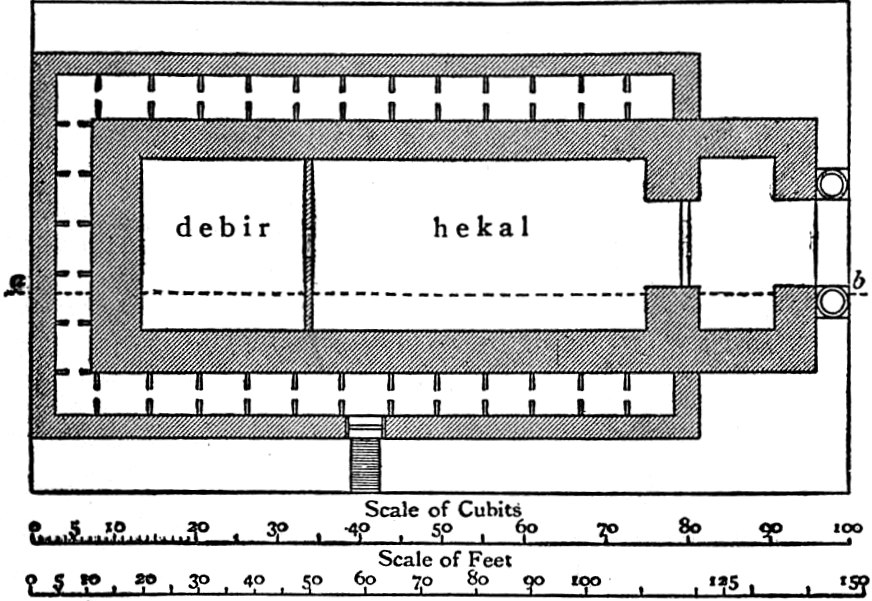 Source: EB1911, “Ground Plan of Solomon’s Temple”, public domain. This is a historical reconstruction diagram, not a revealed plan.
For additional, clearly labeled teaching references, see 🔗 Wikimedia Commons: Solomon’s Temple. Rights and historical accuracy vary by image; use individual file pages before reuse.
Bronze for Cleansing and Service (1 Kings 7:1-37)
1 And king Solomon sent, and took Chiram out of Tyre, 2 the son of a widow woman … a worker in brass, and accomplished in art and skill and knowledge to work every work in brass. 7 And he set up the pillars of the porch of the temple: and he set up the one pillar, and called its name Jachum: and he set up the second pillar, and called its name Boloz. 10 And he made the sea, ten cubits from one rim to the other. 13 And there were twelve oxen under the sea. 24 And he made ten brazen lavers. 37 So the work of the house of the Lord which Solomon wrought was finished; and Solomon brought in the holy things of David his father.
A second Chiram now enters the story: a craftsman whose wisdom, skill, and knowledge are named as gifts worthy of the Lord’s house. Scripture does not reduce holiness to intentions detached from competence. Craft can be prayerful discipline. A singer learns the hymn, a reader prepares the text, a carpenter measures carefully, and a servant learns how to handle holy things with both confidence and fear of God.
The great bronze sea and the lavers belong to priestly cleansing. They are not a blueprint for reducing baptism to a ritual bath, nor a warrant for treating purity as scrupulosity. They teach the enduring truth that no one approaches the holy God casually. Christian baptism is God’s gift of cleansing and new birth; repentance is the ongoing return by which the baptized refuse to make peace with sin.
The pillars receive names that Brenton renders Jachum and Boloz, rather than the more familiar Jachin and Boaz. The spelling difference is a translation and textual-shape detail, not a second pair of pillars. Their placement at the entrance makes a fitting confession: God establishes His people, and their strength is received rather than self-made. The lesson is especially needed where religious work tempts people to trust organization, donors, visibility, or their own competence.
The Palace beside the Temple (1 Kings 7:38-50)
38 And Solomon built a house for himself in thirteen years. 39 And he built the house with the wood of Libanus. 44 And there was the Porch of seats where he would judge, the porch of judgment. 45 And he built the house for the daughter of Pharao whom Solomon had taken. 46 All these were of costly stones. 50 And Solomon finished all his house.
In Brenton’s order, the Temple furnishings are described first and Solomon’s palace afterward. The sequence heightens a moral tension that the narrative does not yet resolve for us. The palace includes a hall of judgment, so royal architecture is not automatically vanity; a king needs a place to administer justice. Yet the reader also sees costly stone, cedar, Pharaoh’s daughter, and thirteen years spent on Solomon’s own house.
This is an early warning, not a license to condemn every home, profession, or human craft. The danger is subtler: the heart can build a private palace beside the Lord’s house. Reputation, control, comfort, possessions, success, or a ministry image can slowly become more beloved than prayer and obedience. The temple story will soon be followed by dedication, but the later story of Solomon will show why beauty without a guarded heart cannot bear the weight of glory.
The corrective is gratitude and simplicity. Receive a home, work, and skill as gifts; refuse to make them an altar to the self. Ask whether the resources, planning, and emotional energy given to personal security are matched by love for God and concrete mercy toward His people.
Spiritual Fruit 🍇
Offer beauty without self-display. Choose one concrete act that makes worship or hospitality more reverent for another person: clean a neglected space, prepare carefully for a hymn or reading, set a table with gratitude, or repair something useful. Offer it quietly. The Temple’s beauty was meant to direct Israel toward God, not toward the builder’s reputation.
Honor hidden labor and its limits. Thank one person whose service is ordinarily unseen. Then ask whether you have assumed another person’s availability without noticing their health, family, or weariness. The Temple’s workers teach that hidden labor matters; the later history of Solomon teaches that no holy purpose excuses crushing people.
Let preparation become repentance. The unworked noise of hammer and axe stayed outside the sanctuary because the stones were prepared beforehand. Before the next Liturgy, name one rough habit Christ is asking you to bring to Him: anger, distraction, careless speech, resentment, or the need to control. Come early enough to pray for a heart made ready.
Name the palace beside the Temple. Identify one pursuit that presently receives more planning, imagination, or desire than prayer. Practice a small fast from it and use the reclaimed time for Psalm prayer, reconciliation, or unhurried attention to someone God has entrusted to you.
Receive created things as gifts for communion. The sea, lamps, gold, cedar, and carved flowers teach neither luxury nor contempt for matter. Give thanks for one material gift without clinging to it, and ask that the visible goodness of creation may lead you to the Creator.
Teaching Notes
Peace, Wisdom, and the Nations’ Offering (1 Kings 5:15-26)
- Ask: What is the difference between peace as comfort and peace as the God-given space in which a people can worship and serve?
- Emphasize: Chiram’s assistance does not erase Israel’s calling; it shows that gifts from beyond Israel may be offered to Israel’s God.
- Watch for: Do not turn this partnership into a simplistic claim that every alliance or cultural practice is automatically holy.
- Connect: Christ gathers Jews and Gentiles into one household without erasing the concrete history of Israel.
Labor, Limits, and the Foundation (1 Kings 5:27-32)
- Ask: Which kinds of labor make parish worship possible but usually go unnoticed?
- Emphasize: Hidden work can be real offering, and Christ—not productivity or public success—is the foundation.
- Watch for: Do not romanticize the levy or use sacrifice-language to pressure exhausted people.
- Connect: Link the prepared stones to 1 Peter 2:4-5 and discuss how living stones are built together by grace.
A House Built in Reverent Silence (1 Kings 6:1-10)
- Ask: What personal “hammering” needs to be brought to Christ before it becomes noise in the life of the community?
- Emphasize: The silence of the construction depicts preparation for holy offering, not contempt for work or for ordinary human speech.
- Watch for: Brenton’s 3 Kingdoms source has an irregular verse sequence here; do not quote invented Brenton text for the covenant speech found in Hebrew-based editions.
- Connect: Relate received liturgical order to freedom from personality-centered worship.
Cherubim, Palms, and the Return toward Life (1 Kings 6:15-36)
- Ask: How do Eden’s cherubim and the Temple’s cherubim hold together humanity’s exile and God’s promise of return?
- Emphasize: Temple imagery points toward Christ’s opening of access to God and the Church as His living dwelling.
- Watch for: Avoid treating icons, architecture, or material beauty as magical substitutes for repentance.
- Show: Use a clearly labeled Temple plan or a photograph of an Orthodox sanctuary to compare sacred-space teaching; verify the rights and provenance of the individual image before reuse.
Bronze for Cleansing and Service (1 Kings 7:1-37)
- Ask: What does Chiram’s named craft teach about the relation of spiritual reverence and patient skill?
- Emphasize: Baptism and repentance are gifts of cleansing that prepare us for communion with God.
- Watch for: Do not reduce the bronze sea to a one-to-one baptismal prediction or turn purity into anxiety.
- Connect: Note the Brenton forms Jachum and Boloz alongside the familiar names; the same pillars confess received strength.
The Palace beside the Temple (1 Kings 7:38-50)
- Ask: What can become a private “palace” in the life of a faithful person or a parish?
- Emphasize: The chapter warns against self-glory while allowing that homes, work, justice, and craftsmanship can be good gifts.
- Watch for: Keep the warning pastoral; do not shame people for ordinary possessions or necessary work.
- Connect: Prepare the class to notice how Solomon’s later divided heart interprets this earlier tension.
Translation and Source Notes
Embedded Scripture is from Brenton’s English Septuagint (LXX).
Brenton names this book 3 Kingdoms. Its chapter and verse shape differs materially from Hebrew-based English editions: 3 Kingdoms 5:1-14 contains material commonly printed near the end of 1 Kings 4, while the Temple correspondence begins at 3 Kingdoms 5:15; 3 Kingdoms 6 has a sparse sequence that reaches verse 36; and 3 Kingdoms 7 describes the bronze work before Solomon’s palace. The excerpts in this guide preserve Brenton’s wording and do not create verses absent from that source.
The guide gives familiar 1 Kings references in headings so readers can follow the book’s conventional English chapter labels. Consult a full edition when comparing verse-by-verse with another translation.
Sources
- Scripture: Brenton’s English Septuagint, 3 Kingdoms 5-7; compare 1 Kings 5-7 in a Hebrew-based English translation for source-shape differences.
- Biblical connections: Genesis 2-3; Exodus 25-31 and 35-40; 2 Chronicles 2-4; Hebrews 9-10; 1 Peter 2:4-5; 1 Corinthians 3:9-17.
- 🔗 Brenton, 3 Kingdoms 5 at CCEL; use the adjacent chapter navigation for 3 Kingdoms 6-7.
- 🔗 Wikimedia Commons: Temple in Jerusalem for individual historical illustrations and reconstruction references; check each file’s rights and accuracy before reuse.
- Iain W. Provan, 1 and 2 Kings.
- Richard D. Nelson, First and Second Kings.
- John M. Monson, The Temple of Solomon: Heart of Jerusalem.