
Kiahk is the fourth month of the Coptic calendar, especially beloved for the extended praises that prepare the Church for Christ’s Nativity. Its distinctive melodies, hymns honoring St. Mary, and Sunday readings from Luke’s first chapter teach us how to wait for the Savior: with attention, repentance, and joy. If you have heard someone invite you to “Kiahk praises,” they mean a service of sung prayer, not a Christmas concert.1
Kiahk and the Nativity Fast overlap, but they are not the same thing. For the coming season, the 43-day fast runs from November 25, 2026, through January 6, 2027. Kiahk itself runs from December 10, 2026, through January 8, 2027. The Feast of the Nativity falls on January 7, which is Kiahk 29 in this cycle.2 The fast begins before the month does; the month continues beyond the feast.
Why Coptic Christmas falls on January 7 is a calendar question with its own history. Kiahk addresses a more intimate question: how do we become ready to welcome the One who is born?
Why the Church sings so much about Mary
Because the Child she bears is God the Word made flesh.
The title Theotokos means God-bearer, or Mother of God. It does not mean that Mary created the Godhead or existed before God. It identifies the One born from her: the eternal Son Himself, truly made man. A Kiahk hymn greets her as the one who brought forth “God the Logos,” meaning God the Word.3 John 1:14 gives us the words to understand the hymn: the Word became flesh. Mary bore that very Word as her child. The hymn honors her by confessing who Jesus is.
St. Athanasius writes that the Word did not merely choose to appear among us: “But He takes a body of our kind.”4 In the same passage, he follows that real bodily life toward Christ’s death and Resurrection. Bethlehem is not a pause from the work of salvation. It is the coming of the Savior who makes our humanity His own and overcomes death.
Kiahk’s images help the heart dwell on this. Its hymns recognize Mary in the bush Moses saw burning without being consumed.3 This is the Church’s poetic contemplation of the Incarnation, not a claim that Exodus names Mary directly. The familiar image becomes a way to wonder at God’s presence without reducing His mystery to something manageable.
And wonder has practical consequences. If the Word truly entered our human life, ordinary bodies and households cannot be beneath His notice. A crowded home, an exhausted parent, or a quiet act of care is not outside the world He came to save.
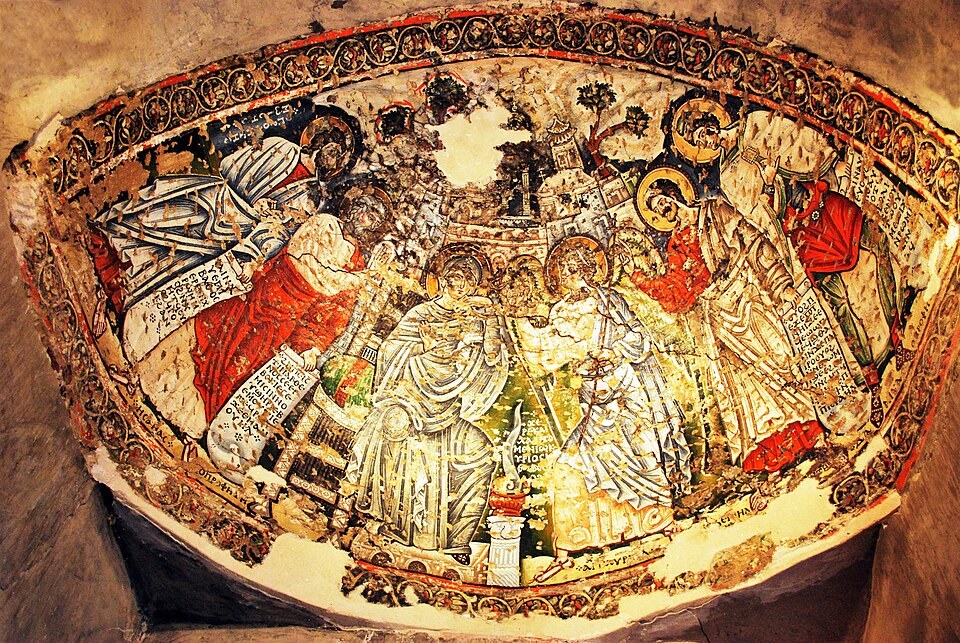 Source: Annunciation with Four Prophets, Dayr al-Suryan, Wadi al-Natrun, photograph by Diaa abdelmoneim, CC BY-SA 3.0; resized without cropping.
At the Monastery of the Syrians in Wadi al-Natrun, the Annunciation is painted among four prophets. The setting makes visible something Kiahk also sings: Gabriel’s greeting to Mary belongs to the long story of God’s promises to Israel. For a modern Coptic treatment of the same scene, see The Annunciation by Bedour Latif and Youssef Nassief, 1987, figure 15.
What are Midnight Praises and “Seven and Four”?
Midnight Praises, often called Tasbeha, are a service of praise. They are distinct from the Midnight Prayer of the Agpeya, the Coptic book of the hours. In the diocesan order for Kiahk Sundays, the Midnight Prayer precedes the praises. The praises then unfold through canticles, hymns, commemorations of saints, and explanations that linger over the mystery being celebrated.5
“Seven and Four” refers to the seven Theotokias, hymns honoring the Mother of God associated with the days of the week, and the four Hos, or canticles. These carry us through the song of the sea, thanksgiving for God’s enduring mercy, the praise of the three young men in the furnace, and the final psalms of praise.1 The four canticles draw on Scripture, but they are part of the sung praise service, not the four Sunday Liturgy Gospels listed below.
There is something striking about preparing for Christmas by singing with people delivered from slavery and people praising inside a furnace. The Church does not require us to pretend that the world is already gentle. She gives us words of deliverance before our circumstances have become easy.
For a first visit, check the parish schedule. “Midnight” names the service, not a guarantee that it starts at twelve. Parish arrangements vary: ask when the praises begin, how long that gathering is expected to last, and which languages are used. Ask for an English text or sit beside someone who can help you follow. You do not need to master every melody before joining the prayer.
A parent who can attend only part of a gathering need not turn the night into an endurance test. Listen for one phrase you can bring home. The point is not to survive a long service, but to let its praise continue working in you.
Four Sundays inside one chapter
Kiahk’s Sunday Liturgy Gospels move slowly through Luke 1. Here are the appointments for the 2026/27 season, not a civil-date template for every year.6
| Sunday | Liturgy Gospel | What to notice |
|---|---|---|
| December 13, 2026 | Luke 1:1-25 | Luke’s opening (vv. 1–4) and Gabriel’s announcement (vv. 5–25) |
| December 20, 2026 | Luke 1:26-38 | Gabriel announces Christ’s birth to Mary. |
| December 27, 2026 | Luke 1:39-56 | Mary visits Elizabeth and magnifies the Lord. |
| January 3, 2027 | Luke 1:57-80 | John is born, and Zechariah blesses God. |
In this cycle, all four occur before the Paramoun, the immediate preparation for the feast. January 6 has Luke 2:1-20 at the Liturgy; the Nativity feast has Matthew 2:1-12.6 Neither should be mistaken for a fifth installment of the Sunday sequence. Other years require their own resolved calendar.
Read the first Sunday’s passage without rushing past Elizabeth’s long sorrow. The announcement is good news, but Luke does not pretend the waiting was painless. Nor should we promise a particular earthly outcome to someone who is grieving or waiting for a child.
Then watch Mary ask how the promise will come to pass and offer herself to God’s word. Her faith is not blank passivity. By the third Sunday it has feet: she goes to Elizabeth. The Magnificat praises the Lord who brings down the mighty and fills the hungry. This is preparation for Christmas that reaches beyond decorating a room.
Finally, Zechariah’s restored speech becomes blessing. His song looks toward the forgiveness of sins and the light that guides feet into peace. The man who fell silent after questioning Gabriel now blesses God aloud. Kiahk gives us time to hear the change.
Bring the praise home
For a simple home reading practice, read the coming Sunday’s passage once before attending Liturgy, then again afterward. This is a suggested practice, not an additional Church appointment. Carry one sentence through the week rather than racing ahead to finish the story.
Join that attention to the Nativity Fast’s prayer and mercy. Arrange your fasting rule with your priest, including any necessary medical accommodations. Let Mary’s journey toward Elizabeth suggest a visit you have postponed. Let the Magnificat’s hungry people have a place in your Christmas budget.
Kiahk is not asking us to manufacture a festive mood. It gives us a place among people who wait, receive a word, go to serve, and learn to bless. Through their words and the Church’s song, we prepare to meet Christ, not as an idea about Christmas, but as the living Lord who has come to save us.
Sources
Footnotes
-
Coptic Orthodox Diocese of the Southern United States, Sunday School Curriculum, Grade 9, “The Hymns of Kiahk,” printed pages 78-81, especially the explanations of Seven and Four and the four canticles. Used for praise terminology and theology, not to establish dated reading appointments. ↩ ↩2
-
Southern Diocese, 2026 Coptic Fasts and Feasts, Nativity Fast entry, November 25 to January 6. Coptic/civil dates checked with the calendar converter in @andraws/lectionary-data 1.3.12 and that package’s date-resolved readings. These dates belong to the stated cycle: in the following cycle, Kiahk begins December 11, 2027, and January 7, 2028, falls on Kiahk 28, not 29. ↩
-
St. Mary and Archangel Michael Coptic Orthodox Church, Houston, The Month of Kiahk, hosted by the Southern Diocese: Verses of Cymbals, printed page 2; Melody for the First Sunday, printed pages 16-18. The former names “God the Logos”; the latter explicitly uses the unconsumed-bush image. This older booklet is cited for those texts, not as a current parish timetable. ↩ ↩2
-
St. Athanasius, On the Incarnation 8.3, paragraph beginning “For He did not simply will to become embodied”, NPNF, second series, volume 4, translated by Archibald Robertson, 1892. Public-domain translation; 8.4 connects His real body with His death and Resurrection. ↩
-
Southern Diocese, Rites of the Coptic Month of Kiahk, “Rites of the Sundays of Kiahk: Midnight Praises.” The document distinguishes the preceding Midnight Prayer from the praise service and supplies a detailed order; local start times, duration, and language arrangements should be checked with the parish. ↩
-
Coptic Sunday and feast Liturgy appointments from @andraws/lectionary-data 1.3.12, Kiahk Sundays 1-4. These preserve dated CopticChurch.net reading records. The 2026/27 calendar has no displacement of these four Sundays by Paramoun or Nativity. ↩ ↩2