
Coptic Orthodox Christians fast to turn their whole lives toward Christ. We abstain from certain foods, and, according to a rule worked out with our priest, from food and drink for a period of time. But the purpose is not to make God admire our endurance. It is to learn repentance, freedom from the tyranny of appetite, and love that makes room for our neighbor. Fasting belongs with prayer and almsgiving, not apart from them.1
That answer matters when the conversation gets stuck at the refrigerator. A person can know exactly which biscuits contain milk powder and still be merciless at the dinner table. Another can require a medically adapted fast and be learning profound dependence on God. The ingredients matter, but they cannot tell the whole truth about a heart.
Why involve the body?
Because Christ saves human beings, not disembodied intentions.
In Matthew 4:1-4, Jesus truly hungers. When the tempter tells Him to turn stones into bread, He answers from Deuteronomy 8:3: we do not live by bread alone, but by what God speaks. Bread is good. Hunger is real. Yet neither tells us what we must do next. Fasting gives us a chance to listen to the Father instead of letting the loudest appetite decide. Christian fasting follows the Lord who entered our bodily life, rather than treating the body as an embarrassing obstacle to holiness.
Our ordinary habits reveal how much training we need. A notification asks for attention and receives it immediately. Irritation demands a sharp reply and gets one. An appetite presents itself as an emergency. Under wise guidance, the small, bodily act of waiting can interrupt that pattern. I can experience a desire without obeying it. I can bring it into prayer.
This does not mean that greater deprivation always produces greater holiness. It means the body can participate in the soul’s return to God. The same mouth that learns restraint is called to bless instead of wound.
Christ also calls Himself the Bridegroom and says His disciples will fast when He is taken from them (Matthew 9:14-17). Here the deepest reason for fasting is not an achievement but a Person. We long for Him. We refuse to let a full stomach persuade us that our deepest hunger has already been satisfied.
The fast God refuses
Isaiah 58 is unsettling because the people are already fasting. They seek God, humble themselves, and wonder why He seems not to notice. Yet they exploit their workers, quarrel, and strike one another. Their religious exercise coexists comfortably with another person’s misery.
God’s answer is concrete: loosen oppression, share bread, shelter the poor, clothe the naked, and do not hide from your own flesh (Isaiah 58:6-7). This is not a suggestion to add a charitable flourish after finishing the important spiritual work. It exposes what the spiritual work was meant to accomplish. A fast that leaves the oppressed under the same burden has missed its purpose.2
Notice the astonishing direction of the passage. The person who withholds bread from himself is told to give bread to someone else. My voluntary hunger must make me more attentive to the hunger another person did not choose.
St. John Chrysostom presses this point with characteristic force: “Shouldest thou fast without almsgiving; the act is not so much as counted for fasting.”3 He is not selling salvation for donations. He is refusing to call a closed heart an ascetical success. Restraint should release something: money for groceries, time for a lonely relative, the willingness to pay someone fairly instead of squeezing another advantage from them.
A useful question is not only, “What did I give up?” It is, “Who received love because I gave it up?”
Why Jesus tells us to wash our faces
In Matthew 6, Christ places almsgiving, prayer, and fasting within the same teaching about the Father’s sight. Each can be corrupted into a performance. We can give for applause, pray for a reputation, and fast so that somebody will notice how much we suffer.
Christ’s instruction to wash our faces and anoint our heads is wonderfully unsentimental. Do not arrange your appearance to advertise your sacrifice. Get ready for the day. Attend to your responsibilities. Let the Father know what the room does not need to know (Matthew 6:16-18).2
This is why a shared Church calendar does not contradict secret fasting. We may know that the parish is keeping a fast without knowing the struggle, prayer, or pastoral accommodation of the person beside us. The Southern Diocese makes precisely this distinction between congregational fasting and its hidden personal depth.1 Inspecting another person’s plate is not a spiritual discipline.
The same chapter includes the Lord’s Prayer and its insistence on forgiveness. It is worth remembering that when an argument begins over what is permissible to eat. We are asking for daily bread while being taught to release debts.
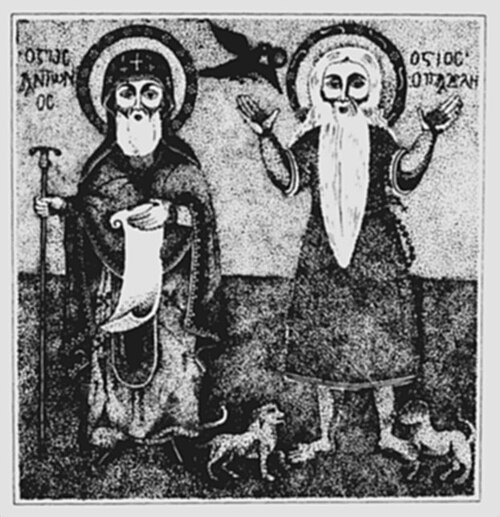 Source: Saint Antony and Saint Paul, Coptic icon, anonymous, catalogued as 14th century; public domain.
This icon pairs Antony and Paul of Thebes. In the Egyptian desert tradition they represent, fasting went hand in hand with prayer. Their example helps explain the purpose of a fast, not how strict everyone’s rule should be.
What the Coptic practice actually involves
On ordinary fasting days, the Coptic discipline includes abstaining from meat, poultry, dairy products, and eggs. Most Wednesdays and Fridays are fast days, recalling Christ’s betrayal and Crucifixion, respectively. The Church also keeps longer fasts. The Southern Diocese’s fasting guide permits fish during the Nativity Fast except on Wednesdays and Fridays, and does not permit it during Great Lent. Ask your priest how to keep the fast in your circumstances. Choosing which foods to eat is distinct from going without food and drink for a period of time.1
They are not an assertion that animal foods are unclean. The Church receives food as God’s gift and sometimes refrains from a good gift for the sake of love. Nor does an elaborate plant-based banquet become spiritually simple merely because every ingredient passes inspection.
The Church also teaches us to feast. The fast serves communion with Christ, not a permanent suspicion of nourishment or joy. In the Southern Diocese’s guide, the seasonal food restrictions still apply on Saturdays and Sundays, but there is no period of going without food and drink on those days. Preparation for Holy Communion is a separate matter; ask your priest for guidance.1
Begin with a conversation, not an endurance contest. Ask your priest for a sustainable rule. If you are pregnant or nursing, have diabetes, take medication, are recovering from an eating disorder, or have another health concern, involve your qualified clinician as well. Do not skip necessary food, fluids, or medicine to prove devotion. The Diocese explicitly counsels adapting fasting to illness and working with one’s father of confession.4 A medically necessary meal is not a spiritual disgrace.
Let one meal open a door
For the coming fast, make one modest connection between the table and the rest of life. Prepare a simple meal you can sustain. Give the money actually saved to someone who needs food. At the time agreed for prayer, put the phone away and read Isaiah 58 slowly. If your conscience names a person you have treated unjustly, make the repair specific.
And when the Nativity Fast brings Kiahk’s long praises, let hunger make room for song. The goal is not to arrive at Christmas proud of an unbroken record. It is to become more ready to receive the Lord who gives Himself to us, and more willing to receive the neighbor He has placed within our reach.
Sources
Footnotes
-
Coptic Orthodox Diocese of the Southern United States, “Lecture VIII: On Fasting”, introduction and questions 1-4. Adapted from Pope Shenouda III’s Comparative Theology. The lecture distinguishes communal fasting, personal abstinence, seasonal food rules, and the goodness of foods; individual application belongs with one’s priest. ↩ ↩2 ↩3 ↩4
-
Isaiah 58:1-12 and Matthew 6:1-18. Biblical references and brief wording follow the NKJV. ↩ ↩2
-
St. John Chrysostom, Homilies on Matthew, Homily 77, concluding exhortation, paragraph beginning “And after these virtues let us seek”, NPNF, first series, volume 10, translated by George Prevost, revised by M. B. Riddle, 1888. Public-domain translation. The page’s internal URL number differs from its printed homily number. ↩
-
Coptic Orthodox Diocese of the Southern United States, pastoral answer on serious illness, medication, and adapting the fast. The specific health examples above are cautions to seek individualized medical and pastoral guidance, not a prescribed fasting regimen. ↩