
Coptic Orthodox Christians celebrate Christmas on January 7 because the Church keeps the Nativity according to its own calendar, during the month of Kiahk. For comparison, December 25 on the Julian calendar currently falls on January 7 on the Gregorian calendar used for ordinary appointments. The difference is in how the dates are reckoned, not in whose birth we celebrate.1
That answers the date. It does not yet explain why the feast is worth arranging our lives around.
One feast, more than one calendar
The Coptic Church has its own calendar, not simply the Julian calendar with Egyptian month names. It has twelve months of thirty days and a short additional month of five days, or six in a leap year. Its leap-year rhythm is related to the Julian system. The Gregorian calendar, introduced in 1582, uses a different rule for century leap years. Those rules account for the present thirteen-day difference between Julian and Gregorian dates.12
The usual Coptic date is 29 Kiahk, as it was on January 7, 2026.3 When the leap-year alignment puts 29 Kiahk on January 8, the Church observes the Nativity on 28 Kiahk instead, keeping the feast on January 7 under the present calendar alignment. January 7, 2028 is one example.45
Christmas is a fixed feast, unlike Easter, whose Sunday is calculated each year. Here, “fixed” distinguishes the Nativity’s calendar observance from the movable paschal cycle; it does not erase leap-year adjustments or guarantee the same civil-calendar conversion for all centuries. The present thirteen-day Julian-Gregorian gap is not permanent.2
Nor should the date become a test of whether another Christian loves Christ. Pope Tawadros II’s explanation of the Coptic calendar distinguishes mathematical calendar reckoning from inherited doctrine.1 Fidelity to our Church’s worship need not become suspicion toward a neighbor celebrating in December. We can explain our tradition without treating someone else’s joy as an insult.
The Child who does not begin in Bethlehem
To understand what we celebrate, read the opening of John’s Gospel beside Luke’s account of the manger.
Luke names a ruler, a journey, a city, a mother, and a child wrapped in cloths. Luke locates the birth in human history without giving us its month and day. Yet John begins before every emperor and calendar: the Word was with God, the Word was God, and everything created came into being through Him (John 1:1-3).
Then comes the astonishing sentence: “And the Word became flesh and dwelt among us” (John 1:14, NKJV).
The One lying in the manger is not a new person who has just begun to exist. He is the eternal Son, now truly human. His birth does not mean that God has ceased to be God. It means that the Son has made our human life His own without surrendering His divinity.
St. Athanasius holds these truths together. In On the Incarnation, he explains that the Word takes a real body from the Virgin, makes it His own, and comes to rescue humanity from corruption and death. His phrase is wonderfully concrete: “He takes unto Himself a body, and that of no different sort from ours.”6 Later he insists that the Word’s presence in His body did not leave the universe empty of His providence.7
The infant is dependent upon His mother’s care according to His humanity; He remains the sustainer of creation according to His divinity. Bethlehem is not the place where God becomes less. It is where His love comes within reach of human hands.
This is why the angel calls the newborn a Savior, Christ the Lord, rather than merely a teacher we might someday admire (Luke 2:11). We need more than advice about living better. We need the One who can heal the life that sin and death have wounded. The body born of Mary is the body He will offer on the Cross and raise in victory. Christmas already opens toward Pascha.
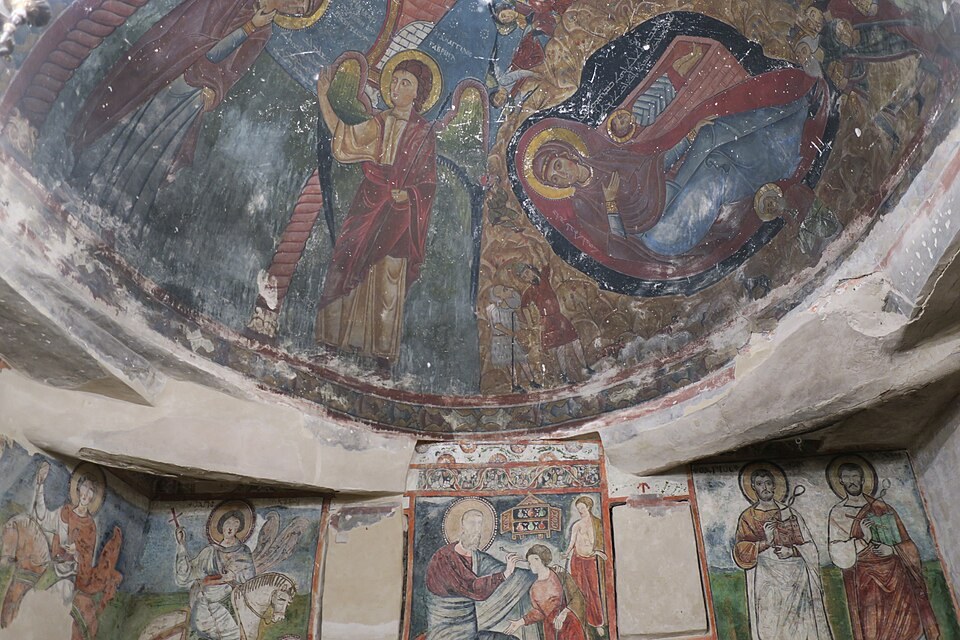 Source: Nativity mural, Dayr al-Suryan, Wadi al-Natrun, photograph by 松照庵, CC BY-SA 4.0; resized without cropping.
In the upper right of this Egyptian monastery mural, Mary reclines near the manger. After all the calendar arithmetic, the painting returns our attention to the child who was actually born.
Let the date become an appointment
An unusual feast date can leave a family feeling out of step with school, work, or relatives. The answer is not to pretend that this is effortless. It is to make room deliberately, rather than discovering that every hour has already been promised elsewhere.
Check your parish’s own service announcement before requesting leave or inviting a guest. If you want to follow the weeks of prayer leading up to the feast, start with the Kiahk reading guide. Check whether your parish’s Nativity service begins on the evening of January 6, and when the Divine Liturgy, the Church’s Eucharistic service, is scheduled. Ask about arrangements for children, transport, or accessibility where needed. These are not distractions from worship. They can help someone actually reach it.
At home, read Luke 2:1-20 slowly before planning the meal. Notice the angel’s words “to you” in the announcement of the Savior’s birth. Then notice that the shepherds go to see Him and return praising God. The news becomes a journey, an encounter, and thanksgiving. Choose one way to let your preparations serve that movement: put the phone aside during prayer, offer a ride, or make room at the table for someone who would otherwise be alone.
Matthew offers another searching detail. The visitors who arrive with treasures first fall down and worship the Child (Matthew 2:11). Their gifts express an encounter; they do not replace it. A beautifully arranged celebration can still leave us distracted from the One we came to honor.
And if a relative asks why your Christmas is later, begin with the simple calendar answer. There is no need to deliver a lecture over dessert. If the conversation opens further, tell them what the date exists to announce.
St. Paul describes the Son’s coming as God’s action in the fullness of time, so that we might receive adoption and call upon the Father through His Spirit (Galatians 4:4-7). The goal is not merely to preserve a square on the calendar. It is to receive, in Christ, a place in the Father’s household.
January 7 is the appointment. The gift is the Son Himself.
Sources
Footnotes
-
Pope Tawadros II, “The Coptic Calendar,” Kiraza, March 21, 2025, especially the calendar divisions and Julian/Gregorian explanation. ↩ ↩2 ↩3
-
U.S. Naval Observatory, “Introduction to Calendars”, “Principal Solar Calendars,” on the different leap-year rules. ↩ ↩2
-
CopticChurch.net, dated readings for January 7, 2026: Christmas, 29 Kiahk. ↩
-
CopticChurch.net, dated readings for January 7, 2028: Christmas, 28 Kiahk. ↩
-
St. Takla Haymanout Coptic Orthodox Church, Alexandria, “The Nativity Fast” (Arabic), on observing the Nativity on 28 Kiahk in Gregorian leap years under the current calendar alignment. ↩
-
St. Athanasius, On the Incarnation 8.2-4, trans. Archibald Robertson, Nicene and Post-Nicene Fathers, second series, vol. 4 (1892). ↩
-
St. Athanasius, On the Incarnation 17.1-5, trans. Archibald Robertson, NPNF, second series, vol. 4 (1892). ↩