
To make the sign of the cross in the Coptic Orthodox manner, use your right hand and move from your forehead to your chest, then to your left shoulder and your right shoulder. A commonly taught hand position joins the thumb, index finger, and middle finger to confess the Holy Trinity. One form taught by the Southern Diocese is: “In the name of the Father, and of the Son, and of the Holy Spirit, one God. Amen.”1 The Southern Diocese teaches this movement and also acknowledges variation in the fingers Christians have used.2
If you are learning, begin slowly. You are not performing a test of coordination. You are confessing the Father, the Son, and the Holy Spirit while marking yourself with the sign of Christ’s saving Cross.
Four steps, from your own perspective
Your right hand moves: forehead → chest → your left shoulder → your right shoulder. Left and right here mean your own left and right, not the sides you see when facing another person.
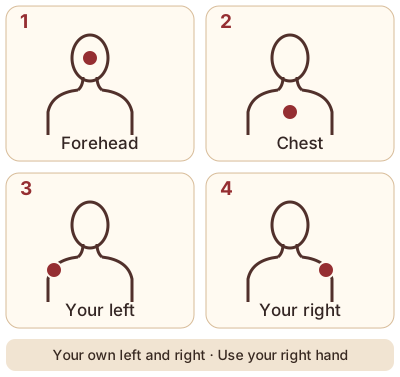 Source: Orthodox Bible Study teaching diagram, based on the diocesan movement guide cited below.
Before you begin, bring the tips of your right thumb, index finger, and middle finger together. Let the other two fingers rest folded toward your palm. The joined three fingers are a confession of one God in three Persons, not three gods.1
- Touch your forehead. Say, “In the name of the Father.” Begin with attention rather than hurrying through the words.
- Move down to your chest. Say, “and of the Son.”
- Touch your left shoulder. Begin the phrase “and of the Holy Spirit.”
- Move to your right shoulder. Finish the same phrase, then say “one God. Amen.”13
The words belong to one invocation of the Holy Trinity. There is no need to become anxious about dividing every syllable between the shoulders. Learn the prayer and movement together, reverently and naturally.
Why these words and this movement?
Christ commands His apostles to baptize “in the name of the Father and of the Son and of the Holy Spirit” (Matthew 28:19). The sign of the cross brings that Trinitarian confession into bodily prayer. The body is not an interruption to worship. The hand, voice, attention, and heart can turn toward God together.
The Southern Diocese explains the downward movement through the coming of the Son for our salvation. The One who is eternally with the Father truly came among us, taking flesh of the Virgin Mary. We do not worship a distant idea of goodness. We worship the Son of God who became man, was crucified, and rose again.3
The diocesan lecture interprets the movement from left to right in light of Matthew 25:33, where the King places the sheep at His right hand.3 The gesture expresses our hope of standing with Christ through His saving work. This is a spiritual interpretation of the gesture, not a claim that the left side of the human body is evil. Nor does the movement mean that the divine Persons occupy separate physical locations.
A few seconds of prayer can therefore carry a great confession: the Trinity, the Incarnation, the Cross, and our hope of standing before Christ in mercy.
Must everyone hold the fingers exactly alike?
The three-finger form is a clear and useful way to learn. It is not a reason to condemn everyone whose hand looks different.
The Southern Diocese’s Q&A 574 explicitly acknowledges different ways of signing over the centuries, including the use of the thumb alone and the joining of three fingers. Another diocesan teaching text also notes a five-finger form associated with Christ’s wounds.23 These sources do not support treating one hand position as the only form Christians have ever used.
Follow the form your Coptic priest teaches. If you are unsure about your own practice, ask your priest; another worshipper’s hand position is not a test of that person’s faith.
Is it a symbol, a prayer, or protection?
It is a bodily confession and an act of prayer, not merely a symbol displayed for others. Saint Paul calls the message of the Cross “the power of God” to those being saved (1 Corinthians 1:18). The power belongs to the crucified and risen Lord, not to a hand movement operating independently of Him.
Saint Athanasius connects the sign of the Cross with Christ’s living victory over idolatry and evil. In the same argument he describes the Savior drawing people toward virtue and the knowledge of the Father. His concern is the activity of the risen Christ, not an impersonal technique.4
Make the sign when you are afraid, but do not treat it as a charm that guarantees a trouble-free day. If someone is threatening you, you can pray while getting to safety and asking for help.
Make it before a difficult conversation, but also refuse the cruel word you were preparing to say. We cannot sincerely confess the Cross while making peace with the passions Christ calls us to crucify.
Learning without anxiety
At home, practice once or twice slowly while saying the full prayer. Before a meal or at the beginning of prayer, allow the movement to gather your attention. In church, learn from your priest and the worship around you without trying to count everyone else’s gestures.
If limited movement, pain, or disability makes the usual motion difficult, do not force yourself into injury. Speak with your priest about a suitable way to participate. God is not measuring the width of your arm movement.
Teach children the words along with the action. Explain that the three joined fingers confess the Holy Trinity and that the Cross belongs to Jesus who loves and saves us. A patient explanation forms prayer more deeply than repeated correction of their hands.
The aim is simple: let the sign on your body become the confession of your heart. Forehead, chest, left, right. Father, Son, and Holy Spirit. Then carry the prayer into the next act of your day.
Continue reading
Sources
Footnotes
-
Southern Diocese, “Making the Sign of the Cross”, instruction on the joined three fingers and folded remaining fingers. ↩ ↩2 ↩3
-
Coptic Orthodox Diocese of the Southern United States, Q&A 574, “What is the correct way of drawing the sign of the cross?”. The answer teaches forehead, chest, left, right and acknowledges different finger arrangements. ↩ ↩2
-
Southern Diocese, “Lecture IV: On the Veneration of the Holy Cross,” Q1, hand position, invocation, movement, and theological interpretation. ↩ ↩2 ↩3 ↩4
-
Saint Athanasius of Alexandria, On the Incarnation 31.1-3, NPNF, second series, vol. 4, translated by Archibald Robertson. ↩