


This narration is from a previous version of the study and may include a combined recording of multiple chapters.
The fields have been stripped, but Joel keeps looking toward the altar. Grain and wine have failed; the offering can no longer be brought to the house of the Lord. Hunger has entered the people’s worship. By the end of this short book, water will flow from that same house, and its final promise will be that the Lord dwells in Zion.
Between the empty altar and the flowing fountain, Joel teaches us to return. His words gather a whole people before God: priests and farmers, elders and children, bridegroom and bride. The promise grows larger than the immediate disaster. The Lord will restore the land, pour out His Spirit, judge the violence that has scattered His people, and make His presence their enduring refuge.
A prophet with few biographical details
Joel introduces himself as the son of Bathuel, the name Brenton uses for Pethuel. He names no reigning king. Jerusalem, the Lord’s house, its altar, and its ministers stand at the center of his concern, but the book does not give enough personal information to fix his date securely. Proposals place him both before and after the exile. A precise royal timeline would promise more certainty than the evidence allows.1
What Joel does ask his hearers to remember is the catastrophe itself: tell the children, and let them tell another generation (Joel 1:2-3). Faithful memory passes on more than the story of what went wrong. It passes on how the people cried to God, and why their hope survived.
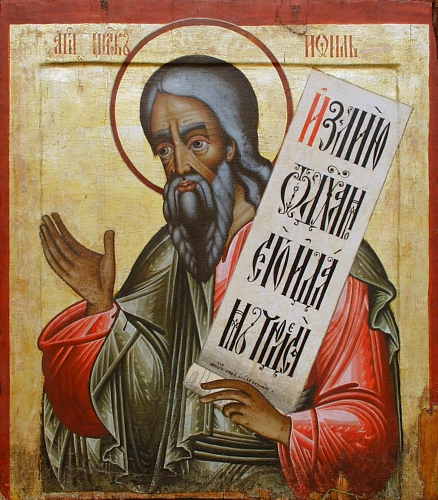 Source: Prophet Joel, Russian icon, first quarter of the eighteenth century; Wikimedia Commons, public domain.
The thread that holds the book together
Joel begins with real losses: crops destroyed, animals without pasture, families without food. Their suffering deserves attention before any spiritual application. The prophet also sees a wound at the altar. The gifts by which Israel offered thanksgiving have disappeared (Joel 1:9, Joel 1:13). What the land can no longer yield, the people can no longer bring.
That connection makes Joel 2:14 a hinge of the book. The hoped-for blessing includes a restored meat-offering and drink-offering. In Brenton’s older English, “meat-offering” here means a food or grain offering. Restoration means bread for hungry people and renewed thanksgiving before God. The Lord cares for bodily need and for the communion in which His gifts are received.
The call to return rests on God’s mercy (Joel 2:13). Fasting does not buy His affection. It gives bodily expression to a heart that turns toward the One who is already compassionate. The same Lord who gathers the people to repentance promises His Spirit to sons and daughters, old and young, servants and handmaids. At Pentecost, St. Peter identifies that promise in the Spirit-filled Church (Acts 2:16-21).
The last chapter faces the evil that repentance must also name: displacement, the sale of children, stolen holy things, and innocent blood. God’s presence is no refuge for cruelty. His judgment assures the oppressed that their suffering has been seen, while His final promise leads beyond the defeat of enemies to life with Him.
The four studies
| Study | The passage’s concern | What to carry forward |
|---|---|---|
| Joel 1: Locusts and lament | Devastation reaches the altar; the people gather and cry to the Lord. | Grief can become prayer without becoming an accusation against the sufferer. |
| Joel 2:1-27: Trumpet, fasting, and restoration | The trumpet gathers the whole people to return; the Lord restores food, worship, and courage. | Mercy makes honest repentance possible. |
| Joel 2:28-32: The Spirit poured out | The Spirit is given across divisions of age and status; salvation is promised to those who call on the Lord. | The risen Christ gives His people life and makes them witnesses. |
| Joel 3: Judgment, living waters, and the Lord in Zion | God judges exploitation and bloodshed, shelters His people, and makes His house a fountain. | Entrust judgment to God and seek the holiness of His dwelling. |
The order carries a promise, not a formula by which people earn the Spirit or guarantee relief from every affliction. God’s grace reaches people in their need. The studies follow that grace from the cry of the devastated land to the promise of His abiding presence.
Numbering: NKJV references, Brenton readings
The study titles and ordinary references follow the NKJV’s three-chapter numbering. The displayed Old Testament readings remain Brenton’s English Septuagint, using its four-chapter arrangement and its own verse labels. Where the systems differ, a short note immediately before the reading identifies the Brenton passage.
| Study reference: NKJV | Brenton reading | Printed Hebrew reference |
|---|---|---|
| Joel 1 | Joel 1 | Joel 1 |
| Joel 2:1-27 | Joel 2:1-27 | Joel 2:1-27 |
| Joel 2:28-32 | Joel 3:1-5 | Joel 3:1-5 |
| Joel 3 | Joel 4 | Joel 4 |
Printed Hebrew Bibles divide Joel into four chapters, as does the Brenton text used here. The familiar three-chapter arrangement in the KJV and NKJV follows the Latin Vulgate chaptering tradition. Our numbered chapters are later reference aids, with their familiar form rooted in medieval divisions; they were not part of the prophet’s original wording.2
Moving a chapter boundary does not add or remove the passage. Differences between the Hebrew and Septuagint wording are a separate matter, explained where they affect the reading. Thus “Joel 3” in these studies means the judgment chapter, while the Pentecost promise has its own study at Joel 2:28-32.
Joel in Coptic worship
The Church’s fasting readings let Joel’s words enter prayer. A summons to repentance can be heard alongside assurance that the Lord restores; the promised Spirit gives Lent a horizon larger than our own effort. The appointments below retain their distinct source levels. Coptic Reader’s week names count the preparation week as the first week.
| Passage | Occasion and service | Source level |
|---|---|---|
| Joel 1:5-15 | Eve of Monday of Holy Pascha, Sixth Hour, prophecy | Printed Holy Pascha book; not yet confirmed against Coptic Reader. |
| Joel 2:1-3 and Joel 2:10-11 | Good Friday, Ninth Hour, prophecy | Printed Holy Pascha book; not yet confirmed against Coptic Reader. |
| Joel 2:12-27 | Wednesday of the first week of Great Lent, prophecy | Listed in the Katameros; not Reader-confirmed. |
| Joel 2:21-27 | Wednesday of the third week of Great Lent, Matins prophecy | Confirmed by Coptic Reader. |
| Joel 2:28-32 | Wednesday of the fourth week of Great Lent, Matins prophecy | Confirmed by Coptic Reader. |
| Joel 3:9-21 | Wednesday of the fifth week of Great Lent, prophecy | Listed in the Katameros; not Reader-confirmed. |
The Pascha appointments are attested in the St. Mary Ottawa Holy Pascha book, 2018 edition. The two Reader-confirmed Matins readings are documented for March 4 and March 11, 2026. The Katameros entries supply the other two Lenten candidates.3
Joel’s connection with Pentecost is established by Acts 2. The table does not assert that Joel itself is appointed at Pentecost services. On Good Friday, the printed appointment of Joel’s darkened heavens can be contemplated beside the darkness and the Lord’s death in Matthew 27:45-50: Christ freely enters the Passion for the world’s salvation.
Reading toward communion
Fr. Tadros Yacoub Malaty, a modern Coptic commentator, calls Joel “the prophet of the Pentecost.” In his opening “A Call to Renewal,” he describes the Spirit’s work as transforming the wilderness of the heart into God’s fruitful paradise.4 That image belongs with the book’s actual fields, rain, and fountain. God restores life, and His gifts become thanksgiving.
The first chapter can help a distracted person become sober; the second can help an ashamed person return. The Spirit promise teaches us to expect renewal from God rather than manufacture spiritual excitement. The final chapter gives both warning and consolation: our cruelty will be judged, and the blood of the innocent will not be forgotten.
The Lord’s dwelling is the hope that gathers these promises. We come to Him with real hunger, damaged relationships, habits we have excused, and grief we cannot explain. Joel gives us words for that return, and room to hear that mercy is already calling.
Teaching Notes
The whole book
- Ask: What changes when the loss of crops is also heard as the loss of an offering at the altar?
- Emphasize: Joel 2:14 answers the interrupted offerings of Joel 1:9 and Joel 1:13. Bodily provision and restored thanksgiving belong together.
- Watch for: Blaming someone else’s disaster on a hidden sin, or promising that repentance guarantees material recovery on demand.
- Connect: Keep Pentecost’s fulfillment in Acts 2 distinct from a claim about a Joel appointment at Pentecost services.
- Show: Use the numbering table whenever a reader moves between the NKJV and the displayed Brenton text. Keep the uncertain date of Joel separate from the date of the icon.
Sources
Embedded Scripture is from Brenton’s English Septuagint (LXX).
Lancelot C. L. Brenton, The Septuagint Version of the Old Testament, Joel, four-chapter text.
New King James Version, Joel 2:28-32, for the study-reference frame; Acts 2:16-21 for the apostolic interpretation of the Spirit promise.
Fr. Tadros Yacoub Malaty, A Patristic Commentary: The Book of Joel, trans. Dr. George Botros, English edition 2007, “A Call to Renewal” and Introduction, PDF.
Footnotes
-
Fr. Tadros Yacoub Malaty, A Patristic Commentary: The Book of Joel, Introduction, “History of the Book,” PDF pp. 4-5, 2007 English edition. Page references count PDF file pages. ↩
-
Compare Hebrew Joel 3 and Joel 4 with Brenton Joel 3 and Joel 4, and the Latin Vulgate boundary. On later chapter divisions and their Latin/English transmission, see “Different chapters for books of the Bible?”, January 7, 2022, and “The Verse Numbers in the Bible”, April 26, 2019. ↩
-
St. Mary Ottawa, Holy Pascha, Lent 1734 A.M./2018, Eve of Monday, Sixth Hour, pp. 86-87; Good Friday, Ninth Hour, pp. 610-611. Coptic Reader, Coptic Orthodox Metropolis of the Southern United States, selected March 4, 2026 and March 11, 2026, Matins, Prophecies, official app. Katameros, Great Lent cycle, first- and fifth-week Wednesday prophecies. These distinct witnesses are represented in lectionary-data 1.3.3. ↩
-
Fr. Tadros Yacoub Malaty, The Book of Joel, “A Call to Renewal,” PDF p. 3, and Introduction, “Features of the Book,” item 10, PDF p. 7, 2007 English edition. ↩