
Coptic Theophany is the feast of Jesus Christ’s baptism in the River Jordan. It celebrates the manifestation of the Holy Trinity: the Son stands in the water, the Father bears witness from heaven, and the Holy Spirit descends like a dove. The Coptic Church also celebrates a blessing of water, commonly called the Laqqan, remembering that the Lord who entered the Jordan gives us cleansing and new life.1
This is not a feast about Jesus needing forgiveness. It is about the sinless Savior coming among sinners to save them. The water matters because the Word truly became flesh. God meets us in the world He made, not in an imaginary spiritual life detached from our bodies.
What does “Theophany” mean?
Theophany means a manifestation of God. Epiphany, another name used for this feast, means an appearance or manifestation. In this Coptic celebration, both names point to Christ’s baptism and the revelation of the Trinity.
The feast falls on Tobe 11, also spelled Toba or Tuba. In 2027, Tobe 11 falls on January 19.2 If you are planning to attend, check your parish’s announcement for the service date and starting time. An evening celebration can begin on the preceding civil date. A calendar entry is not a parish timetable.
For a newcomer, the most important preparation is simple: read Matthew 3:13-17, then come ready to listen. The feast explains not only something that happened to Christ, but the life He opens to us.
Why was the sinless Christ baptized?
John’s baptism called people to repentance. People came confessing their sins, so John himself recognized the startling reversal when Jesus approached: he needed Christ, not the other way around. Jesus answered that they should fulfill all righteousness (Matthew 3:14-15).
Christ did not join the line because He shared our guilt. The eternal Son truly became man. At the Jordan He stands among sinners in obedience to the Father, though He Himself is without sin. He does not save us by keeping His distance. The One who will bear our sins on the Cross first stands among those confessing them at the Jordan.
St. John Chrysostom addresses the apparent contradiction of the Master coming to His servant for baptism. His answer is not embarrassment, but wonder: we should be “amazed at such unspeakable goodness.”3 The humility does not diminish Christ’s majesty. It reveals the goodness of the One who possesses it.
That changes how we approach repentance. We need not pretend to be clean before drawing near to the Savior. We come truthfully because He is holy, merciful, and able to cleanse us. His baptism is not His confession of sin. It is His loving approach to sinners.
The Father reveals His eternal Son
At the Jordan, the Father speaks of His beloved Son. The Holy Spirit descends like a dove. Jesus is baptized (Matthew 3:16-17; Luke 3:21-22).
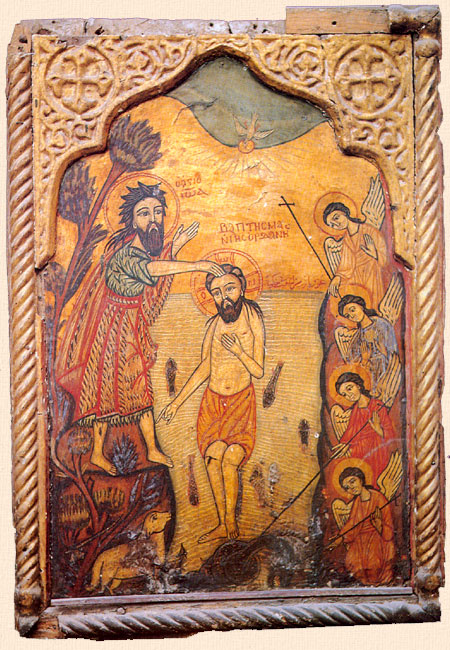 Source: Baptism of Christ, Coptic Church of Saint Mercurius, Old Cairo; anonymous icon, public-domain reproduction via Wikimedia Commons.
Christ stands at the center of the river, between John on one bank and the angels on the other. The icon puts the focus where the Gospel does: on the Lord who humbles Himself to receive baptism.
These are not three gods, nor one divine Person wearing three successive disguises. The Father, the Son, and the Holy Spirit are distinct Persons, one God. The Gospel lets us hear and behold that distinction within the one divine revelation.
Nor does Jesus become the Son of God at His baptism. John’s Gospel identifies Him as the eternal Word before telling of the Baptist’s witness. The Father reveals who the Son is; He does not promote an ordinary man to divinity. Likewise, the Spirit’s descent does not mean that Christ had previously lacked holiness.
The dove is a sign of the Spirit’s manifestation, not a claim that the Holy Spirit is a bird by nature. Keeping these distinctions clear protects the feast’s joy: the eternal Son has truly come among us, and through Him we are brought into communion with the Father in the Holy Spirit.
What is the Laqqan blessing of water?
The Laqqan is a liturgical service of blessing water. The Los Angeles Diocese’s feast guide describes the Theophany water blessing and the priest’s anointing of believers with the blessed water, followed by the Divine Liturgy.1 If you are visiting, ask a parish volunteer where to stand and what to expect during the water blessing.
The Church’s prayer over water is neither a superstition nor a second baptism. Christian baptism is our sacramental entry into Christ’s death and Resurrection, not something repeated annually. The feast’s water blessing directs our attention back to the Lord who sanctifies us and to the baptismal life we are called to live.
At the blessing of water, the Gospel is Matthew 3:1-17, the account of Christ’s baptism. At the feast’s Divine Liturgy, the Pauline Epistle is Titus 2:11-3:7, which speaks of the washing of regeneration and renewal of the Holy Spirit. The Liturgy Gospel is John 1:18-34, in which the Baptist bears witness to the Spirit’s descent and points to the Lamb of God.4 Together, the readings teach one mystery: the Savior who appears is the Savior who renews us.
How can I keep the feast meaningfully?
Begin with gratitude for baptism. St. Paul says that those baptized into Christ are baptized into His death so that they may walk in newness of life (Romans 6:3-4). The right question is not simply, “Did I receive the water blessing?” It is, “Am I living as someone who belongs to Christ?”
If you bless God in church but humiliate someone at home, stop the behavior and apologize without making excuses. If you have a father of confession, speak honestly with him about what needs to change. The feast’s cleansing language is an invitation to truth, not an excuse for shame or concealment.
If you are visiting a Coptic church, you do not need to imitate everything immediately. Receiving a blessing and receiving Holy Communion are not interchangeable; ask the priest about sacramental participation.
If you cannot attend, read the baptism narrative and pray in thanksgiving for Christ’s coming. This is a useful home devotion, not a replacement rite or permission to improvise the Church’s blessing of water.
Theophany leaves us looking at the Jordan, but not standing still. The beloved Son has entered our condition without sin. Through Him, the Church calls us to leave the old life behind and walk as children of God.
Continue reading
Sources
Footnotes
-
Coptic Orthodox Diocese of Los Angeles, Southern California, and Hawaii, “Feast of the Theophany”, especially its explanation of the Trinity and the modern Coptic water-blessing celebration. ↩ ↩2
-
@andraws/lectionary-data, version 1.3.12, date-resolved calendar, January 19, 2027: “The Feast of Epiphany,” Coptic date key
toba-11. Package data is licensed CC BY 4.0. ↩ -
St. John Chrysostom, Homilies on John, Homily VI, on John 1:6, paragraph beginning “What is this,” in NPNF, first series, vol. 14, English translation in the Philip Schaff edition: direct text. ↩
-
@andraws/lectionary-data, version 1.3.12, January 19, 2027: “Liturgy of Blessing of the Water,” Matthew 3:1-17; “The Feast of Epiphany,” Liturgy Gospel, John 1:18-34; Pauline Epistle, Titus 2:11-3:7. Scripture references elsewhere in this article explain the feast without implying that every passage is an appointed reading. ↩