
The paralytic has just risen at Christ’s word and carried his bed through the crowd. Now Jesus passes another seated man and says, “Follow Me.” The first man was visibly unable to rise; Levi sits inside an occupation that has made him publicly compromised or despised. Christ’s authority reaches both forms of bondage. He forgives, calls, and raises.
The call widens into a table crowded with tax collectors and sinners. Christ names Himself as their Physician. He does not wait outside until the sick can prove they are healthy; He draws near to heal, and His mercy opens a road of repentance. The scandal of His company becomes a revelation of His mission.
Levi rises and follows (Mark 2:13-14)
13 Then He went out again by the sea; and all the multitude came to Him, and He taught them. 14 As He passed by, He saw Levi the son of Alphaeus sitting at the tax office. And He said to him, “Follow Me.” So he arose and followed Him.
Mark moves from “all the multitude” to one man. Jesus teaches the crowd by the Sea of Galilee, then sees Levi sitting at the toll or tax office. Capernaum was a small fishing and agricultural community on the northwest shore, within the territory of Herod Antipas. Toll collectors handled charges connected with produce and transported goods, and their work carried deep social suspicion. Mark does not name Levi’s employer or accuse him of a particular fraud, but the scandal is clear: Christ calls a man whose occupation makes him publicly compromised in the eyes of his neighbors.12
The Church remembers Levi as St. Matthew the Evangelist, whose parallel account calls him Matthew (Matthew 9:9); Mark names Matthew among the Twelve in 3:18. Chrysostom admires the Evangelist’s humility in openly naming himself and his former occupation.3 His martyrdom is kept on Babah 12.4
The Greek telōnion names the toll office itself.5 Jesus does not wait for Levi to leave the place and present a cleaner version of himself. He sees him there. Grace reaches the actual person in the actual place of bondage, shame, calculation, and habit. This does not make the tax office holy or excuse injustice. It means that repentance begins because Christ has drawn near, not because the sinner first escaped by his own strength.
“Follow Me” asks for more than admiration. Mark places the command beside Levi’s bodily answer: he was sitting; he arose; he followed. The Gospel does not preserve a speech, bargain, or period of delay. Levi entrusts his future to the One who called him. The same Christ who told the paralytic to arise now raises a man into discipleship. One left carrying his bed; the other leaves the seat from which he had ordered his life.
Saint John Chrysostom, preaching on Matthew’s parallel account, says that Christ called him from his occupation and “from the midst of the evils He drew him up.”3 The wording is severe, but the action is full of hope. Christ is neither ashamed of the sinner nor indifferent to the sin. His call separates Levi from the life that held him and joins him to the Lord who can heal him.
For the Church, this keeps evangelism and repentance together. We do not ask people to heal themselves before approaching Christ, and we do not tell them that remaining seated is the same as following. Mercy speaks a name and opens a road. The first obedient step may be confession, restitution, the end of a dishonest practice, reconciliation, or accepting help that pride has resisted. Whatever the form, grace calls the whole person to rise.
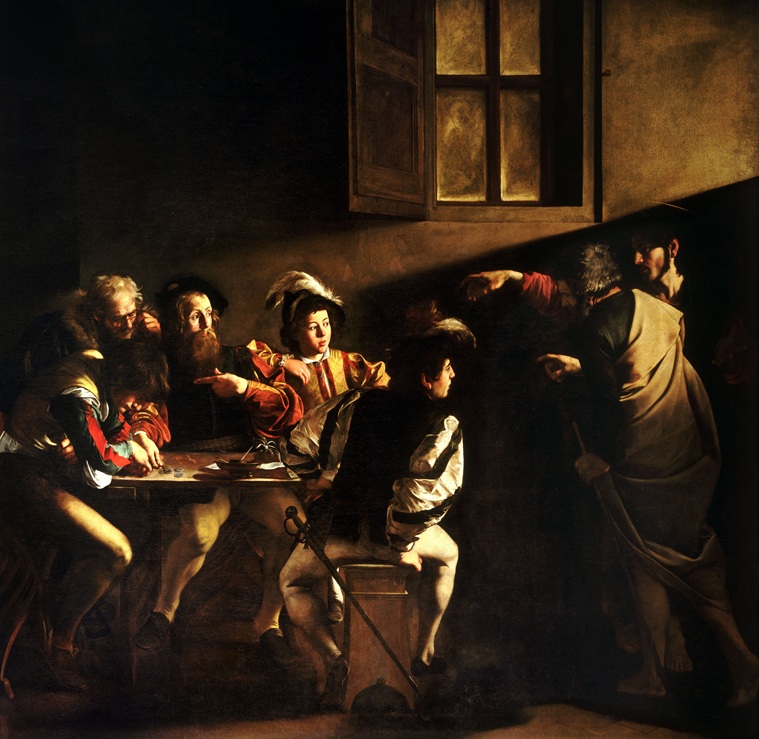 Source: Caravaggio, The Calling of Saint Matthew, Contarelli Chapel, San Luigi dei Francesi, Rome, 1599–1600. Public domain via Wikimedia Commons.
This painting captures the moment Christ points to Levi at the tax office, calling the compromised toll collector to rise into discipleship.
The Physician at Levi’s table (Mark 2:15-17)
15 Now it happened, as He was dining in Levi’s house, that many tax collectors and sinners also sat together with Jesus and His disciples; for there were many, and they followed Him. 16 And when the scribes and Pharisees saw Him eating with the tax collectors and sinners, they said to His disciples, “How is it that He eats and drinks with tax collectors and sinners?” 17 When Jesus heard it, He said to them, “Those who are well have no need of a physician, but those who are sick. I did not come to call the righteous, but sinners, to repentance.”
Levi’s response does not remain private. The man who rose now opens a table where others from the same discredited world can meet Jesus. Luke’s account also tells us that Levi gave a great feast in his own house (Luke 5:29).6
The most easily missed words in verse 15 come at the end: “they followed Him.” The guests are more than a collection of tolerated outsiders. Mark connects the table to discipleship. The NKJV’s “they followed Him” follows the Byzantine wording; other editions read “they were following Him.”7 Both connect the meal to a response to Christ. Christ’s mercy creates access to Him; that access becomes a call to walk with Him.
The scribes and Pharisees do not address Jesus directly. They ask His disciples why He eats and drinks with such people. Their concern should not be dismissed as uniquely Jewish fearfulness. The whole biblical tradition takes holiness and sin seriously, and Christians can reproduce the same posture whenever concern for purity becomes a reason to remain untouched by another person’s need. The question exposes a recurring temptation in religious life: to treat distance from wounded people as proof of nearness to God.
Jesus answers with the image of a physician. A doctor enters the presence of sickness for the sake of healing. Christ’s holiness is active and life-giving; He is not contaminated by drawing near. Chrysostom says that such nearness is “not only blameless, but excellent, and necessary,” because the Physician who refuses the sick abandons the work of medicine.3 The table is therefore neither compromise nor spectacle. It is the place where the sick have come within reach of the One who heals.
The metaphor concerns the sickness of sin. It must never be turned into a claim that bodily illness, mental illness, disability, or trauma proves personal guilt. Nor should Christ’s table mercy be used to pressure a victim into unsafe contact with an abuser. The Physician heals truthfully. His mercy does not conceal exploitation, deny danger, or remove wise boundaries.
The NKJV closes Jesus’ saying with “sinners, to repentance.” The Byzantine text includes “to repentance”; other editions end at “sinners.”8 Repentance is already visible in the story. Levi has already risen and followed, and the many at the table are described as following Jesus. Repentance here is not an entrance fee paid before the Physician will receive us. It is the new direction His mercy makes possible.
The word “righteous” also searches the heart. Jesus is not teaching that some people have no need of grace. He answers people who see sickness clearly in others while remaining confident of their own health. The most dangerous condition in the room is the one that does not seek the Physician. A person may sit near Scripture, fasting, and moral seriousness while guarding an accusation that prevents honest confession. Christ’s answer gives the critics an opening as well: admit the need, and the Physician is already near.
The Church lives from this same mercy. She is not a club for those who can hide their wounds convincingly. She is the community gathered around Christ, where sin is named, forgiveness is received, and lives are restored through repentance, prayer, sacramental confession, the Eucharist, wise pastoral care, and concrete repair. At Christ’s table, welcome and transformation are not enemies. Both come from the Physician.
The Church’s Voice in Worship
On Babah 12, the martyrdom of St. Matthew the Evangelist, Vespers reads Matthew 9:9-13, Matins Mark 2:13-17, and the Liturgy Luke 5:27-32.9 The Church hears the tax collector’s call three times on his own commemoration, once from each Synoptic Evangelist. The man once seated at the tax office is remembered as an apostle, and the Lord’s mercy is remembered as a call that truly changed his life. We honor the Evangelist by approaching the same Physician, not by pretending that we have no wounds.
Spiritual Fruit
-
Rise from the place where compromise has become normal. Levi is called while sitting at the toll office. Name the place where you have learned to remain seated: concealed dishonesty, a profitable injustice, resentment you keep rehearsing, a relationship maintained through manipulation, or a habit that dulls prayer. Bring it to confession and take one verifiable step of obedience. Christ’s mercy reaches you there, and His call gives you a road out.
-
Let mercy become invitation without making safety negotiable. Levi opens his house so people from his world can meet Christ. Consider whom shame, reputation, poverty, addiction, or unfamiliarity keeps at the edge of parish life. Offer a meal, a ride, a patient conversation, or help finding pastoral care. Welcome does not mean hiding sin or removing wise boundaries. The Physician’s nearness is truthful, healing, and protective of the vulnerable.
-
Leave the judge’s chair and approach the Physician. It is possible to recognize another person’s sickness while remaining blind to pride, self-defense, or contempt in oneself. When your first response is “How can they?” pause before repeating the accusation. Pray the Jesus Prayer for the person, then name your own wound plainly before Christ. Correct doctrine bears fruit when it leads to worship, humility, and mercy.
Teaching Notes
Trace the movement from Christ’s call to Levi’s rising, and from the opened table to the Physician’s answer. Welcome and repentance belong to one act of mercy.
Mark 2:13-14: called while sitting
- Observe the narrowing from the multitude to Levi. Jesus teaches all and sees one.
- Trace the verbs: Levi sits, Christ speaks, Levi rises, Levi follows.
- Clarify the history: telōnion is a toll or tax office, but Mark does not name Levi’s employer, levy, or personal acts of fraud.
- Discuss: What is the difference between Christ meeting someone in a compromised place and Christ approving that place?
- Connect to Mark 2:1-12: Christ’s authority to forgive now appears as authority to call and raise a publicly compromised person.
Mark 2:15-17: mercy that heals
- Keep the final words of verse 15 in view: “they followed Him.” The guests are being drawn into discipleship.
- Explain the physician image before applying it. Nearness to the sick belongs to medicine; Christ’s holiness heals rather than withdraws.
- Handle “to repentance” honestly. Preserve the NKJV wording, note the Greek textual variation if the class can use it, and ground repentance in the whole call-and-follow sequence.
- Guard against two errors: mercy as approval of exploitation, and repentance as a demand that the wounded make themselves acceptable before approaching Christ.
- State the pastoral boundary: this passage never requires unsafe contact with an abuser or the removal of prudent safeguarding.
Sources and Further Reading
Scripture is from NKJV.
Footnotes
-
Mark A. Chancey, “Capernaum,” Bible Odyssey, Society of Biblical Literature, 2017, https://www.bibleodyssey.org/articles/capernaum/. ↩
-
Greg Carey, “Tax Collectors and Sinners,” Bible Odyssey, Society of Biblical Literature, 2017, https://www.bibleodyssey.org/articles/tax-collectors-and-sinners/. ↩
-
Saint John Chrysostom, Homilies on the Gospel of Matthew, Homily XXX on Matthew 9:9-17, public-domain NPNF translation, https://www.ccel.org/ccel/schaff/npnf110.iii.XXX.html. ↩ ↩2 ↩3
-
Coptic Synaxarium, Babah 12, the martyrdom of St. Matthew, https://copticchurch.net/synaxarium. ↩
-
BibleHub interlinear and lexical entries for Mark 2:14 and telōnion, https://biblehub.com/interlinear/mark/2-14.htm and https://biblehub.com/greek/5058.htm. ↩
-
Comparative Greek texts for Mark 2:15 and Luke 5:29, https://biblehub.com/text/mark/2-15.htm and https://biblehub.com/text/luke/5-29.htm. ↩
-
Comparative Greek texts and interlinear for Mark 2:15, including critical-text ēkolouthoun and Byzantine/Greek Orthodox ēkolouthēsan, https://biblehub.com/text/mark/2-15.htm and https://biblehub.com/interlinear/mark/2-15.htm. ↩
-
Comparative Greek texts for Mark 2:17, showing the shorter critical form and the longer Byzantine, Greek Orthodox, and Textus Receptus form, https://biblehub.com/text/mark/2-17.htm. ↩
-
Coptic lectionary, Babah 12, complete day, 2026-10-22, https://copticchurch.net/readings?g_year=2026&g_month=10&g_day=22. ↩