
Series: Heirs of the Apostles
Meeting: English Adult Meeting
Date: July 25, 2026
Series placement: Final lesson
Format: Speaker-ready adult lesson, approximately 45 minutes
Main burden
The Desert Fathers did not go into the wilderness to invent a more advanced Christianity. They went there to stop negotiating with the Christianity they had already received. They heard Christ call the rich young ruler to surrender, watched the apostles hold their goods in common, heard St. Paul discipline his body, and saw Christ Himself enter the wilderness to confront the devil. Then they asked a dangerous question: What would happen if we treated these words as a life rather than as religious inspiration?
This is why the Desert Fathers belong at the end of Heirs of the Apostles. Earlier Fathers in this series defended who Christ is, confessed the Trinity, interpreted Scripture, preached repentance, and taught the Church to sing the faith. The desert receives all of that truth and asks whether it has entered the heart. The final test of apostolic doctrine is not whether we can repeat it accurately. It is whether, by grace, it produces a human being who prays, repents, refuses to judge, loves without possessing, and becomes free enough for Christ to live in him.
The desert is not only a location in Egypt. It is the place where our excuses lose their cover and the heart stands before God.
Opening hook: What remains when the noise is gone?
Imagine losing, for one hour, every place you normally hide.
No phone. No work problem to solve. No television. No argument to rehearse. No person to blame. No religious activity to perform for anyone else to see. Just you, a bare room, and the presence of God.
What would rise first?
Peace? Boredom? Anger? Fear? Lust? Regret? The desperate urge to check something? The need to prove that you are useful?
The Desert Fathers discovered that when the noise disappears, the heart does not automatically become quiet. At first, it becomes loud. The desert did not create their passions. It revealed them. Solitude removed the distractions that had kept those passions unnamed.
This is why a brother asked Abba Moses for a word and received an answer that still unsettles us:
“Go, sit in your cell, and your cell will teach you everything.”1
The cell teaches because it does not let us keep escaping ourselves. But the cell is not the Savior. It only exposes the patient. Christ is the Physician waiting there.
1. Why the desert belongs in a series about apostolic inheritance
The phrase Desert Fathers usually refers to the men and women who pursued radical Christian ascetic life in Egypt and neighboring regions, especially from the late third through the fifth centuries. Some lived as hermits. Some gathered in loose communities around an elder. Others lived in highly organized common life.
They did not all follow one model:
- Eremitic or anchoritic life: a solitary or largely solitary life, associated especially with St. Antony.
- Semi-eremitic life: individual cells gathered around an experienced spiritual father, seen in Nitria, Kellia, and Scetis.
- Cenobitic life: ordered common life under a rule and superior, associated especially with St. Pachomius.
- Female ascetic life: consecrated virgins and desert mothers such as Amma Syncletica, Amma Sarah, and Amma Theodora, sometimes in households or urban settings rather than a remote desert.
Their forms differed, but their source was the same Gospel.
The apostolic pattern
Acts describes the first Christian community as steadfast in “the apostles’ doctrine and fellowship, in the breaking of bread, and in prayers” (Acts 2:42). Believers shared their goods so that no one was abandoned. St. Paul speaks of celibacy as an undivided offering to the Lord, of unceasing prayer, of labor with one’s hands, and of disciplining the body without despising it.
Monasticism gathers these apostolic strands into a visible, stable vocation:
- common prayer,
- voluntary poverty,
- chastity for the Kingdom,
- obedience,
- work,
- hospitality,
- care for the poor,
- remembrance of death,
- watchfulness over thoughts,
- and the pursuit of continual communion with God.
The monk is not a Christian with a different Gospel. The monk is a baptized Christian living one particular form of total response to the same Gospel.
This matters for lay people. The Church does not ask everyone to become a monk, but she does ask everyone to die and rise with Christ in Baptism. Monastic vows dramatize demands already present in Christian life: freedom from possession, purity of heart, surrender of self-will, prayer, repentance, and love. The monk’s vocation is distinct, but the call to holiness is shared.
2. Historical setting: more than “persecution ended, so they fled”
A common summary says that when imperial persecution ended after Constantine, Christians who missed martyrdom went into the desert to seek a “white martyrdom.” There is a spiritual truth in the comparison between martyrdom and ascetic self-offering, but the history is more complicated.
Christian asceticism existed before Constantine. St. Athanasius says that when the young Antony began, ascetics already lived near Egyptian villages. Consecrated virgins, widows, celibates, fasting Christians, and local solitaries were not new. Antony himself began his discipline before the legalization of Christianity in 313.
The great fourth-century expansion of Egyptian monasticism arose from several forces at once:
- The direct pressure of the Gospel. Men and women heard Christ’s commands and wanted an undivided response.
- An already existing ascetic tradition. Prayer, fasting, celibacy, almsgiving, and withdrawal were present in Christian communities before the famous desert settlements.
- The search for undistracted prayer. The desert offered distance from social obligation, wealth, status, and the constant claims of village life.
- Resistance to spiritual compromise. As Christianity became socially acceptable, the danger was no longer only persecution. It was comfortable Christianity shaped by power, prestige, and convention.
- Egypt’s geography. Fertile settlements along the Nile stood close to vast desert regions. Withdrawal could be radical without being entirely cut off from the Church and society.
- The attraction of holy elders. Once figures such as Antony, Amoun, Macarius, and Pachomius became known, seekers gathered around them. Solitude generated communities.
So the monks were not simply running away from a corrupt Church or a hostile world. They remained part of the Church, received the mysteries, submitted to bishops and priests in differing ways, welcomed visitors, reconciled disputes, fed the poor, and gave counsel to lay people. St. Athanasius and St. Antony were not rivals. The bishop wrote the monk’s life, and the monk strengthened the bishop’s confession.
Athanasius defended the Incarnation in words. Antony demonstrated what a human life can become when Christ renews it.
3. Christ entered the desert first
“Then Jesus was led up by the Spirit into the wilderness to be tempted by the devil.” (Matthew 4:1)
Christian monasticism does not begin with contempt for creation. It begins with Christ.
The Lord enters the wilderness after His Baptism. Israel had passed through the sea and then failed in the wilderness. Christ passes through the Jordan and enters the wilderness as the faithful Son. Where Israel complained about bread, tested God, and turned toward idolatry, Christ answers every temptation with Scripture and remains obedient to the Father.
The monks understood their desert in this light. The wilderness is:
- a place of sonship, where identity is received from the Father rather than from appetite or approval;
- a place of warfare, where the devil’s suggestions are exposed;
- a place of Scripture, where Christ answers temptation with the Word of God;
- a place of dependence, where man cannot pretend to sustain himself;
- a place of communion, because the Son is never abandoned by the Father or separated from the Spirit.
This is the Christological safeguard against turning asceticism into self-improvement. The goal is not to prove that the will is strong. The goal is to share in Christ’s victory.
St. Athanasius says this explicitly while describing Antony’s struggle: the victory was the Savior’s work in Antony. Antony fought, prayed, fasted, remembered Scripture, and refused consent. Yet grace was not a reward added after the struggle. Grace was the power within it.
This is Orthodox synergy. We do not wait passively for God to change us while protecting every habit. We also do not save ourselves by force. We struggle because grace is present, and grace makes real struggle possible.
4. St. Antony: hearing Scripture as a personal summons
St. Antony the Great was born in Egypt around 251 and died in 356. He is rightly called the Father of Monks, not because no ascetic existed before him, but because his life gave the solitary vocation a form and visibility that transformed the Christian world.
After the death of his parents, Antony entered church while thinking about how the apostles had left everything to follow Christ. Then he heard the Gospel:
“If you want to be perfect, go, sell what you have and give to the poor, and you will have treasure in heaven; and come, follow Me.” (Matthew 19:21)
St. Athanasius writes that Antony received the passage as though it had been read specifically for him. He did not leave church saying, “That was a strong reading.” He reordered his life.
He provided responsibly for his younger sister, gave away his property, distributed his goods, learned from older ascetics, worked with his hands, gave to the needy, memorized Scripture, and gradually withdrew more deeply into solitude. Athanasius says that Antony listened so carefully that nothing written “fell from him to the ground,” and his memory served him in place of books.2
Notice the pattern:
- The call came inside the church through the public reading of Scripture.
- Antony responded with concrete mercy, not merely private austerity.
- He learned from existing elders rather than inventing his own spirituality.
- He combined work, prayer, Scripture, generosity, and discipline.
- His solitude eventually became service to many.
After nearly twenty years in greater seclusion, people broke open the entrance to the abandoned fort where he had lived. Athanasius describes Antony emerging neither emotionally shattered nor physically self-indulgent. He was steady, peaceful, able to console the grieving, reconcile enemies, and direct people toward the love of Christ.3
That is the fruit by which the desert must be judged. If solitude makes me less patient, fasting makes me cruel, silence makes me self-absorbed, or doctrine makes me contemptuous, something has gone wrong. Authentic asceticism produces a person more available to love.
5. The real battlefield: thoughts before actions
The Greek word logismoi refers to thoughts, suggestions, or inner reasonings that seek entry into the heart. The Desert Fathers became careful observers of the process by which a thought becomes a passion and a passion becomes a way of life.
The initial thought is not yet the same as consent. A temptation may appear without our choosing it. The spiritual battle concerns what happens next:
- Suggestion: an image, memory, fear, fantasy, resentment, or desire appears.
- Conversation: we begin to entertain it, argue with it, or enjoy it.
- Consent: the will accepts the thought.
- Captivity: repetition weakens freedom.
- Passion: the pattern becomes established and begins to rule the person.
This is why the Fathers emphasized nepsis, watchfulness or sobriety. They wanted to meet temptation near the door, before it became a resident of the heart.
Modern life makes this harder because our thoughts are constantly fed from outside. Algorithms do not merely show us information. They learn which anger, fear, envy, vanity, appetite, and curiosity will keep us engaged. The phone in our hand can become a machine for turning suggestions into habits.
The desert question is not only, “Did I commit the visible sin?” It is, “What have I been rehearsing? Which thoughts do I welcome? Which imagined arguments do I replay? What appetite am I training?”
St. Antony said he saw the enemy’s snares spread across the world and asked what could pass through them. The answer was one word: “Humility.”4
Humility does not mean low self-esteem. It means living in truth before God. The humble person does not need every thought to flatter him, every argument to vindicate him, or every room to recognize him. The devil can pull many handles in us, but humility keeps removing the handles.
6. Asceticism is medicine, not hatred of the body
“I discipline my body and bring it into subjection.” (1 Corinthians 9:27)
The Fathers fasted, kept vigil, practiced silence, limited possessions, and accepted demanding disciplines. Some ancient stories describe severe practices that should not be copied without context, guidance, and discernment.
Orthodox asceticism does not teach that the body is evil. That would contradict creation, the Incarnation, the Resurrection, and the sacraments. The Son of God took a real body. He healed bodies, fed bodies, suffered in the body, rose bodily, and gives us His Body and Blood.
The body is not the enemy. Disordered desire is the illness. The body participates in both the illness and the healing.
Fasting teaches the appetite that hunger is not lord. Prostrations teach the body to pray. Vigil interrupts spiritual laziness. Chastity gathers desire toward faithful love. Simplicity weakens the fantasy that possessions can secure the soul. Silence restrains the tongue so the heart can become truthful.
But discipline without discernment can become pride, harm, or performance. One saying of St. Antony warns that some afflict their bodies through ascetic practices but remain far from God because they lack discernment.5
This is a crucial pastoral guardrail. The desert tradition is not permission for self-designed extremes. For lay people especially, ascetic practice belongs within the Church’s fasting life, sacramental life, family duties, health realities, and spiritual guidance. A parent who neglects a child in order to complete a private prayer rule has misunderstood prayer. A person who becomes irritable and condemning while fasting has kept the menu and lost the commandment.
The test is not, “How much discomfort did I tolerate?” The test is, “Did this make room for love, prayer, freedom, and obedience?”
7. The cell: staying where God has placed you
Abba Moses’s counsel, “Sit in your cell,” is easy to romanticize. The cell was physically small, repetitive, and often uncomfortable. It confronted restlessness.
We often imagine that holiness is waiting somewhere else:
- in a quieter house,
- in a better parish,
- after the children are older,
- after retirement,
- in a monastery,
- after this work season ends,
- with a different spouse,
- under a better leader,
- or once our emotional life becomes easier.
The cell says: begin here.
The cell is the marriage you are actually in, the family you have been given, the body you inhabit, the parish where you worship, the responsibilities you cannot abandon, and the present hour in which Christ is asking for faithfulness.
This does not mean remaining in abuse, danger, or destructive circumstances. Nor does it mean refusing legitimate change. It means we stop using imagined futures to avoid present repentance.
Amma Syncletica gives the needed balance. She says that some live in the mountains while behaving as if they were in the city, while another person may possess interior solitude in the middle of a crowd.6 Geography helps, but geography cannot repent for us.
A lay person’s cell may be ten phone-free minutes in the same chair every morning. It may be the car before entering the house after work. It may be standing quietly before an icon after everyone is asleep. The physical place matters because bodies need habits. But the purpose is not to create a spiritual mood. It is to remain before God long enough to stop performing.
8. St. Moses the Black: the desert as repentance and mercy
St. Moses the Black is one of the clearest witnesses that the desert was not a refuge for people who had always been respectable. The tradition remembers him as a former robber who became a monk, priest, elder, and finally a martyr at Scetis.
His past did not disqualify him from holiness. It became the place where grace showed its power.
One of the best-known stories tells of a brother who had sinned. The elders summoned Moses to judge the case. He arrived carrying a leaking container of water. When asked what he was doing, he answered that his own sins were running out behind him where he could not see them, yet he had come to judge another. The elders forgave the brother.7
This is not moral indifference. Moses did not say sin was harmless. He exposed the spiritual absurdity of correcting another without self-knowledge.
The desert’s severity was first directed inward. The Fathers could speak firmly because they had stopped pretending that sin belonged mainly to other people. Today we often reverse the order. We are gentle with our own motives and merciless with another person’s visible failure.
Before criticizing your spouse, child, priest, coworker, political opponent, or fellow servant, carry Moses’s leaking vessel in your mind. Ask:
- What am I not seeing behind me?
- Am I seeking this person’s healing or my vindication?
- Have I prayed for him by name?
- Would I say this with the same tone if Christ were visibly seated beside us?
The person who sees his own need for mercy becomes capable of offering mercy without calling evil good.
9. St. Macarius: the proof of prayer is a widened heart
St. Macarius the Great became a father of Scetis, the Wilderness of Sheheet in today’s Wadi El Natrun. The sayings portray him as discerning, humble, patient, and deeply compassionate.
In one story, Macarius meets a struggling brother who is ashamed to admit his temptations. Macarius does not crush him. He lowers himself and speaks as though he shares the struggle, making it safe for the brother to tell the truth. Then he gives practical counsel: fast with greater attention, meditate on the Gospel, refuse to stare at the alien thought, and look toward God for help.
This is spiritual fatherhood. It does not show off the elder’s purity. It makes repentance possible for the weak.
Another saying imagines the devil admitting that he can imitate fasting and sleeplessness, but he cannot defeat Macarius because of one thing: “Your humility.”8
The point is not that fasting and vigil are useless. It is that external achievements alone do not distinguish a saint from a demon. The devil does not eat, does not sleep, and knows facts about God. What he cannot bear is humble love.
A church can have correct doctrine, long services, precise rites, skilled hymns, and disciplined fasting, yet still wound people through pride. The Desert Fathers do not permit us to choose between truth and humility. Apostolic truth should produce apostolic character.
10. The desert produced community, not isolation
The image of a lone monk in an empty landscape is real but incomplete. The desert quickly filled with relationships:
- elders and disciples,
- brothers working and praying together,
- visitors seeking counsel,
- pilgrims receiving hospitality,
- communities distributing food,
- monks reconciling one another,
- bishops corresponding with ascetics,
- and ordinary Christians asking for a saving word.
Even hermits were not autonomous spiritual consumers. Antony learned from others before becoming an elder. Macarius visited Antony. Monks received correction. The sayings themselves are communal memory: one generation preserving what it received from another.
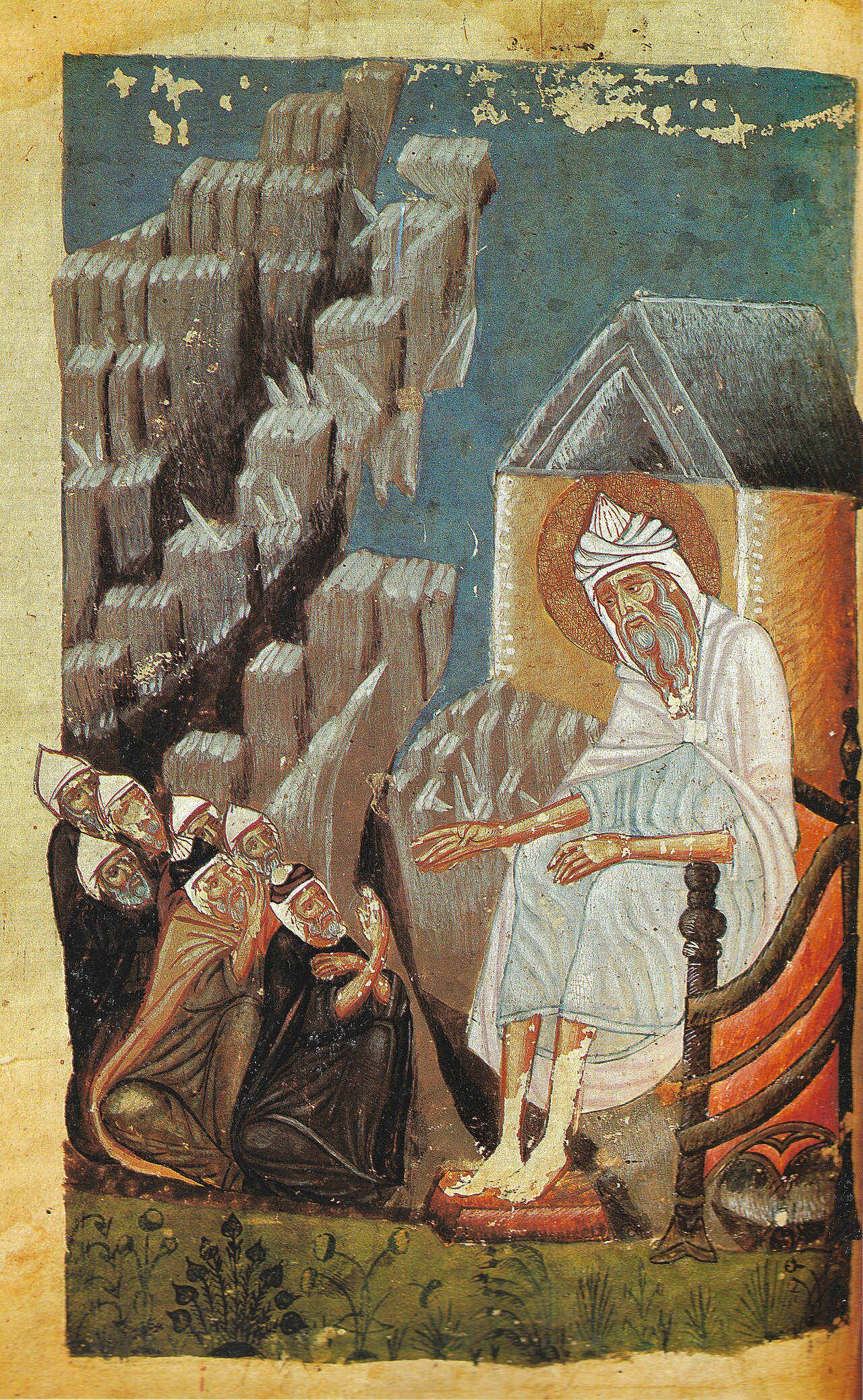 Source: Tadeos Awramenc, Teaching Scene of the Desert Fathers, 1430, public domain, via Wikimedia Commons.
This fifteenth-century Armenian Apostolic manuscript illumination is not a documentary picture of fourth-century Egypt. It is a later iconographic teaching scene. A haloed elder sits before a simple shelter while a group of monks gathers closely at his feet. The rocky landscape dominates the scene. No luxury separates teacher from disciples. The elder’s open hand suggests instruction offered as relationship, not information delivered from a platform. The attentive cluster of monks makes visible the meaning of abba: not a celebrity, but a spiritual father whose word is received within obedience and shared life.
The visual also protects us from a false idea of solitude. The elder has gone into the wilderness, yet his purified solitude has become hospitality. He is alone with God enough to become present to people.
11. Old Testament roots: wilderness, manna, and the undivided heart
The desert is not an invention of fourth-century Egypt. It runs through Scripture.
Moses and Israel
God brings Israel out of Egypt and into the wilderness. There the people discover both God’s provision and their own divided hearts. They receive manna daily, not as stored security. They learn that man does not live by bread alone. The wilderness is where slaves are slowly taught to live as God’s people.
Elijah
Elijah enters the wilderness exhausted and afraid. God feeds him, lets him rest, and leads him to Horeb. The prophet encounters God not in wind, earthquake, or fire, but in the quiet divine presence. The desert is not only combat. It is also healing.
St. John the Baptist
John appears in the wilderness clothed simply, fasting, praying, and preparing the way of the Lord. His whole life becomes a voice: “Repent, for the kingdom of heaven is at hand.” He stands at the threshold between Israel’s wilderness hope and Christ’s arrival.
Christ
Christ fulfills every wilderness pattern. He is the true Israel, the new Moses, the One greater than Elijah, and the Lord whose way John prepares. He is also the true Bread from heaven. The monk does not go into the desert to find a God absent from the Church. He goes to be stripped of false bread so that Christ may become his life.
12. Liturgical, sacramental, and ecclesial meaning
The monastic life is not a private spirituality added beside the Church.
St. Antony’s decisive call came while Scripture was read in church. His response began with almsgiving and responsible care for his sister. The early monks prayed the Psalms, received the Eucharist, sought counsel, and remained bound to the Body of Christ even when they lived far from cities.
Monasticism makes several sacramental truths visible:
- Baptism: the old man is put to death and a new life begins in Christ.
- Repentance and confession: thoughts are brought into light before they harden into bondage.
- Eucharist: Christ, not human endurance, is the life of the Christian.
- The communion of saints: no one becomes holy alone. We receive a life handed down through the Church.
- The age to come: celibacy and simplicity witness that marriage, possessions, and earthly security are good gifts but not the final Kingdom.
The Coptic Church does not remember the desert as a foreign chapter of ancient history. Egypt’s monasteries remain living places of prayer. The names Antony, Macarius, Pachomius, Bishoy, Moses, Shenoute, Sarah, Syncletica, and many others belong to the Church’s memory. The current Coptic tradition commemorates St. Antony on 22 Tobi and identifies St. Paul the Hermit on 2 Meshir.9
But Coptic pride can become spiritually useless if it stops at heritage. It is possible to boast that Egypt gave monasticism to the world while refusing five quiet minutes with God. The right response to this inheritance is gratitude expressed as repentance.
13. Words from the desert that stop the room
The sayings of the Desert Fathers are short because they were not written to decorate a wall. They were words given to expose a heart, interrupt an excuse, or call a person to repentance. The stories can sound severe, even impossible. Read them in the order below. Macarius creates the astonishment; Antony and Syncletica tell us how to judge it; Moses shows the mercy it must produce.
St. Macarius of Alexandria: “If ever he heard of any feat, he did the same thing”
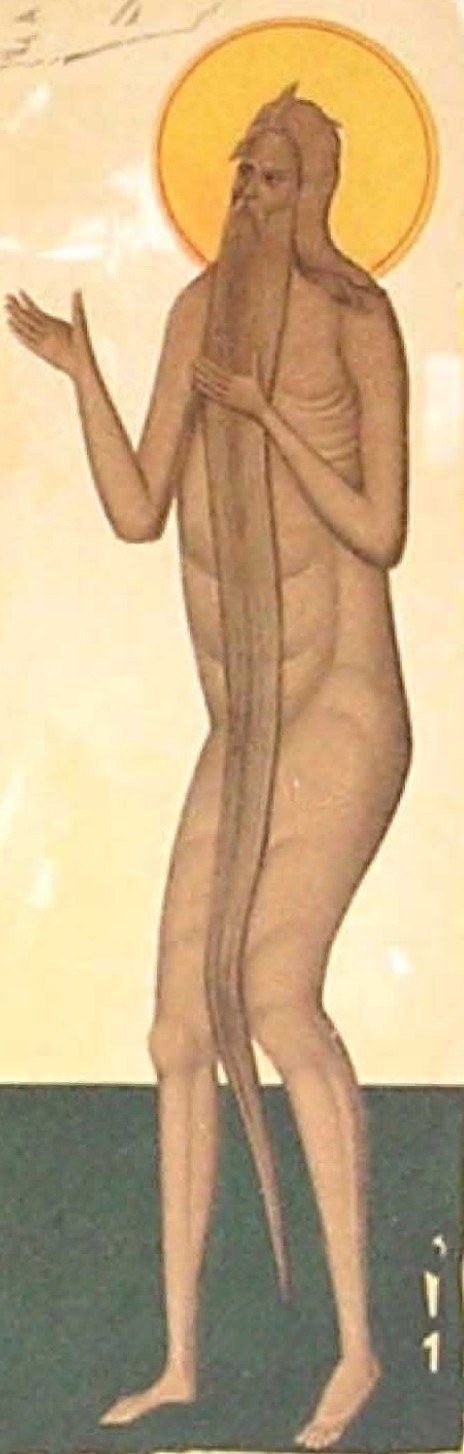 St. Macarius the Younger, identified with St. Macarius of Alexandria; detail from a nineteenth-century Russian Orthodox icon. Public domain via Wikimedia Commons.
First, keep the identities straight. This is St. Macarius of Alexandria, the Alexandrian priest of Cellia whom Palladius knew personally. He is not St. Macarius the Great of Scetis, discussed earlier in this lesson. The two saints are often collapsed into one online, but Palladius treats them separately.
Palladius summarizes the Alexandrian Macarius in one breathtaking sentence:
“This then was the method of his asceticism. If ever he heard of any feat, he did the same thing, perfectly.”10
Then he gives the evidence. When Macarius heard that the monks of Tabennisi ate no cooked food during Lent, he ate nothing cooked by fire for seven years. When he heard of a monk living on one pound of bread, he placed broken bread in a narrow-mouthed vessel so that he could eat only what his hand could withdraw; for three years, Palladius says, he lived on four or five ounces of bread a day, limited water, and a pint of oil in a year. He once remained without shelter for twenty days, scorched by day and frozen at night, trying to conquer sleep. He stopped when he recognized that continuing would drive him into delirium. After killing a mosquito that bit him, he condemned himself to sit exposed for six months in a marsh where the insects bit him until the monks recognized him only by his voice.
Most astonishingly, he traveled in disguise to St. Pachomius’s monastery. During Lent, while seasoned monks followed demanding rules, Macarius stood weaving palm leaves and praying. Palladius says that for the forty days he took no bread or water and only a few cabbage leaves on Sundays. The monks finally protested to Pachomius that this “fleshless man” was condemning them all. When God disclosed the stranger’s identity, Pachomius took him to the altar and said:
“Here, good old man, you are Macarius and you hid it from me.… I thank you for letting my children feel your fist, lest they should be proud of their ascetic achievements.… You have edified us sufficiently. And pray for us.”10
Why preserve stories this extreme? Not to turn the congregation into amateur desert athletes. Palladius also preserves Macarius admitting defeat before bodily limits and the danger of delirium. What should astonish us is his almost frightening refusal of complacency. If he saw a virtue, he wanted it. If he discovered an excuse in himself, he attacked it. We imitate that hunger for holiness, not his regimen. No one should imitate prolonged fasting, dehydration, exposure, or sleep deprivation. Ascetic practice belongs under the Church’s fasting rule, accountable spiritual direction, medical prudence, and the duties of one’s vocation.
St. Antony the Great: effort without discernment can move us away from God
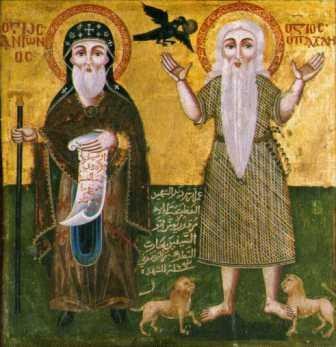 St. Antony the Great with St. Paul the Hermit, fourteenth-century Coptic icon. Public domain via Wikimedia Commons.
After hearing Macarius’s feats, listen to Antony:
“Some have afflicted their bodies by asceticism, but they lack discernment, and so they are far from God.”5
That sentence is audacious because it refuses to be impressed by pain. A severe practice can coexist with pride, delusion, irresponsibility, or distance from God. Discomfort is not proof of holiness.
The often-repeated claim that Antony called discernment “the mother of all virtues” needs precise attribution. In St. John Cassian’s Second Conference of Abba Moses, the elders gather around Antony and compare fasting, vigils, poverty, solitude, and charity. They conclude that great ascetics had fallen because discernment was missing. Cassian then summarizes the judgment associated with Antony and the elders:
“Discretion is the mother of all virtues, as well as their guardian and regulator.”11
Discernment is not a timid substitute for zeal. It is what keeps zeal on the royal road. It asks: Is this practice drawing me toward Christ? Is it producing humility, obedience, mercy, and steadiness? Does it fit my health, vocation, and responsibilities? Have I submitted it to experienced spiritual guidance, or am I appointing myself as my own elder?
Amma Syncletica: even asceticism can become demonic tyranny
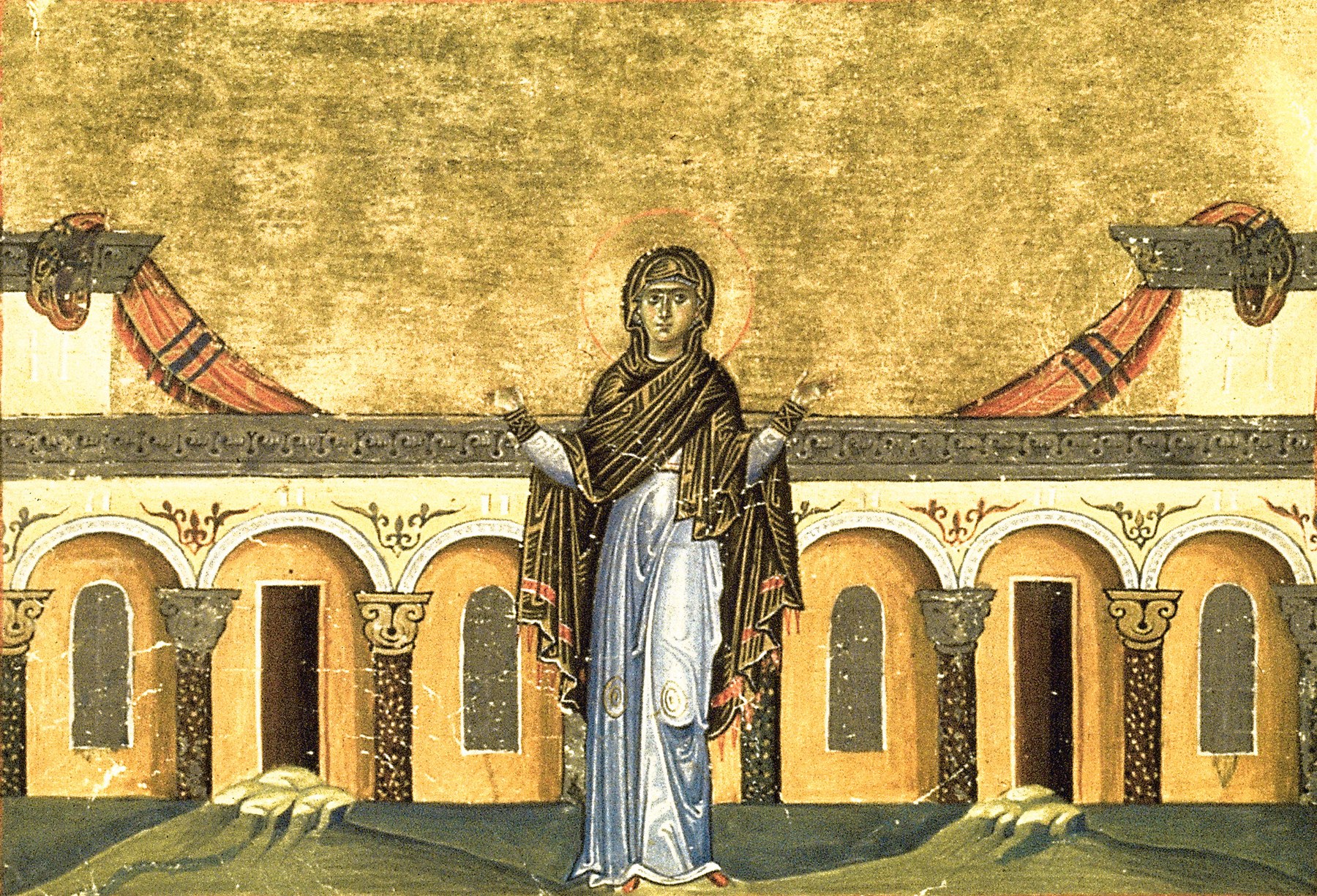 Amma Syncletica of Alexandria, miniature from the Byzantine Menologion of Basil II, c. 985. Public domain via Wikimedia Commons.
Amma Syncletica makes Antony’s warning even sharper:
“There is an asceticism which is determined by the enemy and his disciples practice it.… How are we to distinguish between the divine and royal asceticism and the demonic tyranny? Clearly through its quality of balance.… In truth lack of proportion always corrupts.”12
Those words demolish the idea that whatever hurts most must be holiest. The enemy can exploit religious ambition. He can make a person proud of fasting, addicted to extremes, harsh toward the weak, and careless toward health or family while the person imagines that all of it is devotion.
“Balance” does not mean comfort, compromise, or the absence of sacrifice. It means proportion: a stable rule rather than dramatic swings, obedience rather than self-invention, perseverance rather than spiritual excitement, and love rather than self-punishment. The royal asceticism is demanding, but it remains human because Christ is healing the human person, not erasing him.
St. Moses the Black: carry your own sins into every judgment
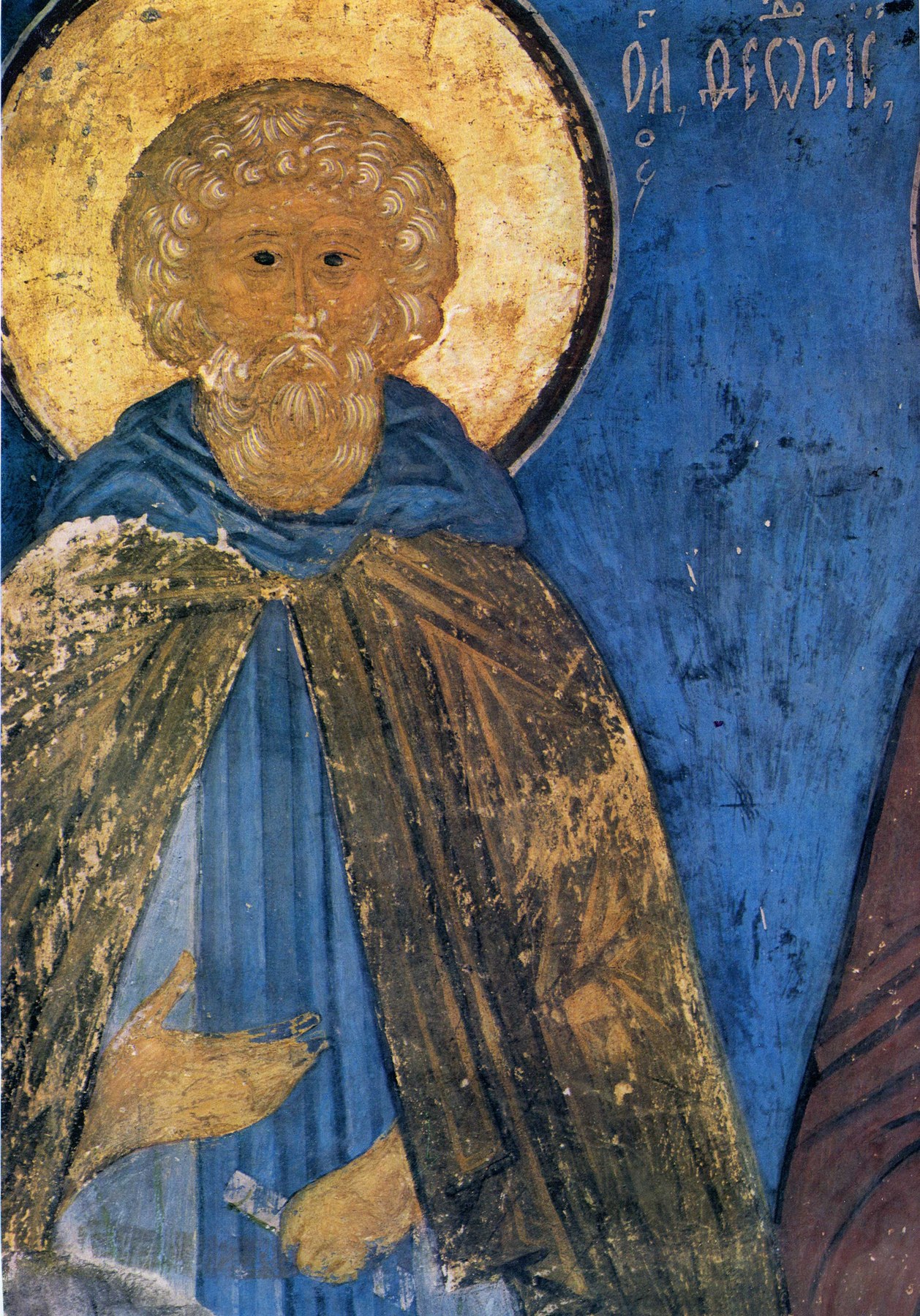 St. Moses the Ethiopian, fresco in the Dormition Cathedral of the Moscow Kremlin, 1479–1481. Public domain via Wikimedia Commons.
A brother at Scetis sinned, and the elders called a council. Moses refused to come. When they insisted, he filled a leaking jug with water and carried it to the gathering. Asked what it meant, he said:
“My sins run out behind me, and I do not see them, and today I am coming to judge the errors of another.”7
The council fell silent and forgave the brother.
The primary collection speaks of a leaking jug filled with water, not the popular basket of sand. The object matters less than the truth made visible: Moses could not approach another person’s fall as though he were standing outside the need for mercy.
He did not say sin was imaginary or correction unnecessary. He exposed condemnation. Christian correction seeks restoration with tears; condemnation enjoys distance, superiority, and public shame. The desert’s harshest judgment was aimed first at the self. Its mature fruit was mercy.
Put the four witnesses together:
- Macarius: desire holiness enough to refuse complacency.
- Antony: never mistake suffering or effort for holiness by itself.
- Syncletica: test every discipline by balance, obedience, and its fruit.
- Moses: if asceticism does not make you merciful, it has not made you like Christ.
14. What the Desert Fathers expose in modern adult life
We are overstimulated but under-attentive
We consume more words than any generation before us, yet struggle to remain with one Psalm. The Fathers memorized Scripture because they needed it in battle. We often collect content about prayer instead of praying.
We confuse urgency with importance
The desert interrupts the demand that every message deserves immediate access to us. Many things are urgent only because someone else wants our attention. Very few things are more important than guarding the heart.
We want transformation without renunciation
We ask God for peace while protecting the habits that keep us agitated. We ask for purity while feeding fantasy. We ask for humility while curating an image. We ask for prayer while refusing silence.
The desert says that every real yes includes a no.
We judge publicly and repent vaguely
Abba Moses carried his unseen sins behind him. We do the opposite: we carry another person’s sins in front of us and keep our own behind the camera.
We mistake self-care for healing
Rest, therapy, medicine, friendship, and healthy boundaries can be genuine gifts. But none can replace repentance. The soul is not healed only by feeling safer or more comfortable. Sometimes healing requires confession, forgiveness, fasting, truth, and the surrender of a cherished resentment.
We spiritualize escape
Some people romanticize monasteries because ordinary obedience feels small. The Fathers would send us back to the commandment in front of us. Your path to holiness may begin with apologizing to your spouse, keeping your word, putting the phone down, arriving at liturgy on time, refusing gossip, or praying when no feeling comes.
15. A seven-day desert rule for people who live in the world
Do not copy an ancient monk’s fasting or vigil. Practice the principle in a form faithful to your vocation and health.
1. Keep one small cell
Choose one place and one daily time. Sit there for ten minutes with no phone. Begin with the Trisagion, pray one Psalm or a short Agpeya section, and remain quietly before Christ.
2. Name one recurring thought
Write one sentence: “The thought that most often captures me is…” Do not analyze ten passions. Bring one pattern into confession and prayer.
3. Practice one hidden renunciation
Give up one unnecessary comfort for seven days: a snack, purchase, entertainment habit, complaint, or repeated check of an app. Tell almost no one. Let the hunger remind you to pray.
4. Carry Abba Moses’s vessel
Before judging anyone, name one fault of your own before God. Then pray once for the person you were about to condemn.
5. Memorize one weapon from Scripture
Choose one verse that answers your recurring temptation. Repeat it when the thought appears. Christ answered the tempter with Scripture, not with negotiation.
6. Perform one act of mercy that costs something
Give time, attention, money, patience, or forgiveness where it is genuinely inconvenient. Asceticism that does not widen love has missed its purpose.
7. End the day with three questions
- Where did I notice God’s grace today?
- Which thought did I entertain too long?
- Whom do I need to forgive or ask to forgive me?
Then pray: “Lord Jesus Christ, Son of God, have mercy on me, a sinner.”
16. Personal spiritual contemplation: enter the inner desert
Close your eyes for a moment and imagine the desert at night.
The heat has left the ground. The sky is wider than anything you can control. There is no audience. No one is impressed that you came. No one is watching your prayer. You cannot hide behind usefulness, intelligence, service, pain, or reputation.
Christ asks only: “Will you remain with Me?”
What would you try to carry into that silence?
Which resentment? Which fear? Which appetite? Which version of yourself are you still trying to protect?
Do not promise God a heroic life. Give Him the next honest thing.
“Lord, this is the thought that rules me.”
“Lord, this is the person I refuse to forgive.”
“Lord, this is the comfort I cannot imagine surrendering.”
“Lord, this is the silence I keep escaping.”
The desert is not empty. Christ is there before you.
17. Conclusion: the Fathers’ final question to us
We began this series with apostolic inheritance: the faith received, defended, explained, preached, sung, and handed down. We end in the desert because the Desert Fathers force the final question.
What has the inheritance produced in us?
Can I confess the Incarnation with St. Athanasius but refuse to let Christ enter my habits? Can I defend the Trinity with the Cappadocians while living in division? Can I call Mary Theotokos with St. Cyril while keeping Christ at the edge of my life? Can I admire Chrysostom’s preaching while ignoring the poor? Can I sing theology with Ephrem while my heart remains noisy and unrepentant?
The desert does not reject doctrine. It proves how much doctrine matters. If Christ is truly God made man, if He has conquered death, if the Spirit truly dwells in us, if the Eucharist is truly communion with His life, then ordinary bondage is not our only possible future.
The Fathers were heirs of the Apostles because they received the apostolic faith whole: words, worship, repentance, suffering, mercy, and life. They did not become holy by escaping humanity. In Christ, they became deeply human.
The series ends here, but the real lesson begins when the room becomes quiet.
Discussion Questions
- When external noise disappears, which inner noise tends to become loudest in you?
- Antony heard one Gospel passage and allowed it to reorder his life. Which command of Christ do you understand but keep renegotiating?
- How do we distinguish healthy ascetic discipline from pride, self-punishment, or neglect of our responsibilities?
- Abba Moses could not judge another without remembering his own unseen sins. What would change in your family, service, or workplace if you practiced that this week?
- What is one realistic “cell” you can keep in the middle of your present life?
Optional closing prayer
Lord Jesus Christ, who entered the wilderness and conquered the tempter, lead us into the truth of our own hearts without allowing us to despair. Strip away the noise by which we avoid You. Teach us the repentance of Antony, the humility of Macarius, the mercy of Moses, the watchfulness of Syncletica, and the courage of all the fathers and mothers of the desert. Give us discipline without pride, silence without coldness, fasting without judgment, and prayer that becomes love. Make our homes, our work, our service, and our hidden thoughts places where Your Gospel becomes a life. Through the prayers of St. Mary, St. Mark, and all the saints of the Egyptian desert, have mercy on us and save us. Amen.
Teaching Guide
Opening and main burden, 5 minutes
- Ask: “What rises in you when the noise is gone?” Let two or three people answer briefly.
- Emphasize: The desert reveals the heart; it does not automatically purify it.
- Say slowly: “The Desert Fathers went into the wilderness to stop negotiating with the Christianity they had already received.”
- Connect: This is the series finale because apostolic doctrine must become apostolic character.
- Watch for: Do not suggest monks are the only serious Christians. Their vocation is distinct, but Baptism calls every Christian to holiness.
History and apostolic roots, 7 minutes
- Emphasize: Egyptian monasticism had several forms: solitary, semi-eremitic, cenobitic, and female ascetic life.
- Watch for: Avoid the simplistic claim that monasticism began only after persecution ended. Antony began before 313, and earlier Christian ascetics already existed.
- Connect: Acts 2:42-47 gives the apostolic grammar of prayer, fellowship, Eucharist, and shared goods.
- Compress if needed: List the forms of monastic life without giving a long chronology.
Christ in the wilderness and Antony, 9 minutes
- Read: Matthew 4:1 and Matthew 19:21.
- Emphasize: Christ’s desert victory is the foundation. Asceticism is participation in His grace, not self-salvation.
- Say slowly: “Antony did not leave church inspired. He left church obedient.”
- Watch for: Antony is “Father of Monks,” not necessarily the first Christian solitary.
- Connect: Antony’s solitude produced consolation, reconciliation, and love. That is the test of authentic asceticism.
Thoughts, the body, and discernment, 8 minutes
- Explain: Suggestion, conversation, consent, captivity, passion.
- Ask: “What thought do you repeatedly rehearse until it begins to feel like truth?”
- Emphasize: The body is not evil. Asceticism is medicine for disordered desire.
- Watch for: Strongly discourage copying extreme ancient disciplines without church guidance, especially where health or family duty is involved.
- Connect: The Incarnation and Resurrection protect Orthodox asceticism from hatred of the body.
Sayings that stop the room, 10 minutes
- Tell in this order: Macarius of Alexandria, Antony, Syncletica, then Moses.
- Show: Each saint’s icon while reading the saying or story slowly.
- Clarify: Macarius of Alexandria is not Macarius the Great of Scetis. Palladius knew both and treats them separately.
- Let the “wow” land: Seven years without cooked food; three years with bread measured by a narrow-mouthed vessel; twenty days without shelter; six months exposed in the marsh; and his disguised Lent at Pachomius’s monastery.
- Immediately add the guardrail: Macarius’s feats are not a lay fasting plan. Palladius records him reaching dangerous limits; Antony and Syncletica make discernment and proportion non-negotiable.
- Tell: Moses’s leaking-jug story last. Let the room become quiet before explaining it.
- Say slowly: “External achievements do not distinguish a saint from a demon. Humble love does.”
- Connect: The sequence moves from zeal, to discernment, to balance, to mercy.
Icon and community, 3 minutes
- Show: Teaching Scene of the Desert Fathers by Tadeos Awramenc, 1430, embedded above.
- Ask: “What do you notice about the relationship between the elder, the listeners, the shelter, and the landscape?”
- Emphasize: This is a later Armenian Apostolic teaching scene, not a documentary image of fourth-century Egypt.
- Connect: Purified solitude becomes spiritual hospitality. The elder withdraws from noise but not from love.
Practical rule and close, 6 minutes
- Choose: Invite each person to select only one practice from the seven-day desert rule.
- Do not: Turn the rule into a public accountability performance.
- Return to the burden: “What has the apostolic inheritance produced in us?”
- End: Use the personal contemplation or the optional prayer.
Glossary
- Abba / Amma: Aramaic and Greek forms meaning father / mother, used for experienced spiritual elders.
- Anchorite / eremite: A Christian who pursues a largely solitary ascetic life.
- Asceticism: Spiritual training through prayer, fasting, self-denial, watchfulness, and obedience. From the Greek askēsis, meaning training or exercise.
- Cenobitic monasticism: Monastic life in an organized community under a common rule and superior.
- Logismoi: Thoughts or inner suggestions that may become temptations when entertained and accepted.
- Nepsis: Spiritual watchfulness or sobriety, especially attention to thoughts before they gain control.
- Scetis / Sheheet: The ancient monastic region in today’s Wadi El Natrun, closely associated with St. Macarius and many Desert Fathers.
- Synergy: Human cooperation with divine grace. Grace initiates and empowers; the person responds freely and actively.
- Theosis: Participation by grace in the life of God, the healing and transformation of the human person in Christ.
Egyptian monasteries: the desert still lives
These photographs are not the ruins of a vanished movement. They show living Coptic Orthodox monasteries shaped by the same Egyptian desert that formed Antony, Macarius, Moses, and generations after them. The buildings have been restored and expanded across the centuries, but prayer still inhabits the landscape.
Monastery of St. Antony, Eastern Desert
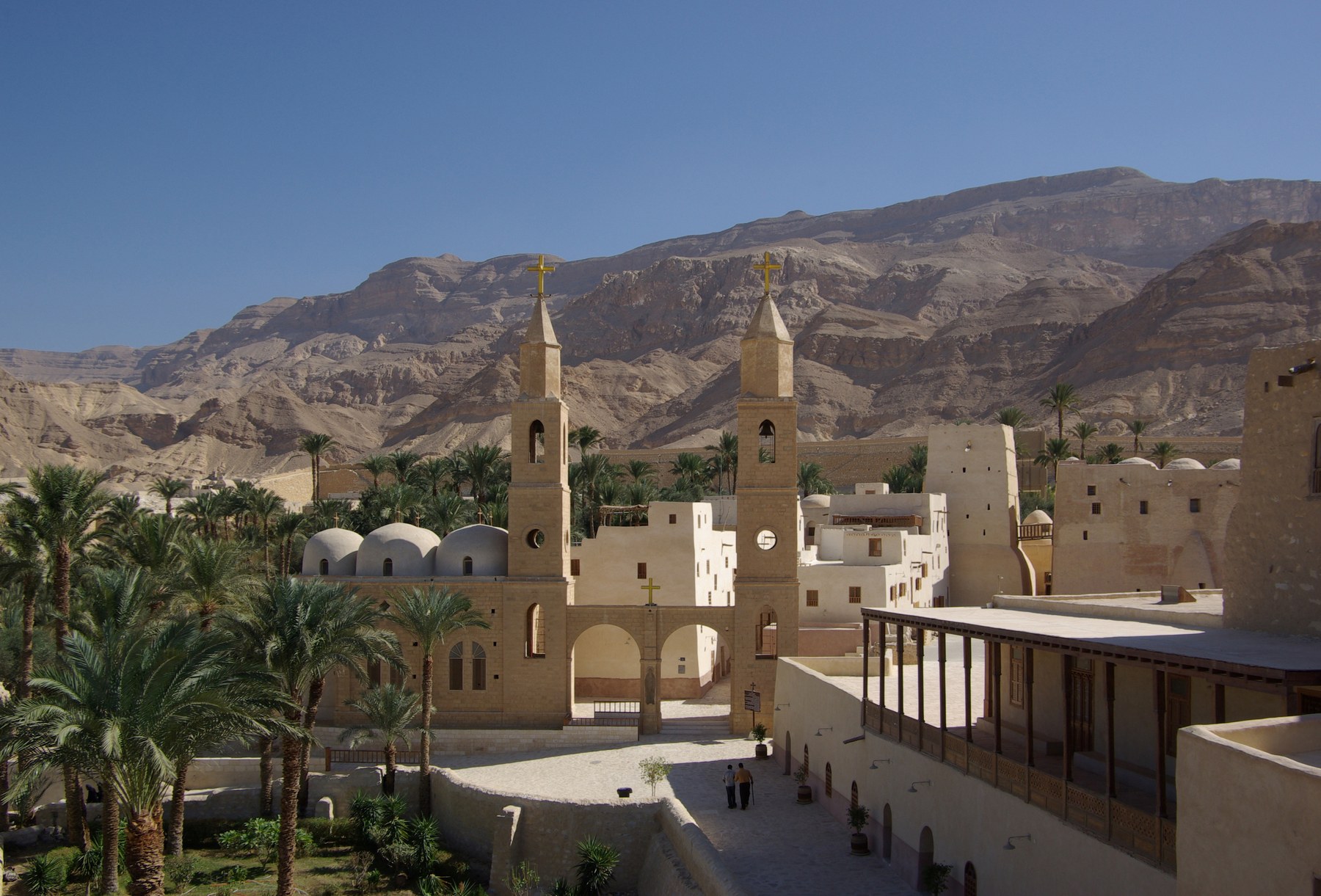 The Monastery of St. Antony beneath the Red Sea Mountains. Photograph by Berthold Werner, 2010, CC BY-SA 3.0 via Wikimedia Commons.
The monastery stands near the mountain to which Antony withdrew. Its walls, churches, cells, gardens, and towers make visible the paradox of the desert: one man sought solitude with God, and a city of prayer grew around his witness.
The cave of St. Antony
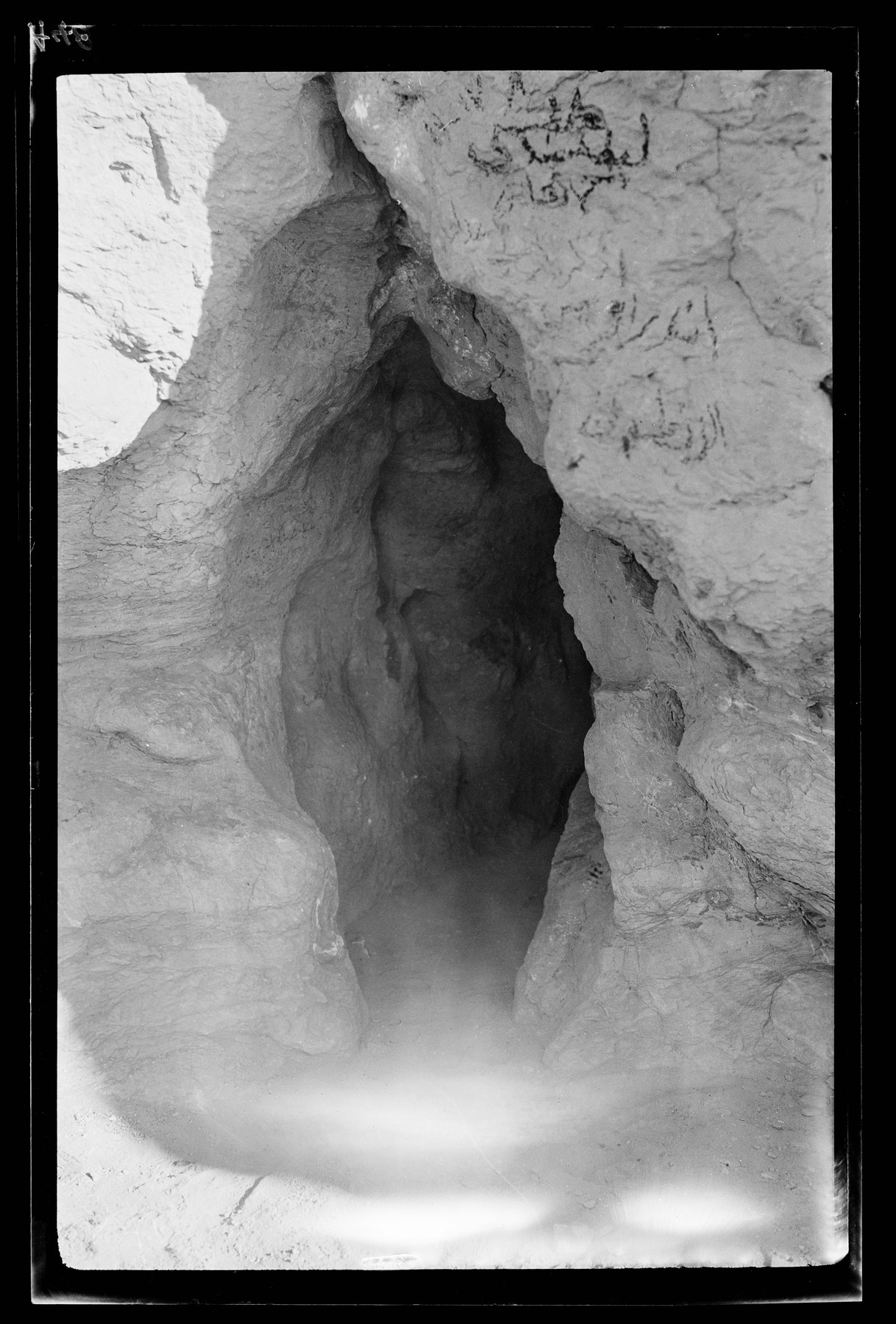 Exterior entrance to St. Antony’s cave, photographed by Kazazian, 1930–1931; Dumbarton Oaks collection. CC0 via Wikimedia Commons.
The historic photograph removes every romantic illusion. The entrance is a wound in the rock, not a retreat center. Antony sought no beautiful atmosphere. He sought the face of Christ where almost nothing remained to distract or congratulate him.
The Syrian Monastery, Deir al-Surian, Wadi El Natrun
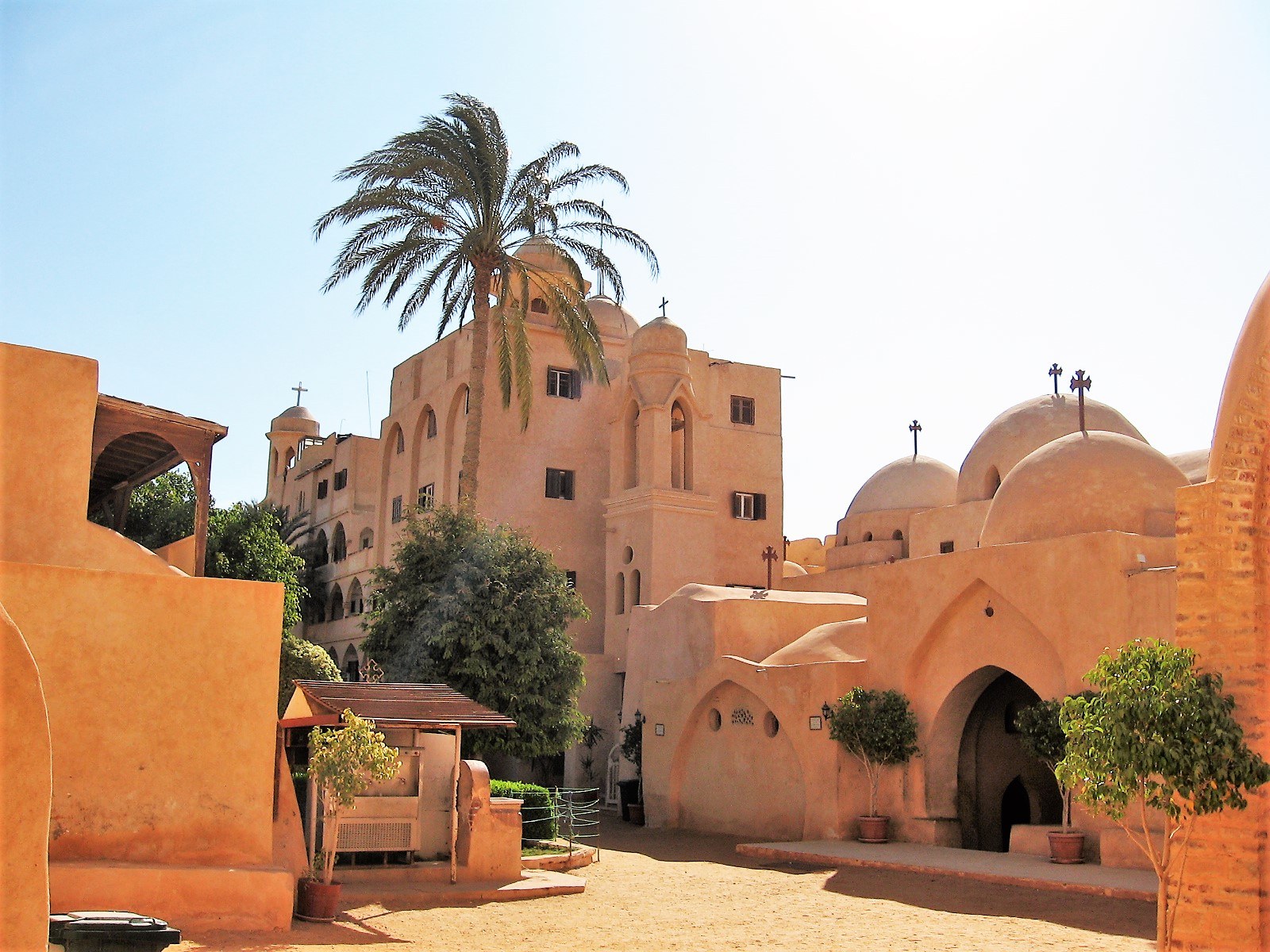 Deir al-Surian in Wadi El Natrun. Photograph by Lumen roma, 2008, CC BY 3.0 via Wikimedia Commons.
Deir al-Surian stands in the ancient region of Scetis. Its libraries, churches, and layers of wall painting preserve the meeting of Coptic, Syriac, Byzantine, and other Christian inheritances. The desert was never culturally empty; it became a crossroads of prayer, manuscripts, translation, and sacred art.
Plaster-wall iconography at the Syrian Monastery
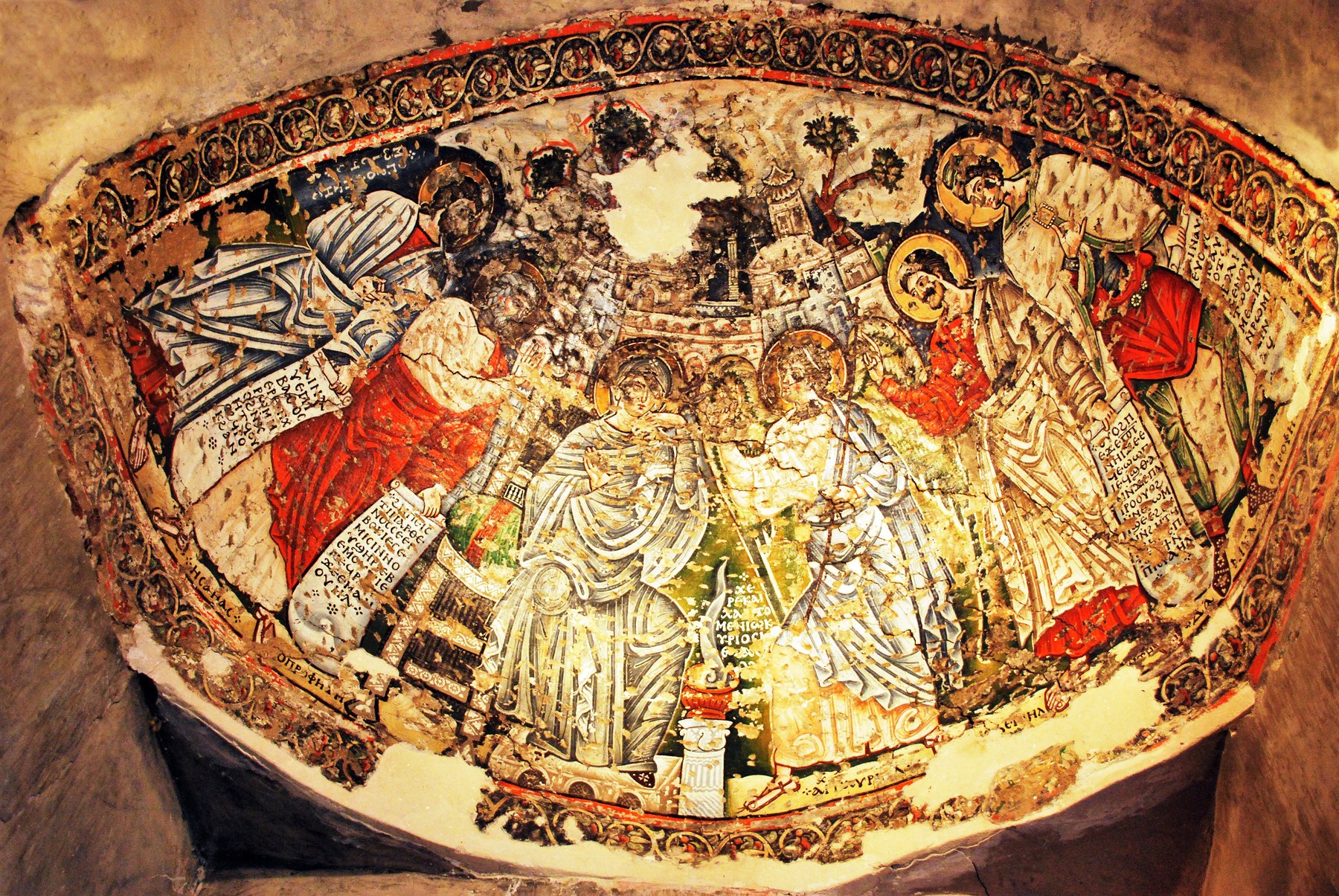 The Annunciation amid four prophets in the Church of the Holy Virgin Mary at Deir al-Surian. The earlier Coptic painting was revealed beneath a later Syrian plaster layer removed in 2007. Photograph by Diaa Abdelmoneim, 2009, CC BY-SA 3.0 via Wikimedia Commons.
The damaged plaster does not weaken the image’s witness. It reveals generations literally painting, worshiping, repairing, and receiving tradition on the same walls. Here history is not a straight line or a clean museum surface. It is layer upon layer of prayer.
Monastery of St. Macarius the Great, Wadi El Natrun
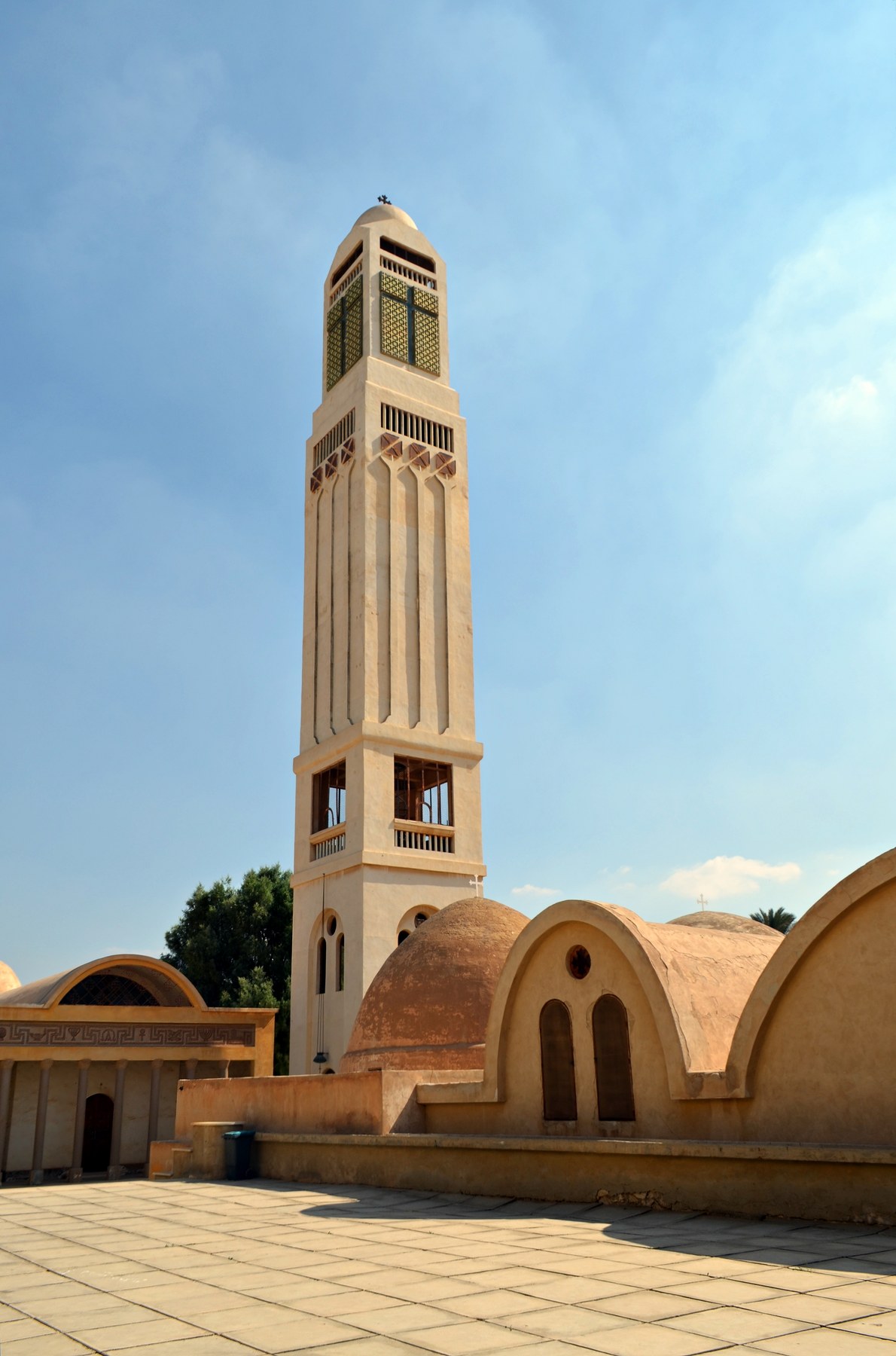 The Monastery of St. Macarius the Great in Wadi El Natrun. Photograph by Faris El-Gwely, 2013, CC BY-SA 4.0 via Wikimedia Commons.
This monastery bears the name of St. Macarius the Great of Scetis, not St. Macarius of Alexandria. The distinction matters, but so does the shared inheritance: the spiritual fatherhood of Scetis became a home in which prayer could be handed from one generation to the next.
Monastery of St. Bishoy, Wadi El Natrun
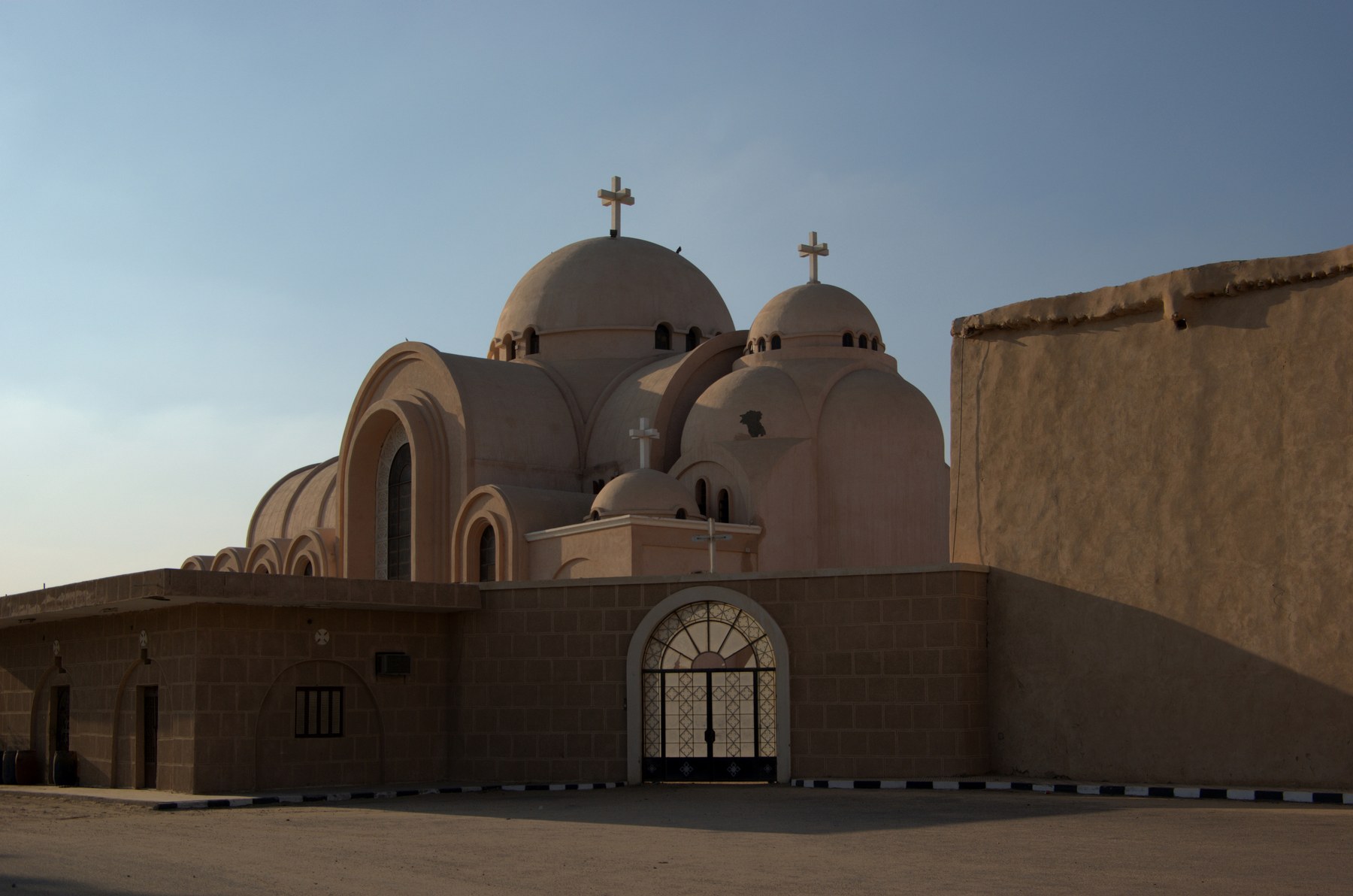 The Monastery of St. Bishoy in Wadi El Natrun. Photograph by Berthold Werner, 2010, CC BY-SA 3.0 via Wikimedia Commons.
St. Bishoy’s monastery reminds us that the desert did not produce one famous saint and then close. It formed communities, fathers, disciples, martyrs, scribes, pilgrims, and servants across centuries. The “desert city” remains a living rebuke to the idea that holiness belongs only to the past.
Sources
Primary sources
- Holy Scripture: Matthew 4:1-11; Matthew 19:16-22; Acts 2:42-47; Acts 4:32-35; 1 Corinthians 7; 1 Corinthians 9:24-27; 1 Thessalonians 5:17. Scripture is from NKJV.
- St. Athanasius of Alexandria, Life of Antony, especially §§2-7, 14, 16, 21-23, 38, 41-42. Public-domain translation reproduced by Hanover College from the New Advent text: https://history.hanover.edu/courses/excerpts/260ath.html.
- Benedicta Ward, trans., The Sayings of the Desert Fathers: The Alphabetical Collection, rev. ed. (Cistercian Publications, 1984), Antony 7-8; Macarius 3 and 11; Moses 2 and 6; Syncletica 15 and 19. Online scan: https://archive.org/details/httpwww.g4er.tkbookssayings-of-the-desert-fathers.pdf.
- Palladius, The Lausiac History, ch. 17, “Macarius of Egypt,” and ch. 18, “Macarius of Alexandria,” trans. W. K. Lowther Clarke (1918): https://www.tertullian.org/fathers/palladius_lausiac_02_text.htm#C18.
- St. John Cassian, Conferences, Second Conference of Abba Moses, 2.2-4, trans. C. S. Gibson in Nicene and Post-Nicene Fathers, Series II, vol. 11 (1894): https://en.wikisource.org/wiki/Nicene_and_Post-Nicene_Fathers:_Series_II/Volume_XI/John_Cassian/Conferences_of_John_Cassian,_Part_I/Conference_II/Chapter_4.
- The History of the Monks in Egypt (Historia Monachorum in Aegypto).
Secondary academic sources
- William Harmless, Desert Christians: An Introduction to the Literature of Early Monasticism (Oxford University Press, 2004): https://global.oup.com/academic/product/desert-christians-9780195162233.
- Douglas Burton-Christie, The Word in the Desert: Scripture and the Quest for Holiness in Early Christian Monasticism (Oxford University Press, 1993): https://global.oup.com/academic/product/the-word-in-the-desert-9780195083330.
- Peter Brown, “The Rise and Function of the Holy Man in Late Antiquity,” Journal of Roman Studies 61 (1971): 80-101, https://doi.org/10.2307/300008.
- Derwas J. Chitty, The Desert a City: An Introduction to the Study of Egyptian and Palestinian Monasticism under the Christian Empire (St. Vladimir’s Seminary Press reprint).
Coptic Orthodox and pastoral sources
- Coptic Orthodox Church, “Coptic History,” section “Coptic Monasticism”: https://copticorthodox.church/en/coptic-church/coptic-history/.
- St. Athanasius of Alexandria, Life of Antony, as the foundational Alexandrian episcopal witness to Egyptian monasticism.
- The Paradise of the Holy Fathers, received widely in Coptic monastic reading and spiritual formation.
Iconography and image sources
The local lesson copies were resized and compressed for web display without cropping; the underlying artwork and photographs were not otherwise altered.
Tadeos Awramenc, Teaching Scene of the Desert Fathers, Armenian manuscript illumination, Kaffa, 1430, Armenian Patriarchate of Jerusalem, manuscript no. 285, fol. 442. Public domain via Wikimedia Commons: https://commons.wikimedia.org/wiki/File:Desert_Fathers._Tadeos,_1430.jpg.
Anonymous, St. Antony the Great and St. Paul the Hermit in the Desert, fourteenth-century Coptic icon. Public domain via Wikimedia Commons: https://commons.wikimedia.org/wiki/File:Webantonyandpaulu.jpg.
Fyodor Solntsev, St. Macarius the Younger, detail from a Russian Orthodox icon, 1846–1853. Public domain via Wikimedia Commons: https://commons.wikimedia.org/wiki/File:Macarius_the_Younger_Full_Body_Length_Icon.jpg.
Unknown iconographer, St. Moses the Ethiopian, Dormition Cathedral of the Moscow Kremlin, 1479–1481. Public domain via Wikimedia Commons: https://commons.wikimedia.org/wiki/File:Saint_Moses_the_Ethiopian_Fresco._Dormition_Cathedral_of_the_Moscow_Kremlin.jpg.
Amma Syncletica of Alexandria, miniature from the Menologion of Basil II, c. 985. Public domain via Wikimedia Commons: https://commons.wikimedia.org/wiki/File:Righteous_Syncletica_of_Alexandria_(Menologion_of_Basil_II).jpg.
Berthold Werner, Monastery of Saint Anthony, Egypt, 2010. CC BY-SA 3.0 via Wikimedia Commons: https://commons.wikimedia.org/wiki/File:Antonius_Kloster_BW_9.jpg.
Kazazian, Saint Anthony’s Cave, Exterior View and Entrance, 1930–1931, Dumbarton Oaks collection. CC0 via Wikimedia Commons: https://commons.wikimedia.org/wiki/File:Monastery_of_Saint_Anthony,_Egypt_-_Saint_Anthony%27s_Cave,_exterior_view,_entrance_-_MSBZ004_A48_-_Dumbarton_Oaks.jpg.
Lumen roma, Deir al-Surian, Wadi El Natrun, 2008. CC BY 3.0 via Wikimedia Commons: https://commons.wikimedia.org/wiki/File:Deir_as_Suriani.jpg.
Diaa Abdelmoneim, The Annunciation amid Four Prophets, Deir al-Surian, 2009. CC BY-SA 3.0 via Wikimedia Commons: https://commons.wikimedia.org/wiki/File:Coptic_Frescos_from_the_Wadi_Natrun_monastery.jpg.
Faris El-Gwely, Monastery of Saint Macarius the Great, 2013. CC BY-SA 4.0 via Wikimedia Commons: https://commons.wikimedia.org/wiki/File:Monastery_of_Saint_Macarius_the_Great,_Egypt-15.JPG.
Berthold Werner, Monastery of Saint Bishoy, 2010. CC BY-SA 3.0 via Wikimedia Commons: https://commons.wikimedia.org/wiki/File:Bischoy_Kloster_BW_5.jpg.
Footnotes
-
Sayings of the Desert Fathers, Moses 6, trans. Benedicta Ward, p. 140. ↩
-
St. Athanasius, Life of Antony §3, https://history.hanover.edu/courses/excerpts/260ath.html. ↩
-
St. Athanasius, Life of Antony §14, https://history.hanover.edu/courses/excerpts/260ath.html. ↩
-
Sayings of the Desert Fathers, Antony 7, trans. Benedicta Ward, p. 3. ↩
-
Sayings of the Desert Fathers, Antony 8, trans. Benedicta Ward, p. 3. ↩ ↩2
-
Sayings of the Desert Fathers, Syncletica 19, trans. Benedicta Ward, p. 235. ↩
-
Sayings of the Desert Fathers, Moses 2, trans. Benedicta Ward, p. 139. ↩ ↩2
-
Sayings of the Desert Fathers, Macarius the Great 11, trans. Benedicta Ward, p. 130. ↩
-
Coptic Orthodox Church, “Coptic History,” “Coptic Monasticism,” https://copticorthodox.church/en/coptic-church/coptic-history/. ↩
-
Palladius, The Lausiac History, ch. 18, “Macarius of Alexandria,” §§1–4 and 12–16, trans. W. K. Lowther Clarke (1918), pp. 77–82, https://www.tertullian.org/fathers/palladius_lausiac_02_text.htm#C18. ↩ ↩2
-
St. John Cassian, Conferences, Second Conference of Abba Moses, 2.2 and 2.4, trans. C. S. Gibson, especially “discretion is the mother of all virtues, as well as their guardian and regulator,” https://en.wikisource.org/wiki/Nicene_and_Post-Nicene_Fathers:_Series_II/Volume_XI/John_Cassian/Conferences_of_John_Cassian,_Part_I/Conference_II/Chapter_4. ↩
-
Sayings of the Desert Fathers, Syncletica 15, trans. Benedicta Ward, pp. 233–234. ↩