
Source: View original Google Doc Converted: 2026-04-22
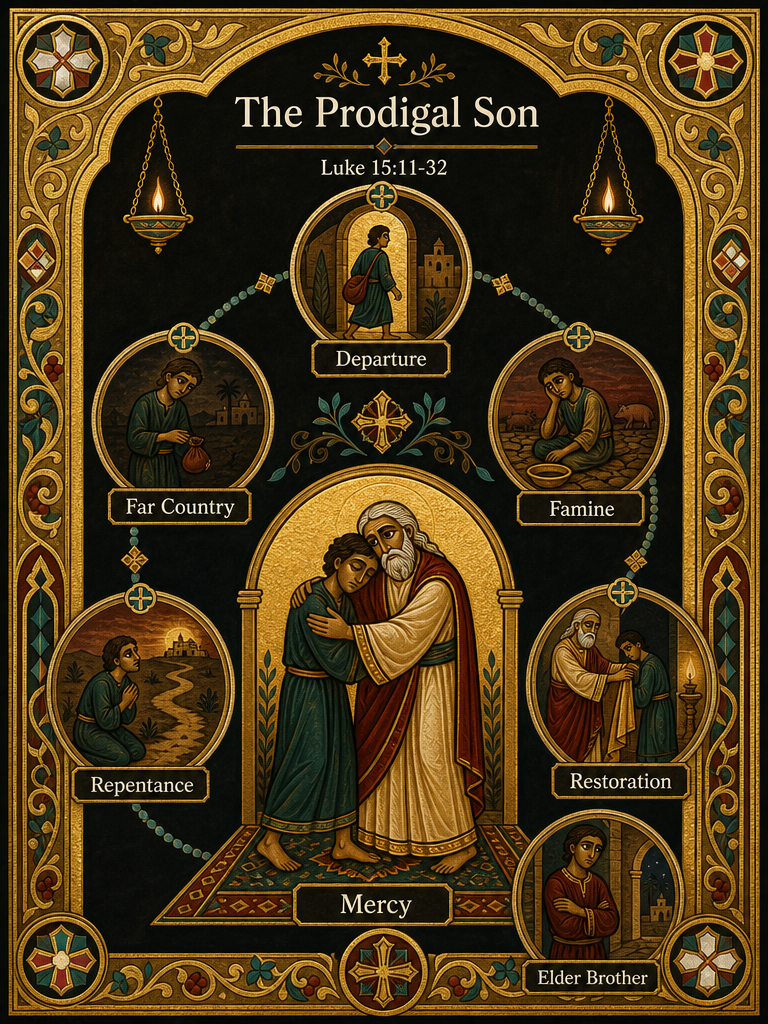
Source: Hermes-generated neo-Coptic Prodigal Son infographic, 2026-06-02.
Context: Two Audiences, One Chapter
Luke 15 is addressed to two audiences simultaneously:
- Tax collectors and sinners — who drew near to hear Jesus
- Pharisees and scribes — who murmured, saying, “This man receives sinners and eats with them” (Luke 15:2)
Jesus answers both groups with three parables: the Lost Sheep, the Lost Coin, and the Prodigal Son. The third parable ends with the elder son — addressed directly to the Pharisees.
The Three Parables of Luke 15
The Lost Sheep (Luke 15:3–7)
“What man of you, having a hundred sheep, if he has lost one of them, does not leave the ninety-nine in the open country, and go after the one that is lost, until he finds it? And when he has found it, he lays it on his shoulders, rejoicing.” — Luke 15:4–5
- The shepherd leaves the ninety-nine to seek one
- He does not wait — he goes after the lost
- He carries it home on his shoulders — it cannot walk on its own
- Heaven rejoices over one sinner who repents
The Lost Coin (Luke 15:8–10)
“Or what woman, having ten silver coins, if she loses one coin, does not light a lamp and sweep the house and seek diligently until she finds it?” — Luke 15:8
- The coin cannot seek itself — it is completely passive
- The woman initiates the search, lights the light, sweeps
- Application: The Holy Spirit searches for us when we cannot search for ourselves
The Prodigal Son (Luke 15:11–32)
This is the longest and most detailed parable. It has three movements.
Movement 1: The Anatomy of Sin
“And the younger of them said to his father, ‘Father, give me the share of property that is coming to me.’ And he divided his property between them. Not many days later, the younger son gathered all he had and took a journey into a far country, and there he squandered his property in reckless living.” — Luke 15:12–13
Five stages of the fall:
- Demand — “Give me” — treating the Father as a means to an end, not as Father
- Distance — “a far country” — sin always moves us away from the Father’s house
- Dissipation — “squandered his property in reckless living”
- Destitution — “he began to be in need… he was longing to be fed with the pods that the pigs ate”
- Degradation — feeding pigs (unclean animals) — the lowest point for a Jewish son
“The pigpen represents a life lived far from God — not necessarily immoral by the world’s standards, but spiritually empty, feeding on what cannot satisfy.”
Movement 2: The Turning Point — “Coming to Himself”
“But when he came to himself, he said, ‘How many of my father’s hired servants have more than enough bread, but I perish here with hunger! I will arise and go to my father, and I will say to him, “Father, I have sinned against heaven and before you. I am no longer worthy to be called your son. Make me like one of your hired servants.”’” — Luke 15:17–19
“He came to himself” — the Greek implies an awakening, a return to right mind. This is the moment of repentance. Notice:
- He does not minimize his sin — “I have sinned against heaven and before you”
- He acknowledges unworthiness — “I am no longer worthy to be called your son”
- He has a plan — “make me like one of your hired servants”
- He arises — repentance requires movement
Movement 3: The Father’s Response
“But while he was still a long way off, his father saw him and felt compassion, and ran and embraced him and kissed him.” — Luke 15:20
The father ran — a remarkable detail. In the ancient Near East, a dignified patriarch did not run. He ran to spare his son the shame of walking through the village past neighbors who knew what he had done.
The Three Signs of Restoration
| Sign | Meaning |
|---|---|
| The best robe | Restoration of dignity and sonship |
| The ring | Restoration of authority in the household |
| Sandals on his feet | Restoration as a son (slaves went barefoot) |
“Bring the fattened calf and kill it, and let us eat and celebrate. For this my son was dead, and is alive again; he was lost, and is found.” — Luke 15:23–24
Movement 4: The Elder Son — Religious Pride
“But he was angry and refused to go in.” — Luke 15:28
The elder son represents the Pharisees — and every person who serves God for wages rather than love:
- “These many years I have served you, and I never disobeyed your command” — service as a transaction
- “You never gave me a young goat” — calculating what he deserves
- “This son of yours” — he cannot say “my brother”
- He is outside the feast, though he never left home
The parable ends without telling us whether the elder son went in. The ending is open — addressed directly to the Pharisees in the crowd.
Lenten Application
This parable is read during Lent because Lent itself is a return to the Father’s house.
- The far country = our spiritual distance during the year
- The famine = the hunger that the world cannot fill
- “I will arise” = the Lenten resolution
- The father running = God’s eagerness to receive us in confession
Practical Steps:
- Identify your “far country” — where have you wandered?
- “Come to yourself” — honest self-examination before confession
- Rise and go — do not delay; the father is watching the road
- Receive the robe, ring, and sandals — let God fully restore, not partially
“Do not think that because you have sinned greatly, God has turned His face from you. No — He watches the road, waiting for you to turn.”